

How SmileDirectClub Disrupted the $9B Orthodontic Market in Just 5 Years

SmileDirectClub
Orthodontic Service Provider
On September 12, 2019, U.S. clear aligner company SmileDirectClub officially listed on the Nasdaq, raising over $1.3 billion and propelling its market capitalization to $9 billion. How did SmileDirectClub, a dental aesthetics startup based in Nashville, Tennessee, rise to become one of the top five U.S. IPOs by fundraising volume in 2019 and emerge as a rising star in the invisible orthodontics sector? More specifically, how did it manage to pull far ahead of competitors in the orthodontic market in just five years?

SmileDirectClub Listed on NASDAQ
As the saying goes, “A beautiful smile accounts for seventy percent of one’s charm.” With rising health awareness and upgrading consumption patterns, people are placing increasing emphasis on oral care. Among various dental services, orthodontic treatment, which combines oral healthcare with facial aesthetic enhancement, boasts an immensely promising market outlook. According to Allied Market Research data, the global orthodontics market was valued at USD 1.493 billion in 2016 and is projected to reach USD 2.597 billion by 2023, representing a compound annual growth rate (CAGR) of 8.2% from 2017 to 2023.
However, traditional metal braces have deterred many patients from pursuing orthodontic treatment due to issues such as poor aesthetics, high costs, and inconvenience in removal and insertion. In 1999, clear aligner technology, represented by Align (Invisalign), ushered in the fourth generation of orthodontics, a position that remains unchallenged by any new technologies or models to date. Then, in 2014, the emergence of SmileDirectClub introduced innovative business models, creating new possibilities for the clear aligner market.

Jordan Katzman (left) and Alex Fenkell (right)
SmileDirectClub co-founders Alex Fenkell and Jordan Katzman met during the summer they were 13 years old. Both wearing traditional metal braces, they became friends after attending a summer camp and eventually went on to become business partners. In 2012, as the pair began searching for new joint venture opportunities, they decided to revisit the bond formed during their earlier acquaintance and officially established the dental alignment company two years later. “Recalling our awkward experiences with metal braces, we believed it was essential to create a better solution to address this common pain point shared by most teenagers,” said Fenkell.
Since its inception, SmileDirectClub has completed multiple rounds of financing in the capital markets. According to Crunchbase, in July 2016, SmileDirectClub secured Series A funding from Gin Lane; in 2016 and 2017, the company received a total of $59.5 million in investment from Align Technology; in October 2018, the company announced it had raised $380 million, led by the private equity firm Clayton, Dubilier & Rice, with participation from Kleiner Perkins and Spark Capital.
Guided by the mission to serve more patients, SmileDirectClub has positioned its core business model as direct-to-consumer since its inception. By leveraging telehealth technologies to connect patients with licensed dentists and orthodontists, it enables them to access clear aligner therapy in a more affordable and convenient manner. Its true innovation lies in introducing “retail” thinking into the healthcare business model.
Traditional clear aligner therapy requires patients to visit hospitals or clinics to have their teeth impressions taken by professional dentists, but SmileDirectClub has broken this limitation. The company offers two methods for obtaining dental impressions: one is to purchase an “Impression Kit” online, take the impressions at home by biting into the provided trays, and then mail the dental molds back to the company; the other is to visit its physical locations (SmileShop or SmileBus) for a 3D intraoral scan to capture the necessary modeling data.
Within 48 hours of completing the aforementioned steps, authorized online dentists and orthodontists will contact the patient to determine a personalized treatment plan. Three to four weeks later, custom-made clear aligners will be mailed to the patient. During this period, patients can transmit updates on their orthodontic progress to the company via selfies; authorized dentists and orthodontists will then conduct remote diagnoses through the SmileCheck virtual platform to make necessary adjustments to the treatment plan. The average duration of the entire correction cycle is six months.
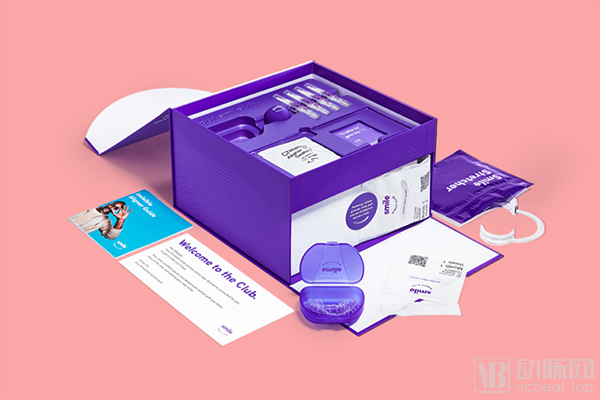
SmileDirectClub Products
Upon completion of treatment, SmileDirectClub also provides patients with retainers and teeth whitening products as part of its aftercare services. Notably, the company recently launched its Nighttime clear aligners, allowing patients to undergo orthodontic treatment during sleep over a 10-month period for the same price, thereby eliminating the need to wear aligners during the day.
In summary, SmileDirectClub streamlined the orthodontic process by bypassing in-person consultations between patients and doctors. Meanwhile, according to the company’s prospectus, the exclusive advantages of its core business model are also reflected in the following aspects:
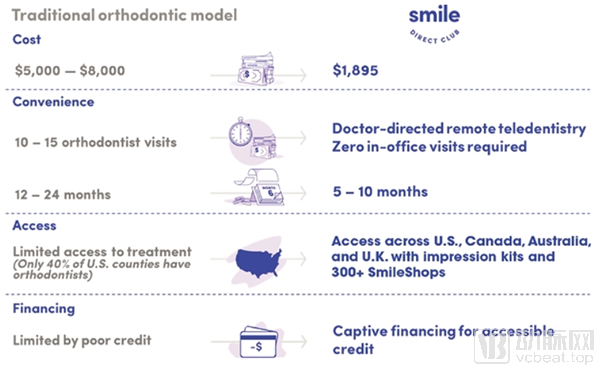
Exclusive Advantages of SmileDirectClub’s Core Business Model (SmileDirectClub Prospectus)
1. Low Price: Traditional orthodontic treatment costs $5,000–$8,000, whereas SmileDirectClub charges only RMB 1,895 by eliminating intermediaries.
II. High Convenience. Traditional orthodontic treatment requires 10–15 in-person visits and a treatment duration of 12–24 months, whereas SmileDirectClub delivers treatment and monitoring to patients through its telemedicine platform, SmileCheck, shortening the cycle to 5–10 months.
3. High Accessibility. There is a significant global shortage of orthodontists; in the United States alone, 40% of counties lack access to such specialists. SmileDirectClub enhances patient access to orthodontic care by offering online aligner kits and operating more than 300 physical locations across the United States, Canada, Australia, and the United Kingdom.
4. Payment Diversity. SmileDirectClub offers two payment options: a one-time payment and the SmilePay plan. The latter requires only a $250 down payment and average monthly installments of just $85, with no credit check required. Additionally, starting in 2019, SmileDirectClub partnered with insurance providers such as United Healthcare and Aetna, allowing patients to use their insurance coverage for payment.
It was precisely by leveraging this disruptive, traditional-business-challenging model that SmileDirectClub briefly became the leading DTC (Direct-to-Consumer) company in the clear aligner industry.
Highly popular among young consumers. Since its establishment in 2014, SmileDirectClub has achieved 5 million monthly visits, with approximately 65% of its members aged between 20 and 40. According to data from its prospectus, the company’s Net Promoter Score (NPS) has reached 69, surpassing that of many large internet companies. Notably, an NPS of 50 is generally considered sufficient to generate positive word-of-mouth.
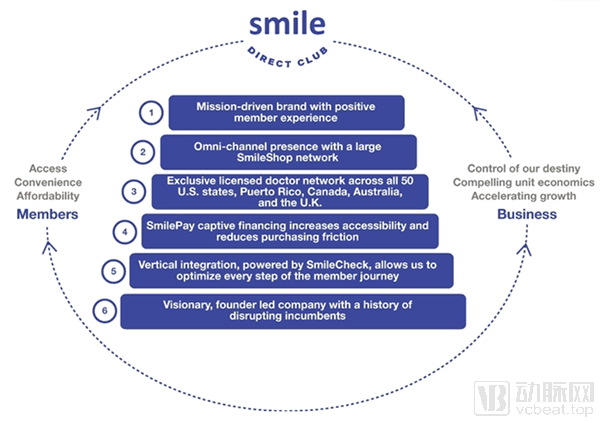
SmileDirectClub’s Closed-Loop Model (SmileDirectClub Prospectus)
In terms of financial performance, SmileDirectClub’s revenue is primarily derived from the sales of clear aligners, impression kits, whitening gel, and retainers. Its total revenue reached $423 million in 2018, representing a 190% increase from $146 million in 2017. For the period ended June 30, 2019, total revenue amounted to $373.5 million, reflecting a 113% year-over-year growth compared to the same period in 2018.
Meanwhile, the company reported net losses of $32.77 million and $74.77 million in 2017 and 2018, respectively, with its primary expenses being the cost of product production and sales, as well as marketing and selling expenses. Notably, marketing costs accounted for 44%, 50.3%, and 55.9% of total revenue in 2017, 2018, and the first half of 2019, respectively, showing an upward trend.
Overall, SmileDirectClub’s rapid growth can be attributed to its continuous innovation in clinical orthodontic outcomes, cost-effective treatment, and customer satisfaction. However, constrained by the pain points of the direct-to-consumer (DTC) model, SmileDirectClub needs to leverage telemedicine as its core selling point and drive brand exposure and customer acquisition through both online and offline channels. Given that orthodontic treatment is a one-time, low-frequency consumer need with a prolonged customer acquisition cycle, the company has experienced rising losses despite rapid revenue growth.
Although SmileDirectClub appeared to be making rapid strides in the market, not everyone was convinced by its application of the direct-to-consumer (DTC) business model within the professional field of orthodontics. Since its inception, the company has faced criticism from the American Association of Orthodontists and dozens of state dental boards, and it encounters similar risks in emerging markets such as Canada and Australia.
From the perspective of many orthodontists, clear aligner therapy is primarily a medical procedure that must be performed by a licensed clinician. Providing aligners to patients without prior diagnostic examinations or radiographic imaging “poses medical risks,” such as gingival and periodontal diseases. Furthermore, photographs taken by patients themselves may not align with the real-time monitoring conducted by professional orthodontists. In 2018, the American Association of Orthodontists issued a consumer alert regarding teledentistry companies, including SmileDirectClub, noting that their business models were insufficient to protect patients because they never had in-person consultations with an orthodontist during the course of treatment.
At this point, it is impossible not to mention the debate over orthodontic treatment models. As a key sector within the dental industry, orthodontics comprises three critical stages: intraoral scanning, aligner fabrication, and clinical treatment. Technological innovations in this field have primarily focused on time efficiency. In contrast, the remote orthodontics model demands seamless coordination and comprehensive innovation across all stages—scanning, fabrication, and treatment—while also addressing the challenges posed by courier logistics to the quality and integrity of aligner products.
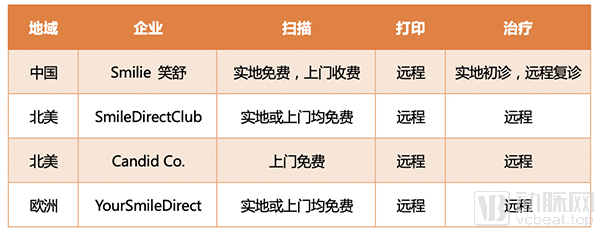
Optimization of Orthodontic Treatment by Teledentistry Companies
It is important to recognize that an “impossible trinity” exists in the healthcare sector, namely enhancing access to services, curbing the growth rate of healthcare costs, and improving the quality of care. These three objectives correspond respectively to healthcare accessibility, affordability, and quality, which are inherently inconsistent with one another. The only way to resolve this healthcare impossible trinity is by introducing new technological and model-based increments.
In terms of accessibility and affordability, SmileDirectClub has made significant efforts, pioneering business model innovation within the industry. However, it faces the common challenges and scrutiny regarding medical quality that affect all digital dental products. As indicated in its prospectus, SmileDirectClub is addressing this issue by recruiting more licensed orthodontists—a strategy that other companies preparing to enter or already operating in the remote orthodontics sector should consider and emulate.
Statistical data indicate that the global orthodontic market currently serves approximately 500 million customers, with a total market value of USD 945 billion. The U.S. orthodontic market accounts for roughly one-quarter of this total, valued at around USD 234 billion, demonstrating significant growth potential. Meanwhile, across the Pacific in China, the orthodontic market is also experiencing robust emergence. According to a research report by Ping An Securities, the current size of China’s orthodontic market stands at approximately RMB 25 billion, with long-term potential reaching the RMB 200 billion level.
In the current Chinese market, numerous enterprises have adopted 3D printing technology for dental applications, including Angelalign, Smartee, HeyGears, and Shining 3D. These companies have experienced rapid growth and attracted significant capital investment. By studying the development model of SmileDirectClub, the next key focus for advancing the digital dentistry sector—after successfully addressing market accessibility and affordability—is to strengthen its clinical medical attributes.