

Penguin Almond Acquires 25 Clinics to Build Urban Healthcare Model and Files for IPO
VCBeat (WeChat ID: vcbeat) has learned that Penguin Almond announced today the completion of its acquisition of 25 clinics. This marks another major move by Penguin Almond following its $250 million major financing round completed in April this year.
The acquisition target comprises 25 clinics of Zhengfu Dental, a well-known dental chain in Shenzhen. Upon completion of the acquisition, Penguin Almond will strengthen its primary care footprint by centering on family physicians and delivering one-stop healthcare coverage that spans from basic medical services to specialized care and referrals to tertiary (Grade 3A) hospitals. This initiative aims to establish a “city model” for primary care in Shenzhen, with plans to gradually replicate it in other cities.
So, what is the logic behind Penguin Almond’s strategy in primary care? Why was Shenzhen chosen as the pilot site? How will this model be replicated in the future? We promptly interviewed Wang Shirui, CEO of Penguin Almond, and Lu Jing, Senior Vice President of Investment and Strategic Development, to provide insights into these questions.
Penguin Almond’s recent acquisition, Zhengfu Dental, was founded in October 2014. Its first dental clinic, the Bao’an Center Branch, opened in 2015. After nearly five years of development, the company now operates 25 dental clinics, establishing itself as one of the leading chain dental institutions in Shenzhen. In 2019, Zhengfu Dental’s clinics are projected to serve approximately 200,000 patient visits throughout the year.
Lu Jing stated that Penguin Almond is focusing on building a family doctor service platform, and Zhengfu Dental can further help Penguin Almond improve its health management services covering the entire family, full process, all scenarios, and full life cycle. Its brand positioning, development strategy, operational tactics, and customer base are highly aligned and complementary to those of Penguin Almond. “After our initial contact in July this year, we quickly reached an agreement and completed the transaction within four to five months.”
Building on the existing scale of Zhengfu Dental, Penguin Almond plans to further expand its clinic network in Shenzhen, with the number of outlets expected to reach 50 by 2021, thereby basically completing the layout of its specialized dental center network in the Shenzhen area.
Since November last year, Penguin Almond has successively acquired Beijing Youlin Clinic and Chengdu Ruoshui Clinic. Similar to previous acquisitions, this deal includes both the existing clinic operations and the integration of the founding teams. By leveraging the operational expertise and management capabilities of the Zhengfu Dental founding team, Penguin Almond aims to enhance its own operational and managerial proficiency.
Lu Jing revealed that, unlike previous deals, the acquisition of Zhengfu Dental marks Penguin Almond’s first purchase of a specialized chain institution. This move strategically further refines its “city model,” enabling the company to provide users with more professional and comprehensive dental care services.
Since its formation last year through the merger of Penguin Doctor and Almond Doctor, Penguin Almond has been strategically building an integrated online-to-offline comprehensive healthcare service system. As of this year, Penguin Almond has aggregated 450,000 physicians on its online platform and operates 54 offline clinics across 12 cities, including Beijing, Shenyang, Shenzhen, Chengdu, and Chongqing. Its diverse business models encompass general clinics, ambulatory surgery centers, specialized clinics, satellite clinics, and corporate infirmaries.
As its business models become increasingly diverse and widely distributed, Penguin Almond’s strategy for positioning itself in primary care is becoming ever clearer. Why choose primary care? Wang Shirui has his own perspective.
Wang Shirui has frequently expressed optimism about the broad prospects of primary healthcare on multiple occasions. On November 20, at the Tencent Global Digital Ecosystem Summit, Wang Shirui stated that, judging from the series of medical policies and initiatives implemented by the government in recent years, primary healthcare holds significant potential. Penguin Almond is committed to striving to provide better primary healthcare services for community health centers across China.
Following Penguin Almond’s announcement of its acquisition of Zhengfu Dental, Wang Shirui stated, “What China currently needs most in terms of coordination is primary healthcare services. Penguin Almond will place family doctors at the core, significantly shortening the service radius between healthcare providers and households through family doctor services.”
Indeed, primary healthcare has long been the weak link in China’s medical system. In recent years, the government has vigorously promoted tiered diagnosis and treatment to facilitate the downward flow of high-quality medical resources. Nevertheless, this process continues to face numerous pain points, including subpar service quality at the grassroots level, fragmented resources, and low patient trust. Penguin Almond has strategically targeted these pain points by integrating resources and establishing a presence in the primary healthcare sector.
Why Did Penguin Almond Choose Shenzhen for Its “City Model”? Behind This Decision Lie Both External and Internal Factors.
As one of the earliest regions to implement the reform and opening-up policy, Shenzhen has long joined the ranks of first-tier cities. By the end of 2018, Shenzhen’s permanent resident population reached 13.0266 million, including 4.5470 million registered residents and as many as 8.4797 million unregistered residents. The reform and opening-up policy, combined with its unique geopolitical environment, has fostered a culture characterized by openness, inclusiveness, and innovation, establishing Shenzhen as an emerging immigrant city.
Shenzhen holds a prominent position in high-tech industries, financial services, foreign trade exports, marine transportation, and creative culture. In 2018, its total economic output ranked among the top five Asian cities.
In stark contrast to its economic development, Shenzhen’s medical resources are inadequate. The city has a limited number of Grade 3A hospitals, and none of its institutions ranked among the top 100 in the latest 2018 edition of China’s Hospital Rankings. While high-quality public medical resources are already insufficient, primary care remains an even weaker link.
Fortunately, Shenzhen’s openness extends to the healthcare sector, with strong government support for privately run medical institutions across multiple segments, including clinics, private hospitals, and internet-based healthcare. Influenced by its status as an innovative city, Shenzhen boasts a vibrant market innovation atmosphere and a strong willingness to leverage advanced technologies to pilot and explore new healthcare models. Meanwhile, the diversification of its population structure has given rise to varied healthcare demands, and patients demonstrate relatively high acceptance of and trust in private healthcare services.
Consequently, the private healthcare sector in Shenzhen is thriving. According to data from Qichacha, there are currently 7,702 clinic enterprises and 7,486 hospital management enterprises in Shenzhen, fostering a robust ecosystem for private medical services.
Currently, Penguin Almond’s clinics in Shenzhen include one flagship clinic, ten satellite clinics, and one day surgery center. Its specialized services comprise one ophthalmology center, one traditional Chinese medicine clinic, and one rehabilitation center. Following the acquisition of Zhengfu Dental’s 25 clinics, Penguin Almond’s specialty service lines have become more comprehensive.
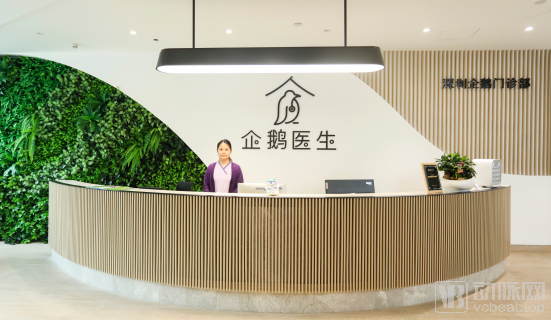
Penguin Doctor Shenzhen Clinic
In addition to this acquisition, Penguin Almond also plans to support 100 community health centers in Shenzhen, working with government departments to further enhance their public health service capabilities and medical standards.
From this perspective, both Penguin Almond’s own business layout and the external market environment meet the conditions for establishing a “city model” in Shenzhen.
So, how did Penguin Almond systematically build its various business systems to prepare for the “City Model”?
It is understood that, prior to the merger, Penguin Doctor primarily built a customer-centric health management service system through a series of product lines, including online services for users, information management systems for institutions, offline intelligent hardware testing terminals, and general practice Penguin Doctor clinics. Almond Doctor is positioned to serve physicians, providing a comprehensive personal practice platform, and pioneered the WeWork-style shared outpatient model to connect doctors with patients.
Following the merger, the two entities consolidated high-quality resources across online and offline channels, as well as among physicians, patients, and clinics. With family physician services at the core, they leveraged a series of measures—including internet hospitals, expert networks, and technological solutions—to focus on primary healthcare.
By reviewing the key milestones of Penguin Almond since its establishment last year, we find that it has laid the foundation for its “city model” through these steps.
Step 1: Drawing on advanced healthcare models. In November 2018, two Penguin Clinics commenced operations in Hong Kong, aiming to introduce Hong Kong’s advanced healthcare model for adoption by medical institutions in mainland China.
Step 2: Leverage core talent to drive multi-tiered business operations. In November 2018, after Penguin Almond acquired Beijing Youlin Clinic, Yu Ying—who holds multiple identities as an internet-famous physician and physician entrepreneur—joined Penguin Almond as Chief Medical Operating Officer and Vice President. She was primarily responsible for medical service quality management, the general practice training system, medical products, and medical content.
Yu Ying has shouldered multiple critical responsibilities, including enhancing the quality of outpatient services, improving the training system for family physicians, and refining Penguin Almond’s medical content. High-quality medical care can help overcome the current inconsistency in the standards of primary healthcare, while standardized family physician services can improve operational efficiency and resident satisfaction.
Step 3: Develop smart terminals to enhance the penetration efficiency of primary healthcare. In March 2019, Penguin Doctor launched four major smart health products, including the Smart Health Kiosk, Health Terminal, Smart Body Composition Analysis Mirror, and Future Specialist Consultation Room. This initiative introduces the new concept of the “Penguin Doctor Future Clinic,” aiming to embed this future clinic model into communities and commercial centers across China, thereby creating a one-stop integrated healthcare service hub.
The Health Kiosks are intelligent micro-clinics occupying just 3 square meters, capable of conducting health screenings, facilitating remote consultations, and enabling rapid access to medical and health products. These smart terminals, characterized by a lightweight front-end and a robust back-end, can be rapidly and extensively deployed due to their ease of replication, thereby accelerating Penguin Almond’s penetration into the primary healthcare sector.
Step 4: Further strengthen online connectivity capabilities. As a key initiative by Tencent in the healthcare sector, Penguin Almond has also engaged in direct business collaboration with Tencent. In November 2019, Penguin Almond signed an agreement with Tencent Cloud to advance its “Internet + Healthcare” strategy.
At the signing ceremony, Wang Shirui stated that Penguin Almond has a wide range of user scenarios and can collaborate with partners in the Tencent ecosystem to jointly build a comprehensive front-end infrastructure. This includes health management platforms, internet healthcare platforms, payment platforms, physician empowerment platforms, chronic disease management, and retail pharmacies, among others. “Penguin Almond looks forward to becoming a core strategic partner for Tencent’s healthcare services, integrating various front-end medical services and synergizing with middle- and back-office operations to create an integrated front-end entry point for Tencent Healthcare.”
Through a multi-step approach, Penguin Almond has amassed richer online and offline resources, along with assured medical service quality and terminal products, thereby gaining the capability to conduct systematic integration.
Currently, in addition to online products such as its app, Penguin Almond has established diverse business models in the offline sector.
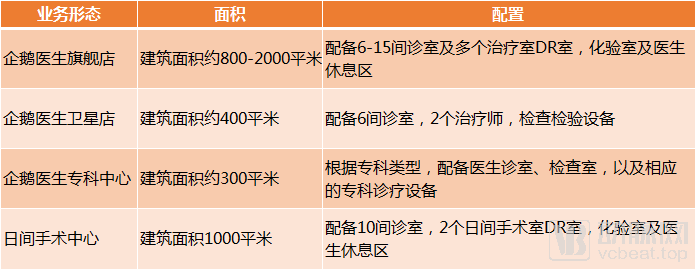
Main Forms of Penguin Almond’s Offline Business | Graphic by VCBeat
We have analyzed the configuration scales of these models, revealing that each has its own advantages and they complement one another. Flagship stores are the largest in scale and offer a wider range of services, but also entail higher investment costs; satellite stores are smaller and more flexible, serving as a supplement to flagship stores; while specialty centers and ambulatory surgery centers address the specific needs of different patient populations.
“The Urban Model” centers on family physicians, integrating resources from various stakeholders to foster synergy, which we have mapped into a relationship diagram.
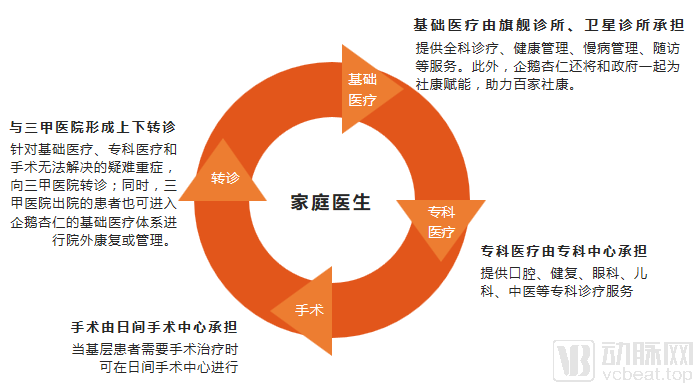
“City Model” Built by Penguin Almond, Chart by VCBeat
In this model, primary care is delivered by flagship clinics and satellite clinics, offering services such as general practice, health management, chronic disease management, and follow-up care. Penguin Almond will also collaborate with the government to empower community health centers, supporting a network of one hundred such facilities. Specialty care is provided by specialty centers, delivering services in dentistry, rehabilitation, ophthalmology, pediatrics, and traditional Chinese medicine. Surgical procedures are handled by ambulatory surgery centers, where patients from primary care settings can undergo surgery when needed. For complex and critical cases that cannot be managed within primary care, specialty care, or surgical services, referrals are made to tertiary hospitals. Conversely, patients discharged from tertiary hospitals can be transferred back into Penguin Almond’s primary care system for out-of-hospital rehabilitation or ongoing management.
“Urban Model” forms a complete closed loop through the connection and facilitation of family doctors. After purchasing family doctor services via online and offline channels, patients can receive corresponding diagnosis and treatment when needed.
“We believe that the current fragmented, specialty-centric healthcare system will transition toward an integrated, primary care-centric model,” said Lu Jing. Penguin Almond’s family physician product will serve as a hub to integrate and connect various types of products and services, providing users with customized, professional, and meticulous medical care while reshaping consumer habits.
Currently, the “Urban Model” has entered the implementation phase in Shenzhen.
Wang Shirui revealed that the “urban model” established in Shenzhen will be adopted and replicated by other cities in the future, with gradual optimization.
During the replication and expansion phase, Penguin Almond will prioritize cities with strong demand for primary healthcare, significant market potential, a favorable policy environment for private healthcare, and substantial room for improvement in the medical service environment. After validating its Shenzhen city model, Penguin Almond plans to replicate this model in 10–15 cities over the next two years.
Therefore, Qi’e Almond will continuously validate its single-city model to refine its comprehensive health management service platform model, which covers the entire family, the full process, all scenarios, and the entire life cycle, and will rapidly expand on this basis in the future.
Penguin Almond once announced a plan to open 500 clinics by 2021, which would cover 30 cities and serve as strong support for the “city model.”
Meanwhile, acquisitions will become a routine strategy for Penguin Almond to refine its business ecosystem. Lu Jing stated that in the future, as acquisitions of targets in other specialty services—such as pediatrics, traditional Chinese medicine (TCM), and ophthalmology—are completed, Penguin Almond’s comprehensive medical service capabilities will be further enhanced. These specialty assets will also achieve strong synergy with Penguin Almond’s owned clinics and the community health service centers being progressively established.
As the country advances its tiered diagnosis and treatment system, the pain points facing primary healthcare are being addressed one by one. To what extent can Penguin Almond contribute to this process, and how much market share will it capture? Only time will tell.