

Analog Devices Inc. (ADI) Unveils Strategic Focus on Medical Health: Three Core Pillars Driving Next-Gen Healthcare Innovation
“We believe that remote monitoring, especially when combined with smart wearables featuring clinical-grade monitoring accuracy, will experience explosive growth, and in-hospital services will increasingly shift to out-of-hospital settings.”
Against the backdrop of factors such as current healthcare cost containment measures under China’s basic medical insurance system, an accelerating aging population, the inclusion of telemedicine in insurance coverage, and the rapid advancement of AI and big data, Peng Zhifeng, Marketing Director for the Healthcare Industry at ADI China, offered the following industry assessment of the broader health sector.
As a high-performance analog technology company with a 55-year history, Analog Devices Inc. (hereinafter referred to as “ADI”) boasts a rich heritage. Looking back on ADI’s journey to success—from its humble beginnings in a makeshift laboratory located in the basement of an apartment building in Cambridge, Massachusetts, USA—it has grown over more than five decades into one of the most distinguished enterprises in the global semiconductor industry.
As a globally recognized leading supplier of data conversion and signal processing technologies, ADI serves 125,000 customers worldwide, encompassing all types of electronic equipment manufacturers across sectors such as healthcare, automotive, communications, industrial, and energy.
Especially in the healthcare sector, ADI’s chips serve medical imaging (such as CT and ultrasound), patient monitors, in vitro diagnostic equipment, and wearable products, covering most medical devices that require data conversion and signal processing.
As of 2019, ADI had been in China for 25 years. Twenty-five is an age when a person is at their most energetic, and likewise, it is a time when a company is at its most vibrant. To this end, VCBeat interviewed Peng Zhifeng, Marketing Director for the Healthcare Sector in Greater China at ADI, to gain insights into ADI’s applications in three major healthcare fields: medical imaging and patient monitoring, medical-grade wearable devices, and in vitro diagnostics.
 Peng Zhifeng, Marketing Director for the Healthcare Industry, ADI China
In recent years, China’s healthcare market has experienced rapid development. In 2014, total healthcare expenditure in China reached RMB 3.52 trillion, accounting for 5.5% of GDP. Over the subsequent five years, this figure grew to approximately RMB 6 trillion, representing 6.6% of GDP. With rising healthcare costs, there has been a significant increase in demand for various types of medical devices.
Regarding the state of the healthcare industry, Peng Zhifeng, who has 12 years of experience in the sector, offers a precise perspective. He notes that with the advancing aging of China’s population, the boundary between in-hospital clinical medical devices and out-of-hospital wearable devices is becoming increasingly blurred. Demand for remote patient monitoring (RPM) services, which evolved from in-hospital clinical equipment, is growing stronger alongside the rising need for home-based health management among the elderly and patients with chronic diseases. As these services begin to extend beyond hospital settings, the out-of-hospital monitoring market is emerging as a new frontier.
However, to effectively implement out-of-hospital monitoring, the precision of in-hospital monitoring must be “replicated” in the out-of-hospital setting. Meanwhile, smart wearable products originally positioned as consumer electronics are beginning to incorporate more health vital sign monitoring functions (such as blood oxygen monitoring, ECG and heart rate monitoring, and sleep monitoring), offering medical-grade health monitoring capabilities with clinical-level or near-clinical precision. This evolution will transform wearable devices from trendy gadgets into essential products for millions of consumers.
In addition, policy is also a significant driver of the future development of healthcare in China. For instance, in the third quarter of 2019, the government’s medical insurance authorities issued a document incorporating internet-based diagnosis and treatment into the scope of public reimbursement. This policy will help accelerate the rapid growth of telemedicine and home care devices (such as remote monitoring) among the elderly population.
China has a large population base and a vast number of patients with chronic diseases. According to estimates from the "Report on Cardiovascular Diseases in China 2018," the number of prevalent cases of cardiovascular disease in China reached as high as 290 million. In terms of chronic disease management and digital remote diagnosis and treatment, as the domestic healthcare system shifts its focus from treating existing diseases to preventing them, and from treatment to prevention, major chronic diseases—led by cardiovascular diseases, diabetes, and chronic obstructive pulmonary disease (COPD)—will become the key priorities in chronic disease management.
Digital remote diagnosis and treatment, centered on digital and internet technologies, will emerge as a new focal point, extending into grassroots community hospitals and home care settings, thereby becoming a new hotspot and trend in the development of the healthcare market.
The implementation of these innovative models for prevention, diagnosis, and treatment is predicated on precise testing. Leveraging its own strengths and aligning with industry development trends in healthcare, ADI chips have been widely applied across all stages, including prevention, diagnosis, treatment, and chronic disease management.
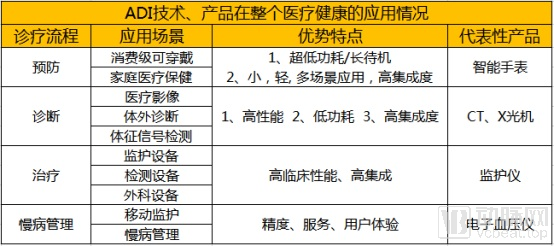
From prevention, diagnosis, and treatment to disease management, ADI’s technological products cover nearly the entire clinical care continuum. In the field of prevention, ADI’s chip products are widely used in consumer-grade wearable devices. Healthy or sub-healthy individuals wear wristbands or smartwatches to monitor physiological signals, thereby receiving guidance for daily lifestyle interventions. For example, patients with diabetes can adjust their diet based on blood glucose monitoring data.
In the diagnostics sector, ADI’s chip products are already deployed in scenarios such as medical imaging, in vitro diagnostics (IVD), and vital signs monitoring. In the therapeutic domain, ADI’s chip products are primarily used for patient monitoring, including intensive care unit (ICU) monitoring and surgical equipment. In chronic disease management, ADI’s technological solutions span the entire workflow, delivering services to customers.
In these fields, given ADI’s global leadership in data conversion and signal processing technologies, most manufacturers of diagnostic and therapeutic equipment for in-hospital settings opt for ADI’s solutions, with the stability and precision of ADI chips being a primary consideration for customers.
Motion and health monitoring capabilities are the key driver behind the rapid growth of the wearable technology industry. An overview of the current market landscape reveals that the wearable product sector is predominantly propelled by demand for fitness and health features. Such health-related functionalities are indispensable across nearly all wearable devices, including bands, watches, smart shoes, and smart clothing. Among these, wristbands and smartwatches account for the largest shipment volume, representing 75% of the market share.
Wearable devices monitor various health vital signs, including blood pressure, blood oxygen saturation, physical activity, body fat, body temperature, activity status, and respiration. The growing number of metrics has enriched the collection of vital sign data. To acquire and process these specific metrics within wearable devices, it is necessary to leverage advanced sensors, analog mixed-signal processing, and corresponding digital processing algorithms.
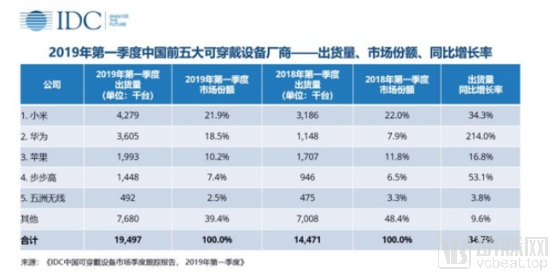
Since the advent of the Apple Watch and Xiaomi Mi Band, smart wearable devices have become widely popular among the general public. Data from the “China Wearable Device Market Quarterly Tracker Report, Q1 2019,” released by IDC, shows that China has become the world’s largest market for smart wearables. In the first quarter of 2019, China’s wearable device shipments reached 19.5 million units, with a year-over-year compound annual growth rate (CAGR) of 34.7%, higher than that in 2018. Leading companies account for the vast majority of market share. This consumer-grade wearable product segment has essentially become a red ocean market.
The primary function of wearable devices is health monitoring. However, most existing wearable products are non-medical-grade, resembling “toys” rather than medical devices. Users seek to manage their health by monitoring parameters such as heart rate, electrocardiogram (ECG), and body mass index (BMI). Yet medicine is a rigorous discipline, and physicians do not endorse data derived from non-medical-grade monitoring. Scientific health management necessitates medical-grade devices; therefore, enhancing the monitoring accuracy of wearables to medical-grade standards is an inevitable trend. Providing high-precision monitoring chips is a core strength of Analog Devices, Inc. (ADI). ADI’s products feature low power consumption, high performance, wireless connectivity, and data services, thereby meeting these requirements.
Moreover, ADI offers a comprehensive suite of solutions. Its sensor portfolio includes temperature, impedance, and optical sensors, enabling the monitoring of vital signs such as heart rate, electrocardiogram (ECG), and blood oxygen saturation. By providing an end-to-end service that encompasses analog-to-digital conversion, signal conditioning, wireless communication, and analytical algorithms, ADI accelerates its customers’ research and development processes.
Furthermore, as the pressure for cost containment within medical insurance systems intensifies, shifting health management from in-hospital to out-of-hospital settings has become a global trend in the broader healthcare sector. Out-of-hospital health management can leverage both medical-grade wearable devices and home-use medical equipment. While home medical devices are relatively widespread in households abroad, their adoption in China remains limited, with blood pressure monitors being the most prevalent.
After receiving diagnosis and treatment at a hospital, patients can undergo therapy and monitoring using medical equipment at home, which can significantly reduce healthcare costs. For instance, with common home blood glucose meters, many diabetic patients only need to monitor their conditions at home and visit the hospital only when abnormalities occur. Other home-use medical devices, including ventilators developed for patients with chronic obstructive pulmonary disease (COPD), can also meet patients’ daily needs.
For years, ADI’s chips have been renowned for their precision, with in-hospital applications of its chip products representing its traditional strength.
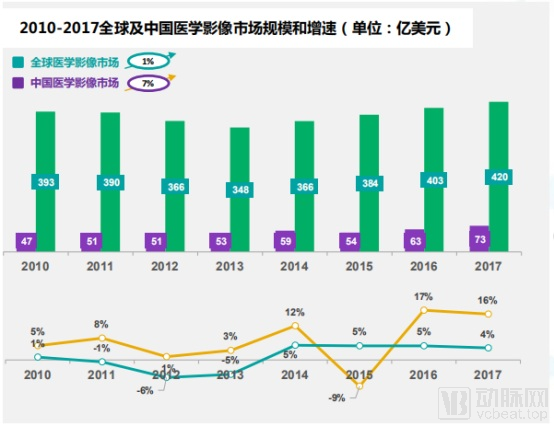
According to the "China Medical Device Blue Book" released by Yixiehui, the global medical imaging market has developed steadily over the past seven years, maintaining a stable growth rate of approximately 5% in the recent three to four years. The demand for new purchases of imaging equipment and the replacement of outdated devices in medical institutions at all levels continues to rise. The overall growth rate of China's medical imaging market exceeds that of the global market, with a seven-year compound annual growth rate (CAGR) of 7%.
As in vitro diagnostics (IVD) represent a traditional application scenario for ADI, its comprehensive portfolio covering the entire signal chain has become the preferred choice for medical device manufacturers.
Taking digital flat-panel X-ray detectors as an example, China has witnessed vigorous development in recent years, decisively breaking the former foreign monopoly. Traditional medical equipment manufacturers, complete X-ray system integrators, and new entrants such as display panel producers (e.g., TFT manufacturers) have all leveraged this sector as a strategic entry point into the professional medical electronics market. ADI integrates its advanced technologies and R&D expertise into the local market, facilitating the rapid expansion of domestically produced equipment.
Amid the dual challenges of surging demand and stringent performance requirements, ADI continues to iterate its product portfolio, launching the highly integrated digital X-ray analog front-end, the ADAS1256. As the industry’s first solution to integrate 256 channels on a single chip, the ADAS1256 is a Chip-on-Flex (COF) module and represents an ideal solution for readout chips in X-ray flat-panel detectors. Consequently, the ADAS1256 not only delivers high-resolution digital X-ray images but also reduces patients’ radiation exposure. Compared with traditional CCD- or CMOS-based products, it enables higher-quality imaging, offers better cost-effectiveness, and facilitates device miniaturization. In this field, ADI holds a globally leading technological position and market leadership.
In addition, ADI offers ultrasound system solutions (AD927x/AD967x, AD9106) and CT system solutions (ADAS1128/9/1134/5). According to Peng Zhifeng, ADI’s products meet market demands through their high level of integration, smaller form factor, lower power consumption, low noise, system-level support and reference designs provided by a dedicated technical team, competitive cost, and a coherent roadmap.
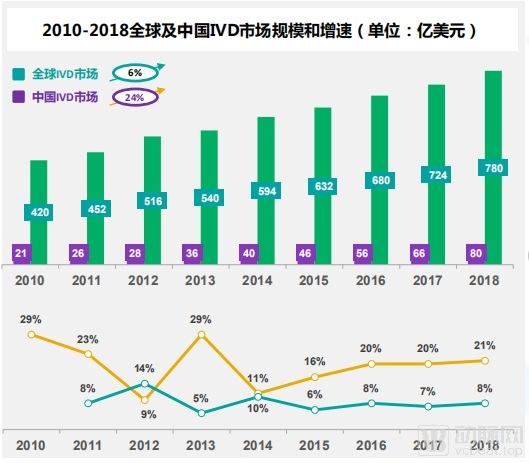
Another widely applied domain for ADI is in vitro diagnostics (IVD). Data from the "Blue Book of Chinese Medical Devices" indicates that the growth of the global IVD market is one of the key drivers behind the expansion of the overall medical device market, with both exhibiting consistent growth trends. Over the past eight years, the global IVD market has achieved a compound annual growth rate (CAGR) of approximately 6%. Although China's IVD market started later, it has developed rapidly, maintaining an average annual growth rate of over 15% in the last four years.
ADI’s high-performance, full-signal-chain products enable low-dose, rapid, and high-precision detection.
Taking in vitro biochemical analyzers as an example, they incorporate a variety of technologies, such as spectral analysis, polymerase chain reaction (PCR), electrochemistry, acid-base measurement (ISE, pH), liquid level detection, flow control, sample processing functions, automatic control, and data processing systems, making system integration highly complex. Among these, optical system control and precision are key elements; reagent volume control is crucial for reducing costs and ensuring consistency; measurement speed is critical, and the system is highly sensitive to temperature fluctuations.
ADI offers a wide range of amplifiers for I/V conversion, filter design, signal conditioning, and ADC driving, along with solutions for data conversion, signal processing, temperature monitoring, and power management, ensuring optimal product quality and reliability in biochemistry analyzer applications. Beyond biochemistry analyzers, ADI also provides solutions for various other IVD devices, including hematology analyzers, flow cytometers, infusion pumps, and ventilators. Furthermore, to help customers bring products to market quickly, ADI supports their design and development efforts by offering evaluation boards, simulation tools, and application-specific technical expertise.
Furthermore, Peng Zhifeng pointed out that IVD devices have power requirements ranging from the main unit to various subsystems, each with distinct specifications. Many high-precision systems are extremely sensitive to power supply noise, imposing stringent demands on power management solutions. Following the acquisition of Linear Technology, ADI’s power product portfolio has been significantly expanded, enabling it to provide diverse power management system solutions for IVD device applications.
In summary, the Chinese medical electronics market holds immense potential across smart wearables, medical imaging and monitoring, as well as in vitro diagnostics. Building on its core strengths in signal conditioning and processing, ADI will integrate complete signal chains—including power management and wireless transmission—to offer modules and even full system-level solutions, thereby supporting the strategic priorities of China’s healthcare industry.
ADI Official Website Link:https://www.analog.com/cn/landing-pages/001/precision/precision-ct-scanning-technology.html?ADICID=BNAD_CN_P191351_VCBEAT-TXT-1x1