

Accelerating Aging Population and the Rising Demand for Integrated Health, Elder Care, and Rehabilitation Services: Forging a New Industry Paradigm [2019VB100]
From December 20 to 22, the “2019 Top 100 Future Healthcare” forum, hosted by VCBeat and co-organized by KPMG China, Legend Capital, BV Baidu Ventures, Weilai Capital, Puhua Capital, Tsinghua Nomura China Research Center, Changling Capital, Legend Star, Yuanjing Capital, the Internet Hospital Branch of the Chinese Society of Research Hospitals, Aimeda, Zero2IPO Capital, and Yanzhi, kicked off at the Jiuhua Villa in Beijing.
At the China-Japan Health Industry Development Forum held on the afternoon of December 21, Ms. Yu Jurong, Partner at Zero2IPO Capital and Partner at Zero2IPO Healthcare Investment, delivered a speech titled “Accelerating Aging, Essential Demand for Healthcare, Nursing, and Elderly Care: A New Integrated Landscape May Emerge!” VCBeat has compiled and edited the highlights of her presentation.
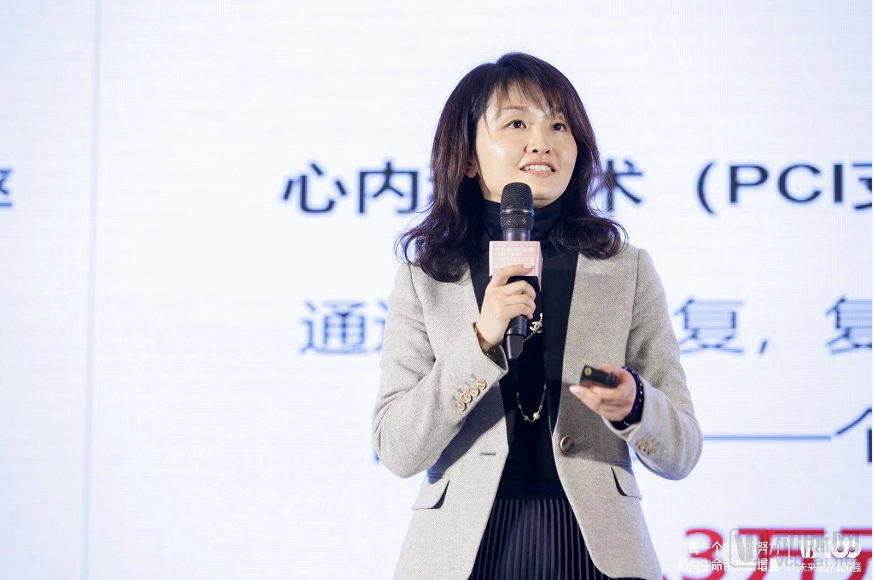
Yu Jurong, Zero2IPO Capital
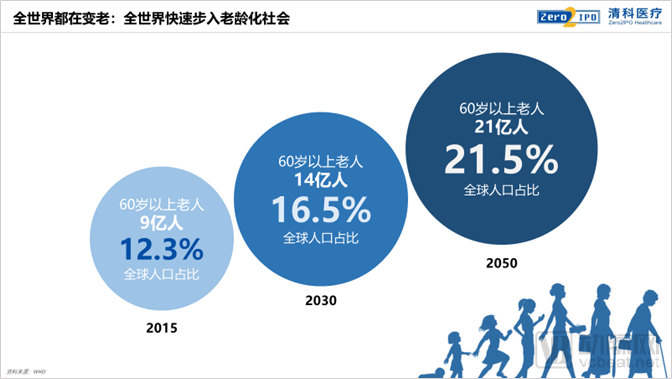
Aging is an inevitable challenge for everyone. As the global population ages, what issues will we face, and how should we make choices, respond, and strive?
With a large existing base and rapid growth, population aging is the greatest challenge of our lifetime.
What Challenges Will Population Aging Bring?
For individuals, on the one hand, thanks to advances in medicine, we can extend our survival time with diseases; but on the other hand, the quality of life while living with illness varies greatly. Can you imagine what it’s like to live without being able to care for yourself?
For families, caring for the elderly is inherently the obligation of the younger generation. However, basic tasks such as assisting with meals, bathing, and mobility become exceedingly difficult when older adults become disabled or partially disabled. Yet, until a comprehensive social support system is established, families are indeed unable to bear this burden alone.
For the government, the goal of healthcare is to ensure basic coverage with broad accessibility. China has done a commendable job in allocating a portion of its constrained medical insurance funds to establish long-term care insurance. However, it is unrealistic to expect the medical insurance system to bear the entire burden of future elderly care needs.
For society as a whole, no one can remain unaffected. When one in every three people in the entire society is an elderly individual, everything from infrastructure to work and leisure will face immense challenges.
Pessimists are always right, but only optimists can change the future. There are always some optimists at the forefront of exploration.
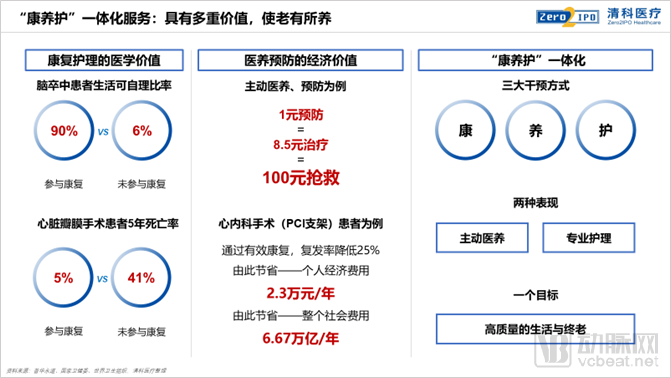
We provide examples to illustrate the medical value of rehabilitation and nursing care. For patients with chronic diseases and stroke, the proportion of individuals who achieve self-care in daily life is 90% among those who participate in rehabilitation, compared to only 5% among those who do not. Among patients undergoing heart valve surgery, the five-year postoperative mortality rate is 5% for those who engage in rehabilitation, versus 41% for those who do not.
Let us further examine the economic value of proactive medical care and early prevention. The ratio stands at: $1 spent on prevention = $8.50 saved on treatment = $100 saved on emergency rescue. Taking patients undergoing percutaneous coronary intervention (PCI) with stent implantation as an example, effective rehabilitation can reduce the recurrence rate by 25%. This results in annual savings of RMB 23,000 per individual and total societal savings of RMB 6.67 trillion per year. Synthesizing these points, we recognize that all elderly care issues fundamentally revolve around health management, wellness, and nursing care. These manifest in two forms: proactive medical-wellness integration and professional nursing care. The ultimate goal remains singular: achieving a high quality of life and dignified aging.
To achieve this goal, the domestic and international markets for health, elderly care, and wellness have been driven by multiple factors:
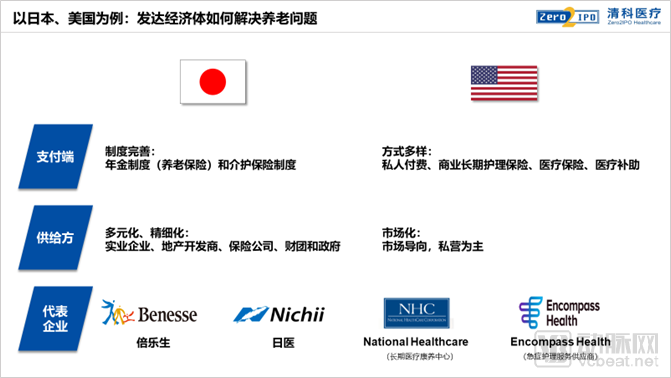
In elderly care, we should learn more from foreign countries and examine their explorations. Take Japan and the United States as examples:
From the nascent stage to formation and finally maturity, Japan’s aging society has progressively unveiled commercial opportunities. Between 2000 and 2012, six of Japan’s top ten nursing care companies went public in a concentrated wave, when Japan’s elderly population rate stood at 12%. In 2018, China’s elderly population rate reached 12%; it is projected to hit 20% by 2030.
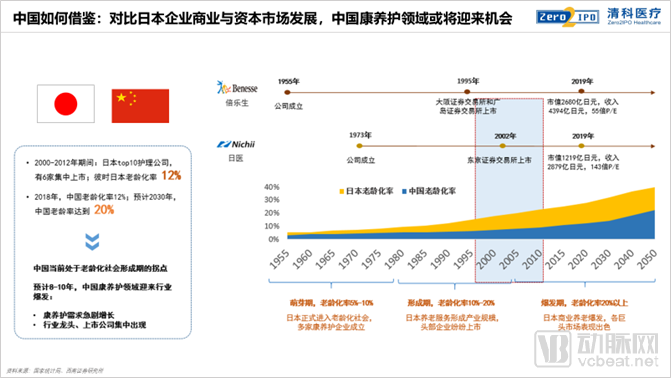
China is currently at a turning point in the formation of an aging society. Over the next 8–10 years, China’s healthcare, elderly care, and nursing sector is expected to enter a period of explosive growth: demand for these services will surge, and industry leaders and listed companies will emerge in large numbers.
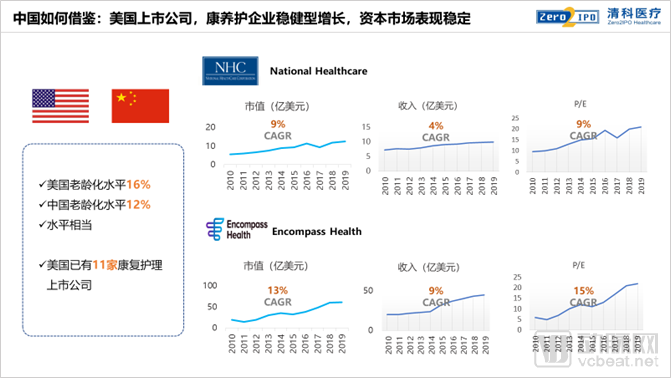
Compared with the United States, where the aging population stands at 16%, China’s rate is 12%, indicating comparable levels. However, the U.S. already has 11 publicly listed rehabilitation and nursing care companies, demonstrating robust growth and high recognition in the capital markets. Notably, Encompass Health, which specializes in acute-care services, has delivered even more impressive performance in the capital markets.
After three decades of development, China’s health and elderly care sector has entered a phase of vigorous growth, with numerous rehabilitation hospitals, nursing homes, care centers, and rehabilitation departments established. At the industry level, companies across the upstream, midstream, and downstream segments are actively participating: from talent training providers such as YiHuJia and HuLianWang, to technology-driven firms like YingHansi and Depin Medical, all exploring diverse solutions for health and elderly care. Nevertheless, demand remains unmet, primarily constrained by a shortage of qualified personnel.
Looking at the capital market, the development trajectory of capital over the past decade has become clearly visible: from traditional medical device manufacturers and distributors investing directly in the sector, to state-owned enterprises (SOEs) and central SOEs gradually entering the investment landscape, followed by the progressive participation of market-oriented private equity (PE) and venture capital (VC) firms, and culminating in today’s competitive strategic investments by corporate giants such as Ping An and Fosun. The evolution of the capital side is now distinctly apparent.
The landscape of health and wellness investment is also constantly evolving: from products to devices, and from platforms to services, capital is making comprehensive investments across all aspects, covering the entire sector.
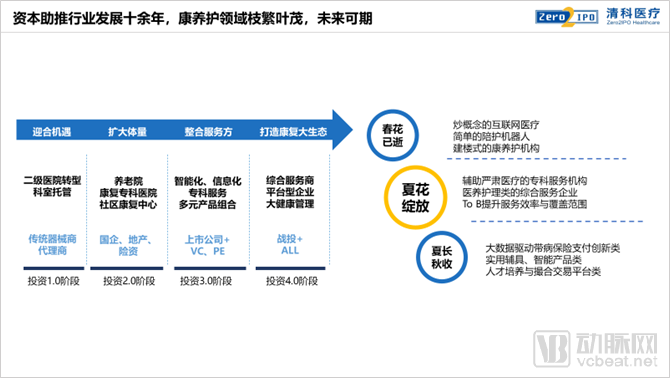
In terms of investment performance, internet healthcare ventures driven by hype, simple companion robots, and facility-heavy elderly care and nursing institutions appear to have limited opportunities; “the spring blossoms have faded.”
Specialized service providers at the level of serious medical care, integrated enterprises in medical and elderly care nursing, and B2B companies enhancing service efficiency and coverage are currently experiencing a period of robust growth—“Blooming in Summer.”
Big data-driven innovations in insurance payment for individuals with pre-existing conditions, practical assistive devices, smart products, and talent development and matchmaking trading platforms still require more patience; we must allow them to fully “grow through the summer” before awaiting the “autumn harvest.”
From in-hospital and peri-hospital medical rehabilitation, to broader community-based rehabilitative care, and ultimately to home-based nursing and elderly care—which accounts for 90% of the total—the global population is aging at an accelerating pace. Addressing this challenge is a complex and long-term endeavor that no single industry, company, or country can undertake alone; only through collaborative efforts can we effectively confront and resolve this issue.
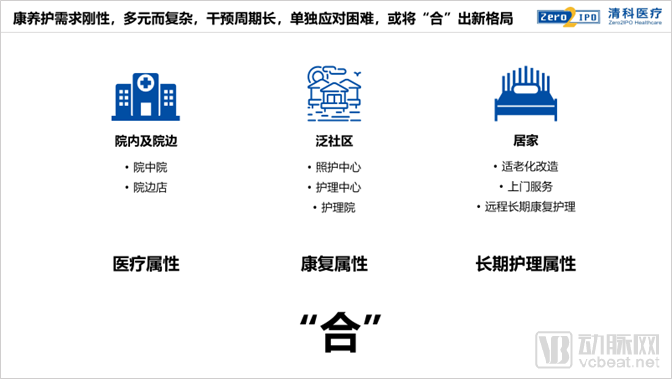
The Chinese character “合” (hé, meaning union or harmony) may offer us the most crucial insight into elderly care. Beginning with the radical “人” (rén, meaning person), it reminds us to truly see each individual in the eldercare sector, recognizing that aging is an inevitable fate for all. The horizontal stroke “一” (yī, meaning one) at the center of the character suggests that the industry must develop a unified understanding and consistent philosophy, directing services toward the public in a cohesive manner. Meanwhile, elderly care serves merely as an entry point, much like the “口” (kǒu, meaning mouth) component at the bottom of the character. Ultimately, our focus must remain on life itself and on fostering a brighter future for humanity.
Across different industries, sectors, and even among organizations with competitive relationships, achieving synergy and collective strength necessitates a more effective binding agent. On one hand, stakeholders must share common values in addressing elderly care challenges—eschewing isolated development and the excessive pursuit of short-term gains and speed, while embracing the potential for extending healthspan and adopting a long-term orientation to jointly prioritize our shared destiny. On the other hand, capital instruments can be leveraged to foster cohesion and drive collaborative synergies.
Qingke Medical is dedicated to providing financial and research services to healthcare companies and institutions at every stage, from inception to IPO. Over the past seven years, our clients have made remarkable contributions to addressing elderly care and rehabilitation challenges in China and Japan. Some have dispatched high-quality caregiving professionals to Japan, others have partnered with Japanese entities to establish nursing homes, and still others have jointly invested with Japanese partners in the research and development of next-generation rehabilitation and caregiving technologies. We look forward to doing even more in the future.
Ultimately, we may also interpret this topic in the following way: In a world that is aging as a whole, we too will inevitably grow old. We are not merely helping others; rather, by engaging in discussions on this cause, we are truly helping ourselves. The challenges of elderly care are severe and difficult to resolve. Only through collaborative symbiosis and a shared orientation toward the future can we hope to achieve happy and healthy lives up to the age of 100.