

Beijing Surgerii Files IPO Prospectus: Pioneering Modular Single- and Multi-Port Laparoscopic Surgical Robot to Challenge Global Monopoly

SHURUI
Surgical Robot R&D and Manufacturer
Over the past year, the surgical robot market has been fiercely contested.
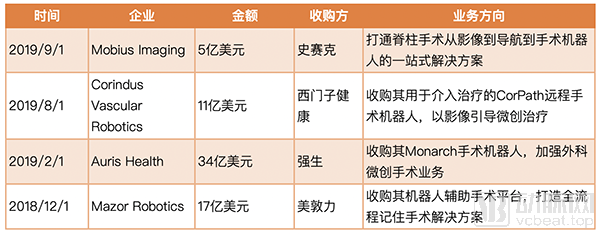
Within just 12 months, four medical device giants—Medtronic, Johnson & Johnson, Siemens, and Stryker—have collectively invested $6.7 billion to compete for a foothold in the surgical robotics sector, breaking transaction records twice and underscoring the industry’s surging momentum. According to a report by Allied Market Research, the global surgical robotics market is projected to reach $98.737 billion by 2024.
To trace the origins of this “battle for surgical robots,” one must mention the da Vinci surgical robot, which has monopolized the market for nearly two decades. As the most successful surgical robot currently recognized in the industry, the da Vinci system has sold over 5,000 units across 66 countries and regions worldwide since receiving FDA approval and launching in 2000. It has been used to perform more than 6 million procedures, generating substantial profits for its developer, Intuitive Surgical. According to annual reports, the company has maintained a gross profit margin of around 70% and a net profit margin exceeding 20% consistently since 2005, with its market capitalization reaching as high as $60 billion.
Although the da Vinci system has become synonymous with surgical robots, its exorbitant price tag has deterred many hospitals and institutions. Reportedly, a single da Vinci surgical robot costs approximately RMB 20 million, with annual maintenance fees around RMB 2 million. Wire-driven surgical instruments require mandatory replacement after every 10 uses. Meanwhile, the per-procedure cost of RMB 50,000–100,000 for da Vinci-assisted surgery remains largely unaffordable for the general public.
In this context, the development and manufacturing of affordable, high-performance surgical robots have become a breakthrough for latecomers to challenge da Vinci’s monopoly. This is precisely the original intention behind the establishment of Beijing Shurui Technology Co., Ltd. (hereinafter referred to as “Beijing Shurui”), which is dedicated to the research and development of domestically produced laparoscopic surgical robots.
“I first encountered surgical robots during my studies in the United States. After five years of specialized study, I believe I have essentially mastered the theoretical framework of the discipline and recognized the immense commercial potential of this industry. Therefore, I aspired to launch my own venture in this field at an early stage,” said Xu Kai, Founder of Beijing Shurui Technology Co., Ltd. and Professor at Shanghai Jiao Tong University.
After earning his bachelor’s and master’s degrees in engineering from Tsinghua University, Xu Kai went to Columbia University in the United States in 2004 to pursue his Ph.D., studying under Professor Russell Taylor, a pioneer in surgical robotics. He later participated in the development of IREP, the world’s first single-port laparoscopic surgical robot system with a diameter of 15 mm, led by Professor Dennis Fowler, an expert in single-port laparoscopic surgery. Although Titan Medical, a Canadian startup that had secured the commercialization license for this patent from Columbia University, extended an offer to Xu Kai, he chose to remain in academia to continue his in-depth research and further refine the technology for single-port laparoscopic implementation. “I hope to be able to translate my own research outcomes into practical applications myself,” he said.
In 2010, Xu Kai returned to China after completing his studies and joined Shanghai Jiao Tong University as a faculty member, dedicating himself to R&D efforts aimed at overcoming the industrialization challenges of single-port laparoscopic surgical robots. It is worth noting that although single-port laparoscopic surgical robots can avoid the complex preoperative positioning required for multi-arm systems, streamline surgical procedures, and reduce patient trauma, they impose higher design requirements on the dexterity, precision, strength, and workspace of the surgical robotic arms.
It was not until 2014 that Xu Kai independently developed the innovative “dual continuum mechanism” design, which resolved critical issues associated with applying flexible continuum mechanisms to surgical robot systems, including low structural reliability, insufficient force-loading capacity, inability to rapidly and accurately estimate deformation, nonlinear stiffness variations, and difficulties in modular reconfiguration. This achievement laid a solid technical foundation for the industrialization of continuum snake-like surgical execution arms and modular surgical system platforms.
Meanwhile, leveraging this innovative design, Xu Kai independently developed a prototype of the SURS single-port laparoscopic surgical robot, featuring an abdominal incision of only 12 mm and comprehensive performance ranking among the top internationally. It was also in that year that Beijing Shurui Technology Co., Ltd. was established.
Benefiting from the “Independent Commercialization of Scientific and Technological Achievements” policy introduced by Shanghai Jiao Tong University, Xu Kai was able to transfer a series of core technologies to Beijing Shurui Technology Co., Ltd. Building on this foundation, the company independently developed and expanded into a range of key technologies and core components. To date, the company has assembled an R&D team of approximately 50 members, including senior engineers from world-renowned medical device companies such as Medtronic, Siemens, and GE. With nearly 100 patents granted in China and the United States, the company is gradually establishing technical barriers for its complete surgical robot system.
“From an industry perspective, the da Vinci Surgical System is indeed the benchmark we are striving to catch up with; however, from a technical standpoint, our approach is fundamentally different,” said Xu Kai.
According to available information, a standard laparoscopic surgical robot consists of three components: the console, the surgical execution arms, and the imaging system. The involvement of the robot enables more intuitive and precise laparoscopic surgical operations. Compared with the da Vinci Surgical System, the Beijing Shurui surgical robot features two primary distinctions:
Greater flexibility in surgical manipulation:Beijing Shurui Technology Co., Ltd. employs a continuum snake-like surgical execution arm with independent intellectual property rights, where each robotic arm has 7 degrees of freedom; additionally, a wrist structure is added to the end of the robotic arm, enhancing its operational flexibility during surgery.
Modular Mounting System:Unlike the Da Vinci surgical robot, which requires separate robotic systems for multi-port and single-port laparoscopic surgeries that must be purchased individually, Beijing Shurui’s SHURUI robotic system leverages the structural adaptability of its continuum mechanism to perform a variety of procedures—including single-port laparoscopy, multi-port laparoscopy, and endoscopic therapies—with just one system. This enables cross-departmental treatment for multiple indications and offers broader clinical applications.
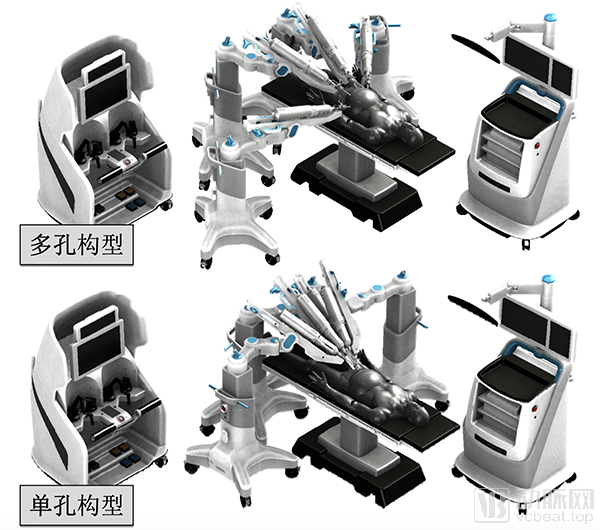
Beijing Shurui Single-Port Multi-Channel Modular Laparoscopic Surgical Robot
“Our robotic system actually comprises six carts, including one master control cart, one equipment cart, and four tool carts,” Xu Kai told VCBeat. “The tool carts adopt a modular design concept, capable of accommodating various surgical instruments and consumables. By varying their placement configurations, the system can achieve both single-port and multi-port operative modes.”
Xu Kai revealed that the SHURUI surgical robot system has currently reached cooperation intentions with multiple hospitals, and animal experiments and clinical trials are being carried out successively in departments such as urology, pulmonology, and hepatobiliary and pancreatic surgery.
Beijing Shurui Surgical Robot Peels Quail Eggs
In Xu Kai’s view, robot-assisted laparoscopic surgery is an inevitable trend under a high level of consensus. The advantages offered by surgical robots—such as 10x magnified visualization and precise, stable manipulation that surpasses the limits of the human hand—not only reduce patient blood loss and complications and shorten postoperative recovery time, but also help clinicians alleviate surgical fatigue and enable less experienced surgeons to significantly improve their operative quality. Given these benefits, the promotion of robotic surgery is imperative.
According to data from Intuitive Surgical, China has only one da Vinci surgical robot per 20 million people, compared with 147 and 34 units in the United States and Japan, respectively. Despite this low penetration rate, the average annual number of procedures performed per da Vinci system in China reached 388 cases in 2017, significantly higher than the global average of 198 cases during the same period. From 2008 to 2016, the total number of surgeries in China grew at a compound annual growth rate (CAGR) of 10.55%, while the volume of da Vinci-assisted surgeries surged at an annual growth rate of 84.48%. These figures indicate that China’s surgical robotics market holds substantial growth potential.
On the other hand, in recent years, China has successively introduced multiple strategic plans and supportive policies, including "Made in China 2025" and the "Robotics Industry Development Plan (2016–2020)," to promote the healthy and rapid development of the robotics industry. Following a rigorous multi-tier selection process, Beijing Shurui Technology Co., Ltd., as the sole domestic manufacturer of laparoscopic surgical robots, participated in the "Exhibition on Achievements in Promoting the Development and Application of Advanced Medical Equipment," jointly organized by the Ministry of Industry and Information Technology (MIIT) and the National Health Commission (NHC). At the event, the company listened to inspiring remarks from leaders of both ministries on accelerating the promotion and application of advanced medical equipment.
Stimulated by both policy and market forces, the development of domestic surgical robot companies is thriving in fertile ground. Public records show that Beijing Shurui Technology Co., Ltd. completed a RMB 10 million angel financing round in 2017, and two years later secured tens of millions of RMB in Series A financing led by Shunwei Capital and Huiding Jishi Capital. The funds obtained were all used for the research and development of its laparoscopic surgical robot system. Xu Kai recently disclosed to VCBeat that,The company may conduct its Series A+ financing in the first half of 2020 to fund scaled-up production and multicenter clinical trials following the finalization of its surgical robot system design.
Regarding the company’s future plans, Xu Kai stated that Beijing Shurui would not seek to meet market demand by increasing the number of products, but rather by developing a range of disposable consumables for its core platform to address diverse clinical needs. “Currently, our primary focus is on laparoscopic and thoracoscopic surgeries; in the future, we aim to expand into natural orifice endoscopic surgery and interventional procedures.”
He added, “Developing surgical robots with independent Chinese intellectual property rights will not only help break the monopoly pricing of da Vinci surgical robots in the market, but also allow more people to benefit from the improved quality of medical care brought by advanced robotic technology. At the same time, it will enable China to step onto the international stage with original technologies, shaping a new global image of ‘high-end medical equipment, independently designed and manufactured in China.’”