Johnson & Johnson's Oncology Business Hits Breakthrough Moment with $25.38 Billion Revenue in 2025

Johnson & Johnson
Medical Device R&D and Manufacturer
Fifteen years ago, Johnson & Johnson Oncology's performance was only a mere $1.465 billion.The proportion of revenue from innovative drugs is only 6.5%.Today, it has successfully surpassed its autoimmune segment to become the largest pillar of Johnson & Johnson's innovative drug revenue. The latest 2025 financial report shows that Johnson & JohnsonOncology business continues to maintain a high growth rate of 22.1%, generating revenue of $25.38 billion, which is 1.56 times that of the autoimmune sector, contributing 42% of the innovative drug segment's income.。
Johnson & Johnson's Autoimmune and Oncology Business Revenue Over the Years (Unit: Billion USD)
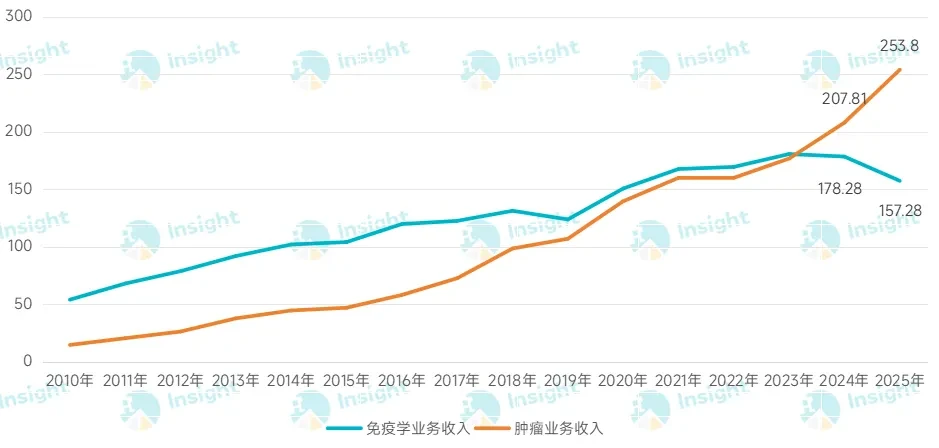
Data source: Johnson & Johnson annual reports, Insight database chart
From a "supporting role" with only 6.5% share, to the absolute centerpiece contributing 42% of revenue, Johnson & Johnson's oncology business has completed a stunning transformation in fifteen years.So, how did Johnson & Johnson cultivate its oncology business from a small sapling into a towering tree that supports the company's performance?

Multiple Myeloma
Comprehensive Layout to Establish Dominant Position
The majority of Johnson & Johnson's oncology business revenue comes fromMultiple Myeloma(MM)Pipeline. 20Over 25 years, Johnson & Johnson's MM pipeline generated revenue of $17.371 billion, contributing 77.6% of the oncology segment's income.
In the MM field, Johnson & Johnson has built a strong and diverse product pipeline.Drug types includeChemical drugs, monoclonal antibodies, CAR-T, and bispecific antibodies, with a treatment scope covering patient populations from later-line to front-line, have become the dominant force in the MM field.
Johnson & Johnson's layout in the multiple myeloma field began with bortezomib. Bortezomib is a proteasome inhibitor, initially developed by Millennium.In 2003, Johnson & Johnson secured the rights to develop and commercialize bortezomib outside the United States through a collaboration exceeding $535 million. In 2008, Millennium was acquired by Takeda for $8.8 billion, after which bortezomib came under the global co-development and commercialization by Takeda and Johnson & Johnson.
BortezomibFirst approved in the United States in May 2003 for third-line or later treatment of MM, it was the first new drug approved by the FDA in the MM field in over a decade. In the MM field,Bortezomib quickly advanced from later-line to front-line treatment, with approved indications including monotherapy and combination therapy, and has become a first-line treatment for MM patients.In the indication of mantle cell lymphoma, the treatment status of bortezomib has also moved from second-line to first-line.
According to Johnson & Johnson's financial report, between 2008 and 2020,Bortezomib has cumulatively sold nearly 14.8 billion US dollars, plus undisclosed sales before 2007 and after 2021,The total revenue this drug has brought to Johnson & Johnson is conservatively estimated to be over 15 billion US dollars.。
BortezomibAnnual Sales Revenue
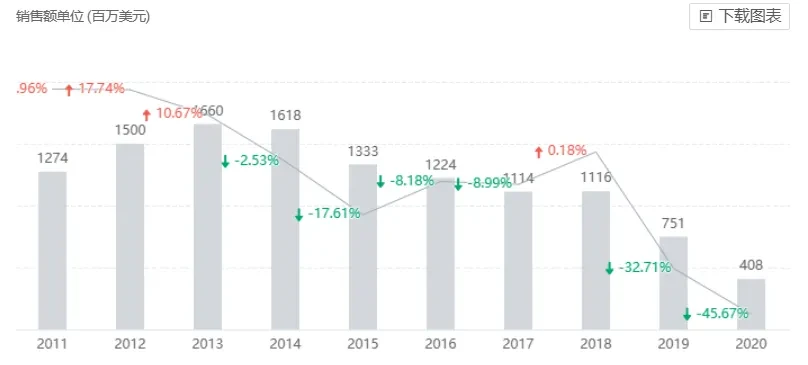
Image Source: Insight Database
As the patent expired, the sales of bortezomib plummeted.By 2020Sales(Johnson & Johnson side)Only $408 million. However, Johnson & Johnson has a plan.
Daratumumab: Blockbuster Product
Daratumumab is the successor to bortezomib. It was initially developed by Genmab. In August 2012, Johnson & Johnson secured the global exclusive rights to the drug with an upfront payment of $55 million. Due to its remarkable efficacy in MM treatment, daratumumab received Fast Track designation, Breakthrough Therapy designation, and Priority Review status from the FDA.
In November 2015, daratumumab received FDA accelerated approval.(Now fully approved), for the treatment of MM patients in fourth-line and above, and has becomeThe World's First Approved CD38 Monoclonal AntibodyIn the second year of its commercial launch, it generated $1.242 billion in sales, offsetting the revenue decline caused by the expiration of bortezomib's patent.
Thereafter, Johnson & Johnson acceleratedExpanding the indications of daratumumab in the MM field from the last-line to third-line, second-line, and first-line.Meanwhile, to enhance its market competitiveness, Johnson & Johnson has also developed a subcutaneous injection formulation of daratumumab.
With the expansion of new indications, the successful development of subcutaneous formulations, and the increase in approved regions, the sales of Daratumumab have skyrocketed. In 2024, nine years after its market launch, ...Sales exceeded $10 billion for the first time($11.67 billion), becoming one of the super blockbuster drugs. 2025,DaratumumabContinued strong growth of 23.0%, generating revenue of $14.351 billion, single-handedly propping up half of Johnson & Johnson's oncology business.
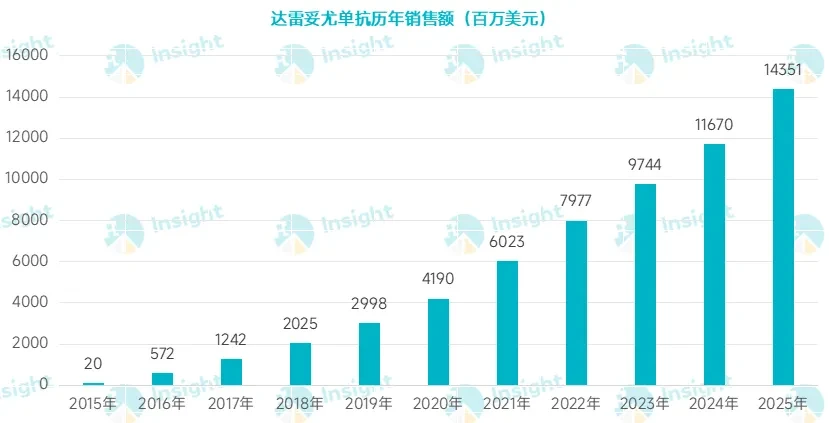
Data source: Johnson & Johnson annual reports, Insight database chart
The potential of daratumumab in the MM field has not been fully unleashed. In the second half of 2025, subcutaneous daratumumab was successively approved in Europe, the US, and Japan for the treatment of high-risk smoldering multiple myeloma.(HR-SMM)。Smoldering Multiple Myeloma isThe asymptomatic precursor stage of MM, for which there have been no effective means to prevent disease progression in high-risk patients.Approval of HR-SMM IndicationMeaningWith the pre-cancer market for MM covered by Daratumumab, a closed-loop for the full-line treatment of MM patients has been established.
Cilta-cel: New Growth Point
Cilta-cel is a BCMA CAR-T product that Johnson & Johnson introduced from Legend Biotech, primarily due to its promising therapeutic potential in MM.
At the 2017 ASCO conference, Cilta-cel gained significant attention in a Phase I clinical trial for relapsed/refractory MM, emerging as the dark horse of the ASCO that year. In December of the same year, Johnson & Johnson and Legend Biotech reached a collaboration to jointly develop and commercialize Cilta-cel, further expanding their MM and oncology pipelines. On the other hand, 2017 marked the first year of CAR-T commercialization, and through the introduction of this product, Johnson & Johnson was able to quickly enter the CAR-T field.
Cilta-cel was first approved in 2022 and has now been approved in Europe, the US, Japan, and China for the last-line treatment of relapsed/refractory MM, and in the US and EU for second-line treatment of relapsed/refractory MM. In 2025,Cilta-cel Generates Revenue of $1.887 Billion, year-on-year growth95.9%, successfully enteredBlockbuster Club.
Cilta-cel Key Progress Timeline
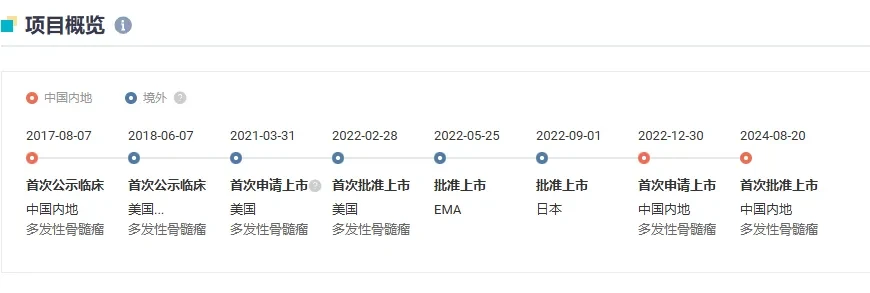
Image Source: Insight Database
Dual Antibody: A New Force
Despite the significant efficacy of the newly listed Cilta-cel, Johnson & Johnson has still developed two bispecific antibodies for its MM pipeline — Teclistamab and Talquetamab, both of which were introduced from its "long-time partner" Genmab. Compared with CAR-T, which requires personalized custom production, bispecific antibodies can be produced in batches, making them more convenient.
Talquetamab was first approved in August 2022 and has now been approved in Europe, the United States, China, and Japan for the treatment of relapsed or refractory multiple myeloma.Is the world's first approved BCMA×CD3 bispecific antibody. 2025,Trastuzumab Revenue$670 million, a year-on-year increase of 22.1%。
Talquetamab was first approved in the United States in August 2023 for the treatment of relapsed or refractory multiple myeloma.Is the world's first GPRC5D×CD3 bispecific antibody, which can provide a new option for patients who have progressed after receiving BCMA CAR-T or BCMA×CD3 bispecific antibody treatment. In 2025,The drug achieved a high growth rate of 61.3%, generating revenue of 4.63.Billion US dollars。

Heavyweight Bomb in Hematological Tumors: Ibrutinib
In the field of hematological tumors, Johnson & Johnson has also developed a blockbuster product—Ibrutinib.(Imbruvica). Ibrutinib is a product from Pharmacyclics, a Johnson & Johnson company.(Later acquired by AbbVie)The introduced BTK inhibitor is the second product in Johnson & Johnson's hematology oncology field.
Ibrutinib was first approved in 2014 as the world's first marketed BTK inhibitor, with approved indications covering chronic lymphocytic leukemia/small lymphocytic lymphoma.(CLL/SLL, second-line/first-line), Mantle Cell Lymphoma(Second Line), Waldenström's macroglobulinemia, graft-versus-host disease.
Since its listing,Ibrutinib has contributed more than $31.4 billion in cumulative revenue to Johnson & Johnson, with annual sales peaking at over $5.4 billion.However, with the patent expiration, the sales of Ibrutinib began to decline in 2022, reaching $3.038 billion in 2024. In 2025, its sales continue to drop by 7.1% to $2.823 billion.

Solid Tumor Field
Johnson & Johnson's revenue in the solid tumor sector mainly comes from two prostate cancer treatment products—abiraterone and apalutamide, which have collectively contributed approximately $40.2 billion to Johnson & Johnson's income.
Abiraterone is a selective and irreversible CYP17A1 enzyme inhibitor, initially developed by Cougar Biotechnology. Johnson & Johnson acquired the product in 2009 through the acquisition of Cougar. The drug was first approved in 2011 for second-line treatment of castration-resistant prostate cancer and later expanded to first-line treatment.
As of 2025,Abiraterone has generated over $270 billion in revenue cumulatively.. With the patent having expired,AbirateroneAnnual sales have declined from a peak of $3.498 billion to $502 million in 25 years.(YOY -20.4%)。
After the patent for abiraterone expired, Johnson & Johnson successfully launched its successor product, apalutamide.Apalutamide is a second-generation nonsteroidal androgen receptor(AR)Inhibitor, initially developed by Aragon Pharmaceuticals, was acquired by Johnson & Johnson in 2013 through the purchase of Aragon.
Apalutamide was first approved in 2018 and has since been approved in the United States, the European Union, Japan, and China for the first-line treatment of castration-resistant prostate cancer and hormone-dependent prostate cancer. Since its launch,ApalutamideSales have been rising steadily,Revenue of $3.574 billion in 25 years, a year-on-year increase of 19.2%, offsetting the impact of the expiration of Abiraterone's patent on performance.
ApalutamideKey Progress Timeline
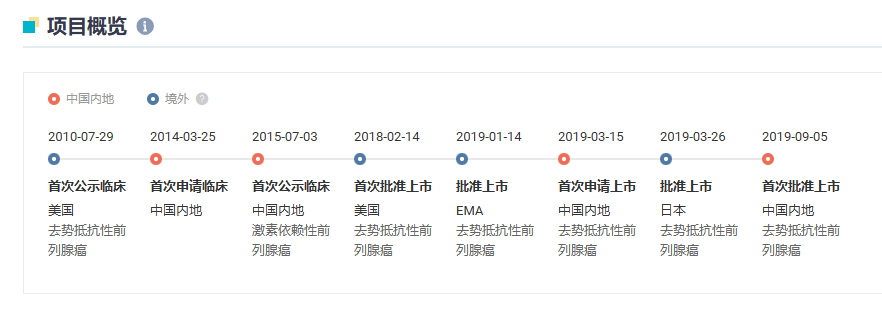
Image Source: Insight Database
In the field of prostate cancer,Johnson & JohnsonLaunchedNiraparib + Abiraterone Acetate Compound Preparation —— AkeegaAkeega was first approved in April 2023 and has now been launched in the EU, the US, and China, in combination with prednisone or prednisolone for the treatment of adult patients with BRCA1/2-mutated metastatic castration-resistant prostate cancer.(mCRPC)First-line treatment. December 25In the same month, the drug also received FDA approval for use inBRCA MutationFirst-line treatment for hormone-dependent prostate cancer.
At present, Johnson & Johnson is also gradually expanding.Other than prostate cancerOther solid tumors.In the field of lung cancer, Johnson & Johnson has successfully launched Amivantamab and Lazertinib.Amivantamab is an EGFR×c-MET bispecific antibody that Johnson & Johnson introduced from Genmab, and Lazertinib is another compound that Johnson & Johnson introduced fromIntroduced by Yuhan CorporationA third-generation EGFR-TKI.
Amivantamab has been approved as a single agent or in combination with chemotherapy for EGFR ex20ins mutation NSCLC, and in combination with Lazertinib for EGFR-sensitive mutation NSCLC. By 2025,Amivantamab andLanreotide(IncludingMonotherapy and Combination Therapy)Total sales of $734 million. December 12, Year 25The subcutaneous injection form of Amivantamab has also been successively approved in the United States, Japan, and China. This means,Amivantamab is expected to see further growth in 2026.
In addition, Johnson & Johnson has introduced a pan-FGFR inhibitor from Astex Pharmaceuticals.Erdafitinib, The drug has been approved in the United States, European Union, Japan, and China for patients with locally advanced or metastatic urothelial carcinoma. However, Johnson & Johnson did not disclose the specific sales of the drug.
 Summary
The rise of Johnson & Johnson's oncology business is almost a history of BD deals and acquisitions, with all these oncology pipelines being acquired through company mergers or introduced from external sources. Particularly,Genmab has successively provided Johnson & Johnson withDaratumumab,Talimogene laherparepvec, Tarextumab,Amivantamab Four First-in-Class Products.
In the field of treatment, Johnson & Johnson is highly focused, deeply cultivating the MM field, and has iteratively developed products step by step over the past two decades. The types of drugs are very rich, especially in handling product patent periods, ensuring continuous annual growth in performance. In the solid tumor field, the major contributor remains the prostate cancer product, followed by contributions in the lung cancer field.Amivantamab and Lazertinib were just approved not long ago, representing subsequent growth points.
Johnson & Johnson is also very confident in its own oncology business.Johnson & Johnson once stated that by 2030, it aims to increase its oncology business sales to $50 billion. Although the goal is ambitious, considering Johnson & Johnson's oncology pipeline layout, it is not impossible to double its performance in five years.
References:
[1] Johnson & Johnson Annual Reports and Official Press Releases
[2]Insight Database
Cover image source: Visual China
Disclaimer:This article is for information sharing only and does not represent the position or viewpoint of Insight. It does not recommend or introduce any treatment plans. If necessary, please consult and contact正规医疗机构.
Editor:Xin Medicine
PR Article Coordination: WeChat insightxb
SubmissionWeChat: insightxb; Email: insight@dxy.cn