

JD Health's Internet Healthcare 3.0 Vision: Full-Process Integration of Premium Medical Resources and Leading Traffic
“Today, we may have witnessed together a landmark event in the field of internet healthcare.” At the “Internet Healthcare Cooperation and Development Forum & JD Health Heart Center Launch Ceremony,” held at the lecture hall of the JD.com Building in the southeastern suburbs of Beijing during the chilly late winter of 2019, Xin Lijun, Vice President of JD Group and CEO of JD Health, once again addressed the public. “We have been continuously exploring how to leverage JD’s resources to deliver more tangible benefits to patients, and all our visions will start becoming a reality from today onward.”
The year 2019, now drawing to a close, holds epoch-making significance for JD Health.
In May, the second year of its foray into internet healthcare, JD.com announced the establishment of the JD Health subsidiary while releasing its financial results for the first quarter of fiscal 2019. The market widely anticipated that JD Health would become the third giant unicorn, following JD Digits and JD Logistics. Sixty-nine days after JD Health’s inception, Xin Lijun assumed office, shouldering a significant responsibility.
In October, JD Health held the “Co-creating a New Era of Health – 2019 JD Health Partner Conference,” where CEO Xin Lijun shared for the first time his insights into demand-side dynamics in the “New Era of Health,” and presented supply-side strategic plans and solutions addressing current pain points. At that time, Xin Lijun pointed out that there were already many point innovations in Internet-plus-healthcare, such as lightweight online consultations, online appointment registration, post-diagnosis consultations, chronic disease management, home delivery of medications, Internet hospitals, telemedicine, and AI-based medical imaging. “JD Health does not need to rush to create something new; rather, it should consider what logic can be used to connect all these elements together.”
Two months later, the “JD Health Heart Center,” established by JD Health in collaboration with renowned cardiovascular expert and medical educator Professor Hu Dayi and his expert team, has officially launched. This marks a significant national-level initiative in internet healthcare, described by Academician Han Yaling, a prominent cardiovascular specialist and member of the Chinese Academy of Engineering, as “a feasible and promising development trend.”
Xin Lijun, Vice President of JD.com and CEO of JD Health
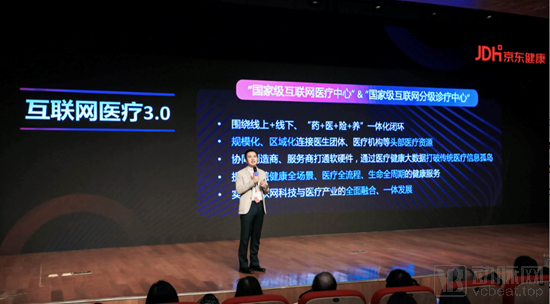
Xin Lijun, who presents a refined and scholarly demeanor, has adopted a decisive and vigorous approach in his strategic initiatives within the medical and broader healthcare sector. At the event, he shared his insights on the era of Internet Healthcare 3.0, regarding the establishment of the JD Health Heart Center as a landmark starting point for this new epoch.
Since the first wave of internet healthcare pioneers began experimenting with appointment scheduling and online consultations for minor ailments, nearly a decade has passed in the development of internet healthcare. Although it has not yet undergone large-scale commercial validation, there is a widespread belief that internet healthcare is currently in its most promising stage of development. According to data from the Statistical Information Center of the National Health Commission, as of October 2019, a total of 269 internet hospitals had been established across China, representing an increase of 173 since April of the previous year, when the General Office of the State Council issued the “Opinions on Promoting the Development of ‘Internet + Medical Health’.”
Exploration of Internet-Enabled Healthcare. Prior to 2016, internet-based healthcare primarily focused on lightweight online consultations, with application scenarios mainly including medical information inquiries, online appointment registration, online consultation services, and online prescription and medication purchases. Xin Lijun defined this period as Internet Healthcare 1.0.
The Iteration of “Internet + Healthcare”. After 2016, internet hospitals gradually took shape. The scope of practice for internet healthcare is no longer limited to peripheral medical services such as online consultations; instead, it allows the provision of certain medical services using internet technology under regulatory compliance. This includes permitting online follow-up visits for some common and chronic diseases. Once physicians have access to patients’ medical records, they are allowed to issue prescriptions online for certain common and chronic conditions, as well as provide telemedicine, health consultation, and health management services, thereby gradually connecting the pre-diagnosis, during-diagnosis, and post-diagnosis stages of the healthcare journey. “This represents the basic form of Internet Healthcare 2.0,” stated Xin Lijun.
After progressing through two phases—online light consultations and internet hospitals primarily focused on managing common and chronic diseases—how to provide “readily accessible” medical services for patients with major and severe conditions, such as heart disease, has become a “new agenda” for internet healthcare. Meanwhile, pain points in the healthcare sector, including uneven distribution of medical resources and information silos among medical institutions, remain urgent challenges to address. Precisely aligning with users’ health needs and delivering comprehensive, full-lifecycle health services have also become imperative requirements for internet healthcare.
“The greatest value of the internet in the healthcare sector lies in its ability to enable decentralization, revitalize various medical resources, and match appropriate medical resources with suitable patients.” The Internet Healthcare 3.0 model defined by Xin Lijun is precisely JD Health’s new solution to this “new agenda.”
The Era of Internet Healthcare 3.0 Signifies “Two Shifts”: Transitioning from Traditional Offline Hospitals or Online Internet Hospitals Toward an Integrated Closed-Loop Model Combining “Online + Offline” and “Pharmaceuticals + Medical Services + Insurance + Elderly Care,” Which Gives Rise to Two New Trends: On the One Hand, Scalable and Regional Integration of Premium Medical Resources, Including Physician Groups and Medical Institutions; On the Other Hand, Collaboration with Manufacturers and Service Providers to Leverage Big Data in Health and Medicine, Shifting Toward Comprehensive Health Services That Cover All Health Scenarios, the Entire Medical Process, and the Full Life Cycle, Thereby Achieving Deep Integration Between Internet Technology and the Healthcare Sector.
Xin Lijun further explained that the era of Internet Healthcare 3.0 requires achieving more valuable connectivity and integration across four levels. First, continuously optimize the allocation of medical resources at all levels and types, promoting balanced and homogeneous distribution of healthcare resources. Second, leverage internet-based tools to enhance primary care capabilities, strengthen the general practitioner system, improve initial diagnosis and triage capacities, and advance tiered diagnosis and treatment. Third, establish a comprehensive health management system spanning health education, prevention, treatment, medication, and rehabilitation. Fourth, build national-level multidisciplinary diagnosis and treatment platforms organized by disease type.
Xin Lijun’s Vision for Internet Healthcare 3.0 Is First Implemented in the Cardiovascular Specialty
According to the "Report on Cardiovascular Diseases in China 2018," the prevalence of cardiovascular diseases in China remains on the rise, with an estimated 290 million affected individuals. Deaths attributable to cardiovascular diseases account for more than 40% of all disease-related deaths among residents, ranking first among all causes of death and making it the leading threat to public health.
Not long ago, the State Council issued the “Opinions on Implementing the Healthy China Action,” along with the “Healthy China Action (2019–2030),” which proposes 15 major special initiatives centered on disease prevention and health promotion. These initiatives address three key areas: major health risk factors, priority populations, and major diseases. Among them, the 11th initiative is the “Action for Prevention and Control of Cardiovascular and Cerebrovascular Diseases.” This underscores both the threat posed by cardiovascular diseases to national public health and the state’s high prioritization of cardiovascular disease control.
As the first national-level specialized medical center dedicated to cardiovascular health services with an integrated online-offline model, the JD Health Heart Center connects and aggregates top-tier medical resources, including leading hospitals and physicians, to deliver integrated online-offline medical services. By leveraging internet technologies to achieve interconnectivity of information and resources, it facilitates the downward flow of high-quality medical resources, supports the implementation of tiered diagnosis and treatment nationwide, and enhances the equity and accessibility of healthcare resources.
Hu Dayi, Chairman of the Cardiac Prevention and Rehabilitation Professional Committee of the Chinese Association of Rehabilitation Medicine and Director of the JD Health Heart Center, introduced the organizational structure of the JD Health Heart Center at the event.

JD Health Heart Center has established four major sub-centers: Cardiology, Cardiac Surgery, Prevention and Rehabilitation, and Psychocardiology. A total of 35 top-tier cardiac experts from across China, including Professor Hu Dayi, have been appointed to core management positions at the JD Health Heart Center. Concurrently, JD Health has launched the Heart Disease Research Institute, with Professor Ma Changsheng—currently Director of the National Clinical Research Center for Cardiovascular Diseases and Director of the Cardiology Center at Beijing Anzhen Hospital—serving as its Dean and Chief Scientist.
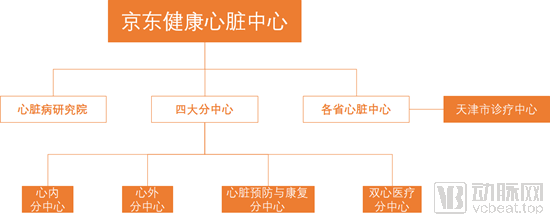
JD Health Heart Center Architecture
Furthermore, JD Health Heart Center will establish provincial heart centers across the country, with the first regional diagnosis and treatment center launched at Tianjin Nankai Hospital. At the press conference, Xin Lijun and Hu Dayi, representing JD Health Heart Center, presented a cooperative plaque titled “JD Health Heart Center Tianjin Diagnosis and Treatment Center” to Wang Ximo, President of Tianjin Nankai Hospital and Chairman of the General Surgery Professional Committee of the Chinese Association of Integrative Medicine.
Hu Dayi stated that focusing on issues in the field of heart disease in China, promoting the integrated development of cardiac rehabilitation and prevention, and exploring a model for cardiac prevention, rehabilitation, and chronic disease control and prevention that aligns with China’s national conditions and features Chinese characteristics, so as to improve the level of medical diagnosis and treatment services and better safeguard the health of the people, is not only the common goal of all cardiovascular professionals but also the mission behind the establishment of the JD Health Heart Center.
As a new-generation player in the internet healthcare sector, JD Health undoubtedly possesses unparalleled technological capabilities and resource advantages to lead the industry into a new phase.
JD Group boasts over 300 million active users and a trusted brand image, continuously providing users with a diverse range of high-quality products and services through its comprehensive supply chain system and efficient logistics network. JD Health is bolstered by the group’s robust resources, including its industry-leading pharmaceutical retail business, the sector’s first online “medical care + pharmaceuticals” closed-loop ecosystem, and intelligent health monitoring and management solutions that integrate hardware and software.
Currently, JD Health has achieved preliminary coverage across the entire pharmaceutical industry chain, the full medical care process, all health-related scenarios, and the entire user lifecycle. It has built the most extensive and comprehensive “Internet + Healthcare” ecosystem in the industry, with each of its subsidiary businesses leading their respective segments. Leveraging industry-leading AI technologies, JD Health has implemented a series of products and applications in the healthcare field, including AI triage, AI-assisted diagnosis and treatment systems, AI-powered customer service for follow-up visits, and AI systems for rational medication use and prescription review.
JD Health has positioned its collaboration with local governments and offline hospitals as an “integrated” smart solution for the future coordinated online-offline development of internet healthcare. It has signed strategic “Healthy City” cooperation agreements with more than 20 cities or regions, covering areas such as pharmaceutical retail, internet hospitals, online medical insurance reimbursement, and smart healthcare. In addition, large public tertiary Grade-A hospitals across various regions are key partners for JD Health. The company has collaborated with multiple hospitals in areas including co-building smart hospitals, AI-assisted diagnosis and treatment, AI-based rational drug-use systems, and health management.
In the future, to lead innovation in internet healthcare models, JD Health will focus on two key areas: physicians and hospitals. On one hand, it will leverage its platform and technological advantages to connect with top-tier physician groups, utilizing internet technologies to disseminate expert skills and knowledge to more primary-care and young physicians, thereby ensuring a steady supply of talent. On the other hand, it will strengthen collaborative development between its specialized internet healthcare centers and physical hospitals by establishing offline regional centers, thus achieving tripartite integration among JD Health, physician resources, and offline hospitals.
Xin Lijun pointed out that JD Health will take the establishment of the Heart Center as a starting point, adopt a user-centric approach, and provide integrated online-offline medical services across more specialized disease and specialty areas, thereby advancing the development of national-level internet healthcare centers and national-level internet-based tiered diagnosis and treatment centers.