

Turning Point Therapeutics: Breaking into the Competitive Targeted Oncology Market with a Fourth-Generation ALK Inhibitor

Turning Point Therapeutics
Cancer Drug Developer
Outstanding overseas enterprises have long served as key benchmarks for Chinese entrepreneurs. At the turn of the year, VCBeat conducted an in-depth analysis of the top 30 overseas healthcare companies by financing volume in 2019, presenting these case studies to readers. This initiative aims to help investment institutions identify promising directions and assist investors in finding valuable models for learning.
The anti-cancer drug market has always been a fiercely contested arena for major pharmaceutical companies worldwide. Established giants such as Roche, Celgene, and Bristol-Myers Squibb (BMS) secured early-mover advantages, while newer entrants like Gilead Sciences, Eli Lilly, and Clovis Oncology have rushed into the field to capture market share. Amidst this intense competition, a startup specializing in anti-cancer drug R&D, founded just six years ago, has managed to break through the pack and carve out its own niche.
In April 2019, Turning Point Therapeutics (hereinafter referred to as “TP Therapeutics”) officially listed on the NASDAQ market in the United States. Its stock price surged by more than 50% on the first day of trading, raising a total of $192 million. From relative obscurity to becoming a favorite of the capital markets, what kind of team and R&D strategy lie behind TP Therapeutics, and where is its future direction headed? With these questions in mind, let us explore the answers together with VCBeat.
To understand the success of TP Therapeutics, one must tell the story of its co-founder and Chief Scientific Officer, J. Jean Cui.
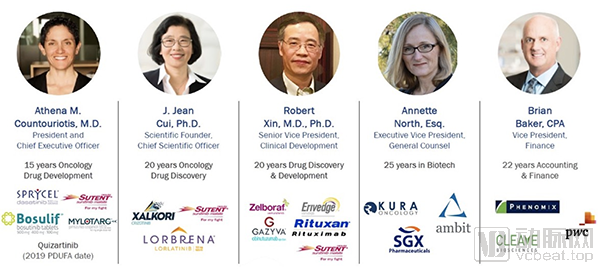
TP Therapeutics Management Team, with Dr. Cui Jingrong second from the left
According to the 2016 Global Burden of Disease Study published in The Lancet, cancer has become the second leading cause of death worldwide. Lung cancer is the most commonly diagnosed malignancy and the leading cause of cancer-related mortality. In this context, countless scientists have raced to find ways to combat cancer, and Cui Jingrong is one of them.
Jingrong Cui, who earned her Ph.D. in organic chemistry from The Ohio State University in the United States, joined pharmaceutical giant Pfizer after graduation, where she led oncology drug research and development for 14 years. During her tenure, she spearheaded the development of crizotinib (brand name Xalkori), the first novel drug for precision medicine in lung cancer.
It is reported that prior to 2011, before crizotinib received FDA approval, lung cancer treatment relied predominantly on chemotherapy, with no significant improvement in therapeutic efficacy for decades. The advent of crizotinib substantially improved cancer control in patients harboring anaplastic lymphoma kinase (ALK) gene alterations, pioneering the era of precision medicine for non-small cell lung cancer. In recognition of this achievement, Cui Jingrong was awarded the 2011 Pfizer Innovation Award and the 38th Annual National Inventor of the Year Award in the United States.
In addition to crizotinib, Cui Jingrong also participated in the development of sunitinib (Sutent), the manufacturing of the c-MET-specific inhibitor PF-04217903, and the design of the third-generation ALK inhibitor lorlatinib (approved by the FDA in 2017). Given her numerous achievements, some media outlets have even hailed her as the “God of Anti-Cancer Drugs.”
On October 8, 2013, Cui Jingrong and her husband, Li Yishan (Peter Li), co-founded TP Therapeutics, a biotechnology company dedicated to the research and development of next-generation tyrosine kinase inhibitors (TKIs). The company focuses on designing and developing novel small-molecule targeted cancer therapies to treat tumors that have developed resistance to existing TKIs.
It was on this very day that the stage was set for Cui Jingrong, in her capacity as a scientific researcher, to stand alongside several female executives and strike the listing gong, a moment that would later be featured in The Wall Street Journal.
Drawing on years of experience in the development of ALK inhibitors, Cui Jingrong has led the team at TP Therapeutics since its inception to develop the fourth-generation ALK inhibitor repotrectinib (TPX-0005), aiming to treat ROS1-positive non-small cell lung cancer and NTRK-positive solid tumors.
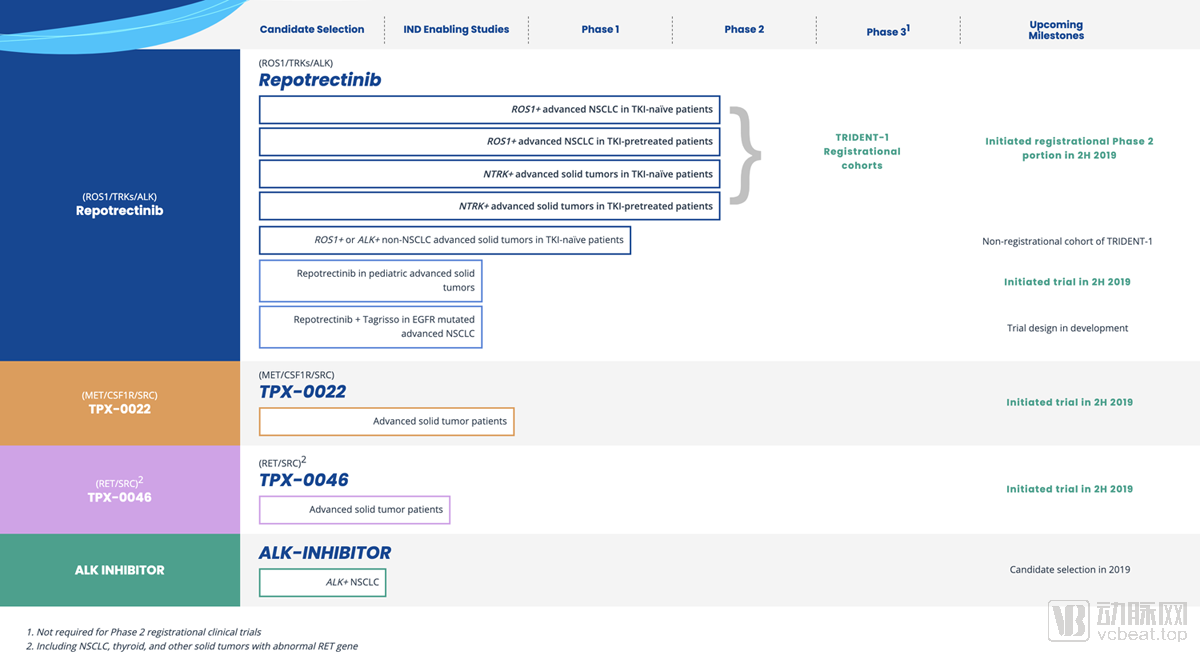
TP Therapeutics’ Drug Development Pipeline and Anticipated Milestones (Image source: TP Therapeutics official website)
So, as the lead candidate in TP Therapeutics’ R&D pipeline, how exactly does lorupretinib achieve cancer control? Compared with earlier-generation ALK inhibitors, what advantages does lorupretinib offer? To answer these questions, we must start with cancer mutations.
For example, when an individual has an ALK rearrangement in their genes, it leads to the production of large amounts of kinase, which in turn causes uncontrolled cell division and results in further carcinogenesis. A crucial step in the kinase workflow is called phosphorylation, which involves attaching a phosphate group supplied by ATP (adenosine triphosphate) to a protein.
One approach to precision cancer therapy involves modulating the aforementioned phosphorylation reactions. Specifically, a precision drug molecule can bind to a kinase, thereby blocking its interaction with ATP and inhibiting kinase-mediated phosphorylation, which in turn curtails the pathways driving cancer progression.
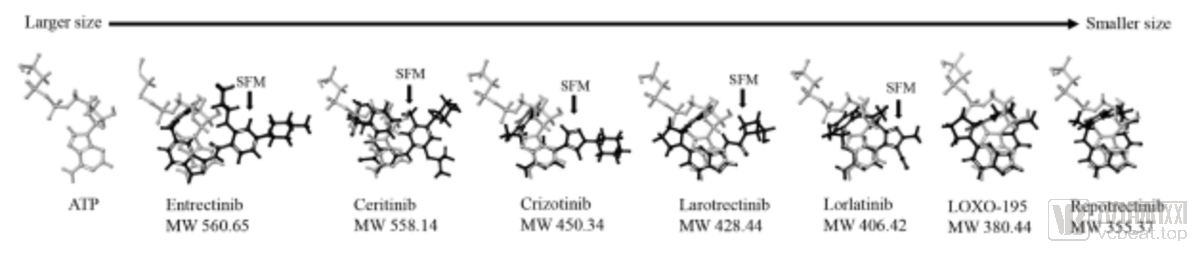
Structural similarities between the ATP molecule (gray) and the inhibitor molecule (black). Due to this similarity, the drug molecule can occupy the ATP-binding site in the kinase, thereby reducing the binding of the kinase to ATP (Image source: TP Therapeutics prospectus)
According to the prospectus of TP Therapeutics, compared with previous generations of ALK inhibitors, lorlatinib has a smaller biomolecular structure and better overlap with the benzene ring portion of ATP. This allows the drug to bind more tightly to the kinase, resulting in more pronounced therapeutic effects. Secondly, its compact molecular structure enables more precise binding to the target, overcoming resistance commonly seen with other kinase inhibitors. Furthermore, the small molecule may more effectively penetrate the blood-brain barrier, thereby providing effective treatment for metastatic cancer.
Results from the Phase 1/2 clinical trial of repotrectinib demonstrated a response rate of up to 90% in non-small cell lung cancer (NSCLC) patients with ROS1 gene rearrangements. Moreover, the drug showed significant efficacy in ROS1-positive NSCLC patients who had developed resistance to other inhibitors. Preliminary data also indicated efficacy against brain cancers and salivary gland cancers with NTRK gene rearrangements.
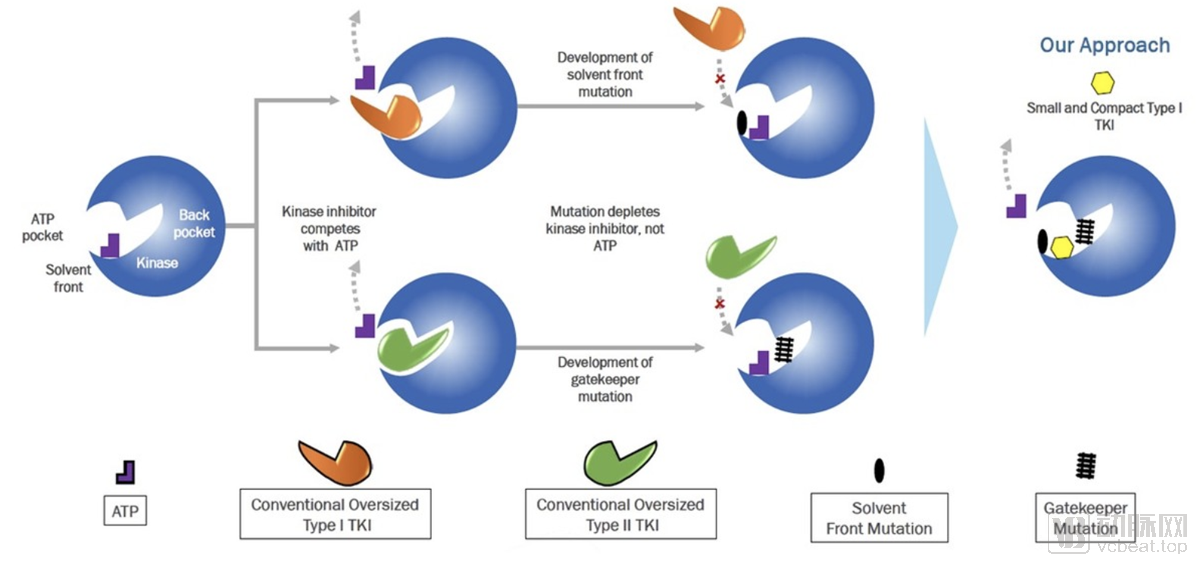
Technical Advantages of TP Therapeutics’ Kinase Inhibitor (Yellow Hexagon in the Figure): Its compact structure allows it to be fully concealed within the kinase’s ATP-binding pocket upon binding, thereby reducing the risk of drug resistance. (Source: TP Therapeutics Prospectus)
Based on the aforementioned clinical efficacy, on June 27, 2017, lorlatinib was granted orphan drug designation by the U.S. FDA for adenocarcinoma-type non-small cell lung cancer (NSCLC) associated with gene rearrangements involving ALK, ROS1, NTRK, and other genes.
For startup pharmaceutical companies, financing serves as the “lifeblood” that sustains ongoing R&D and operations prior to a drug’s commercial launch. According to publicly available data from Crunchbase, TP Therapeutics completed four rounds of funding in addition to its IPO, raising a total of $144 million. The proceeds were primarily used to advance the development of loxoprofenib across various stages.
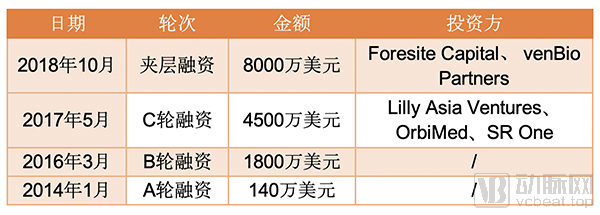
TP Therapeutics' Historical Financing Rounds
Meanwhile, according to the IPO prospectus of TP Therapeutics, approximately 50% of the funds raised will be used to advance loxpertinib into Phase II clinical trials. This phase will enroll cancer patients who have developed resistance or are refractory after prior treatment with tyrosine kinase inhibitors (TKIs), as well as patients who have not previously received TKI therapy.
Additionally, approximately 40% of the IPO proceeds will be used to advance two other drug candidates, TPX-0046 (a RET/SRC inhibitor) and TPX-0022 (a MET/CSF1R/SRC inhibitor), into early-stage clinical trials, and to submit an Investigational New Drug (IND) application for a novel ALK inhibitor.
Financial data indicate that TP Therapeutics is a typical development-stage biopharmaceutical company, with no revenue and lacking substantial R&D and G&A expenditures associated with advancing its pipeline through regulatory requirements. Third-quarter 2019 financial reports show that, as of September 30, 2019, the company held $172 million in cash, with total current liabilities amounting to $11.72 million.

Q3 2019 Financial Report
Following regulatory approval and market launch, commercial sales will become the company’s primary revenue source. According to its prospectus, the potential patient population for lopritinib in the United States is approximately 680,000, including around 160,000 patients with non-small cell lung cancer (NSCLC). In the five major European countries (the United Kingdom, France, Germany, Spain, and Italy), the potential patient population is approximately 670,000, including about 120,000 NSCLC patients. These figures illustrate the substantial market size.
Regarding future development, in addition to accelerating the research and development and commercialization of repotrectinib, TP Therapeutics stated that it will also explore pediatric indications to expand the drug’s market opportunities. Furthermore, the company will leverage its proprietary platform to develop and advance a pipeline of multi-target candidate drugs aimed at addressing areas of unmet medical need.
With the intensifying aging of China’s population, changes in residents’ living environments and lifestyles, increased survival pressures, and other economic and environmental factors, the number of cancer-related deaths in China has shown a significant upward trend since the 1970s.
By 2018, the annual number of new cancer cases in China had exceeded 4 million, creating substantial demand for anticancer drugs due to the large patient population. According to Zhiyan Consulting, the market size of anticancer drugs in China reached RMB 148 billion in 2018, representing a year-on-year growth of 16.72%.
Meanwhile, China has continuously encouraged the development of anticancer drugs through policy measures in recent years, such as implementing zero tariffs on 28 types of medicines, including anticancer agents, and promoting the inclusion of antineoplastic drugs in the national medical insurance catalog. Driven by substantial market demand and favorable policies, many companies have actively begun to build their oncology drug pipelines. Pharmaceutical firms such as Hengrui Medicine and Beta Pharma have already secured their initial profits by developing targeted anticancer therapies.
However, industry experts caution that while the anti-cancer drug market has been a hot sector in recent years, it requires substantial investment, involves long R&D cycles, and carries a high failure rate. Companies should exercise prudence when entering this field, avoid blindly chasing “hot trends,” and assess their own capabilities before committing resources. For pre-listed innovative pharmaceutical companies, ensuring the sustainability of high investments during the anti-tumor drug development phase is critical, making capital involvement even more essential.