

Miao Health Files for IPO After Four Consecutive Years on China's Future Healthcare 100 List
A vibrant healthcare industry celebration concluded at the end of 2019, coinciding with the grand release of the highly anticipated annual “Top 100 Future Healthcare Companies” list. Miao Health, a health technology company, was once again featured on the list and was also selected as one of the most promising enterprises in the health insurance niche, ranking among the Top 10 in the “Health Insurance TPA” sub-list.
2019 marked the fourth year since the launch of the Future Healthcare 100 list. Miao Health has ranked among the top 100 for four consecutive years, with its position on the list steadily climbing from the lower half (outside the top 50) to its current 15th place. The company’s valuation has grown from RMB 1 billion in 2016 to over RMB 5 billion.
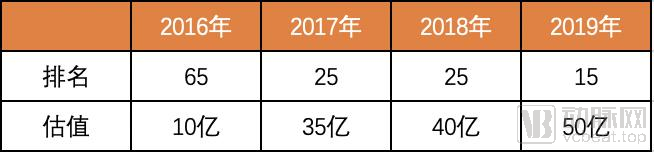
2016–2019 Changes in Miao Health’s Valuation Ranking
Since 2016, a wave of innovation and entrepreneurship has swept through the healthcare industry. The scarcity of medical resources, technological advancements, and the shift toward a patient-centric philosophy have collectively driven the development of innovative healthcare solutions. The healthcare sector has gradually begun to adapt to evolving public needs. Within the private economy, this transformation has directly led to continuous iteration and upgrading of business models, resulting in a more diversified and segmented market.
What remains unchanged is that over the four years from 2016 to 2019, the “Future Healthcare 100” list has stayed true to its original mission, continuously seeking out the core forces of China’s healthcare industry and looking forward to witnessing the great transformation of the medical sector.
According to the “2019 Future Healthcare Top 100 Companies Growth Report: Data-Driven Insights into Growth Trajectories” published by VBInsight, as macroeconomic growth began to slow in 2019, the healthcare industry was also affected by the broader economic environment. Capital markets became more cautious, imposing stricter criteria for company selection and limiting valuation upside, which led to a decline in the average valuation of companies listed on the 2019 Future Healthcare Top 100 ranking.
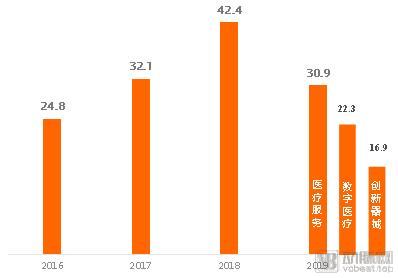
Average Valuation Change (in RMB 100 Million) of Companies Listed on the Future Healthcare Top 100 List, 2016–2019
In fact, since the second half of 2018, talk of a “capital winter” has been rampant. The chill has been even more pronounced in the health management sector where Miao Health operates. Often positioned at the front end of the medical care continuum, the sector has faced skepticism due to its ambiguous definition and non-standardized services, with questions such as “What exactly is health management?” and “Is health management truly an essential need?” This has led to a significant decline in fundraising performance for a large number of health management companies. Nevertheless, Miao Health not only secured nearly RMB 500 million in Series C financing in April 2019, but also achieved counter-trend growth in its valuation. How was this accomplished?
Since 2015, VCBeat has been documenting the development of Miao Health from an industry perspective. Judging by its fundraising history, the company has secured over RMB 100 million in each round of financing. Why has Miao Health been so favored by capital markets, enabling it to consistently rank among the “Top 100 Future Healthcare Companies” starting from its second year of operation? Perhaps by retracing its development path, we can gain some insights.
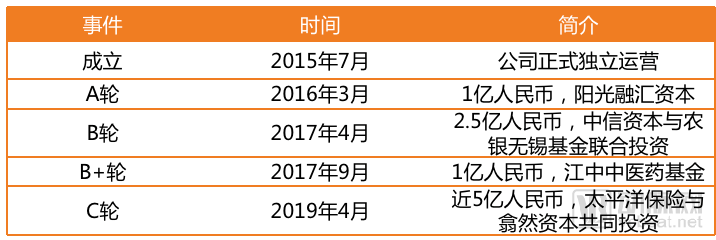
Miao Health's Financing History
For a long period, many companies in the health management sector have been navigating uncharted waters, continuously seeking business models that can adapt to market changes and meet public needs while identifying viable payers.
At the 2019 Future Healthcare Top 100 event, Kong Fei, CEO of Miao Health, shared the company’s explorations and practices in leveraging AI-driven interventions and technological tools to achieve health management. In summary, this strategy focuses on building two core capabilities, serving two key scenarios, and engaging two types of users.
According to Kong Fei, the development of two core capabilities has been a goal set for the team since the company’s inception. These two capabilities can also be understood as two platforms: the Health Risk Assessment Platform (H Platform) and the Intelligent Health Intervention Platform (M Platform). The H Platform calculates a user’s health risk index based on data from smart wearable devices, physical examination results, and self-reported assessments, providing a comprehensive evaluation and scoring of the user’s health across dimensions such as physical condition, lifestyle, and psychological well-being. The M Platform establishes a composite index, known as the “M Score,” to quantify personal health behaviors, thereby promoting improvements in users’ daily health practices across multiple dimensions, including exercise, nutrition, sleep, and mental health.
Behind Miaojiankang’s two core capabilities lies the support of technologies such as big data, artificial intelligence, and the Internet of Things (IoT). The M Platform targets the “information silo” problem in health big data by building a platform and establishing data interface standards to enable interoperability and connectivity. Currently, the M Platform has integrated data from over 90% of smart health devices on the market, including more than 300 monitoring devices such as smart bands, blood pressure monitors, glucometers, body fat scales, and thermometers.
Secondly, Miao Health has officially launched China’s first “AI Health Manager,” which has gained recognition from authoritative institutions. Built upon big data analytics in health and medical care, NLP-driven health knowledge graphs, clinical guidelines, expert consensus, and 23 years of clinical medical evidence from the Canadian Health Management Center, the AI Health Manager provides users with customized, scientifically proven, and effective health intervention plans. It is widely applied to empower various industries, ultimately enhancing the overall health literacy of residents.
Serving Two Major Scenarios: B2B and B2CMiao Health operates on a B2B2C model and has amassed a vast user base of over 80 million. As its B-side business continues to expand, employees and service customers from enterprises in sectors such as insurance, government, banking, real estate, telecommunications, and mobile device manufacturing are being continuously onboarded onto the platform.
Finally, the two types of users managed are distinguished by light online management and intensive offline management. The health management philosophy advocated by Miao Health aims to help users move beyond vague, generalized health interventions such as the simplistic advice from doctors to “watch your diet and exercise more.” By leveraging the synergy between its online app and offline health management centers, Miao Health enables scientific and effective interventions.
It is worth mentioning that on December 28, 2019, Miao Health and Tsinghua University officially launched the project “Research on Key Technologies for AI-Based Health Management,” further exploring technical means to achieve the goal of “maximizing health benefits with minimal investment” and actively promoting transformation in the medical and health industry.
Five Years of Unrelenting Effort: How Miao Health Has Gradually Become a Leader in the Health Management Sector. Regardless of how pessimistic the market sentiment has been toward the concepts of internet healthcare and health management, Miao Health has repeatedly responded to skepticism by demonstrating its technological prowess, strong fundraising performance, and continuous growth in both business volume and user base.
2019 was a year for Miao Health to expand its footprint, particularly through the integration of health management with insurance scenarios, which garnered increasing attention from the capital market. In August 2019, the “Miao Bao” technology-driven insurance platform was officially launched. Spearheaded by Shanghai Tongren Insurance Brokerage Co., Ltd., this one-stop service platform integrates product development, sales, and service capabilities to deliver chronic disease management, risk protection, and medical services, marking the beginning of a new chapter in the insurance landscape.
In fact, Miao Health entered the insurance sector at an early stage, initially establishing an Insurance Business Division within its organizational structure, which was later upgraded to an Insurance Business Center. Following its Series C financing round, Miao Health’s integration with the insurance industry became even closer, as this round was jointly invested by CPIC Pension Industry Investment, CPIC Medical Health, and Xiran Capital. Accordingly, the mobile health management service brand “CPIC Miao Health,” designed to facilitate business collaboration between the parties, was launched shortly thereafter.
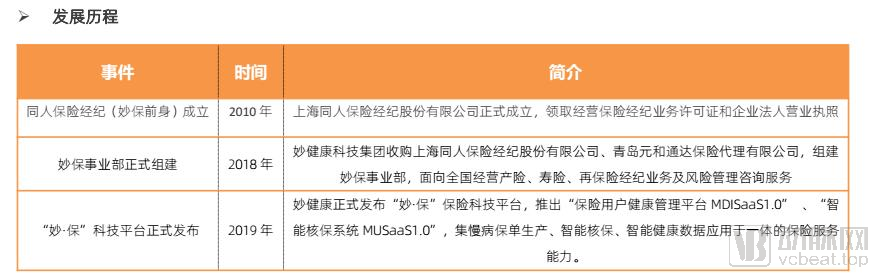
Miaobao’s Development History, Source: VCBeat “2019 Innovative Commercial Insurance Report”
The integration of insurance scenarios with health management has become an inevitable trend, a point affirmed by the CBIRC’s newly issued Administrative Measures for Health Insurance in November 2019. Interactive policy practices abroad have also demonstrated that health technology may be one of the key drivers transforming the health insurance industry, while this transformation is only just beginning in China.
According to the “2019 Innovative Commercial Insurance Report” published by VCBeat: The health insurance sector is experiencing rapid growth, and management service businesses such as Third-Party Administrators (TPAs) for health insurance—which assume responsibilities other than core risk-bearing obligations within health insurance plans—are also rising in prominence.
For insurance companies, health management serves as a tool for assessment and cost control. Adhering to the philosophy of “managing chronic diseases and mitigating risks,” Miao Health explores greater possibilities within the payment ecosystem. Through innovative models, it provides insurance consulting, risk assessment, health management, and claims services to both individual and corporate clients.
In addition, Miao Health provides insurers with a comprehensive digital and graphical visual management backend. Leveraging real-time visualization tools such as user tags and business tags on the platform, insurers can independently correlate and analyze data on users, profiles, and products to generate reports, thereby offering more precise decision-making support for product optimization and underwriting and claims management.
Leveraging its comprehensive health record management system and data, Miao Health employs AI-driven analytics to assess disease risk and evaluate insurance underwriting criteria, thereby generating underwriting decisions and future risk analysis reports. Building on this capability, Miao Health collaborates with insurance companies to develop a range of chronic disease management insurance products, enabling individuals with pre-existing conditions to access insurance services.
Today, Miao Health has mastered core capabilities including AI health coaches, interactive insurance policies, a health cloud SaaS platform, and lifestyle medicine, providing varying levels of health management services to both online and offline clients and helping users gradually develop healthy behavioral habits.