

Haodf Online: Building a Doctor-Centric Internet Healthcare Ecosystem Over 14 Years with 7 Years of Annual 'Top Doctors' Rankings
On January 4, 2020, the online healthcare platform Haodf.com held its annual China Haodf Summit and released the 2019 Haodf Rankings, with more than 400 physicians featured on the list. This marks the seventh consecutive year that Haodf has published its annual Haodf Rankings.
In addition to the annual rankings, Haodaifu also held an on-site award ceremony for physicians who have been listed consecutively multiple times. Director Zhou Fude of Peking University First Hospital, Director Yin Youkuan of Shanghai Huashan Hospital, Director Zheng Jiawei of Shanghai Ninth People’s Hospital affiliated to Shanghai Jiao Tong University School of Medicine, and Director Yang Xichuan of Chongqing Southwest Hospital have all received awards for six consecutive years. Director Fang Yousheng of Shanghai Huashan Hospital has received awards for seven consecutive years. In other words, these physicians have witnessed the inception and growth of the rankings.

Good Doctor Award Winner for 6 or 7 Consecutive Years
For two consecutive years, the China Good Doctor Summit has invited Jing Yidan to serve as the host. Zhang Quanling, a prominent figure who has crossed over from hosting to investing, has also delivered speeches at the event for two consecutive years. The China Good Doctor Summit has gradually become an annual anticipation for physicians.
Physicians are the core resource of internet healthcare. Over its 14 years since inception, Haodf has remained committed to consumer-facing services. Yet, as Wang Hang puts it, “In the healthcare industry, to truly achieve patient-centric care, we must adhere to the principle of ‘physicians as the foundation’ in order to build a robust platform and streamline all relationships.” Haodf Online has consistently emphasized building physicians’ professional brands and enhancing the quality of medical care. What underlying logic and trends does this approach reflect?
The annual Haodaifu ranking was developed and evaluated based on criteria established by the Health Industry Development Research Center of the Chinese Academy of Social Sciences. Leveraging authentic data from the Haodaifu platform, the ranking comprehensively assesses multiple dimensions, including patient post-consultation reputation ratings, the volume of consultations where patients independently selected physicians via the Haodaifu platform, and consultation satisfaction rates. The 2019 ranking comprises 411 Annual Haodaifu awardees, 30 Young Haodaifu awardees, and 3 County-Level Haodaifu awardees.
Among the doctors listed in 2019, those from Beijing and Shanghai continued to lead, accounting for 152 and 109 spots, respectively.
A total of seven hospitals had more than 10 doctors on the list, namely Peking Union Medical College Hospital (15 doctors), Huashan Hospital Affiliated to Fudan University (15 doctors), Chinese PLA General Hospital (15 doctors), Peking University Third Hospital (11 doctors), Shanghai Ninth People’s Hospital Affiliated to Shanghai Jiao Tong University School of Medicine (11 doctors), Peking University First Hospital (10 doctors), and Eye & ENT Hospital of Fudan University (10 doctors).
Chen Qiulin, Deputy Director of the Health Industry Development Research Center at the Chinese Academy of Social Sciences, stated that the center has been involved in designing the selection criteria since 2018. The original intention was to conduct ongoing research into the value created by the convergence of the internet and healthcare, the potential issues arising from this integration, and how to regulate it effectively.
At the summit, Qian Qingwen, a professor at the Institute of Hospital Management of Tsinghua University and an expert member of the Second State Council Leading Group on Healthcare Reform, delivered a speech on leveraging the Internet to create value for physicians. Ye Sheng, a physician at the Children’s Hospital of Zhejiang University School of Medicine; Zhang Xifeng, Chief Physician of Orthopedics at the Chinese PLA General Hospital; and Wu Long, an obstetrician-gynecologist at the West Campus of Beijing Chaoyang Hospital, each shared their perspectives on personal brand building. Their insights drew upon their respective experiences in emphasizing patient services and evidence-based practice, prioritizing patient satisfaction, and utilizing short videos for science popularization.
Building Brand-Name Doctors: A Recurring Theme at the Haodaifu Summit
A review of the Haodaifu rankings over the years shows that while no departmental distinctions were made in 2013 and 2014, department-specific evaluations have been conducted since 2015. The total number of award-winning physicians grew from 77 in 2013 to 444 in 2019. On one hand, this indicates that the internet is becoming increasingly attractive to physicians, with more doctors offering online consultation or diagnostic and treatment services, and recognizing the potential to enhance their professional and academic capabilities by accumulating patients and case data online. On the other hand, physicians are gradually realizing the importance of personal branding, improving patient satisfaction through medical science popularization and doctor-patient interactions.
Wang Hang, Founder and CEO of Haodf Online, stated at the summit: “Over the past two years, many people have asked us what Haodf has done right to attract such a large number of outstanding physicians. Our answer is that all our business operations have consistently remained physician-centric. How to serve physicians well, and how to enable them to work more effectively, derive greater value, and practice in a safer environment, has always been our unwavering starting point.”

Wang Hang, Founder and CEO of Haodf.com
There is a reason for this answer.
A review of the development of internet healthcare enterprises reveals that their business operations now comprehensively cover five key stakeholders: patients, physicians, enterprises, hospitals, and governments. Patient-facing services, such as online consultations, family doctor programs, chronic disease management, and health education, are offered by nearly all internet healthcare companies. In other business segments, many internet healthcare enterprises have also made significant inroads, albeit with varying degrees of involvement.
Over the 14 years since its establishment, Haodf Online’s secret to delivering excellent patient services has been to prioritize serving physicians. We have summarized the business models of internet healthcare and Haodf’s approximate boundaries within this landscape in the figure below:
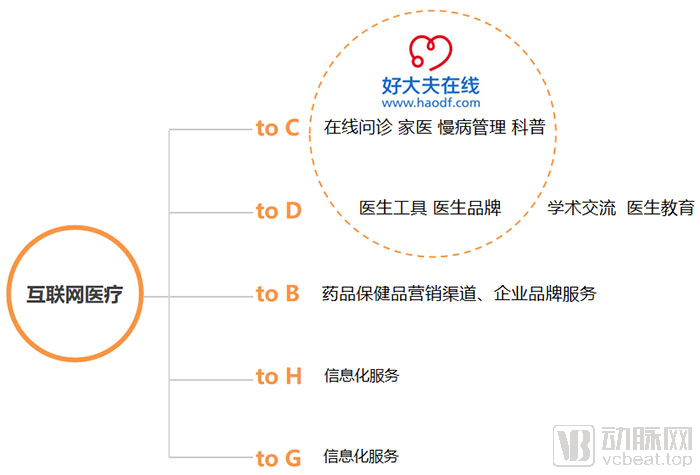
Core Business of Internet Healthcare vs. Haodf Online’s Service Scope | Chart by VCBeat
Under such a business model, physician resources—particularly those of high-caliber physicians—are especially critical.
In 2019, 210,000 doctors across China provided patients with 32 million text-and-image consultations, 950,000 telephone consultations, and 970,000 outpatient consultation services via the Haodf Online platform. After visiting hospitals, patients posted 630,000 medical service reviews on the Haodf Online platform, providing feedback on their satisfaction with treatment outcomes and physician attitude.
To date, Haodafu has provided assistance to a cumulative total of 59 million patients.
These patient services are premised on high-quality physician care and efficient operational management; in the logic of Haodf, this equates to building the brand of elite physicians.
How exactly does Haodf deliver physician services? Let’s first examine Haodf’s development stages and key milestones.
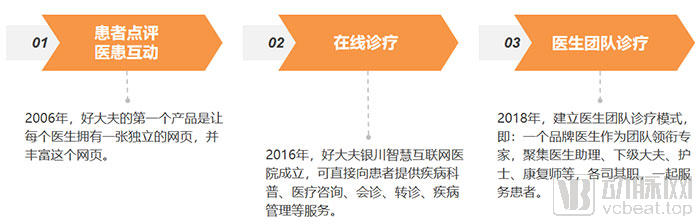
Key Milestones in the Development of Haodf Online, Chart by VCBeat
Different Products for Different Stages
In 2006, Haodafu created personal webpages for physicians and gradually enhanced online communication and interaction features. After thorough online consultations, patients could transition to offline visits; following their appointments, they could scan a QR code to return to the online platform, maintain communication with their physicians, and enable doctors to conduct follow-up management. Additionally, patients could post reviews of their doctors, which influenced the physicians’ online rankings.
In 2016, Haodaifu Yinchuan Smart Internet Hospital obtained its medical practice license. Registered physicians on the Haodaifu platform can provide online diagnosis and treatment services after completing the filing for multi-site practice, enabling patients to receive online management for minor illnesses and remote consultations for serious conditions.
In 2018, a physician team-based care model was established. To address the limitations of specialists’ available time and service capacity, a branded physician served as the lead expert, assembling a multidisciplinary team comprising physician assistants, junior physicians, nurses, and rehabilitation therapists.
In this process, Haodf leverages technological means to enhance efficiency and launch physician service products by drawing on the operational models already familiar to and routinely used by offline physicians.
For example, AI-powered intelligent triage systems not only interpret medical records but also understand physicians’ areas of expertise, thereby improving the matching between patients and doctors.
Medical record management provides physicians with two integrated systems. The first is a unified medical record center, where various patient-uploaded materials, images, and laboratory and diagnostic test reports are stored. All online clinical consultations and prescriptions issued by physicians are also archived, allowing for on-demand access at any time.
Second, the cloud-based note-taking system allows each physician to document their analyses, impressions, reflections, and even relevant materials pertaining to case studies from both online and offline clinical consultations. This cloud-based note-taking system serves as a private workspace accessible only by the physician themselves; however, they may grant access to physicians within their own team.
Furthermore, Haodifu’s physician team model also draws on the operational practices of offline hospitals. In traditional hospital settings, physicians focus solely on clinical duties, while supporting tasks are arranged by the institution. When transitioning to online platforms, physicians lack the bandwidth to handle non-core ancillary work, such as basic consultations beyond diagnostic care. Therefore, dedicated teams are established to manage these responsibilities. Under the physician team model, specialist resources are utilized more effectively, and other healthcare professionals participate more extensively in internet-based medical services, thereby enhancing their professional competencies.
Achievements and Issues of the Current Diagnosis and Treatment Model
At the Haodaifu Summit, Wang Hang introduced that 5,411 physician teams have joined the Haodaifu platform, among which 3,903 are qualified teams. “A qualified team refers to one in which all members, whether specialists or assistants, participate in online work.”
In 2019, the total number of patients seen by the physician teams reached 693,000, compared to only 88,000 in 2018, representing a year-on-year increase of 687%. The online consultation fees for the physician teams also rose from RMB 3.98 million in 2018 to RMB 25.23 million in 2019, a year-on-year increase of 534%.
“Judging from these figures, the direction of the team-based model is correct and warrants continued investment,” said Wang Hang.
From this perspective, Haodaifu’s services and operations for physicians will continue to revolve around the team-based care model for the foreseeable future.
However, Wang Hang also candidly acknowledged that the physician team model faces four challenges.
First, team formation is difficult, resulting in very slow growth in the number of teams.
Second, after the team is formed, there is an imbalance in member roles, with a disproportionately high ratio of junior physicians and an insufficient proportion of nurses. Nurses play a significant role in clinical support; their meticulous attention to pre-consultation preparation, pre-admission procedures, and post-discharge care can substantially enhance patient satisfaction.
Third, after the team members came online, the division of labor was unclear. Most clinicians are not adept at task allocation, resulting in ambiguous individual responsibilities and ultimately leading to a siloed approach where each member works independently.
Fourth, the allocation of consultation fees is unreasonable. In 2019, the total consultation fees for team-based care amounted to RMB 25.23 million, but the leading experts distributed only RMB 4.58 million to team members. “The distribution mechanism is a core factor affecting the long-term development of medical teams. Only by ensuring fair compensation can leaders effectively manage their teams; experts need to shift their mindset in this regard,” said Wang Hang.
In response to existing physician service pathways and current challenges, Haodafu has proposed six major business modules centered on branded physicians, collectively forming a new system, model, and ecosystem for internet healthcare.
The relationship among the six major modules is as follows:
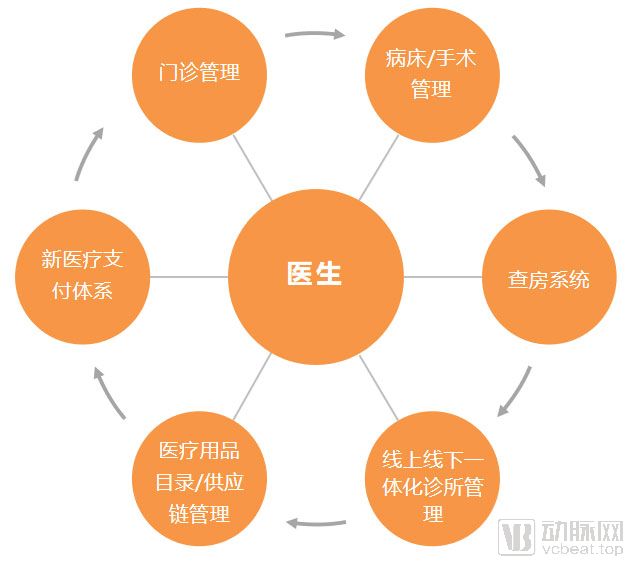
New Ecosystem Model of Haodf.com, Chart by VCBeat
Specifically, by using the cross-hospital outpatient management system, physicians can publish their outpatient practice locations online. Patients can then select their preferred healthcare facility based on factors such as their medical condition, geographical proximity, and health insurance coverage, thereby achieving automatic patient triage. Physicians are also able to conduct comprehensive management online. This system was previously launched.
To address the challenges physicians face in managing hospital beds and scheduling surgeries across multiple institutions, Haodafu is about to launch a cross-hospital bed and surgical management system. Physicians will be able to publish their patient admission information and available surgery dates at different hospitals online, allowing patients to choose their preferred surgery time and location based on their individual circumstances.
The ward round system is developed for the management of patients hospitalized in different locations. The medical team requires an online ward round system and a team collaboration system to implement unified medical standards for quality control and risk management. This system will be upgraded based on the aforementioned cloud-based physician note-taking system, with its functionalities gradually enhanced, and is scheduled to go live within this year.
Once physicians have accumulated a substantial patient base and established their personal brand on the Haodafu platform, how can they further bridge this presence to offline settings? Haodafu has launched integrated online-to-offline (O2O) clinics, providing a free clinic Hospital Information System (HIS) that seamlessly connects online and offline operations, thereby laying the foundation for physicians’ independent practice.
In fact, the new pilot regulations for clinics introduced in 2019 generally encourage physicians to establish their own practices. However, many doctors remain hesitant due to deficiencies in areas such as business management and patient services. Could Haodaifu facilitate this process by first helping physicians build their patient base and enhance their service orientation, and then providing integrated clinic management software? Only time will tell.
In the catalog of medical supplies and supply chain management, each doctor can add their own catalogs for medications, medical devices, consumables, rehabilitation products, and rehabilitation courses online, as well as health supplements, nutritional products, and skincare items. Behind these catalogs, Haodafu has established partnerships with over 10,000 merchants and 1,500 pharmacies, covering 5,400 types of products and services.
Regarding the new healthcare payment system, Haodf.com established a strategic partnership with Manulife-Sinochem Life Insurance in 2019 to provide patients with innovative commercial medical insurance. Moving forward, we will gradually explore this insurance model, wherein insurers centrally procure medical services and make bundled payments to physicians after patients purchase coverage, enabling doctors to deliver health-oriented services to patients.
This model can encourage doctors and their teams to provide patients with long-term medical services and health management. Addressing the pain point of patient payment effectively enhances patient adherence to internet-based healthcare, thereby increasing the volume of online services provided by physicians.
These six major modules are progressively layered to form a closed loop centered on physicians. Therefore, Haodaifu’s approach to building physician brands extends beyond mere promotion of individual reputation; it comprehensively addresses nearly all auxiliary needs of physicians throughout the diagnosis and treatment process.
Meanwhile, Wang Hang stated that as these systems are refined, the new ecosystem of internet-based healthcare—centered on patients and grounded in physicians—will become increasingly clear, potentially being realized within the next two to three years.
At the Future Healthcare Top 100 Conference hosted by VCBeat on December 20, Wang Hang drew on the development trajectory of e-commerce in his speech to examine the trends shaping internet healthcare.
Here, let us examine internet healthcare from another perspective by analyzing the evolution of mobile internet products. As is well known, mobile internet products have focused on user acquisition in recent years. However, given that the population size is finite and the time users spend on these platforms is limited, user growth has gradually hit a ceiling. Consequently, the industry has shifted its focus to lower-tier markets and vertical sectors, aiming to identify and meet the diverse needs of specific user groups through personalized, in-depth operations to enhance engagement, retention rates, and other key metrics.
By the same token, the total number of physicians is limited, with renowned specialists being even scarcer, and doctors’ time is likewise finite. In the first half of the internet healthcare era, regardless of when they entered the market, internet healthcare companies needed to aggregate a large pool of physicians; at that stage, competition was primarily among these internet healthcare enterprises themselves.
Following the advent of policy certainty in internet healthcare, the industry has entered its second half. The number of internet hospitals has surged, with enterprises across various healthcare subsectors joining the fray. Public hospitals have also been establishing their own internet hospitals, making high-quality physician resources even more scarce.
So, where would physicians with limited time choose to allocate their scarce resources? Beyond fulfilling scheduled duties at the internet hospitals affiliated with their primary practice sites, how do they select third-party platforms? The answer is naturally platforms that are user-friendly, practical, efficient, and productive—products that can even uncover latent needs physicians themselves may not have clearly recognized.
On the physician side, internet healthcare may shift from quantitative growth to in-depth operational management; only by prioritizing the fulfillment of the aforementioned needs can it effectively attract and retain physicians, particularly high-caliber ones.
Based on Haodaifu’s comprehensive strategy, it is premature to conclude that full implementation can be guaranteed; however, a clear roadmap has been established, with meticulous arrangements in place for every detail.
On a Friday afternoon in May 1998, Bill Gates and Warren Buffett engaged in a historic dialogue at the University of Washington. When asked about the secret to wealth, they both wrote down the same word on paper: Focus.
"Persist in doing one thing and strive for perfection, and the outcome will hardly be unsatisfactory."