

Guiding Principles for Real-World Evidence Supporting Drug Development and Review (Trial Implementation)
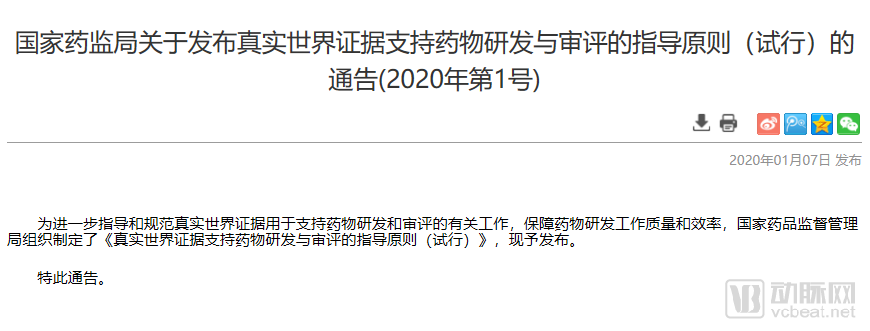
The State Council’s “Opinions on Reforming the Review and Approval System for Drugs and Medical Devices” (Guo Fa [2015] No. 44) and the “Opinions of the General Office of the CPC Central Committee and the General Office of the State Council on Deepening the Reform of the Review and Approval System to Encourage Innovation in Drugs and Medical Devices” both propose encouraging the research and development of new drugs. With the implementation of a series of reform measures, drug R&D has developed rapidly, accelerating the market launch of new drugs, while also imposing higher requirements on the quality and efficiency of drug R&D work. Randomized controlled trials (RCTs) are generally considered the gold standard for evaluating the safety and efficacy of drugs; however, challenges may arise when extrapolating their findings to real-world clinical practice, or traditional clinical trials may be difficult to conduct or entail prohibitive time costs. In recent years, how to leverage real-world evidence to evaluate the efficacy and safety of drugs has become an increasingly prominent issue in drug R&D and regulatory decision-making both domestically and internationally.
Several foreign drug regulatory authorities have conducted extensive discussions on how to leverage real-world evidence (RWE) to support regulatory decision-making, as reflected in their relevant guidelines or framework documents. In China, however, there are currently no specific guidelines on the use of RWE to support drug development and evaluation. To further standardize related practices and enhance the quality and efficiency of drug development, relevant departments of the National Medical Products Administration (NMPA) organized a task force comprising representatives from academia, the pharmaceutical industry, and other relevant institutions, and initiated the drafting of these guidelines in November 2018.
Based on the work frameworks and technical requirements of foreign drug regulatory agencies, and in light of domestic R&D practices, the research team reviewed, studied, and distilled the general principles and basic technical requirements for using real-world evidence (RWE) to support drug development and evaluation, thereby producing a preliminary draft of the guidance. After several rounds of discussion, the document “Basic Considerations for Using Real-World Evidence to Support Drug Development (Draft for Comment)” was formulated and opened for public comment from May to August 2019, during which more than 1,000 comments were received. The Center for Drug Evaluation (CDE) of the National Medical Products Administration (NMPA) organized a comprehensive analysis of these comments, further solicited input from industry stakeholders, clinical experts, and other relevant parties, and convened additional expert finalization meetings and internal discussions, ultimately finalizing the “Guiding Principles for Using Real-World Evidence to Support Drug Development and Review (Trial).”
“Guidelines for Supporting Drug Development and Review with Real-World Evidence (Trial)” mainly includes six parts, and is accompanied by four appendices: a glossary, examples, commonly used statistical analysis methods, and a Chinese-English terminology comparison. The main contents include:
(I) Definitions Related to Real-World Studies
To leverage real-world evidence (RWE) in supporting drug development and regulatory review, it is essential to first clarify the core concepts of real-world studies (RWS) and avoid common misconceptions. Key definitions include real-world studies, real-world data (RWD), and real-world evidence. It is crucial to correct erroneous beliefs such as equating observational studies with real-world studies, assuming that any analytical results derived from real-world data automatically constitute real-world evidence, and viewing real-world evidence as being inherently opposed to traditional randomized controlled trials (RCTs).
(II) Sources and Applicability of Real-World Data
The Guidelines outline the potential sources of real-world data (RWD) in China, including but not limited to health information systems, medical insurance systems, disease registries, and data proactively collected in prospective study designs that reflect patients’ health status, with the aim of broadening perspectives on the selection of applicable RWD for drug development. The applicability of RWD is primarily assessed through its relevance and reliability. Sponsors should conduct analyses based on applicable RWD to generate valid real-world evidence (RWE) that addresses specific clinical questions.
(3) Real-World Evidence to Support Drug Regulatory Decision-Making
Real-world evidence is used to support regulatory decision-making for drugs, including providing evidence of efficacy and safety for new drug registration and market approval, supporting changes to the labeling of marketed drugs, and fulfilling post-marketing requirements or re-evaluations. In light of China’s unique context—specifically, the accumulation of human use experience and clinical development of empirical formulas from renowned senior traditional Chinese medicine (TCM) practitioners and TCM hospital preparations—the guidelines propose a development strategy that combines real-world studies with randomized clinical trials, thereby providing a reference for the evaluation of such TCM products. Furthermore, real-world evidence can be used to guide the design of clinical studies and precisely define target populations.
(IV) Basic Design of Real-World Studies
The basic designs of real-world studies include pragmatic clinical trials, single-arm trials using real-world data as controls, and observational studies. It is important to clarify that real-world study designs are not mutually exclusive with quality control measures such as randomization; the choice of study design should be considered in conjunction with specific research and development objectives. Compared with randomized controlled trials (RCTs), causal inference in real-world studies requires particular attention to adjusting for confounding effects, necessitating the use of relatively complex statistical models and analytical methods. Appendix 3 provides some commonly used statistical analysis methods for real-world studies.
(V) Evaluation of Real-World Evidence
Two Key Principles for Evaluating Real-World Evidence: First, whether the real-world evidence can address the clinical question at hand; second, whether existing real-world data can be transformed into the required real-world evidence through rigorous study design, meticulous implementation, and appropriate statistical analysis.
(6) Communication with Review Agencies
Any use of real-world evidence (RWE) for the purpose of drug registration requires adequate communication with regulatory review agencies to ensure consensus on strategies for utilizing RWE and on the design of real-world studies, among other aspects. The guideline specifies the timing, channels, and content of such communications.
ClickLink, download the policy document.