

Visual Recovery Guards Files IPO Prospectus: Pioneering Vision Therapy for Adult Low Vision and Older Adolescents with Amblyopia
The eyes are a vital medium through which humans acquire information from the external world and communicate with it. So, what exactly is the process by which humans perceive the world through their eyes?
Objects perceived by the human eye reflect light, which passes through the cornea and lens before reaching the retina. The retina contains a vast number of photosensitive neural cells, namely rods and cones. Upon detecting light, these rods and cones convert it into chemical and electrical signals. The optic nerve transmits these signals to the brain, where they are processed and interpreted, enabling the perception of a colorful world.
So, how do photoreceptor cells generate electrical signals? In the 20th century, American scientist George Wald discovered that the binding of the protein rhodopsin to the small molecule retinal produces color. Upon light exposure, rhodopsin dissociates from retinal, causing the color to fade. The activated rhodopsin then initiates a cascade of chemical reactions, leading to the generation of electrical signals in the retina’s photoreceptor cells.
Low vision problems, such as myopia and amblyopia, are preventing some people from seeing the world clearly. For example, the prevalence of myopia in China has shown a significant upward trend in recent years, reaching approximately 33%, which is 1.5 times the global average. Myopia has become a major public health issue affecting the eye health of the Chinese population, particularly adolescents.
The exact causes of myopia remain unclear. Most scholars believe that myopia is associated with multiple factors, including genetics, environmental influences, and poor eye-use habits. As for amblyopia, it results from abnormal function of the visual cortex in the brain due to underdevelopment of the visual system. Causes of amblyopia include monocular strabismus, high refractive error, anisometropia, and form deprivation.
For the treatment of myopia, current mainstream approaches include wearing eyeglasses, pharmacological therapy, surgical intervention, and traditional Chinese medicine. However, all these methods aim to achieve clear retinal imaging by either using corrective lenses or altering the refractive power of the eye’s optical surfaces. Myopia is irreversible; existing treatments can only prevent its progression to more severe stages, and no available therapy can cure myopia.
Treatment modalities for amblyopia include addressing the underlying cause, optical correction, occlusion therapy, and pharmacological optical therapy. Generally, if children do not receive active treatment before the age of eight, visual deficits become difficult to correct due to the maturation of the visual system. Children who undergo continuous treatment before the age of five may experience varying degrees of improvement in visual acuity, with some even achieving normal vision. For children aged 3–5 years, earlier initiation of treatment is associated with higher cure rates.
Naked Vision Guardian is a company dedicated to the research and development of vision treatment devices. Shi Jun, founder of Naked Vision Guardian, stated: “The National Health Commission previously released data showing that in 2018, the overall myopia rate among children and adolescents in China was 53.6%, including 14.5% for six-year-olds, 36% for primary school students, 71.6% for junior high school students, and 81% for senior high school students. On the other hand, the widespread use of computers and smartphones, coupled with increasing academic and life pressures, has led to a year-on-year rise in the incidence of common eye conditions such as myopia.”
When humans receive various information from the external environment, more than 90% of it is input through the visual channel. Therefore, visual acuity has a significant impact on work, study, and daily life. Myopia has attracted increasing attention, and with the rise in domestic residents' income levels and health insurance coverage rates, the demand for ophthalmic medical services in China continues to expand.
According to the 2019 semi-annual report of a listed ophthalmology company: revenue from refractive surgery grew by 21.44% in the first half of the year, maintaining a rapid growth rate; revenue from optometry services increased by 30.98%, primarily driven by the national policy promotion of myopia prevention and control among adolescents during the period. A securities firm analyst noted that the optometry business has significantly benefited from the national implementation of policies for myopia prevention and control in children and adolescents, and is expected to become the largest growth highlight for ophthalmology enterprises over the next 3–5 years.
According to data from the China Commercial Industry Research Institute, the market size of China's ophthalmology sector grew from RMB 46.77 billion in 2013 to RMB 86.7 billion in 2017, representing a compound annual growth rate (CAGR) of 17%. Driven by the rising incidence of eye diseases, increased patient awareness of self-diagnosis and treatment, consumption upgrades, and the iteration of high-end technologies, the market size is projected to reach RMB 111.69 billion in 2019. Over the next five years, the ophthalmology market is expected to maintain a CAGR of approximately 13%–15%.
In response to the rising prevalence of amblyopia and myopia, Luoshi Weishi has developed a medium-frequency electrotherapy device for ocular electrical signals after ten years of research. This ocular medium-frequency therapy device was jointly developed by the R&D teams of Beijing Yanshiwei Company and Xinjiang Luoyan Weishi Company. The R&D team includes radio frequency engineers from the National Astronomical Observatories of the Chinese Academy of Sciences, professors from Nanjing University of Aeronautics and Astronautics, and professors from Xinjiang Normal University.
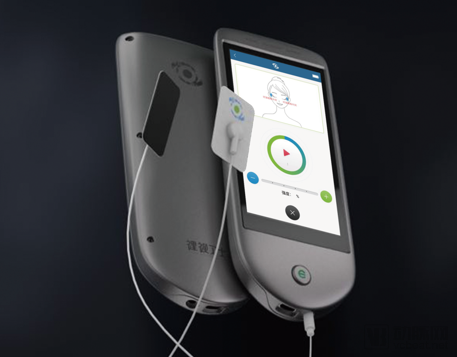
(Courtesy of the company)
Luoshi Weishi is based on bioelectric theory, collecting, decrypting, and encoding the bioelectrical signals of human vision to form the underlying algorithms and digital models for frequency signals.
“New sustained vibrations are generated and enhanced through the superposition of waves produced by an electrical signal generator. Human cells can transmit and receive vibrational information, and resonance can induce cellular activation,” explained Shi Jun. Visual information forms visual nerve impulses within the retina, which are transmitted by photoreceptor neurons, bipolar neurons, and ganglion cell neurons. The axons of ganglion cells, i.e., nerve fibers, convey visual information along the visual pathway to the visual center in the brain, ultimately resulting in vision.
The medium-frequency electrotherapy device for ocular electrical signals it developed acts on the retina, enhancing the photosensitive function of retinal photoreceptors and optic nerve cells in the fundus, thereby improving retinal visual function and vision.
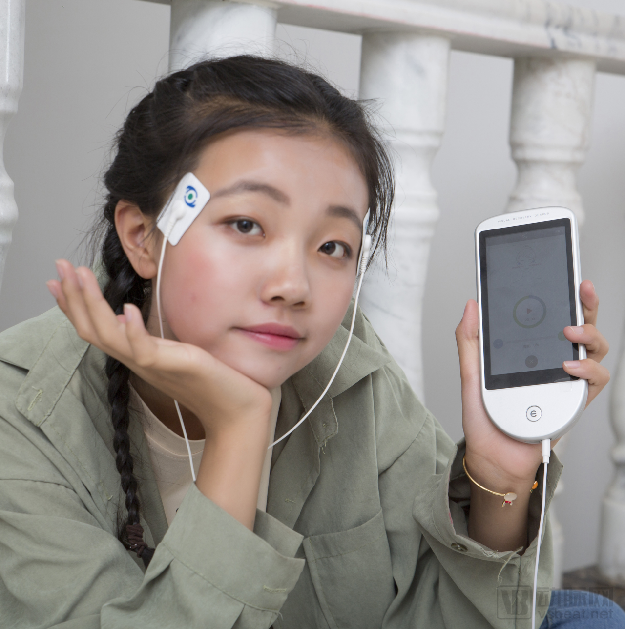
(Images provided by the company)
Shi Jun stated, “The product obtained its medical device registration certificate in May 2019 and its production license in July. Following small-batch trial production, it has met the requirements for mass production. In addition, the research and development as well as trial production of the next-generation intelligent product have been completed.”
According to the official website of the National Medical Products Administration (NMPA), the ocular intermediate-frequency therapeutic device delivers intermediate-frequency electrical signals to acupoints around the eyes and the posterior neck. This promotes ocular blood circulation, enhances metabolism, alleviates ciliary muscle fatigue, improves the photosensitive function of retinal ganglion cells, and thereby enhances uncorrected visual acuity and corrects refractive errors. It serves as an adjunctive therapy for myopia and amblyopia in children, adolescents, and adults.
Shi Jun told reporters, “Minors are still developing and are not candidates for surgical treatment. While orthokeratology (OK) lenses have high customization barriers, the therapeutic device developed by Luoshi Weishi focuses on enhancing retinal visual function as its core value. Adopting a model of primary therapy supplemented by corrective fitting, it is a low-risk, low-barrier, mass-market product in the category of ‘affordable premium eye care medical services.’”
Regarding product promotion, Luoshi Weishi plans to establish optometry clinics and build a standardized middle platform for optometric medical services, laying the groundwork for online optometric healthcare delivery. Meanwhile, Luoshi Weishi intends to collaborate with ophthalmic hospitals and optometry research institutes to support research projects and clinical observational evaluations. Finally, Luoshi Weishi plans to open up franchise and investment opportunities, partnering to develop optometry clinics and other related projects.
Shi Jun stated, “We are currently conducting fundraising, with a planned amount of RMB 8 million, to be used for clinical evaluation reports, academic research and observation projects, as well as the construction and basic operational expenses of optometry centers (clinics).”