

Jianke Proposes Hospital-to-Home (H2H) Healthcare Ecosystem in IPO Prospectus, Leveraging Technology to Redefine Medical Service Delivery
2019 is regarded as the year with the most intensive rollout of pharmaceutical-related policies in the past two decades. Behind a host of annual keywords—such as the new Drug Administration Law, the Measures for the Administration of Internet Pharmaceutical Services, tiered diagnosis and treatment, volume-based procurement, drug traceability, and medical insurance reform—the internet healthcare industry is undergoing profound and continuous transformation.
The debate over inheritance and innovation in internet healthcare has remained evergreen, serving as the backbone for the most intensely contested sub-forum during VCBeat’s Top 100 Future Healthcare Conference. Stakeholders continue to strive for a refined self-awareness of their demand for medical services, leveraging the internet to establish business models that foster broad-based win-win outcomes among all parties involved. Hao Jianyao, Vice President of Jianke, argues that internet healthcare must gain a profound understanding of the fundamental needs of different stakeholders. “Demand is fluid; only when tangible needs align with mutual benefits can lasting connections be forged.”
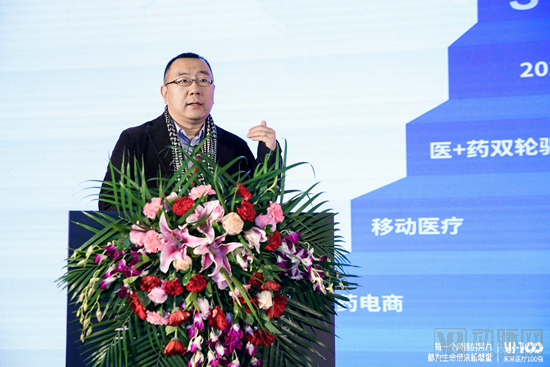
Hao Jianyao, Vice President of Jianke, Delivered a Speech at VB100 2019
Hao Jianyao pointed out that Jianke has always believed that technology is and will continue to drive a series of transformations in the healthcare sector. The company has been leveraging its unique advantages derived from technological investment and business accumulation to connect diverse healthcare elements in innovative ways. “We have built a service ecosystem centered on the relationships among patients, hospitals, and pharmaceutical companies. The value of this ecosystem lies in the fact that technology can deliver greater efficiency.”
In Jianke’s internet healthcare model, the pharmacist-patient relationship—centered on meeting patients’ basic health needs—is positioned as the foundational layer of medical interactions. “Virtually all diagnosis and treatment ultimately culminate in medication use.”
Therefore, Jianke’s first initiative in the healthcare industry was to leverage the internet to improve drug accessibility. In 2009, Jianke started as an online pharmacy, securing China’s first Internet Drug Transaction Service License C, and subsequently obtaining Licenses B and A. By 2011, it had evolved into a larger-scale pharmaceutical e-commerce platform.
Jianke has digitized the patient-pharmaceutical relationship, significantly enhancing patients’ access to medications while supporting medication needs in remote areas. As internet-based symmetry of pharmaceutical information continues to improve, the traditional, single-channel patient education and sales model for prescription drugs is gradually diversifying. Patients can now obtain information on globally available new drugs with strong clinical demand through more channels beyond physicians. The increased influence of highly educated individuals with superior health literacy in formulating treatment plans reflects a new transformation in both doctor-patient and patient-pharmaceutical relationships, prompting Jianke to prioritize the enhancement of its medical service capabilities.
In 2016, Jianke was among the early movers in China to strategically position itself in mobile healthcare. In 2017, it successively launched supporting products such as Jianke Hospital and Jianke Doctor. In 2018, Jianke announced a strategic shift toward a dual-engine “medical care + pharmaceuticals” model, formally allocating more than half of its corporate resources to the internet healthcare sector. Over the two years since the launch of its internet hospital services, Jianke has maintained a top-three industry ranking in both scale and growth rate, trailing only the internet healthcare divisions of traffic giants JD.com and Alibaba.
“For Jianke, the accumulation during the era of pharmaceutical e-commerce will largely serve as the infrastructure for subsequent provision of medical services.” In 2019, Jianke explored extending medical scenarios to more settings beyond hospitals, and at its year-end partner conference, officially announced Hospital-to-Home (H2H) as its new strategic focus for 2020. By leveraging four platforms—Jianke Doctors, Jianke Online Pharmacy, Jianke Chronic Disease Management Center, and Jianke New Media—the company integrated functions such as online follow-up consultations, electronic prescriptions, medication services, behavioral interventions, medication adherence support, and health education, thereby building a closed-loop business ecosystem spanning patients, hospitals, and pharmaceutical companies.
At the year-end gala, CEO Xie Fangmin enthusiastically stated that digital technologies are enabling the rapid and orderly implementation of traditional family doctor and tiered diagnosis and treatment models at low cost, unlocking immense potential. Jianke will help more doctors fully leverage their expertise in their respective fields to provide precise services to every family.
Hao Jianyao told VCBeat that the core of the H2H strategy is the Jianke Doctor Platform. Unlike the common prescription outflow model based on online consultations, Jianke has developed robust pharmaceutical service capabilities with a diverse product portfolio and a stable supply chain, leveraging its early business accumulation. This has attracted a large number of physicians to register as online doctors through multi-site practice, centered around follow-up visit prescriptions.
Under the Jianke Doctor model, patients complete their initial consultation at a physical hospital and establish an online relationship with their physician based on this offline interaction, with the physician proactively migrating the relationship to the internet hospital platform. Although the growth rate of follow-up prescription volumes under the Jianke Doctor model is slower compared to the prescription outflow model that directly taps into the outpatient traffic of large hospitals, Hao Jianyao believes that all Jianke Doctors are registered with regulatory authorities, and the electronic follow-up prescriptions they issue are backed by one-on-one offline doctor-patient relationships, making the internet hospital operations more compliant and effective.
“Currently, the regulatory details regarding the operations of internet hospitals remain unclear. From the outset, we have scaled our internet hospital business under the strictest standards to minimize policy risks,” pointed out Hao Jianyao. Over the past year, Jianke Doctors completed a cumulative total of 1.59 million electronic prescriptions for follow-up visits, averaging more than 5,000 per day. “This likely represents the industry ceiling for effective electronic prescriptions in follow-up care.”
The Jianke Doctor Platform has established stable, strong connections with its online physicians. All Jianke doctors are proprietary physicians practicing at multiple sites, duly filed and compliant with the National Health Commission’s regulations, rather than being sourced from a vast pool of physicians obtained through open registration. Since the platform’s launch two years ago, the number of online physicians has exceeded 100,000, representing a 25-fold increase. Currently, there are approximately 3 million licensed physicians in China, among whom nearly one million work on the front lines of hospitals rated at Grade II Class A or above. Nearly 10% of these physicians have registered as Jianke doctors. “Surpassing 100,000 online physicians is a milestone event for Jianke Internet Hospital. This means that, in terms of physician headcount, we have become the largest hospital in the world.”
Furthermore, Jianke Internet Hospital has established partnerships with 114 pharmaceutical companies, and its operating revenue increased from over RMB 400,000 in October 2018 to RMB 49 million in October 2019. These data are validating Jianke’s vision for optimizing the doctor-patient relationship.
"In China, the initial vision behind the advent of internet healthcare was to integrate and leverage physicians' idle time. 'However, a series of practical applications have falsified this premise,' said Hao Jianyao. 'In reality, it is unlikely that physicians have significant idle time; the true opportunity lies in the efficiency revolution driven by technology.'"
Taking chronic disease management as an example, medication adherence among patients in China is poor; they often discontinue medication without authorization upon perceived improvement in their physical condition, while physicians find it difficult to personally manage each patient’s medication regimen. Jianke was an early adopter of AI-assisted customer service representatives within the industry and has now achieved mature, large-scale deployment, with machines handling nearly 70% of patient inquiries. At the Jianke Chronic Disease Management Center, AI completes nearly 60% of standardized outbound calls for medication tracking and management, with human agents intervening only when more complex issues arise, thereby significantly improving efficiency.
“Although Jianke has been exploring model innovation in the medical services sector, the internet background of its founding team has led us to firmly believe in the transformative power of technology,” Hao Jianyao told VCBeat. He noted that the financial commitment required for building and maintaining R&D teams is substantial. For instance, Jianke leverages blockchain technology to enable drug traceability; merely establishing the technical team incurred labor costs potentially reaching tens of millions of yuan. “We consider blockchain technology a critical infrastructure, and our team quickly reached a consensus on this investment decision.”
Over the past year, Jianke has leveraged blockchain technology to achieve true “one code, one item” traceability for pharmaceuticals, with precision extending to every link in the entire supply chain. In the event of quality issues, this enables point-to-point product recalls and records detailed information at each stage, including wholesalers, distributors, retail outlets, sales timestamps, and even purchaser identities, marking significant progress in traceability application scenarios.
Currently, relevant regulations explicitly require pharmaceutical companies to assume primary responsibility for drug traceability, mandating that they establish traceability systems either through in-house development or via third-party partnerships. Over the past two years, many pharmaceutical companies have adopted Alibaba’s solutions for batch-level drug tracking; however, these applications exhibit a relatively low level of maturity. In Hao Jianyao’s view, the true value of traceability lies in identifying solutions when issues arise, and precise traceability provides exactly such potential solutions.
Jianke demonstrates strong resilience to the long cycles and large-scale investments required for technological R&D, even establishing a technical team of over 100 members directly in Beijing, a hub for specialized technical talent. In early January 2020, “Jianke Xiaobai” was selected as one of the “Top 10 AI Medical Innovation Projects of Healthy China (2019)” by the People’s Daily client app, reflecting growing external recognition of Jianke’s technological capabilities. Hao Jianyao stated that the potential for healthcare scenario transformation driven by technological innovation remains vast. Fields such as insurance, health check-ups, home-based elderly care, and medical finance—areas relatively unfamiliar to Jianke’s current operations—are likely to become key directions for its future integration efforts.