

West China Hospital Pioneers 5G-Enabled AI System for Abdominal CT Quality Control and Diagnostic Assistance
In recent years, research and development in the field of medical artificial intelligence in China has been flourishing. Some R&D achievements have already moved beyond the research phase and demonstrated preliminary clinical application value. As a research-oriented medical institution ranked second nationally in comprehensive strength and first in scientific research capability, West China Hospital of Sichuan University has long been acclaimed by the industry for its scientific and technological innovation capabilities. In the field of medical AI—a technology area with the greatest potential to significantly improve the current state of healthcare—West China Hospital has naturally achieved numerous accomplishments, continuing to lead industry development.
Recently, under the witness of Sichuan Provincial Department of Science and Technology, Sichuan Provincial Health Information Center, West China Hospital, Xici Yigou and other units, the application product based on artificial intelligence technology launched by West China Hospital of Sichuan University to empower abdominal CT quality control and assist in diagnosis has successfully completed clinical testing.
This field test leveraged 5G technology to remotely connect with the People’s Hospital of Aba Prefecture, the People’s Hospital of Ganzi Prefecture, and the People’s Hospital of Liangshan Prefecture. With the cooperation of these institutions, the objectives of quality control and assisted diagnosis for abdominal CT scans were accurately and efficiently achieved.
According to VCBeat, the actual testing officially commenced on the afternoon of January 8. Three hospitals located in Aba, Ganzi, and Liangshan transmitted multiple CT imaging cases to the testing site. The master control device completed the analysis tasks—including CT image quality control, organ segmentation, and computer-aided disease diagnosis—at a speed of less than one minute per scanning sequence, presenting the analytical results to the experts. The product accurately identified the boundaries of the scanned regions, clearly distinguished artifacts and other interfering factors, precisely segmented major organs, and accurately detected suspicious lesions while delineating the lesion areas.
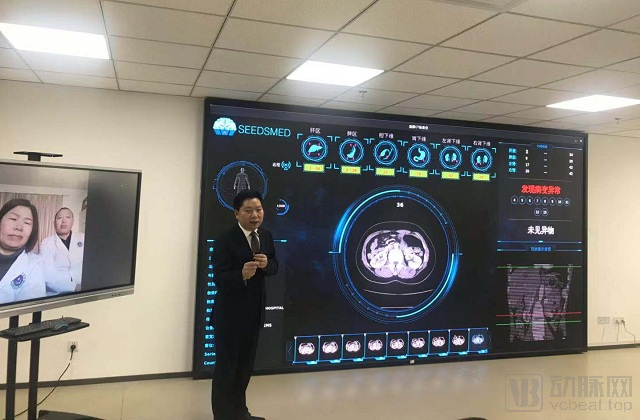
Professor Li Zhenlin, Deputy Director of the Department of Radiology at West China Hospital and President-Elect of the Chinese Society of Radiological Technology under the Chinese Medical Association
Professor Li Zhenlin, Deputy Director of the Department of Radiology at West China Hospital and President-Elect of the Chinese Society of Radiological Technology under the Chinese Medical Association, who serves as the project leader, introduced that CT is widely available in medical institutions across China and is currently one of the most routine clinical imaging modalities. However, there are two prominent issues in its clinical application: First, varying levels of expertise among CT technologists and radiologists across hospitals of different tiers lead to inconsistent image quality and diagnostic accuracy. Consequently, patients are often required to undergo repeat examinations when referred to higher-tier hospitals, resulting in significant waste of medical resources.
Second, although CT equipment can reconstruct more imaging data, the shortage of highly skilled medical professionals limits the number of images that can be reviewed and diagnosed, leading to systematic missed diagnoses. Therefore, leveraging AI products enables hospitals at all levels to perform high-quality CT scans, accurately segment organs in the scanned regions, and identify and process a greater volume of imaging information. This assists physicians in making diagnoses with high efficiency and minimal omissions, effectively facilitates quality control, improves diagnostic and treatment capabilities at primary care institutions, reduces waste of medical resources, and promotes the implementation of tiered diagnosis and treatment.
The product tested in this actual measurement represents a milestone achievement from the AI-enhanced CT imaging research directly conducted by the Big Data Center of West China Hospital and Professor Li Zhenlin’s team in the Department of Radiology. The technology was developed by the “West China–CisMed Medical Artificial Intelligence R&D Center,” which was jointly established by West China Hospital and Sichuan CisMed Heterogeneous Medical Technology Co., Ltd. in 2017. Since its inception, the center has introduced multiple technologies to the market.
It is reported that the R&D effort spanned two years and involved dozens of experts from West China Hospital and C-Data Intelligence. The phased achievements attained to date have demonstrated certain clinical value. Moving forward, the project team will build on these existing results to sequentially launch CT artificial intelligence products targeting other anatomical regions.
Song Jie, head of Xishi Yigou Company, a joint R&D partner, stated that the impressive results are primarily attributed to two key features of the product: CT scan quality control and assisted diagnosis. The CT scan quality control function can accurately identify the scanned anatomical region and assess its appropriateness, thereby preventing missed detection of localized organs. Additionally, it evaluates CT image quality across multiple dimensions, indicating whether the scan results meet diagnostic requirements.
Its auxiliary diagnostic capabilities enable precise segmentation of major organs within the scanned region, as well as analysis of CT images to identify suspected lesions and structural abnormalities, thereby providing diagnostic guidance.
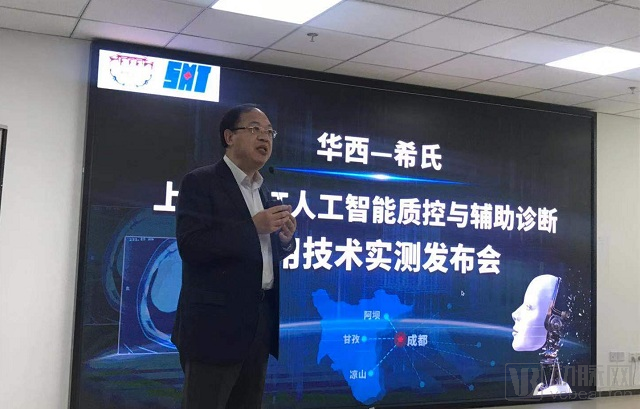
Song Jie, Head of Xishi Yigou Company
Song Jie also told reporters that this product has two application directions: one is localized application in conjunction with CT equipment, and the other is to provide remote services by integrating with a 5G technology platform. Compared with previous medical artificial intelligence research achievements, this product has a broader scope of application in quality control and lesion recognition. Moreover, it is no longer merely a laboratory study but a product with tangible clinical value.
China Mobile (Chengdu) Research Institute, the strategic partner of the project, provided the 5G platform for this test. Dr. Zhou Bingbin, head of the medical projects at China Mobile Research Institute, stated that 5G features low latency and high bandwidth. The mobile 5G platform can deliver telemedicine services with enhanced real-time performance. China Mobile (Chengdu) Research Institute has entered into a strategic partnership with C-Shape Heterogeneous Computing, and the two parties will jointly explore the applications of mobile 5G and edge cloud computing in healthcare with West China Hospital in the future.
It is reported that West China Hospital of Sichuan University is one of the earliest medical institutions in China to conduct research and development on the application of artificial intelligence (AI) in medicine. In 2017, it jointly launched the world’s first AI-powered digestive endoscope with Xishi Yigou. Currently, the relevant technologies and equipment have entered the regulatory approval stage, with market launch expected within the year. The hospital will also fully advance the application of CT technology, rapidly deploying 5G-based AI CT services and integrating them into localized medical devices.
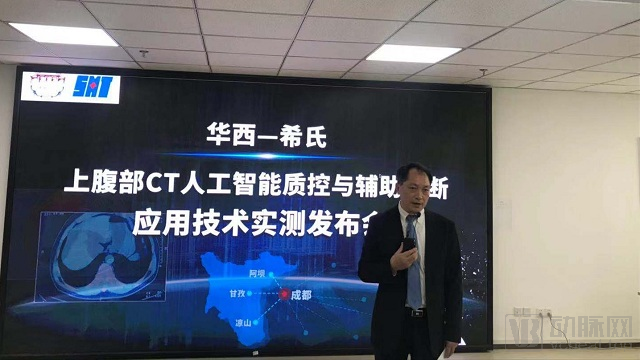
Professor Zhang Wei, Party Secretary of West China Hospital
Professor Zhang Wei, Party Secretary of West China Hospital, stated that as a large research-oriented medical institution, West China Hospital will not only continue to deepen its research in traditional medical technologies but also intensify its R&D efforts in emerging technological fields such as medical big data, artificial intelligence, and 5G, making these areas significant breakthroughs for the hospital’s future scientific research development.