

Yuanjing Capital Highlights Three Key Opportunities in AI-Driven Healthcare Innovation: Drug Discovery, Disease Treatment, and Chronic Disease Management

Vision Capital
Technology Sector Investment Firm
“Since 2017, our team has evaluated nearly all medical AI projects on the market. From a technical perspective, AI can indeed empower physicians to a certain extent; however, within the healthcare industry itself, technology is not the primary barrier to entry. We focus most on enterprises that leverage innovative technologies and products—such as the internet, AI, and big data—to optimize existing diagnostic and treatment workflows and enhance current medical efficiency.” This is how Tian Min, Partner at Vision Capital, describes their investment philosophy in health tech.
As the head of the healthcare sector at Vision Capital, Tian Min stated that, andThis does not mean they are bearish on medical AI; rather, it reflects a rational assessment made at a time when medical AI companies were heavily concentrated in the medical imaging sector, leading to severe product homogenization. Faced with numerous medical AI business models, Vision Capital holds its own distinct perspective, with drug discovery, disease treatment, and chronic disease management being the areas it has consistently prioritized.。
Guided by this rationale, Vision Capital announced in January 2018 its investment in Lida Rongyi, a smart healthcare data services company. Founded in July 2015, Lida Rongyi is China’s first medical technology service provider specializing in the integration of clinical pathway data and data services for cardiology and obstetrics/gynecology. Its business spans multiple segments, including intelligent systems, data services, supply chain transactions, and postoperative patient management.
Vision Capital, an investment firm with strong internet DNA, has backed high-quality ventures such as Tantan, Missfresh, and Xinchao Media. Leveraging this heritage, Vision Capital differs from other healthcare-focused funds by prioritizing technology-driven healthcare projects—particularly those that leverage innovative technologies like AI, the internet, and big data to empower the healthcare sector, thereby reducing costs and improving efficiency.
 Tian Min, Partner at Vision Capital
Recently, VCBeat conducted an exclusive interview with Tian Min, Partner at Vision Capital, to discuss the investment logic of Vision Capital in light of the topic “Innovation Opportunities in AI + Healthcare.”
Healthcare is a heavily regulated sector, where policy shifts can often determine the survival or demise of an industry. For instance, the trajectory of internet hospitals has experienced dramatic fluctuations, akin to a roller coaster, driven by regulatory changes. Today, the pharmaceuticals and medical consumables sectors are undergoing profound transformations under the impact of the “4+7” volume-based procurement pilot and the “zero markup” policy.
Encouragingly, the Chinese government has continuously introduced policies to support the development of medical artificial intelligence, and many hospital administrators are actively working to facilitate the implementation of medical AI products, thereby laying a solid foundation for the advancement of medical AI.
This year, the development of artificial intelligence has entered a critical phase, with medical AI facing the test of commercial implementation. Major products are increasingly being integrated into commercial applications and clinicians’ workflows, marking the transition of medical AI products from a year of product validation to a year of market validation.
Given the current state of the medical AI market, China’s “AI + Healthcare” sector remains in a relatively early stage. However, with continued favorable policies and in-depth technological exploration, Vision Capital is optimistic about various fields that integrate AI data with medical technologies.
Tian Min believes that AI technology can play a significant role in both the pharmaceutical and healthcare sectors. This encompasses drug discovery, drug synthesis, preclinical CRO, and clinical CRO within the pharmaceutical domain, as well as early diagnosis and screening, pathological diagnosis, disease diagnosis, and post-treatment rehabilitation along the healthcare industry chain closely related to patients.
Faster and more precise development of therapies and drugs for various diseases is a core objective for major pharmaceutical companies. It is well known that new drug development is costly and time-consuming; improving efficiency can effectively reduce R&D costs. In particular, traditional drug discovery and synthesis can achieve significant efficiency gains with the assistance of AI.
Preclinical and clinical CROs possess extensive data applicable across the entire pharmaceutical value chain. During the early stages of drug development, leveraging AI-driven collaborations to collect sample data and engage in joint development with pharmaceutical companies is a proven strategy to accelerate new drug R&D cycles and reduce costs.
In the healthcare sector, AI can empower the entire diagnosis and treatment process, including early detection and screening, pathological diagnosis, disease diagnosis, and chronic disease management. Notably, Tian Min believes that AI-enabled early detection and screening do not rely on imaging for auxiliary screening. Instead, innovative technologies in this field, such as liquid biopsy, ctDNA, CTCs, and mRNA, combine big data with medical technologies to achieve more precise and effective early disease screening.
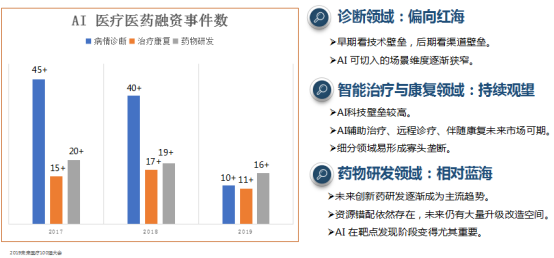
A comparison of financing events in the AI healthcare and pharmaceutical sector in 2017, 2018, and 2019 reveals that disease diagnosis attracted the highest number of deals among the three key areas—disease diagnosis, treatment and rehabilitation, and drug R&D. Within this segment, medical imaging-assisted diagnosis accounted for as much as 80%, making it a veritable red ocean market.
Tian Min stated that in the diagnostic field, particularly in imaging diagnostics, countless companies have flocked to launch startups across various imaging segments since 2016. However, the early technological barriers in this sector were not as high as anticipated, whereas the exploration of business models and the development pathway in the later stages have proven to be lengthy. Nevertheless, AI has played a significant role in early screening and diagnosis of diseases, especially in primary care settings where high-quality medical resources are scarce.
In the field of drug development, significant differences still exist between China and the United States. A large number of U.S. medical AI companies are concentrated in drug R&D, while in China, returnee teams and local teams have begun making various attempts in this area over the past two years. Relatively speaking, China is still in the early stages of development in this field, but it holds immense market potential. As AI-enabled drug research involves high technical barriers, companies need to establish technological collaborations with major pharmaceutical firms in the early stage. In the later stage, they must rely on continuous data accumulation and the construction of robust business models to build their own industry moats.
The empowering effect of AI on the healthcare industry is self-evident; however, in the medical field, clinical value is not entirely equivalent to commercial value. As a partner at Vision Capital, which leads investments in the healthcare sector, Tian Min has developed her own approach to selecting high-quality medical AI projects.
First,The Scarcity of TechnologyAI-assisted drug discovery is an industry with high technical barriers. It requires founding teams to possess expertise in medicine, chemistry, and algorithms, and to integrate these domains organically in order to develop high-quality products. For investors without a technical background, it is difficult to assess the scarcity of a project from a purely technological perspective. Tian Min has therefore chosen to evaluate such projects from alternative angles.
“Relatively speaking, the application of AI technology in drug discovery presents high technical barriers. Companies need to establish technical collaboration capabilities with large pharmaceutical firms in the early stages, while relying on continuous data accumulation and business model development in later stages.”
In short, while investors may not fully grasp the technology, a project’s partners, upstream and downstream service providers, and customers do; their willingness to pay serves as proof of its value.
Second,Verified asset valueUnder the “time machine” theory, many domestic investors follow an investment logic of backing Chinese “replicas” of projects or business models that have already been validated as successful in Europe and the United States; this holds true in the healthcare sector as well. One key reason why AI-assisted drug discovery has garnered strong market enthusiasm is the existence of successful overseas case studies.
In June 2014, BenevolentAI announced a collaboration with a U.S. pharmaceutical company, selling two novel Alzheimer’s disease drug candidates currently in the lead compound evaluation stage to this American firm. The deal was valued at up to $800 million, with BenevolentAI receiving a $400 million upfront payment and an additional $400 million contingent upon successful later-stage development of the new drugs.
Although China’s AI-driven drug discovery sector is still in its early stages, it holds immense market potential. In China, we have already observed business collaborations between AI drug discovery companies and pharmaceutical enterprises. These developments demonstrate that the business model of AI-assisted drug discovery has been successfully validated.
Tian Min stated that specific AI-assisted drug development projects fall under distinct R&D pipelines. When these pipelines align with those currently being developed by large pharmaceutical companies, the project possesses potential market value. Startups can collaborate with major pharmaceutical firms on multi-pipeline development, taking responsibility for specific stages within the R&D pipeline; in such cases, big pharma companies are willing to pay for these services.
Third,The Ceiling for Disease CategoriesStartups typically possess distinct technological strengths, which often correspond to specific diseases. The market size for these corresponding diseases will determine the startup’s market value and future growth potential.
In the therapeutic landscape, surgical intervention remains a critical modality alongside pharmacological treatment. Vision Capital’s investment focus extends beyond pure hardware products such as surgical robots and minimally invasive devices; it also favors software-driven systems developed using AI, imaging technologies, and software engineering, including surgical planning platforms, big data analytics for case studies, intelligent risk monitoring and control, and AR-based simulated fluoroscopy.
Tian Min told VCBeat that minimally invasive surgery has become the mainstream in the healthcare industry. However, minimally invasive techniques demand greater precision, stability, and speed to reduce trauma, control infection risks, facilitate rapid patient recovery, and lower costs. This requires pairing existing and innovative hardware with more precise software systems to achieve integrated hardware-software solutions. Such integration enables comprehensive preoperative planning, as well as intraoperative monitoring, assessment, and guidance, thereby reducing surgical risks and complexity. In this direction, AI software technologies can be better integrated with hardware systems, achieving higher efficiency and precision than manual surgeries.
In this sector, Chinese startups still lag behind their international counterparts, with the market dominated by foreign products. Against the backdrop of import substitution, this presents a significant opportunity for domestically produced products to capture greater market share in the future.
Vision Capital’s focus in the rehabilitation sector is primarily on chronic disease management. As population aging intensifies, chronic diseases have become a significant burden on China’s healthcare expenditure. There is substantial demand for rehabilitation services, whether for common chronic conditions such as diabetes and hypertension, or for the growing trend of managing cancer and cardiovascular diseases as chronic conditions. However, medical resources in China are scarce, and there are insufficient healthcare resources to meet the rising demand for chronic disease management.
With the rise and gradual proliferation of wearable medical devices, an increasing amount of data will be accumulated. By leveraging AI to integrate and analyze this big data, targeted guidance and recommendations can be provided for chronic disease management and rehabilitation therapy. This empowers family physicians and primary care providers to effectively prevent and control chronic diseases, helping patients avert acute episodes and disease progression—a sector poised to become a substantial market in the future.