

Investor Brief: 2020 J.P. Morgan Healthcare Conference Highlights Drug Pricing and Telemedicine, with 15 Chinese Companies Featured in Emerging Markets Forum
From January 13 to January 16, 2020, the annual J.P. Morgan Healthcare Conference will be held as scheduled. This year marks the 38th edition of the conference, which continues to take place at the Westin St. Francis in San Francisco. It attracts thousands of investors from around the world and hundreds of companies ranging from startups to those with market capitalizations exceeding $300 billion, covering the entire global healthcare sector.
As the first international forum in the healthcare sector each year, the J.P. Morgan Healthcare Conference serves not only as a review of the previous year but also as a forecast of trends for the current year. Companies and institutions also use the conference to seek investment and collaboration opportunities, with countless investments and mergers and acquisitions finalized amidst the networking and social engagements.
VCBeat will provide continuous coverage of the conference. Please visit the VCBeat website for the latest news and updates.
This year is a U.S. presidential election year, and healthcare development is invariably one of the unavoidable topics during election cycles. As the first major forum in the healthcare sector each year, the J.P. Morgan Healthcare Conference will also signal the development trends for the entire year in the healthcare industry.
In the United States, drug pricing has long been a contentious issue. In recent years, in particular, patients’ out-of-pocket costs for medications have risen sharply. A recent poll conducted by the Kaiser Family Foundation found that 80% of Americans consider prescription drug prices to be unreasonable. Therefore, reducing the cost of prescription drugs should be one of the top priorities for the U.S. Congress.
Not only in the United States, but China’s pharmaceutical industry is also grappling with these challenges. As domestic approval processes accelerate, an increasing number of new drugs from both home and abroad are entering the Chinese market. Even though these medications have been launched in China at the lowest prices globally, they remain unaffordable for the majority of Chinese patients. Meanwhile, as the financial pressure on medical insurance payments intensifies, how innovative drugs will be priced domestically in the future is a topic worthy of significant discussion.
Therefore, for pharmaceutical companies worldwide, focusing solely on drug development is no longer sufficient; they must take into account a broader range of factors. “For both pharmaceutical and biotechnology companies, patients’ ability to pay will remain one of the core challenges they face. Companies can no longer focus exclusively on drug R&D; they must also ensure that drug prices remain within patients’ financial reach, thereby enabling patients to ultimately access these medications,” said Chris Schott, Senior Analyst for U.S. Specialty and Advanced Pharmaceuticals at JPMorgan Chase.
In the pharmaceutical sector, we are also witnessing that innovative biotechnologies are driving the rapid development of novel drugs. In 2019, the U.S. FDA approved 58 new drugs, which, although lower than the 71 approved in 2018, remains a remarkably high figure. A similar trend has been observed in China: following the approval of nine domestically produced Class 1.1 new drugs in 2018, six more were approved in 2019. Additionally, one domestically developed innovative drug received approval from the U.S. FDA. Looking ahead to 2020, it is evident that the surge in new drug approvals will continue.
“We have always believed that consumers will be at the forefront of healthcare transformation. In 2019, we viewed new care models such as telemedicine as an emerging trend, and we continue to hold this view in 2020,” said Lisa Gill, Senior Analyst for Healthcare Technology and Distribution Research at J.P. Morgan.
Consumers want to access healthcare services at their desired time, location, and lowest price. In the United States, a growing number of young people are forgoing contracts with private physicians and turning to mobile health solutions for more convenient care. Telemedicine enables the efficient collection of patients’ long-term medical records, allowing them to receive high-quality healthcare services anytime, anywhere.
In the realm of telemedicine, China has clearly taken a global lead. Internet-based healthcare has moved beyond its exploratory phase and entered a critical stage of practical implementation.
The integration of new technologies is also shaping the development of telemedicine. For instance, AI technology can help patients identify the most appropriate treatment plans through the analysis of patient data, while blockchain will address the storage issues of patients’ medical records. In the coming years, telemedicine will continue to advance, driven by emerging technologies and innovative models.
The main forum area of the J.P. Morgan Conference resembles a corporate roadshow hall. The world’s leading healthcare companies will unveil their core strategies for the year, discuss industry developments, and seek new collaboration opportunities here.
This year’s J.P. Morgan Healthcare Conference will feature the participation of numerous Chinese healthcare companies. The Emerging Markets Forum, held on January 15, brought together enterprises from multiple countries, including China and South Korea. Chinese companies delivering presentations at the forum included Ocumension Therapeutics, AiKe BaiFa, LinkDoc Technology, WuXi AppTec, Sino Biopharmaceutical, BeiGene, Mindray Medical, Adagene, WeDoctor, Ping An Good Doctor, Viva Biotech, Dizal Pharmaceutical, Transcenta Holding, Akeso, and Tigermed.
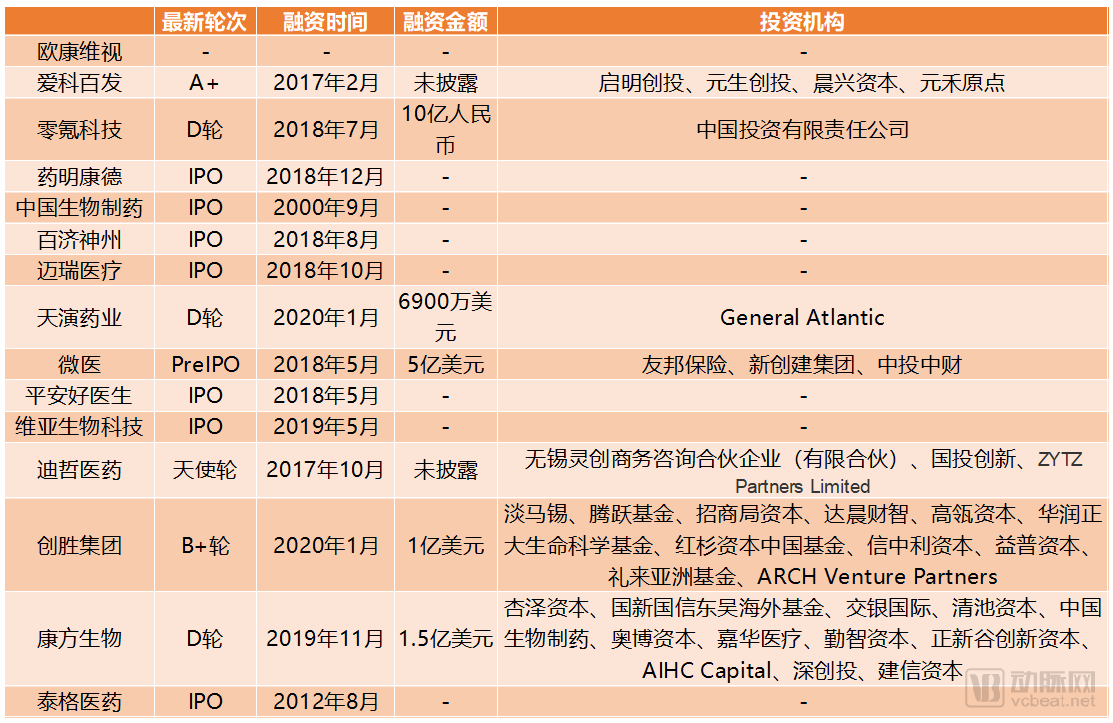
Chinese Companies Presenting at the J.P. Morgan Conference (Listed in Order of Presentation)
Among the 15 presenting companies, seven are already listed on domestic exchanges, the Hong Kong Stock Exchange, or NASDAQ. Of the remaining eight, LinkDoc Technology and WeDoctor, as unicorns in China’s digital healthcare sector, have long approached the threshold for an initial public offering. Adagene, Transcenta Holding, and Akeso have all recently disclosed substantial latest rounds of financing. The strategic plans these five companies will present at the J.P. Morgan Healthcare Conference, and whether they are pursuing overseas listings, will be a key highlight of the event.
The other three companies each have notable backgrounds. Dizal Pharma originated from AstraZeneca’s China Innovation Centre. In October 2017, Dizal Pharma was established as a joint venture between AstraZeneca and the Advanced Manufacturing Industry Investment Fund, which is under SDIC Innovation. Zhang Xiaolin, the former head of AstraZeneca’s China Innovation Centre, was appointed CEO of Dizal Pharma, and all employees of the Innovation Centre were invited to join the new company. Since its spin-off, Dizal Pharma’s product pipeline has expanded from three to seven candidates, with two drugs already in clinical trials.
Aikobio is a biopharmaceutical technology company focused on developing novel therapeutics for respiratory viral infections and viral hepatitis. Its lead candidate, Ziresovir, a new drug targeting respiratory syncytial virus (RSV), represents its core pipeline. The pediatric formulation has entered Phase III clinical trials, while the adult formulation is currently undergoing Phase II clinical studies.
Ocumension Therapeutics is perhaps the most enigmatic of the three companies, appearing primarily under its English name in most press releases. There is very little media coverage about this company; only a news item from November 2018 revealed that Ocumension Therapeutics had obtained exclusive rights to develop and commercialize EyePoint Pharmaceuticals’ innovative ophthalmic therapies in China. Related reports also indicate that Ocumension Therapeutics is wholly owned by Allier Capital.
This year’s J.P. Morgan Conference featured a total of 33 satellite meetings, seven of which were directly related to China. These included two satellite meetings independently hosted by WuXi AppTec and GenScript, as well as five other satellite sessions focusing on China-related topics.
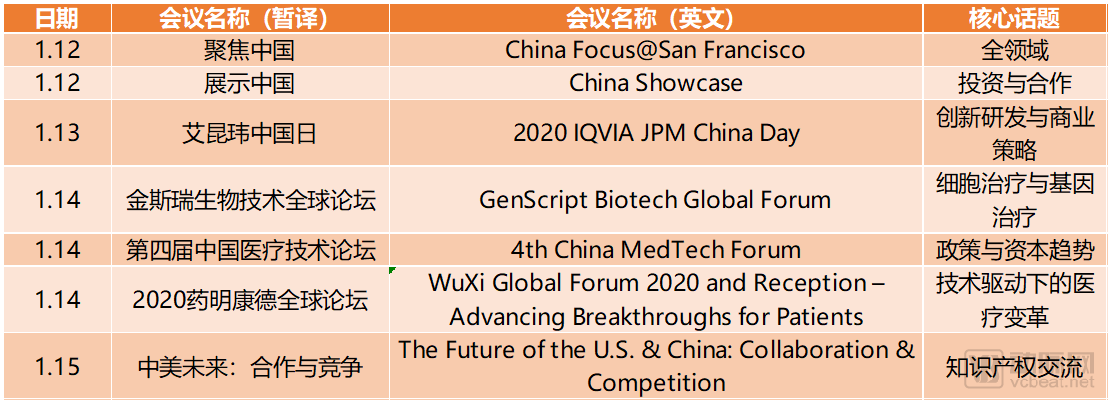
Satellite Meetings Directly Related to China at the J.P. Morgan Conference
Each of the seven satellite symposia had its own distinct focus, addressing developments and trends in different fields. However, a review of the relevant content revealed that three major topics recurred across various meeting agendas, signaling the development trends of China’s healthcare industry in 2020.
The Globalization of the Chinese Market
The Chinese market is engaging with the global marketplace with increasing openness. This exchange extends beyond the import and export of medical products to encompass the integration of capital, technology, and services.
“Showcase China” provides companies with an opportunity to present their businesses to Chinese investors, enhance brand visibility, and identify potential investment and partnership opportunities. Prominent institutional investors, including China Renaissance, OrbiMed, Decheng Capital, and Haitong Securities USA, will participate in this sub-forum to explore expanded overseas investment opportunities.
“IQVIA China Day” will center on the theme of integration, exploring business strategies, tactics, and best practices that bridge Eastern and Western markets to drive business growth and success within the current global pharmaceutical landscape. Attendees will examine Chinese innovation from multiple perspectives, including technological innovation, product development, regulatory approval processes, and cross-border mergers and acquisitions.
At the “Focus on China” forum, several keynote speeches will also explore opportunities for China in international exchanges. Particularly during the afternoon session, pharmaceutical companies from both home and abroad—including Medtronic, Johnson & Johnson, Bayer, Fosun Pharma, and Harbin Pharmaceutical Group—will engage in a roundtable discussion centered on strategies for multinational corporations entering the Chinese market, as well as the overseas expansion and collaboration of Chinese pharmaceutical firms.
Cell Therapy and Gene Therapy
Not only in China, but innovative biological therapies are also one of the most closely watched segments of the healthcare industry by enterprises and capital worldwide. Cell therapy technologies, represented by CAR-T therapy, have conquered the field of hematologic malignancies, which had long lacked breakthroughs, through a novel therapeutic approach. Meanwhile, the emergence of gene therapy has made it possible to cure severe diseases caused by genetic defects.
China’s cell therapy and gene therapy sectors are developing rapidly. Although no products have been approved to date, many companies have begun entering this cutting-edge niche, translating their understanding of technology and industry into tangible products.
The agenda for this year’s satellite symposium clearly demonstrates that China’s cell and gene therapy sector is capturing global attention. Renowned experts and industry leaders in cell and gene therapy from China and abroad will convene to discuss the opportunities and challenges for these advanced technologies in China, as well as to address remaining issues in industrialization and commercialization.
“Focus on China” and the “2020 WuXi AppTec Global Forum” both featured roundtable sessions dedicated to discussing the development directions of cell therapy and gene therapy. The Global Biotechnology Forum hosted by GenScript bore the subtitle “Cell & Gene Therapies and the Booming Chinese Market,” with all its agenda topics centered around cell therapy and gene therapy.
Based on the current agenda, leading global cell therapy companies such as Kite Pharma and Tmunity, along with Chinese firms including JW Therapeutics, Fosun Kite, Legend Biotech, CARsgen Therapeutics, and Exegenesis Bio, as well as numerous investment institutions such as Lilly Asia Ventures and Blue Pool Capital, will participate in discussions on related topics. In addition, Scott Gottlieb, who stepped down as FDA Commissioner last year, will deliver a keynote speech at a satellite symposium.
Internet Healthcare and Health Insurance
For a long time, China’s healthcare and insurance landscape, dominated by public medical institutions, made it difficult for commercial entities to gain entry. However, in recent years, the increasing diagnostic and treatment burden on public hospitals, coupled with the national health insurance system’s need for cost containment, has created opportunities for commercial players to enter the Chinese market.
Among the many specialized sectors of healthcare, internet-based healthcare may be one of the few areas where China leads the world. Through appointment scheduling, online consultations, and electronic prescriptions, internet hospitals are already capable of providing patients with a complete end-to-end diagnostic and treatment process. With the introduction of new regulations governing internet hospitals, the trajectory of China’s internet healthcare sector is becoming increasingly clear.
At the “4th China Medical Technology Forum” on January 14, the President of Penguin Almond Group will deliver a keynote address titled “Emerging Business Models for Internet Healthcare and Online Hospitals,” focusing on potential commercial pathways within the internet healthcare industry.
Health insurance became the most dynamic sector in China’s healthcare industry in 2019. According to VCBeat’s statistics, there were 23 financing and investment deals in the health insurance sector in 2019, four of which involved amounts exceeding RMB 500 million.
Also at the “4th China Medical Technology” Forum, the co-founder of Zhisuan Technology will deliver a speech titled “Trends and Opportunities in China’s Health Insurance,” exploring what changes are expected in China’s health insurance sector in 2020.