

Gender Equality Remains Distant: Survey on Gender Equity in Healthcare and Eight Improvement Measures
Within the healthcare industry, leaders of startups and venture capital firms are continually striving to achieve gender equality. In 2019, Rock Health conducted a survey of employees at healthcare startups and venture capital firms to understand their perspectives on initiatives promoting women’s advancement within their organizations and to provide concrete solutions for industry leaders actively driving gender equality.
Over the past year, we have witnessed significant progress in gender equality among businesses and society at large. The medical journal The Lancet and Dr. Francis Collins, Director of the NIH, have both pledged to ensure “equal and unrestricted participation for men and women” at their events. Meanwhile, several companies’ efforts have caught our attention in surveys: Jordan Sale launched 81 Cents, a startup that addresses the gender pay gap by leveraging market outsourcing data for salary negotiations; additionally, Salesforce spent $8.7 million to rectify pay disparities among employees of different genders.
However, progress toward gender equality remains sluggish. These data serve as a sobering reminder that there is still a long way to go before achieving equal treatment and compensation for men and women in the business world. The World Economic Forum’s Global Gender Gap Report 2018 estimates that it will take a protracted 208 years to achieve gender parity in the United States. Although female founders hold an equity stake of 48%, identical to that of their male counterparts, women account for only 22.5% of board members in Fortune 500 companies.
As an early-stage investor, Rock Health has played a role in bringing new entrepreneurs into the digital health space and supporting their newly founded companies. From this perspective, Rock Health has direct exposure to the significant gender gap among industry healthcare leaders, investors, and entrepreneurs, as well as the challenges different organizations face in pursuing gender equality. Therefore, Rock Health publishes an annual report on gender diversity in the healthcare sector, providing an opportunity to assess progress made toward gender equality and offer actionable recommendations for the path forward. Below are some key insights from this year’s report:
1. Motivation: Diversity is a powerful competitive advantage for enterprises. Diverse teams can achieve superior financial performance, foster greater innovation, and attract and retain top talent across various dimensions. Particularly in the startup sector, companies with women on their founding teams go public, on average, one year faster than other companies.
2. Key Focus: In this report, we examine gender representation in healthcare leadership roles across Fortune 500 companies, venture capital (VC) firms, and startups. However, gender in leadership is only one measure of diversity. While we anticipate that many of the strategies highlighted in this report will promote equity and inclusion for individuals of all identities, the primary purpose of this report is to underscore the disproportionate representation of men in healthcare industry leadership—particularly within VC firms and startups—and to outline strategies for addressing this disparity.
3. Objective: In this report, we strive to contribute to the field of venture capital and the entrepreneurial ecosystem in healthcare. We recognize that the challenges far exceed what we can resolve alone. Therefore, we aim to contribute our expertise to discussions exploring broader issues such as diversity, equity, and inclusion among different groups. We also hope that respectful communication will create an upward trajectory for shared learning and growth.
This year, Rock Health conducted a survey in July of 218 respondents (both men and women) working at healthcare startups and venture capital firms to gauge their attitudes toward gender equality and their perceptions of organizational initiatives aimed at advancing women’s status. The organization also interviewed 15 leaders in the healthcare sector, including startup CEOs, venture capital partners, and executives dedicated to improving diversity, equity, and inclusion (DEI) within the industry. The discussion primarily covered three themes:
We still have a long way to go toward gender equality, but expectations for progress remain high. Although significant gaps persist across various industries today, both industry leaders and employees believe that gender parity can be achieved in the near future.
Most companies have implemented measures to promote gender equality. However, a gap often persists between ideals and reality. The initiatives most commonly adopted by companies frequently diverge from those that respondents deem most effective. This discrepancy presents organizations with an opportunity to reevaluate their culture and diversity programs, aligning them with the strategies employees perceive as most impactful.
Part Three explores why organizational loyalty is sometimes perceived as insufficient. To support organizations across various industries in adapting to this environment and creating diverse, fair, and equitable workplaces, the final section of this report outlines solutions that leaders can adopt to promote gender equality.
1. We are still far from gender equality, but we have high expectations for progress
Although women constitute 65% of the healthcare workforce, they occupy only a small fraction of leadership roles in healthcare companies—a pattern that holds true across all industries. While gender parity is improving within the executive teams and boards of Fortune 500 healthcare companies, U.S. hospitals, healthcare venture capital firms, and digital health startups, progress remains sluggish, as we reported last year.
The most significant progress made by Fortune 500 healthcare company boards was an increase in female representation from 22.6% in 2018 to 26.0% in 2019. Female representation in U.S. hospitals continued to exceed that of Fortune 500 healthcare boards and executive teams, reaching 37.1% in 2019. The least progress was seen in the proportion of female partners at venture capital firms, which increased by only 0.4 percentage points, while the share of deals led by female CEOs of digital health startups rose by just 0.6 percentage points.
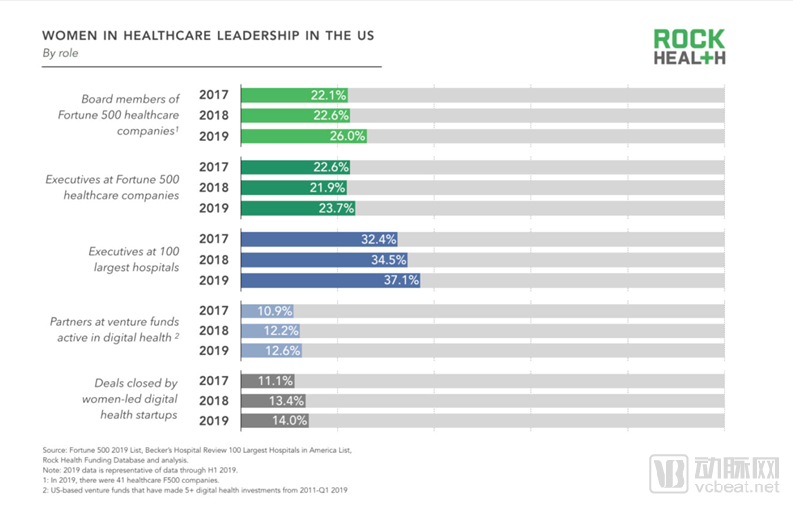
Although this change is progressing slowly, achieving gender parity in leadership across various industries will take even longer. Drawing inspiration from the World Economic Forum’s Global Gender Gap Report, Rock Health developed three models to simulate the number of years required to achieve gender parity among: 1) senior executives at healthcare venture capital firms, 2) Fortune 500 healthcare executives, and 3) Fortune 500 healthcare board members. By leveraging several publicly available data sources, they obtained baseline gender ratios and average tenures for different industry segments. With this information, they projected the time needed to reach gender parity in each segment. The key variable was the rate at which women are hired into these roles—Rock Health built multiple scenarios into each model to test what would happen if women were appointed to leadership positions at rates of 50%, 75%, and 100%.
If 50% of all new partner seats in healthcare venture capital firms hired from now on are held by women, it will take 94 years to reach an overall ratio of 45%, and 132 years to reach an overall ratio of 48% (due to the asymptotic nature of the curve, it may in fact take even longer). The outlook for F500 healthcare executive teams and boards is similar. Executive teams will have to wait 77 years to achieve a 45% female leadership share, while boards will need to wait 72 years.
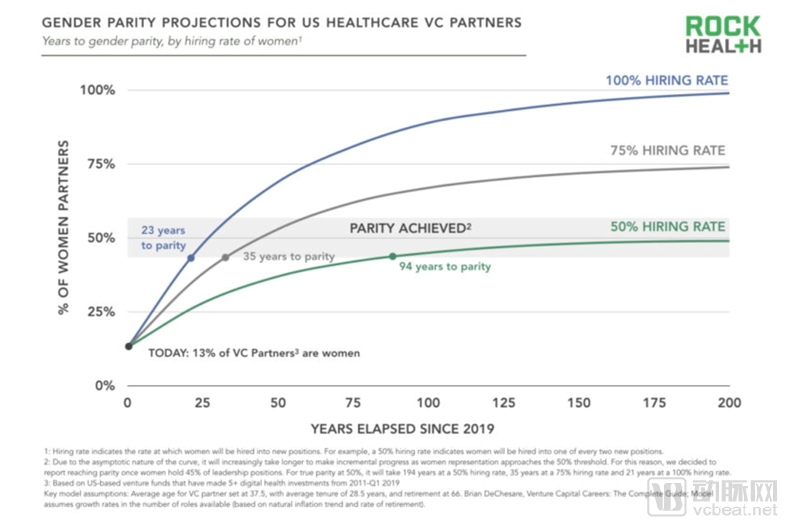
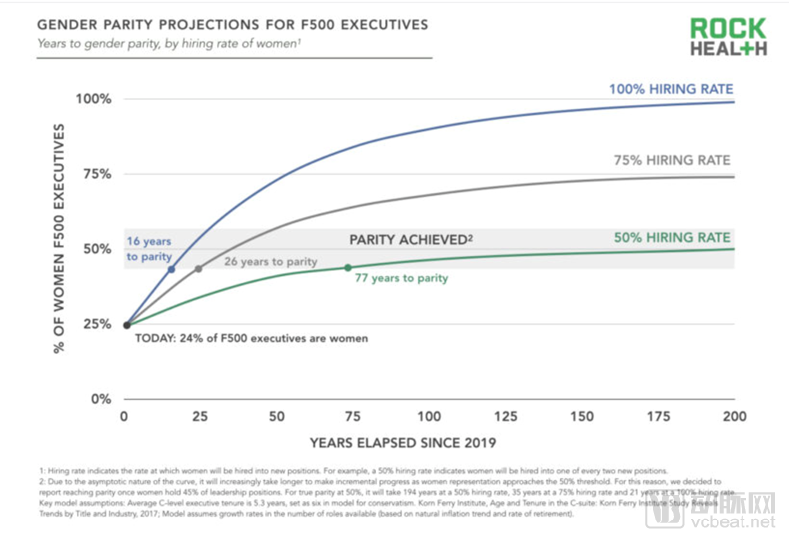
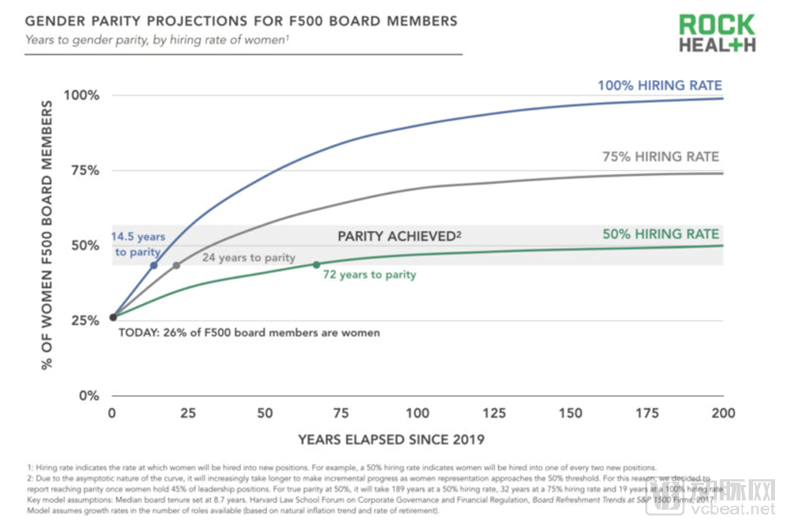
If women are hired at a rate exceeding 50%, gender parity can be achieved more rapidly. Models in the venture capital sector indicate that if healthcare venture capitalists begin hiring only women as partners starting today, the proportion of female partners will reach 45% within 23 years. With a female hiring rate of 75%, gender parity among venture capital partners would occur within 35 years. In contrast, if one woman and three men are hired for every four investor job openings, the representation of women in these positions will remain permanently stuck at 25%.
Despite rigorous quantitative analyses of leadership roles across the entire healthcare industry, the digital health sector has come closer to achieving gender balance compared with other industries. For example, 13% of partners at healthcare-focused venture capital firms are women, whereas the average proportion of female partners in venture capital overall is only 10%. To date, only 14% of U.S. digital health deals have gone to companies with female CEOs, compared with just 11% of all funded companies across all industries that are led by female CEOs.
Optimistic About Change Capability
In a Rock Health survey of employees at healthcare startups and venture capital firms, nearly 80% of female respondents believed they would see gender parity in the workplace within 25 years. Male respondents appeared slightly more optimistic: 54% of men believed gender parity would be achieved within ten years, compared to only 38% of women.
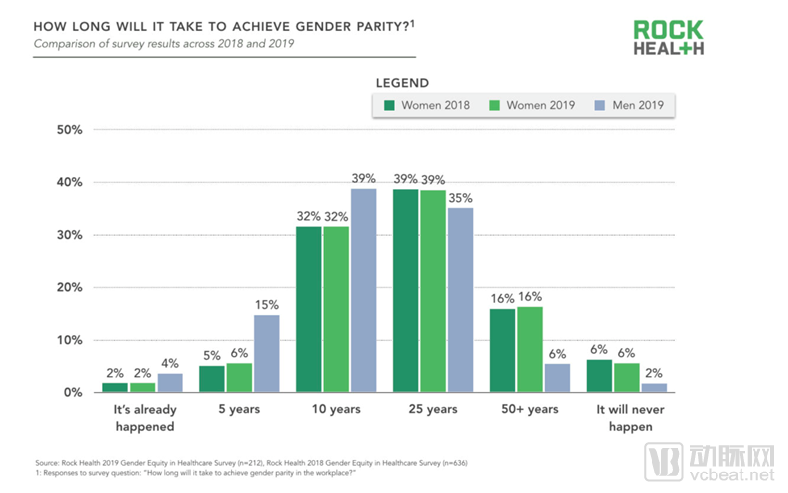
Women have anticipated the various obstacles hindering their career development and are unafraid of challenges.
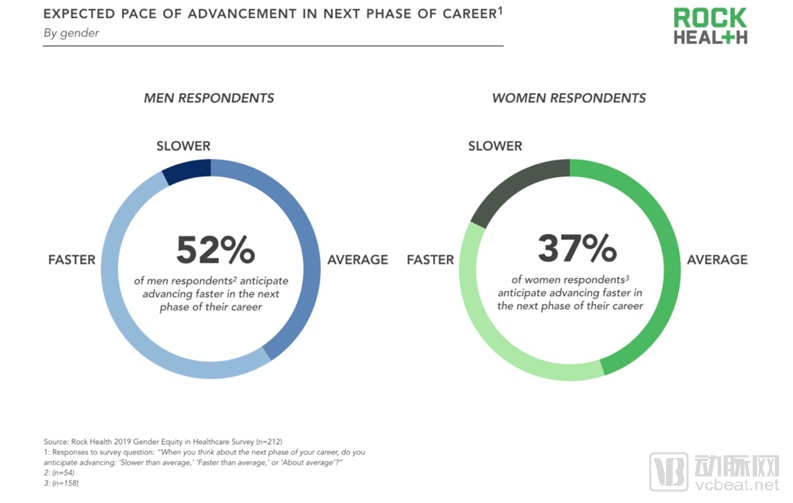
Survey respondents indicated that women’s career expectations may differ from those of men. For instance, male respondents tended to express a desire for faster advancement in the next stage of their careers compared with female respondents.
Among the women surveyed, there is a wider gap between their career ambitions and the perceived likelihood of achieving them. Among female respondents working at healthcare startups, 71% reported that their career goal is to reach senior executive positions or become board members. However, among the 36% of women who aspire to top management roles, only 59% expect to achieve this goal, compared with 86% of men with the same ambition.
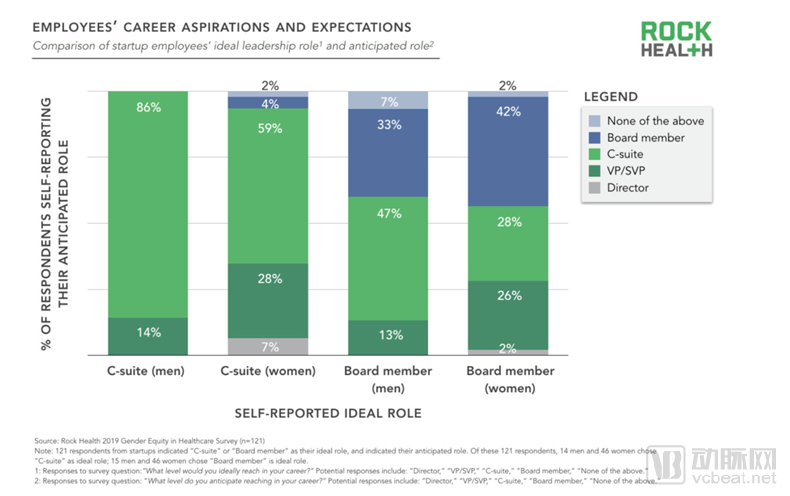
If we look only at these data, we might assume that women are less confident in their abilities than men. However, professors from Georgetown University’s McDonough School of Business and Harvard Business School argue that there are no inherent differences between women and men, despite the pervasiveness of such stereotypes (for example, the common public belief that women are poorer negotiators or lack confidence). They conclude that workplace inequality is often exacerbated by corporate cultures and norms, as well as by the ways in which men and women are treated within such environments.
Rock Health believes that true change comes from structural transformations within healthcare startups and venture capital firms, rather than encouraging women to adapt individually to existing paradigms. Rock Health conducted a survey of organizations that have established work environments supporting women’s status and overcoming remaining challenges, and included the findings in its report.
II. The Most Common Initiatives to Promote Gender Equality May Not Be the Most Effective
This survey queried employees of healthcare startups and venture capital firms to determine whether their workplaces had implemented any initiatives to support the advancement of women, such as flexible work arrangements, women’s communities, employee resource groups (ERGs), and unconscious bias training. If respondents indicated that such initiatives were present in their workplaces, the survey further examined the effectiveness of these measures in promoting the advancement of women.
According to the survey, most startups and venture capital (VC) firms are unlikely to take measures to support gender equality. However, flexible work arrangements—such as the opportunity to work remotely outside of regular business hours—are an exception, with employees reporting that most startups and VC firms offer this flexibility. Among startups, informal mentorship and women’s communities are the next most common initiatives, yet only 29% of startup employees report having access to these opportunities in their workplaces. Surprisingly, 23% of startup employees and 17% of VC employees reported that none of the requested initiatives were available in their workplaces. While these initiatives do not represent all possible means of supporting women in leadership roles, they are part of the broader strategy. Nevertheless, for companies considering how to formally implement gender equality to support a more diverse workforce and ultimately become industry leaders, they do represent a path forward.
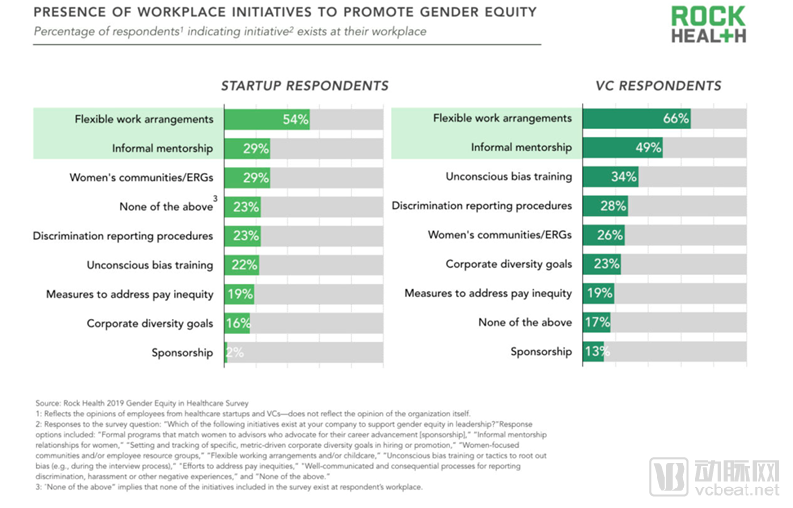
Rock Health believes that while implementing actions to support gender equality is important, the impact of these initiatives matters even more. Survey respondents rated certain initiatives highly; for instance, on a scale of 1 to 7, venture capital respondents rated the effectiveness of “measures to address pay inequity” at 6.2. However, overall, we found a discrepancy between the initiatives most likely to be implemented and those considered most effective. For example, some of the most common workplace initiatives, such as informal mentorship and women’s communities, were consistently not regarded as high-impact measures. Furthermore, few startups and venture capital firms actually implement the two initiatives with the highest impact: addressing pay inequity and ensuring equitable sponsorship. These gaps can serve as a starting point for leaders and employees to discuss the effectiveness of current programs, while also potentially contributing to a lack of employee engagement.
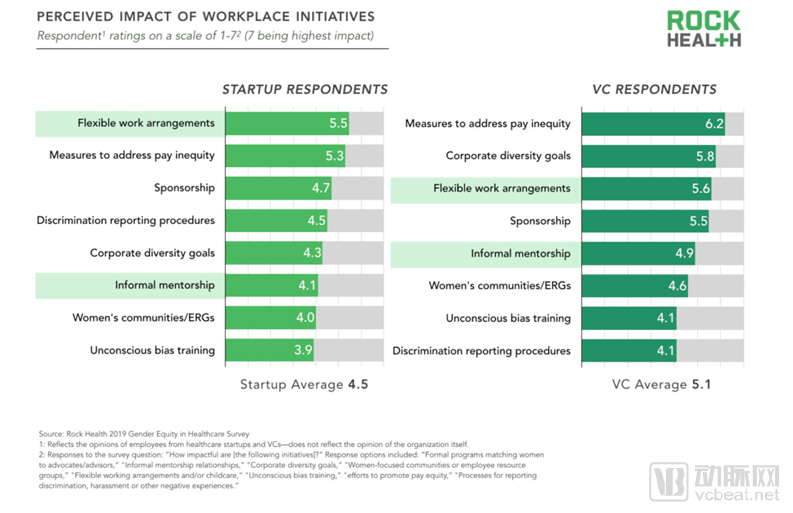
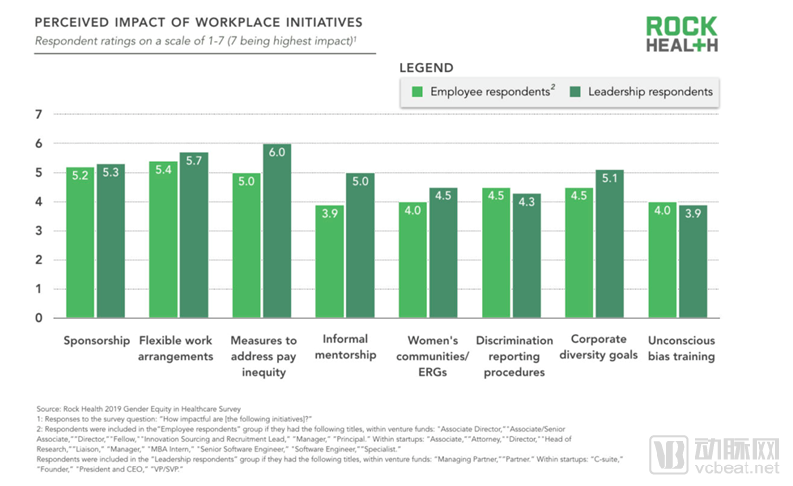
These data reveal another important insight: leaders tend to perceive these initiatives as more impactful than they actually are. Overall, respondents in leadership roles rated the impact of these programs higher (average score of 5.0) compared to employee respondents (average score of 4.6). The greatest disparity between leaders and employees emerged in the assessment of informal mentorship, where leaders overestimated the extent to which junior staff could benefit from these relationships.
III. Commitment Gap Between Individuals and Organizations
The vast majority of respondents believe that investment firms favor companies with significant female representation in the workplace. This view was consistent across all respondent groups: most female and male participants, including employees and leaders from startups and venture capital firms, acknowledged their responsibility for driving change, though female leaders evidently felt a stronger sense of accountability.
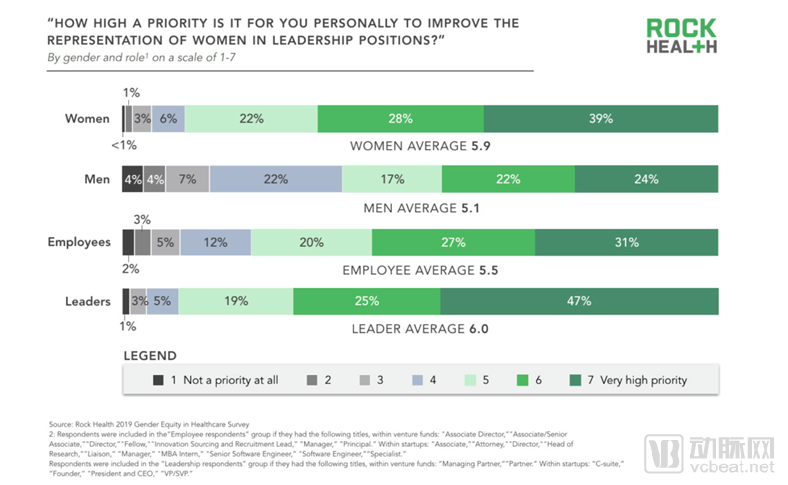
However, some respondents reported not observing the same level of commitment to gender equality at the organizational level. Among employee respondents, nearly 40% believed that their senior leaders were not sufficiently committed to improving gender diversity in leadership roles. This apparent gap between individual and organizational commitment can be particularly disconcerting, especially for those who are visibly affected—groups that often face challenges of underrepresentation while simultaneously bearing the burden of advocating for their own advancement and that of others.
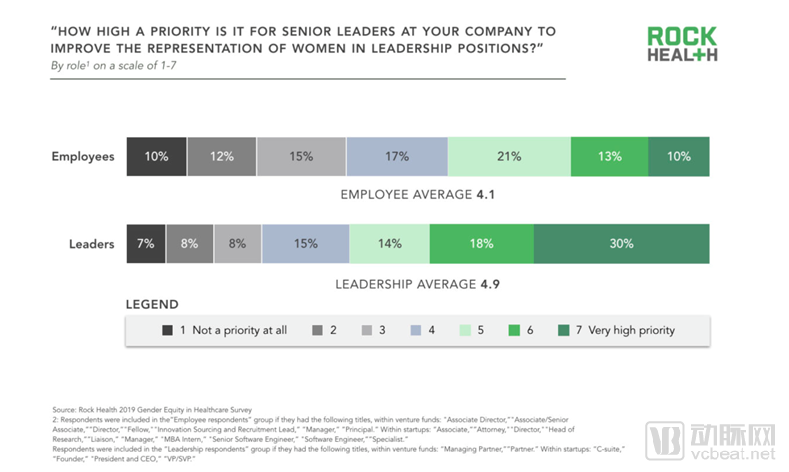
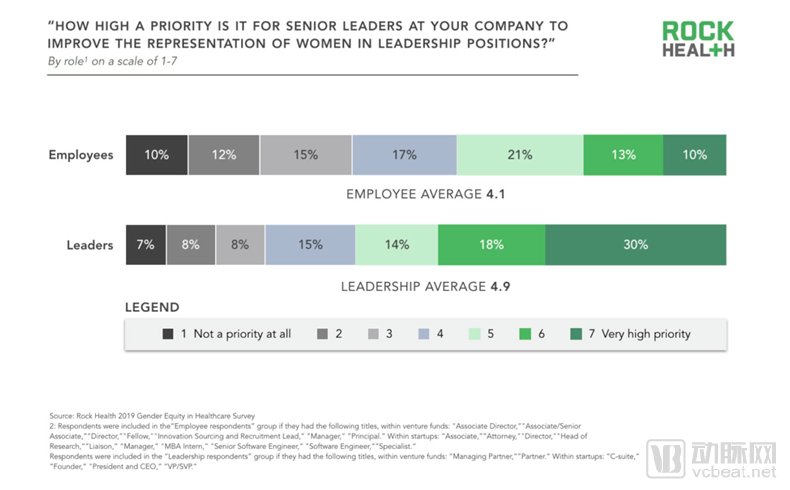
When gender diversity within the executive team is greater, the gap between individual and organizational commitment begins to narrow. This is perhaps not surprising: in companies where women hold leadership positions, the proportion of female employees is generally more likely to reach or exceed 50%, and teams in these companies have greater confidence in their organization’s commitment to gender equality than do teams led predominantly by men.
Everyone we interviewed agreed that leaders’ commitment to gender parity will be the key determinant of whether change occurs. However, commitment alone is insufficient; leaders must implement strategies that promote gender equality.
IV. Tactical Skills for Investors and Startup Leaders
In addition to the aforementioned measures, discussions held by Rock Health with founders, investors, and DEI advocates have yielded numerous strategies for building workplaces that support gender equality:
1. Start as early as possible. Although startups face pressing priorities such as intense competition and have limited resources, it is essential to prioritize fostering a diverse and inclusive culture from the very beginning.
“Unless you prioritize gender diversity from the outset and establish it as a core value or priority, it becomes difficult to address later on. For instance, transforming a company with 90% white male employees into one with 50% white employees remains a significant challenge with serious repercussions, even after a year of operational improvements. You should not place business considerations above all else from the start, as this limits the development of diversity and, most importantly, hinders the potential success of future business endeavors.” — Elli Kaplan, Founder and CEO of Neurotrack
2. Without plans, goals, or accountability measures, companies are likely to maintain the status quo. Most employees from healthcare startups and venture capital firms stated that they have not established diversity targets for leadership roles, as clear targets are not the only pathway to achieving gender parity. However, without explicit focus and accountability, DEI initiatives may stall when competing with other urgent business priorities.
“I don’t believe the lack of equity culture stems from people waking up each day eager to uphold patriarchy. The lack of diversity simply reflects what is happening across our broader society. If you do not actively push back against this culture, one day you will wake up to find your team equally lacking in diversity—not because you are not a good person, but because you have failed to counter prevailing cultural norms.” — Toyin Ajayi, Co-Founder and Chief Health Officer of Cityblock Health
3. Facilitating Structural Improvements Through Third-Party Organizations. Leadership at Cityblock and Omada utilizes third-party employee feedback and analytics platforms to create targeted surveys addressing specific DEI issues, aiming to understand their employees’ (and specific employee groups’) perceptions of company culture and identify areas for improvement. OODA Health engaged a gender consultant who conducts individual consultations with employees to uncover factors that may hinder certain groups from reaching their full potential, such as gender bias and business blind spots. The consultant also works with leadership to ensure they are equipped to become effective advocates for diversity.
4. Transparent career advancement paths and salary ranges can help eliminate bias. Startup founders have proposed several strategies to narrow the gender pay gap: (1) Adhere to clearly defined salary ranges—this can help prevent unconscious gender bias. (2) Clearly communicate role expectations and the criteria required for promotion to the next level.
“In each compensation cycle, we ensure adherence to our commitment to equal pay for equal work by analyzing any potential compensation disparities that cross gender lines.” — Co-founder and CEO of Omada Health
5. In the venture fund, bringing transparency to the deal process may uncover unconscious biases. The Rock Health founding team tracks the gender of co-founders and founders in our deal flow. This year, 18% of the companies we reviewed had female CEOs, and 33% had women on their founding teams. Four of the seven companies we invested in this year are led by female CEOs. Tracking these data enables us to conduct a more in-depth analysis of potential gender gaps. Although firms like Kapor Capital provide some notable examples.
“When I discuss the importance of gender and racial equity, people believe that there is a trade-off between equitable practices and venture-scale returns. We released a social impact report that details not only our internal team but also the personnel at our portfolio companies. We are one of the fastest-growing teams because we have a diverse team. After achieving diversity, we actually secured more deals, as entrepreneurs seek investors who understand their backgrounds. As entrepreneurs demand greater transparency from investors, much like tech companies are required to disclose financial figures, information on gender diversity will become increasingly public.” — Ulili Onovakpuri, Partner at Kapor Capital
6. As expectations for diversity increase, so does the risk of tokenism. Multiple respondents noted that although they have seen more women promoted or hired as partners in funds, they are concerned that these women may hold varying levels of responsibility on investment committees. Organizations can minimize unconscious bias and ensure they truly identify the most suitable candidates for positions by structuring their hiring and promotion processes with gender considerations in mind, rather than making decisions based solely on gender.
“I don’t like being labeled a ‘female’ founder; I prefer to be recognized as a smart and business-savvy founder. I’m not interested in being a ‘token woman.’” – Kelsey Mellard, Co-founder and CEO of Sitka
7. Allies are crucial. If men and others feel they do not have sufficient room to make mistakes, they may find it difficult to form alliances. Helping individuals from underrepresented groups ascend to ally roles is essential for supporting these communities. “Sometimes it is hard for people to speak up for themselves; if you are present and witness the situation, you can speak on their behalf. Compared with being an ally themselves, allies face significantly less risk; they are not directly impacted.” — Bao Wenxiong, Founder and CEO of Project Include.
8. Leverage available resources. Project Include’s Startup Include program offers an eight-month, goal-oriented initiative for early-stage startups and CEOs, designed to foster peer dialogue, gauge employee satisfaction, and provide guidelines and frameworks for initiating diversity and inclusion efforts. They also offer a wealth of (free) diversity and inclusion resources and tools.
Gender equality remains a long journey ahead; only by staying true to our original aspirations can we see it through to the end. Female entrepreneurs should not be discouraged—it is only when everyone embraces change that we can truly transform the world.