

Junlin Healthcare New Drug Bulletin 2020 Issue No.2: IPO Prospectus Highlights Key Oncology, Hematology, and Musculoskeletal Pipeline Updates
Jan 13, 2020 18:00
CST Updated
18:00

This week, there were 7 new drug data entries, including 4 for oncology, 1 for musculoskeletal disorders, and 2 for hematologic diseases.
❖The FDA released its 2019 New Drug Review Report, approving a total of 48 new drugs in 2019. This figure ranks second in history over the past two decades, trailing only the 59 approvals recorded in 2018. Several notable statistics stand out: 21 (44%) of the newly approved drugs were orphan drugs for rare diseases (surpassing oncology to claim the top spot); 20 (42%) were first-in-class (FIC) novel drugs; and 29 innovative drugs (60%) received at least one of the FDA’s four major designations. Among the FIC new drugs, two were particularly highlighted: Janssen’s erdafitinib, an oral pan-FGFR inhibitor and the first FDA-approved targeted therapy for metastatic bladder cancer; and Sage Therapeutics’ Zulresso, the first FDA-approved medication specifically for postpartum depression.
❖ Blueprint Medicines Announces Positive Results from Phase 1/2 Trial of Pralsetinib (BLU-667), a Highly Selective RET Inhibitor, in Treating RET Fusion-Positive NSCLC, and Prepares for Rolling Submission of an NDA. RET-activating fusions and mutations are key disease drivers in many cancer types, including non-small cell lung cancer (NSCLC, with 1%-2% driven by RET) and medullary thyroid carcinoma (MTC, with 90% of advanced cases driven by RET). However, there are currently no therapies specifically targeting this mutation. Although "dirty" TKIs such as lenvatinib and afatinib can also hit the RET target, they are considered insufficiently precise and may cause off-target toxicity. Therefore, if pralsetinib (BLU-667) is successfully launched, it will become the first-in-class agent in the field of RET inhibitors. CStone Pharmaceuticals holds exclusive development and commercialization rights for BLU-667 in Greater China, and Phase 1 clinical trials are currently underway in the country.
FDA Approves Blueprint Medicines’ Ayvakit for the Treatment of Adult Patients with GIST
FDA Approves Blueprint Medicines’ Ayvakit (avapritinib) for the Treatment of Adult Patients with Unresectable or Metastatic Gastrointestinal Stromal Tumors (GIST)
Approximately 6% of newly diagnosed GIST patients harbor PDGFRA exon 18 mutations. Ayvakit (avapritinib) is a potent, highly selective inhibitor of KIT and PDGFRA mutant kinases.
In the efficacy results of the Phase 1 clinical trial named NAVIGATOR, 43 GIST patients harboring PDGFRA exon 18 mutations received treatment.
Ayvakit achieved an overall response rate of 84% (95% CI: 69%, 93%), with 7% of patients achieving complete response; the median duration of response (DOR) was not reached.
ADC TherapeuticsItsADCMedications in the Treatment of Relapse/RefractoryDLBCLPatient's2Achieved the primary endpoint in phase clinical trials
ADC Therapeutics Announces That Its ADC Drug Loncastuximab Tesirine (ADCT-402) Met the Primary Endpoint in a Pivotal Phase 2 Clinical Trial for Patients with Relapsed/Refractory Diffuse Large B-Cell Lymphoma (R/R DLBCL)
Loncastuximab tesirine is an antibody-drug conjugate (ADC) targeting the CD19 antigen.
145 patients with relapsed/refractory diffuse large B-cell lymphoma (R/R DLBCL) were enrolled in this multicenter, open-label Phase 2 clinical trial. The trial primarily evaluated the efficacy and safety of loncastuximab tesirine as a monotherapy for patients with R/R DLBCL.
Treatment with loncastuximab tesirine resulted in an overall response rate (ORR) of 45.5%, with 20% of patients achieving a complete response (CR), thereby meeting the primary endpoint of the trial.
loncastuximab tesirineStructure Diagram
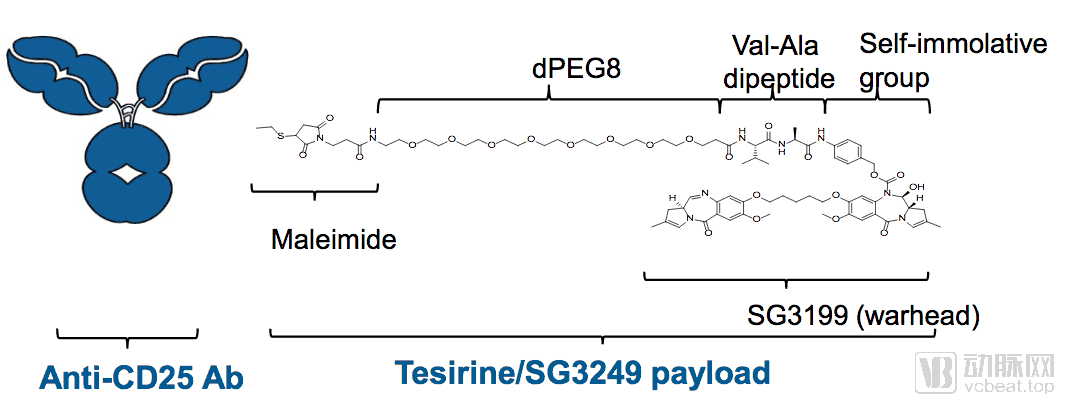
Data Source: ADC therapeutic
Regeneron Announces That REGN2477 Met Primary Endpoint in Phase 2 Trial in Patients with Fibrodysplasia Ossificans Progressiva
Regeneron Announces That Its Investigational Drug Garetosmab (REGN2477) Met the Primary Endpoint in Phase 2 Trial for Patients with Fibrodysplasia Ossificans Progressiva, Compared with Placebo
Garetosmab, which can bind to the downstream targets of the protein encoded by the ACVR1 gene, preventing abnormal bone growth.
A total of 44 adult patients with fibrodysplasia ossificans progressiva (FOP) participated in LUMINA-1, a randomized, double-blind, placebo-controlled Phase 2 clinical study.
After 28 weeks of treatment, garetosmab reduced the formation of new lesions by nearly 90% and decreased the total number of lesions by 25% compared with placebo.
Blueprint Announces Positive Topline Results from Phase 1/2 Clinical Study of Its RET Inhibitor in Patients with RET-Positive NSCLC
Blueprint Medicines Announces Positive Topline Results from the Phase 1/2 ARROW Clinical Trial of Pralsetinib (BLU-667), a Highly Selective RET Inhibitor, in Patients with RET Fusion-Positive Non-Small Cell Lung Cancer (NSCLC)
Pralsetinib consistently demonstrates subnanomolar potency against the most common RET gene fusions, activating mutations, and resistance mutations. Moreover, this drug exhibits significantly improved selectivity for RET compared with approved multikinase inhibitors.
Phase 1/2 trial with two subgroups: one subgroup comprising 80 patients with RET fusion-positive NSCLC who had previously received platinum-based chemotherapy, and another subgroup consisting of 26 treatment-naïve patients.
In the previously treated subgroup, pralsetinib treatment achieved an objective response rate (ORR) of 61%, with tumor shrinkage observed in 95% of patients, including a 14% complete response (CR) rate. In the treatment-naïve subgroup, pralsetinib treatment achieved an ORR of 73%, including a 12% CR rate.
FDA Approves Merck’s Keytruda for the Treatment of Patients with Specific High-Risk Non-Muscle-Invasive Bladder Cancer (NMIBC)
U.S. FDA Announces Approval of Merck & Co.’s Blockbuster PD-1 Inhibitor Keytruda for the Treatment of Patients with Specific High-Risk Non-Muscle-Invasive Bladder Cancer (NMIBC)
Keytruda is a blockbuster PD-1 inhibitor developed by Merck & Co.
Results of the KEYNOTE-057 multicenter, single-arm clinical trial. It included 148 patients with high-risk non-muscle-invasive bladder cancer (NMIBC), 96 of whom had BCG-unresponsive carcinoma in situ.
Among 96 high-risk patients with BCG-unresponsive disease, Keytruda achieved a complete response rate of 41% (95% CI: 31, 51). Among patients who achieved a complete response, the median duration of response was 16.2 months, and 46% of patients maintained a complete response for more than 12 months.
Apellis Announces That Its Investigational C3 Complement Inhibitor Met the Primary Endpoint in a Phase 3 Study for the Treatment of Adult Patients with Paroxysmal Nocturnal Hemoglobinuria (PNH)
Apellis Announces That Its Investigational C3 Complement Inhibitor Pegcetacoplan Met the Primary Endpoint in the Phase 3 PEGASUS Study in Adult Patients with Paroxysmal Nocturnal Hemoglobinuria (PNH)
Pegcetacoplan is a C3 complement inhibitor designed to modulate excessive complement activation in many diseases. Pegcetacoplan is a synthetic cyclic peptide conjugated to a polyethylene glycol polymer, which can specifically bind to C3 and C3b.
In the Phase 3 clinical trial, a total of 80 adult patients with paroxysmal nocturnal hemoglobinuria (PNH) were enrolled. These patients first received four weeks of treatment with eculizumab and pegcetacoplan, followed by randomization to receive either eculizumab or pegcetacoplan.
After 16 weeks of treatment, the mean hemoglobin level in patients receiving pegcetacoplan improved by 3.8 g/dL compared with those in the active control group.L
BMS and Acceleron Announce Significant Efficacy of Reblozyl, an Erythroid Maturation Agent for MDS Patients, in Key Phase 3 Trial for Anemia Treatment
BMS and Acceleron recently announced that Reblozyl (luspatercept-aamt), an erythroid maturation agent for patients with myelodysplastic syndromes (MDS), demonstrated significant efficacy in a pivotal Phase 3 trial for the treatment of anemia.
Reblozyl is an erythroid maturation agent indicated for the treatment of anemia in adult patients with beta-thalassemia who require regular red blood cell transfusions.
MEDALIST was a randomized, double-blind, placebo-controlled, multicenter phase III study conducted in 229 patients with very low- to intermediate-risk MDS to evaluate the efficacy and safety of luspatercept versus placebo in the treatment of anemia.
Compared with the placebo group, the luspatercept treatment group showed a statistically significant increase in the proportion of patients achieving red blood cell transfusion independence (RBC-TI) for ≥8 weeks during the first 24 weeks of the study (weeks 1–24) (38% vs. 18%, p<0.001).
Results of the MEDALIST Study
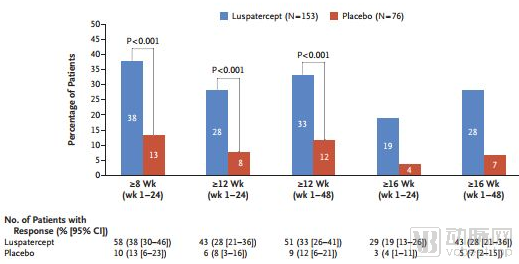
Data source: NEJM
❖ CA: A Cancer Journal for Clinicians, with an impact factor of 223.679, published the latest American cancer statistics report. This report provides a comprehensive overview of cancer occurrence based on the most recent data on cancer incidence through 2016 and mortality through 2017, highlighting that the U.S. cancer mortality rate experienced its largest single-year decline on record in 2017. From 1991 to 2017, the U.S. cancer mortality rate declined continuously, dropping by 29% overall, which translates to 2.9 million fewer cancer deaths.
❖The FDA released its 2019 New Drug Review Report. A total of 48 new drugs were approved in 2019, ranking second in the past two decades, just behind the 59 approvals in 2018. Among these, 21 (44%) were orphan drugs for rare diseases, and 20 (42%) were first-in-class novel drugs. Twenty-nine innovative drugs (60%) received at least one of the FDA’s four major designations: 35% were granted Fast Track designation, 27% received Breakthrough Therapy designation, 58% were eligible for Priority Review, and 19% obtained Accelerated Approval.
❖Merck & Co. Announces Global Exclusive Collaboration and Licensing Agreement with Taiho Pharmaceutical Co., Ltd. and Otsuka Pharmaceutical Co., Ltd. for Oncology Small-Molecule InhibitorsMerck & Co. has secured global exclusive rights to a small-molecule inhibitor candidate from Taiho Pharmaceutical and Otsuka Pharmaceutical, paying the two companies a $50 million upfront fee, with potential future milestone payments totaling $2.5 billion. Reportedly, one of the primary reasons for Merck’s significant investment is Taiho’s existing KRAS product pipeline.