

SonoStar Files IPO Prospectus: Pioneer of Wireless Handheld Ultrasound Recognized in China's 13th Five-Year Plan and Winner of National Innovation Award
In the ultrasound examination room, a physician held the transducer in their right hand while skillfully operating the ultrasound machine with their left. Various images appeared on the monitor, enabling the doctor to rapidly and accurately diagnose the patient’s condition.
The power of ultrasound devices lies precisely here; they serve as a second pair of eyes for physicians.
Ultrasound devices have become a primary diagnostic tool for numerous diseases. However, as ultrasound examinations are typically confined to hospital imaging departments, their usage scenarios are limited, requiring patients to schedule appointments in advance or wait in line, which makes the process relatively cumbersome. For hospitals, traditional large-scale ultrasound equipment is bulky, heavy, difficult to move, and expensive. Additionally, the need for specialized physicians further constrains their application.
Unlike traditional ultrasound diagnostic equipment, handheld ultrasound devices make bulky ultrasound machines lightweight and user-friendly. By integrating remote assistance and artificial intelligence systems, they enable remote guidance and even automatic lesion detection, addressing the challenges faced by primary care physicians in operating ultrasound devices and interpreting imaging results.
Relevant national authorities have also attached great importance to the development of handheld ultrasound. It is reported that in the “Guidelines for the First Batch of Project Applications in 2016 under the Pilot Special Program of the National Key R&D Program during the 13th Five-Year Plan Period,” issued by the Ministry of Science and Technology of China in 2015, handheld ultrasound imaging systems were listed as a National Key R&D Project for 2016–2020.
The miniaturization and intelligentization of ultrasound instruments have become a development trend, with domestic and international enterprises joining the ranks of developing, producing, promoting, and popularizing compact ultrasound imaging devices. Among them is Guangzhou Sonostar Technologies Co., Limited (hereinafter referred to as “Sonostar”).
Sonostar, established in 2011, is a high-tech enterprise specializing in the research and development, manufacturing, and sales of ultrasound equipment. Its main products include wireless handheld ultrasound devices, conventional B-mode and color Doppler ultrasound systems, bladder scanners, ophthalmic A/B-scan ultrasonography units, and optical coherence tomography (OCT) imaging instruments.
“Sono” means ultrasound in English and is transliterated as “Sonuo,” while “Star” means “star.” The brand name reflects the aspiration to develop SonoStar into a leading star in the ultrasound industry. Cai Weizhong, the company’s founder, is full of confidence in the future of Sonostar.
After graduating from university in 2001, Cai Weizhong joined the Shantou Institute of Ultrasonic Instruments (SIUI), one of China’s earliest and largest manufacturers of ultrasound diagnostic equipment. In 2008, he joined the founding team of Guangzhou Doppler Electronic Technology Co., Ltd.
After spending a decade in the ultrasound market and gaining insights into its development direction and trends, Cai Weizhong began exploring new paths for industry growth, embarking on his entrepreneurial journey in 2011 by founding Sonostar.
“With a very low starting point—only tens of thousands of yuan in capital and a small room of just over 30 square meters—the underlying aspiration was, however, relatively high: I hoped to contribute to social progress while achieving my own professional development.” This has been Cai Weizhong’s enduring pursuit.
Sonostar’s mission is to continuously reduce product manufacturing, marketing, and sales costs, delivering high-quality, affordable products that offer exceptional value. By meeting the needs of more users, we aim to make healthcare professionals’ work more efficient and effortless, while enabling broader access to superior medical services for the general public.
As the saying goes, “In an ordinary world, the only way to avoid mediocrity is through relentless struggle.” Cai Weizhong has consistently put this philosophy into practice. Undeterred by the hardships of entrepreneurship, he drove Sonostar not only to survive but also to rapidly launch a range of portable and cart-based B-mode and color Doppler ultrasound systems through unremitting efforts, product innovation, and flexible business operations. Moreover, Sonostar became the first in China to introduce the Ultrasound Box and tablet touchscreen B-mode ultrasound devices.
In 2015, Sonostar abandoned the traditional “console + probe” model by integrating the console into the probe, launching China’s first wireless probe-based B-mode ultrasound system.
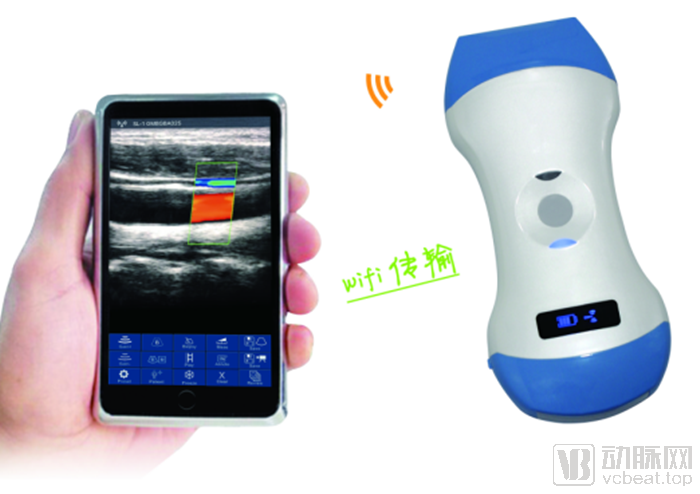
Sonostar Product Images (Images provided by the interviewee)
Weighing only 200 grams and comparable in size to a standard smartphone, this device integrates the main unit of a traditional ultrasound system onto a small circuit board measuring just a few centimeters in length and width, which is housed within the probe. Image data is transmitted via a built-in Wi-Fi chip to a smartphone or tablet equipped with dedicated ultrasound application software for display. This product is particularly well-suited for use in primary care settings and clinical departments for emergency examinations, preliminary screening, visualization-guided interventional procedures, and remote consultations.
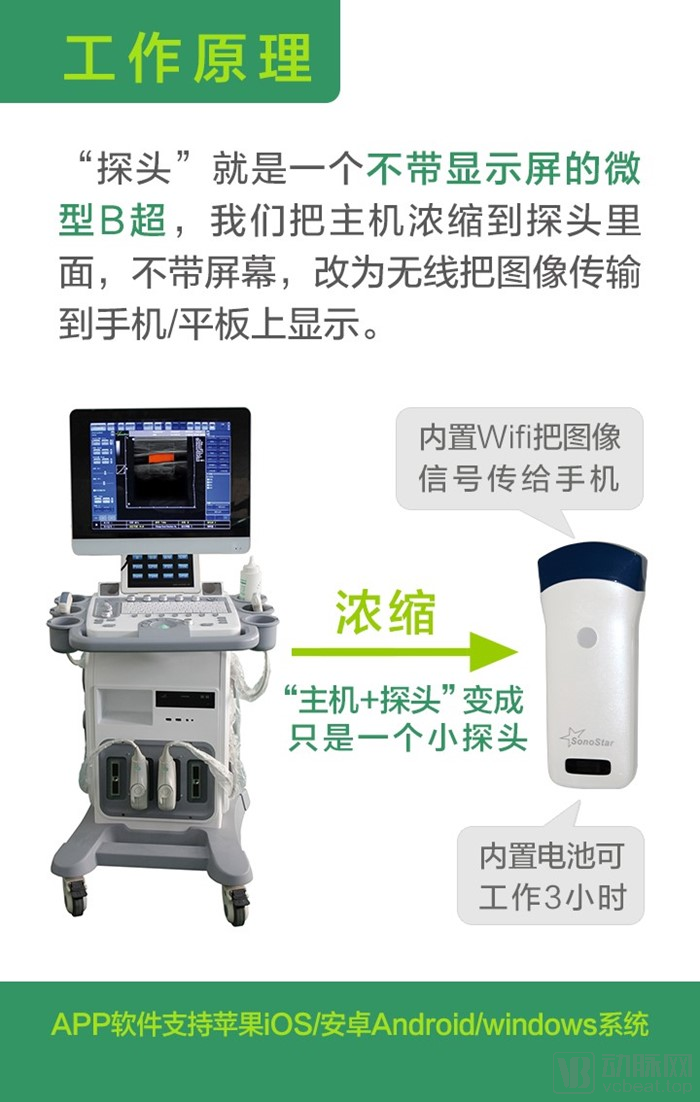
Principles of Sonostar Wireless Ultrasound (Image provided by the interviewee)
In the following years, Sonostar’s product portfolio was further enriched, with various models of wireless probe-based ultrasound devices, ultrasound bladder scanners, and ophthalmic A/B-scan ultrasound systems successively launched into the market.
Sonostar also places great emphasis on intellectual property protection, having secured a total of 22 IP assets, including invention patents, utility model patents, and software copyrights. In 2015, Sonostar was recognized as a National High-Tech Enterprise due to its advanced technology. Additionally, the company has successively undertaken projects such as the Guangdong Province Industry-University-Research Collaboration Science and Technology Program, the Guangzhou Innovation Fund, and the Guangzhou Science and Technology Program. Its wireless probe-based handheld ultrasound device was included in the National Key R&D Program under the Ministry of Science and Technology during the 13th Five-Year Plan period, receiving R&D funding support of RMB 10 million. In late 2019, it won the Grand Prize at the 8th China Innovation and Entrepreneurship Competition. Indeed, after nine years of entrepreneurship, Sonostar has achieved remarkable success.
In addition to pursuing product differentiation and innovation, Sonostar places significant emphasis on innovation in marketing, business models, corporate operations management, and cost control. As a result, the company ranks among the industry leaders in market sales and corporate profitability.
With the miniaturization and intelligent development of ultrasound equipment, ultrasound technology is no longer confined to the radiology department but has expanded into various clinical departments across hospitals, including interventional visualization guidance, point-of-care examinations, and emergency assessments. This expansion has significantly enhanced the precision and timeliness of diagnosis and treatment. Furthermore, the portability and ease of operation facilitate the deployment of ultrasound services at the primary care level, thereby meeting the growing demand for ultrasound examinations among the general population in grassroots communities.
According to research by Probe Capital and Signify Research, the global market size for ultrasound imaging equipment was $7.5 billion in 2015 and is projected to reach $10.5 billion in 2021, representing a compound annual growth rate (CAGR) of approximately 7%. Notably, the portable ultrasound segment experienced a 40% growth in market size from 2016 to 2017. With improvements in performance and usability, this segment is expected to continue growing at an annual rate exceeding 20% in recent years.
“Handheld ultrasound devices can serve as valuable aids to physicians, much like stethoscopes, and may be referred to as ‘visual stethoscopes.’ The market demand and potential for widespread adoption are substantial. Moreover, only a handful of companies have entered this field, with very few demonstrating strong performance. Currently, the handheld ultrasound market remains a blue ocean, presenting significant growth opportunities for Sonostar,” said Cai Weizhong.
Cai Weizhong stated that Sonostar will next focus on refining its handheld ultrasound products, expanding market share, building a robust remote diagnostic assistance platform, and launching AI-assisted diagnostic services. In the future, Sonostar will continue to prioritize miniaturization and intelligence as its core operational characteristics, introducing more medical products, as well as technology and electronic products, into its business scope. Institutions interested in the company should contact the financing assistant, Xiao Yun, at: DongMai_Investent