

Alzheimer's Disease Treatment Breakthrough: Immune-Neurology Approach – Alector Identifies 40 Immune Targets | Global Case Study

Alector
Neurodegenerative Disease Therapeutics Developer

According to World Health Organization estimates, up to 1 billion people worldwide are affected by neurological disorders. Currently, more than 50 million people suffer from neurodegenerative diseases, with over 10 million new cases diagnosed each year. As the most common neurodegenerative disease, Alzheimer’s disease is projected to incur cumulative total costs of $750 billion for Medicare and Medicaid in the United States alone by 2050, representing an increase of more than 300% compared to the projected expenditure levels in 2018. (Source: Alzheimer’s Association)
Neurodegenerative diseases remain one of the medical challenges yet to be overcome by humanity. Since the early 20th century, neurodegenerative diseases have been closely linked to protein misfolding, with numerous conditions such as spinocerebellar ataxias (SCAs) and Huntington’s disease widely recognized as being caused by this phenomenon. Efforts have been made to identify cures for neurodegenerative diseases by studying the mechanisms underlying protein misfolding and aggregation; however, after a century, these diseases still remain untreatable with existing therapies.
Humans cannot help but explore novel therapies beyond the principle of “protein misfolding.” In recent years, immunotherapy has flourished and demonstrated remarkable efficacy in cancer treatment. Immunology has revealed that the human immune system can potentially combat pathological tumor cells. This raises the question: Can the human immune system also counteract neurodegenerative diseases?
Seeking Answers Worldwide. VCBeat (WeChat ID: vcbeat) recently conducted an in-depth analysis of Alector, a biopharmaceutical company specializing in the treatment of neurodegenerative diseases based on immunological principles. The company aims to harness the body’s natural immune defenses to combat neurodegenerative disorders. This novel therapeutic approach for neurodegeneration moves beyond the traditional debate over targeting beta-amyloid or tau proteins, shifting the R&D focus toward immune-targeted therapies.
Alector, founded in 2013 and headquartered in San Francisco, USA, is a pioneer in the field of immunoneurology. Immunoneurology posits that immune dysfunction is the root cause of degenerative brain diseases and aims to combat neurodegenerative disorders by restoring normal immune function in the brain. The company integrates neuroimmunology, human genetics, and antibody technologies to focus on developing novel therapies capable of curing neurodegenerative diseases.
Notably, Alector listed on the Nasdaq Stock Exchange (ticker symbol: ALEC) on February 7, 2019, completing a $176 million initial public offering (IPO), and on the same day finalized an $8.2 million equity investment in INmune Bio, a tumor immunotherapy company.
Is Immune Disease at the Core of Neurodegenerative Diseases?
While the prevailing view recognizes neurodegenerative diseases as disorders of protein misfolding, Alector posits that their core mechanism is immunological. In this perspective, neurodegenerative conditions such as Alzheimer’s disease are essentially the consequence of the immune system’s failure to identify certain pathogens before they spiral out of control.
Based on extensive genetic data, Arnon Rosenthal, co-founder of Alector, pointed out that many genes associated with neurodegenerative diseases such as Alzheimer’s and Parkinson’s can actually modulate the immune system. This led Arnon Rosenthal to believe that regulating the immune system could offer hope for curing neurodegenerative diseases, thereby enabling the first-ever therapeutic intervention.
Since most neurodegenerative diseases are age-related, Alector predicts that the brain’s immune cells will gradually lose their function over time, failing to support the brain in repairing otherwise preventable neurological conditions. Moreover, through futile efforts, these senescent immune cells may further exacerbate disease by secreting toxic immune mediators and engaging in indiscriminate clearance.
Alector’s hypothesis positions the immune system as a key player in the development of neurodegenerative diseases, with supporting evidence already identified in existing research findings. With the completion of genome-wide association studies (GWAS), new genetic variants associated with neurodegenerative diseases have been identified. Surprisingly, most of these newly discovered genes are immune-related genes expressed in microglia—the immune cells of the brain. This suggests that microglia not only respond rapidly to disease but can also actively drive neuronal degeneration. Leveraging this discovery, researchers can target immune genes associated with these specific diseases to enhance immune system function and halt disease progression.
40 Immune Targets and 4 Candidate Drugs
Having identified the link between immunology and neurodegenerative diseases, Alector has adopted a comprehensive approach to leveraging the immune system against these complex conditions. Over the past six years of exploration, the company has identified more than 40 immune system targets, developed over 10 preclinical R&D pipelines, and advanced four core drug candidates.
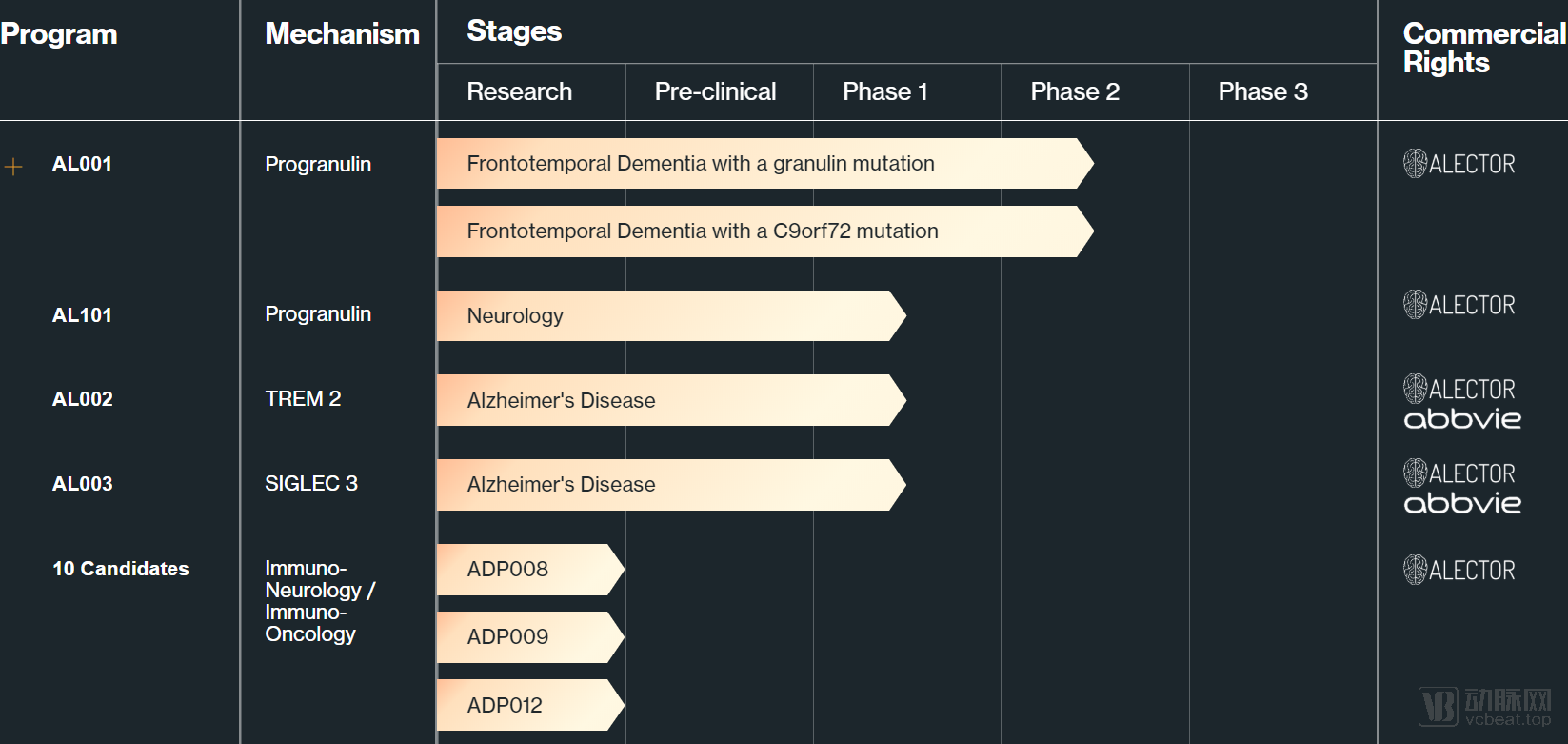
Alector’s Partial R&D Pipeline (Image Sourced from the Official Website)
Alector’s most advanced pipeline candidate is AL001, which has entered Phase II clinical trials. AL001 is a human monoclonal antibody designed to modulate progranulin, a brain-immune activity regulator genetically linked to multiple neurodegenerative diseases.
AL001 primarily targets progranulin deficiency-associated frontotemporal dementia (FTD-GRN) within the spectrum of frontotemporal dementia (FTD). FTD is a dementia syndrome characterized by atrophy of the frontal and temporal lobes in middle-aged and older adults, leading to personality changes, speech impairments, and behavioral abnormalities. Patients with FTD-GRN develop frontotemporal dementia due to mutations in the PGRN gene.
AL001 increases progranulin levels in the human body by inhibiting the degradation mechanism of progranulin, thereby attempting to restore progranulin levels to normal in patients with FTD-GRN and achieve treatment for frontotemporal dementia. The company has already achieved success in its Phase 1b trial involving subjects with FTD-GRN. Dr. Robert Paul, founder of the company, stated, “We are encouraged by the latest data from the Phase 1b clinical trial of AL001, which demonstrated that AL001 was well-tolerated and restored normal physiological levels of progranulin in the central nervous system of patients with FTD-GRN.”
The AL001 pipeline has entered Phase II clinical trials. The Phase II trial is primarily designed to evaluate the longitudinal safety, tolerability, pharmacokinetics (PK), pharmacodynamics (PD), and impact on neurodegenerative biomarkers of AL001. The trial will enroll patients with FTD-GRN as well as those with other C9orf72 mutations (FTD-C9orf72). Robert Paul, Chief Medical Officer, added, “In the Phase II clinical trial, we plan to enroll up to 32 patients to prepare for the pivotal Phase III study in 2020 and to gain important insights into the safety and activity of AL001 in this patient population.” It is reported that the Phase III clinical trial of AL001 will be advanced in 2020.
In June 2018, AL001 was granted orphan drug designation by the U.S. FDA for the treatment of FTD.
In addition to AL001, Alector has three other core candidate drugs—AL101, AL002, and AL003—all of which have entered Phase I clinical trials.
AL101 is the company’s second drug candidate, capable of increasing progranulin levels in the human brain. Robert Paul, Chief Medical Officer at Alector, stated, “Progranulin is a key regulator of microglial function in the brain. Reduced levels increase the risk of neurodegenerative diseases, whereas elevating these levels holds promise for counteracting such diseases at the pathological level.”
On January 6, 2020, Alector announced that it had administered the first human dose in its Phase 1 study of AL101, demonstrating therapeutic potential for Alzheimer’s disease and Parkinson’s disease.
The AL002 and AL003 pipelines are designed to treat patients with Alzheimer’s disease. Alector completed the Phase 1a study of AL003 in healthy subjects in the first quarter of 2019. In the AL003 Phase 1a dose-escalation trial, more than eight dose levels were evaluated in 38 healthy subjects, and dose-dependent changes in target engagement biomarkers in blood were observed post-treatment. The company subsequently completed the Phase 1a study of AL002 in healthy subjects in the third quarter of 2019, observing dose-dependent changes in target engagement biomarkers in cerebrospinal fluid after treatment. The company also initiated a Phase 1b study of AL002 in patients with Alzheimer’s disease, which was expected to be completed in the first half of 2020.
The Team Behind It: World-Renowned Neuroscientists Join Forces, 3 Pharmaceutical Companies and 4 New Drugs
Alector has been able to identify novel therapeutic approaches for neurodegenerative diseases and has identified 40 immune targets, some of which have been advanced into preclinical trials. The team behind the company is even more impressive given these remarkable achievements.
Alector was co-founded by Dr. Arnon Rosenthal, Dr. Tillman Gerngross, and Dr. Asa Abeliovich. Dr. Arnon Rosenthal currently serves as the CEO of Alector. He is an Israeli-American neuroscientist, a world-renowned inventor, and a biotechnology entrepreneur who previously led the development of the analgesic Tanezumab, the migraine medication Fremanezumab (brand name: Ajovy), the Alzheimer’s disease drug Ponezumab, and Vismodegib for the treatment of basal cell carcinoma.
Alector is Dr. Arnon Rosenthal’s third venture. Previously, he founded Rinat Neuroscience Corporation, a company dedicated to the development of novel therapeutics for neurodegenerative and pain disorders, which was acquired by Pfizer for approximately $500 million in 2006. He later founded Annexon Biosciences, a biopharmaceutical company focused on autoimmune neuropathies and degenerative eye diseases, where he served as CEO.
Over the course of Dr. Arnon Rosenthal’s 36-year research career in neuroscience, he identified multiple neuronal survival factors and receptors at Genentech, a world-renowned biotechnology company, to prevent the death of degenerating neurons; as President and Chief Scientific Officer at Rinat Neuroscience Corporation, he discovered clinical antibodies designed to target misfolded proteins; and as CEO of Annexon Biosciences, he and his team developed clinical antibodies that prevent the disruption of neuronal connections.
Currently, Dr. Arnon Rosenthal is the named inventor on more than 350 issued patents and patent applications, and the author of over 100 peer-reviewed publications.
Dr. Tillman Gerngross, another co-founder of Alector, currently serves as Chairman of the Board of Directors of Alector. He earned his bachelor’s and master’s degrees in chemical engineering and his Ph.D. in molecular biology from the Vienna University of Technology in Austria. He also serves on the board of Adimab; is the founder and a director of Avitide; is the founder and chairman of Arsanis; is a venture partner at SV Life Sciences Advisors; and is the co-founder and chief scientific officer of GlycoFi.
Dr. Asa Abeliovich, the last co-founder of Alector, is no longer featured on the company’s official website. This is likely due to the fact that in August 2019, Alector filed for arbitration against Dr. Abeliovich, alleging that he had used Alector’s confidential information during his tenure at Prevail Therapeutics. Notably, Dr. Asa Abeliovich is also the founder and CEO of the biopharmaceutical company Prevail Therapeutics.
Strategic Collaboration with AbbVie and Adimab
In October 2017, Alector announced a strategic collaboration with AbbVie to jointly develop novel therapeutics for Alzheimer’s disease and other neurodegenerative disorders (the “AbbVie Agreement”). Under the AbbVie Agreement, the parties will develop antibody-based drugs targeting a specific target, with AbbVie obtaining global development and commercialization rights for AL002 and AL003 directed against this target. Alector will be responsible for exploratory research, drug discovery, and development of the program through the completion of proof-of-concept studies.
If AbbVie exercises its option, AbbVie will be responsible for the late-stage development and commercialization of the drug. The two parties will share research costs and global sales profits from the drug. AbbVie is required to pay Alector an upfront payment of $205 million and will make a $20 million equity investment in Alector in the future.
As of September 30, 2019, Alector recorded $159.4 million in deferred revenue through its collaboration with AbbVie. The deferred revenue is expected to be recognized upon completion of Phase II clinical trials during the research and development phase of the program.
In addition to AbbVie, Alector has entered into a strategic alliance with Adimab, an industry leader in antibody therapeutics, under which the Company will develop antibodies identified by Adimab for its product candidates AL001 and AL101 (the “2013 Adimab Agreement”). In August 2019, the Company further entered into a new collaboration agreement with Adimab (the “2019 Adimab Agreement”) to research and develop other novel antibodies.
Pursuant to the Adimab Agreement, Alector has assigned to Adimab the patent rights for inventions made during the research process and those related to improvements in the Adimab platform technology. Alector retains an exclusive option to obtain ownership of a specified number of optimized antibodies discovered by Adimab, along with certain patent rights associated with such antibodies. Prior to the exercise of this option, each party grants the other a non-exclusive license to the relevant intellectual property.
IPO in 2019, currently unprofitable, with strategic partnerships becoming the primary source of revenue
According to Alector’s latest publicly released annual financial statements, the company has not yet achieved profitability, as it remains in the preclinical research and development stage and has no approved drugs on the market. The company aims to expedite the market launch of its first drug candidate to generate revenue.
Since its inception, Alector has incurred net losses each year. As of September 30, 2019, Alector’s accumulated deficit amounted to $189.3 million, with expenses primarily attributable to new drug research and development, as well as operating and administrative costs.
The Company currently requires additional funding to support the continued development of its product candidates and to fund its operations for the foreseeable future. The Company’s ability to generate future product revenue will depend on the successful development and eventual commercialization of Alector’s product candidates.
To date, Alector’s revenue has been primarily associated with the AbbVie agreement, under which the company recognizes revenue related to research and development grants as it performs the relevant research services.
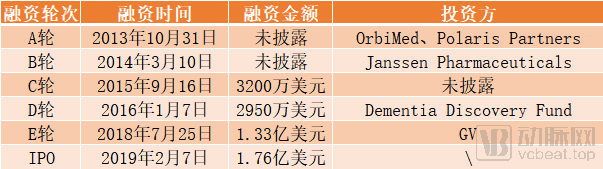
Alector's Historical Funding Data (Source: Crunchbase)
In terms of financing, Alector has raised funds nearly every year in a steady progression since its establishment in 2013, and ultimately went public on the Nasdaq Stock Exchange in 2019. According to data disclosed by Crunchbase, Alector’s IPO valuation was approximately $1.3 billion.