

Lu Gang of Legend Star: Payment Reform Empowers the Emerging Forces in Healthcare

Legend Star
Angel Investment Firm
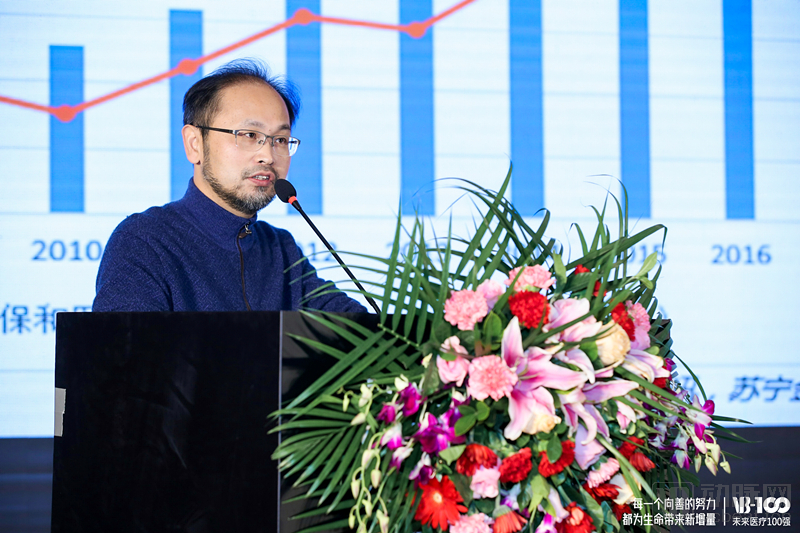
Recently, Lu Gang, Partner at Legendstar Capital, attended the “2019 Future Healthcare 100” forum hosted by VCBeat and VBInsight, and delivered a presentation titled “Payment Reform Empowering New Forces in Healthcare.”
Lu Gang believes that to achieve higher protection efficiency with limited medical expenditure resources, it is necessary to establish a new force in the value chain of “supporting healthcare through services,” empowering product resources, payment resources, and medical service resources. In terms of product resources, the market for generic drugs, medical devices, and consumables is characterized by simultaneous declines in volume and price, resulting in a shrinking market where survival depends on “scale”; the market for innovative drugs and gene technologies is an expanding market that trades price for volume, where global lowest prices are the norm and success depends on “innovation”; in overseas markets, the “Made in China” phenomenon will similarly take hold in China’s pharmaceutical and medical device industries.
Below is Lu Gang’s sharing. Enjoy~
Thank you, everyone! As we reach the end of the year, it is time to reflect on the past and look toward the future. The past year has been historically significant for the healthcare industry. The acceleration of healthcare reform has introduced substantial variables, placing the entire sector at a “historic inflection point” marked by profound structural shifts. Having worked in this industry for many years, we have all experienced gains and losses. As the saying goes, “times create heroes.” How can we accurately characterize the nature of this inflection point and anticipate emerging trends? In entrepreneurship and investment, how can we align with the right currents, navigate hazardous waters, and seize future opportunities? These are the topics I wish to share with you today.
Over the past five to six years, both entrepreneurship and investment in healthcare services have been extremely vibrant, with topics emerging one after another. Trends have shifted from mobile health and physician groups to private hospitals and chain-based business models, and further to AI-driven healthcare and health insurance. However, regardless of the topic, discussions on commercial implementation and profitability inevitably confront the sobering reality that “the ideal is full, but the reality is stark.”
For instance, in the commercial implementation of internet healthcare, we initially monetized physicians’ consultation fees (through appointment slot expansion) and their fragmented time (via online consultations). However, the challenge lay in the limited availability of such fragmented time among high-quality physicians. Later, we shifted our focus to facilitating pharmaceutical sales.
Is there any future prospect for pharmaceutical sales? With the National Healthcare Security Administration’s price negotiations driving even innovative drug prices down to “the lowest globally,” I estimate that the value of the pharmaceutical sales segment in the supply chain will likely be reduced to mere logistical distribution. A currently prominent commercial application is assisting insurance companies in selling insurance policies. Many internet healthcare platforms have begun offering insurance products, representing a highly promising business scenario with significant growth potential, which I find very encouraging.
However, it is important to note that the consumer base on medical platforms largely consists of individuals with pre-existing conditions. Although they have a strong willingness to purchase insurance, their extensive experience with chronic illness often leads to adverse selection. This raises the question of whether they are truly viewed as “long-term high-quality customers” by insurers. If this issue is not adequately addressed, the business may struggle to achieve sustainable growth.
Let’s take a look at this chart: Since its establishment in May 2018, the National Healthcare Security Administration has conducted three rounds of volume-based procurement price negotiations with pharmaceutical companies, aggressively slashing prices each time. Generic drugs saw significant price cuts initially, and the third round of negotiations drove innovative drug prices down to “the lowest globally.” The CCTV footage of the final price negotiation even turned both negotiating parties into minor internet celebrities.
Progress of the National Healthcare Security Administration's Volume-Based Procurement:
September 2018 First Negotiation: All 17 Drugs Saw a 56.7% Price Reduction
Second Round of Negotiations in December 2018: Prices of All 25 Drugs Reduced by 52%
Third Round of Negotiations in November 2019: Prices of All 97 Drugs Reduced by an Average of 60.7%, with Imported Drugs Cut to the Lowest Global Prices
Previously, innovative pharmaceuticals were the hottest sector in healthcare investment, bar none! Yet recently, discussions within the investment community have all been“The National Healthcare Security Administration is running out of funds, hindering innovation: Can investment in innovative drugs continue in the future?”Such topics.Extending further, are medical devices and healthcare services still viable investment opportunities?Everyone is pondering: although China’s healthcare industry boasts substantial growth potential and demographic dividends, the National Healthcare Security Administration (NHSA), as the largest payer, has demonstrated an unwavering and irresistible resolve to control costs. So, where exactly do future investment opportunities lie?
Legendstar Capital has been engaged in healthcare investment for over a decade, investing in nearly 100 projects. Many of these ventures have performed well, yielding substantial returns and producing standout successes such as Kintor Pharmaceutical and Burning Rock Biotech. Our approach in the healthcare sector is somewhat distinctive: we maintain a diversified investment portfolio across multiple high-potential tracks, including innovative drugs, gene technology, medical devices, AI-driven healthcare, primary care, and insurance payment solutions.
Through years of investing in numerous startups and helping them grow, we have gained valuable insights and reflections.Today, we will focus on three key words: urgency, speed, and empowerment, to share our views on the future and our confidence in investment at this point in time.We hope to help everyone further reflect on their business implementation and models on the entrepreneurial journey by distilling complex issues into simple logic.
Why have recent medical insurance policies been introduced so rapidly and with such intensity, featuring uncompromising price negotiations? This is closely related to the financial strain on medical insurance funds. Population aging has already placed severe pressure on limited medical insurance resources.
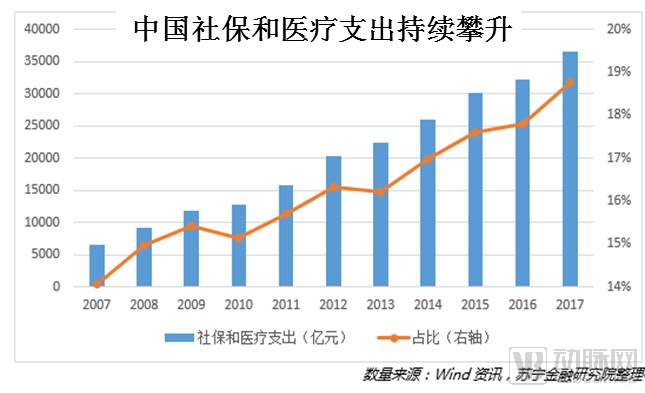
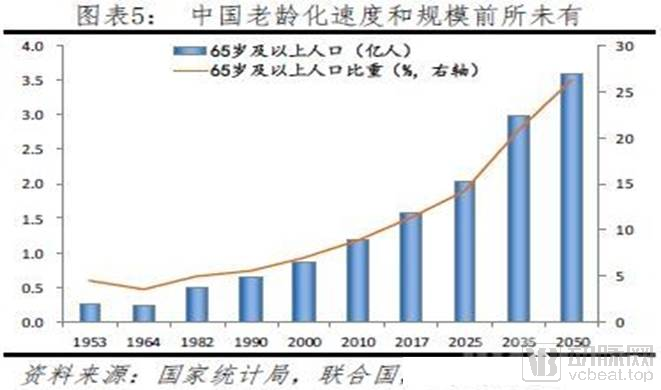
As shown in the left chart above, the proportion of social security and healthcare expenditures in China’s fiscal revenue has been continuously rising; meanwhile, the right chart indicates that the pace and scale of population aging in China are unprecedented. Per capita medical costs are also increasing, placing severe pressure on the medical insurance system. Previously, the “drug-funded healthcare” model led to high drug prices, resulting in significant inefficiency and waste. Now, even the National Healthcare Security Administration, as the largest payer, can no longer bear the burden. What lies ahead? Therefore, drug prices must be cut, and cut sharply.
Is Such Aggressive Price Bargaining Reasonable?Let’s take a brief look at data from other countries to gain some perspective. In the United States, generic drugs account for over 20% of spending while meeting nearly 90% of prescription medication needs, thereby saving substantial healthcare costs. This is what we call efficiency. In China, by contrast, generic drugs consume approximately 90% of total expenditure.
Thus, it is not difficult to understand that healthcare reform must first address the issue of drug supply efficiency.Limited healthcare expenditure resources necessitate higher efficiency in coverage.Of course, many other issues remain to be addressed, such as how to ensure funding for innovation by pharmaceutical manufacturers after drug price cuts, and how to safeguard the income of hospitals and physicians. These challenges will be resolved step by step. I fully endorse the National Healthcare Security Administration’s efforts in negotiating lower drug prices. Only in this way can the healthcare sector establish a foundation for sustainable development.
In the past two years, it has been widely felt that healthcare reform policies have been introduced rapidly, with substantial intensity and precise focus—often described as “fast, accurate, and decisive.” Why? Not only because the problems are evident,Furthermore, healthcare and health insurance are issues concerning “public stability” and “national prosperity.”. If we adopt a broader perspective, we can gain clearer insights into the issues at hand. From a national standpoint, the accelerating trend of population aging, coupled with housing, education, and healthcare expenditures—the three major rigid household expenses—will significantly impact household financial stability and the country’s overall future development.
After enduring soaring housing prices and exorbitant education costs, households have keenly felt the burden of the first two major expenditure categories. Against the backdrop of an accelerating aging population, the third category has become a hidden concern for families.
If society fails to provide a cost-effective and reasonable healthcare system, or cannot offer families a predictable and reassuring outlook on medical expenses, the consequences will extend beyond issues such as patient satisfaction, doctor-patient conflicts, and elderly protests. It will undoubtedly undermine residents’ long-term confidence, leading to increased savings for old-age care and reduced consumption, ultimately affecting consumer behavior. A moderately prosperous society would no longer be a healthy one.
Therefore, from this perspective, the National Healthcare Security Administration’s aggressive price negotiations and the “urgency” of healthcare reform policies become easier to understand. One should no longer harbor any illusions; this is a major issue concerning national stability and public well-being, not a “minor matter” for the medical and health industry. Understanding this layer provides a fundamental insight into future policy trends and the evolution of the industry.
Given the sense of “urgency,” with the industry previously witnessing a constant stream of trends and significant investment, why has commercial implementation fallen so short of expectations, and why has the value growth of startups been so sluggish?
Many argue that healthcare is inherently a slow-moving industry that demands patience. Yet, after more than five years, venture capital has already demonstrated considerable patience. If the pace remains this sluggish, what will continue to attract VC investment? In this new landscape, how should startups craft their fundraising narratives?
Let me share our analysis and insights to explain why progress was previously “slow” and why it will accelerate in the future.
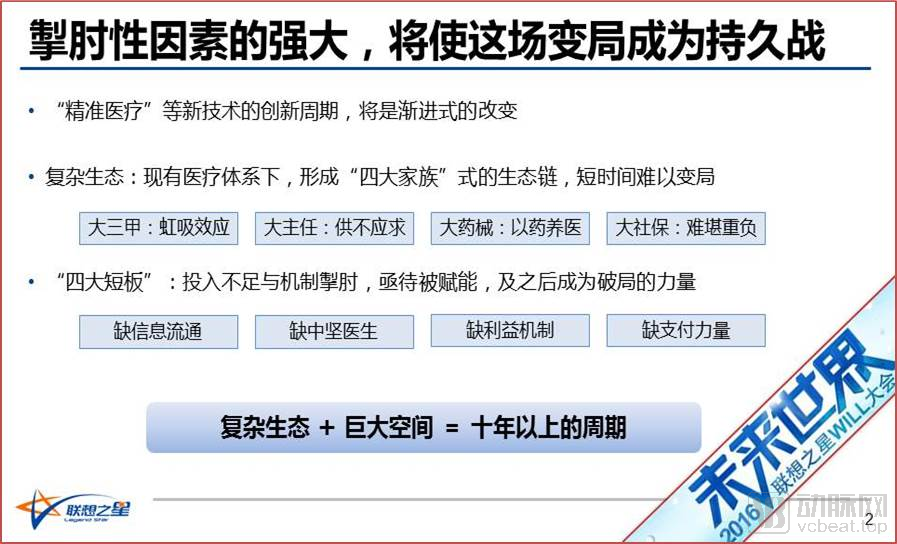
The slide above was presented by us at the Legendstar WILL Conference in July 2016, an event attended by six to seven hundred participants. At that time, the mobile health sector was experiencing a surge of enthusiasm, with high expectations for explosive growth. Using this chart, we analyzed that due to the strength of constraining factors, the industry would have a slower start rather than an immediate explosion. Both investors and entrepreneurs needed to exercise patience.
The primary rationale, derived from an analysis of the driving forces behind industrial change, is that the fundamental ecosystem of the healthcare industry is characterized by complex gaming dynamics: the “four major families”—large tertiary hospitals, senior department heads, major pharmaceutical and medical device companies, and large-scale social insurance programs—consume a substantial share of resources. Meanwhile, four critical shortcomings persist: inadequate information flow, a shortage of mid-level physicians, flawed incentive mechanisms, and insufficient payment capacity.
Based on an analysis of the driving-force structure, combined with an understanding of the laws governing industrial evolution, we proposed at that time thatAs shown in the figure below, the development pace of the healthcare industry clearly exhibits three stages: first, the connectivity and empowerment phase; second, the transaction and stickiness phase; and third, the new ecosystem formation phase.More than three years have passed, and driven by the vigorous advancement of healthcare reform, the industry has undergone a “turning point” shift. It can now be said that the first phase of “slow medicine” is transitioning to the second phase of “fast medicine,” entering a stage characterized by an acceleration from slow to fast, requiring all stakeholders to keep pace with this rhythm.
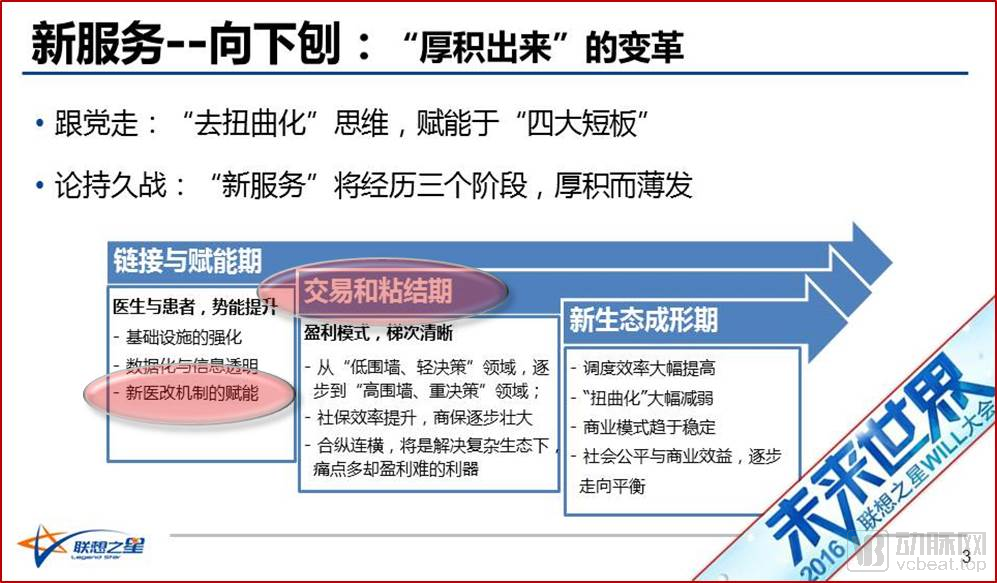
It is difficult to predict the pace of the first phase, as it heavily depends on the effectiveness of empowerment driven by the new healthcare reforms. If the empowerment yields strong results, the process will accelerate; otherwise, it will slow down. The most significant variable this year has been the rapid introduction and substantial intensity of policy measures. The National Healthcare Security Administration’s “aggressive price cuts” and the “swift, precise, and forceful” nature of healthcare reform policies indicate that policy has clearly emerged as the most positive driving factor for the industry. Therefore, I am confidently optimistic about the future trends of the industry.
As for the pace, there is no need to hesitate due to excessive concern over “slow medicine.” Once policy uncertainties are resolved, we will face a future with clear certainty. The combination of robust policies and resource development will accelerate the industry’s pace from a slow walk to a fast run, entering a phase characterized by active trading and strong stakeholder stickiness.
Given that the urgency stems from the imperative to change, and the acceleration is driven by policy-induced breakthroughs reshaping the industry landscape, the next step is to consider how to leverage these momentum shifts. At the outset today, I raised the question of how to “go with the flow.” Let us unpack the value chain to identify which elements align with the trend and which run counter to it.

In the past, much debate centered on two mindsets: supply-side thinking, which is physician-centric, and demand-side thinking, which is patient-centric. The early internet healthcare sector’s bold claims about disrupting doctors and hospitals were typical examples of demand-side thinking.
After years of business practice, it is now widely recognized that the core issue in China’s healthcare system lies on the supply side, not the demand side.
Identifying the key scarcities within the supply-side value chain reveals where future “new forces” are likely to emerge.The core constraint on the supply side lies in the shortage of medical service resources (capacity and efficiency)., therefore, a core business element in supply-side thinking is how to enhance physicians' motivation. Guiding business strategy and anticipating future policy trends with this mindset will likely lead to a higher probability of success.
On the supply side, there are three “new forces”: product resources, payment resources, and medical service resources.Product resources, such as medical devices and equipment, are at the forefront of market segmentation.

Generic drugs, devices, and consumables:This is a market characterized by simultaneous declines in both volume and price. On the pricing front, sharp cuts have driven procurement prices to their bottom. In terms of volume, physicians no longer prescribe medications as liberally as before, and medical insurance reimbursement has become more restrictive. This is a contracting market. Japan also implemented gradual drug price reductions in response to its aging population; from approximately 1995 to 2010, the number of pharmaceutical manufacturers plummeted from around 1,500–1,600 to just 300, leaving only 20% of the original companies. Currently, China has over 7,000 manufacturers of generic drugs and medical devices. I believe the consolidation of Chinese manufacturers will proceed even faster than in Japan, taking less than half the time.
Innovative Drugs and Gene Technology:There is no need for further debate; the “global lowest price” is likely to become the norm. With a population of 1.4 billion and a monopsonistic procurement mechanism—the national health insurance system—China has become an incremental market where prices are exchanged for volume. Overseas giants such as AstraZeneca recognize this logic and have thus prudently adopted a cooperative stance.
With R&D costs for innovative drugs being so high, are their low prices a good or bad thing? In my view, this is largely a positive development. Most Chinese innovative pharmaceutical companies are startups that lack established commercial sales brands and resources. To bring innovative drugs to market, these companies must not only overcome the hurdles of product development but also navigate the challenges of market commercialization. Under the healthcare system where medical practices are subsidized by drug revenues, substantial marketing expenditures are inevitably required for market expansion.
Now, with volume-based procurement in place, significant marketing costs are saved, making market entry much easier. In any market, a sudden reduction in consumptive friction within the value delivery chain is a major positive signal that can catalyze explosive growth. The innovative drug market is no exception, provided, of course, that the products in question are genuinely innovative.
Overseas Markets:The story of “Made in China” has unfolded not only in market-driven industries that have endured fierce competition, such as apparel, hardware and machinery, home appliances, smartphones, and even the internet. We can fully expect that, having undergone similarly intense competition and consolidation, this narrative of products expanding overseas will also play out in China’s pharmaceutical and medical device industries.
Many countries around the world are facing an aging population trend, necessitating the procurement of affordable medications, which presents an opportunity for Chinese-made pharmaceuticals to expand into overseas markets. In fact, this trend has already begun, albeit on a relatively small scale.
Let us re-examine our payment resources; there is significant potential in leveraging them effectively. The current insurance sales models exemplify the empowerment of payment resources. If the aforementioned issue of adverse selection is properly addressed, it can help enterprises refine their market positioning and drive commercial growth.

Empowering Healthcare Cost Containment:Information technology, DRGs... there is much work to be done. By serving the country and safeguarding the public’s financial well-being, you can secure the future.
The Rise of New Commercial Insurance Products:Health insurance, long-term care insurance, and insurance for individuals with pre-existing conditions... These insurance sectors were all highly popular in 2019. Although they face the risk of severe underwriting losses, they undoubtedly represent a major trend and are emerging forces worth cultivating. Empowering these sectors will ultimately yield rewards, despite any interim challenges.
Development and Monetization of Diverse Traffic Resources:This pertains to the consumer-facing (C-end) sector. While internet healthcare boasts substantial traffic resources, competing on this front means going up against tech giants with massive user bases such as Tencent, Alibaba, ByteDance, and Meituan. Therefore, identifying a precise niche positioning is crucial. At this stage, building a new traffic pool from scratch would entail prohibitively high customer acquisition costs, making it an unrealistic strategy for startups.
The final, and most critical, emerging force is healthcare service resources. This area offers greater scope for innovation, stronger practical applicability, and a closer proximity to revenue generation.
The payment transformation we discuss empowers the emerging forces of the future. Both payment resources and product resources constitute payment capabilities; one is related to costs, while the other is directly linked to incremental growth. Both must empower the core medical service resources.
How to empower? A large number of internet healthcare companies have engaged in all aspects of pharmaceuticals, physician services, and insurance-related businesses. I feel this resembles a “city-building campaign,” where they attempt to do everything, which is extremely exhausting. In the past, this approach was driven by the lack of various infrastructure elements; however, as boundary conditions are now falling into place, companies should focus on their core competencies, specialize, and extend their strategic depth. Rather than attempting to handle every aspect in-house, it would be more effective to form strategic alliances and collaborate with others.

Tiered Diagnosis and Treatment and the Decentralization of Medical Expertise:Tiered diagnosis and treatment has been widely emphasized, with particular attention needed on the decentralization of medical expertise. It is not only by managing complex and rare diseases that one demonstrates greatness; significant contributions are also made by bringing high-quality medical talent and advanced products to lower-tier hospitals, thereby improving the accessibility of basic healthcare services and enhancing diagnostic and treatment efficiency.
Tiered Diagnosis and Treatment Integrated with Commercial Insurance:Meeting the demand for highly specialized medical services driven by consumption upgrading. What is meant by stratification? Medical resources are concentrated in regional hubs and operate through a cascading transmission mechanism. The underlying pattern involves diffusion from highly developed cities—where medical resources are most densely concentrated—to areas with secondary density, then to moderately dense regions, and finally to rural areas.
How Can Tiered Diagnosis and Treatment Meet Demand? On one hand, medical service resources should be developed across market tiers; on the other, physicians’ motivation must be taken into account. The model of subsidizing healthcare through drug sales is no longer viable due to its low efficiency. We must unequivocally advocate for compensating physicians through service-based revenue, and support both doctors and medical institutions. Only in this way can we ultimately benefit patients. Without physicians’ motivation, how can patient satisfaction be achieved?
Telemedicine and Intelligent Technologies:Various technologies must be integrated to empower physicians’ capabilities and increase their reasonable income, thereby truly leveraging the power of payment.
I leave you with one final thought to ponder together,Betting on “Weather” or Betting on “Climate”? What’s the Difference?
I often say that in a snowballing, long-term market trend, whether in entrepreneurship or investment, we are unlikely to clearly see the “temperature” three weeks from now, but we can clearly see the “climate” three months ahead. Uncertainty is the “temperature”; certainty is the “climate.” The progressive development of the healthcare industry embodies the adage: “The future is bright, but the path is tortuous.” So, do we bet on the “temperature,” or do we bet on the “climate”?
That concludes my presentation. Thank you all!