

DingXiang Doctor Releases '2020 National Health Insight Report': Mental Health Emerges as Top Concern
On January 14, DXY released the “2020 National Health Insights Report” (hereinafter referred to as the “Report”). This year’s Report was produced in collaboration with Penguin Eating and Drinking Guide in the dietary sector, Keep in the fitness sector, and KnowYourself in the psychological sector. It established health indicators across dimensions such as positive mood, quality sleep, healthy gut, clear skin, and fit physique, and used these keywords to explore people’s perceptions of health and the various efforts they make in pursuit of it.
This report involved approximately 70,000 participants. Following the emergence of “punk wellness” as a popular internet buzzword in the 2019 National Health Insight Report, the 2020 Report identified a distinct demographic characterized by “Flag-setting wellness.” The findings indicate that individuals who tend to set health-related goals (“flags”) exhibit more optimistic health outcomes.
"Those with goals are more proactive; those who set health goals become healthier."
“Slim as a lightning bolt, break the singlehood record, and prevent baldness by going to bed early and waking up early” was the New Year’s resolution posted by Xiao Wang, a member of the post-90s generation, on his WeChat Moments on New Year’s Day 2020. The post received numerous likes upon being published. However, there is an open secret among young people in contemporary China: the more resolutions you make at the beginning of the year, the harder reality will slap you in the face by year’s end.
Is this really the case?
To better understand the impact of health goal-setting on the improvement of individual health status, Dingxiang Doctor categorized respondents into four groups based on two dimensions: “goal setting” and “practical action.” These groups are: Hardcore Health Enthusiasts (who set goals and take consistent action), Punk Health Enthusiasts (who do not set goals but take direct action), Laid-back Health Enthusiasts (who neither set goals nor take much action), and All-Talk Health Enthusiasts (who set goals but take little action).
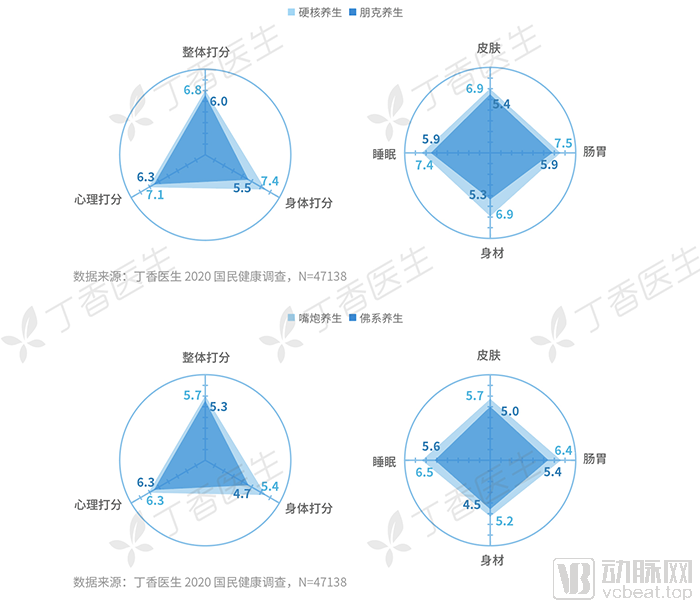
A comparison of these four groups reveals that the “hardcore wellness” group naturally achieves optimal health outcomes most readily.
Meanwhile, although both the “Punk Health” and “Buddha-style Health” groups have low expectations and demands regarding their health, the “Punk Health” group, which makes silent efforts, exhibits better overall health status than the “Buddha-style” group, which adopts a passive and indifferent approach.
However, when comparing the “all-talk wellness” group with the “laissez-faire wellness” group—both of which make no actual efforts toward health—it was found that the “all-talk wellness” group, who still hold expectations for their health, exhibited significantly better health indicators than the “laissez-faire wellness” group.
A comparative analysis reveals that if one cannot actively implement health-improving measures, setting personal health goals (or “flags”) is a beneficial first step. Establishing such goals contributes to enhancing one’s health status; indeed, individuals who set more health-related flags tend to enjoy better health outcomes.
In response, Chen Haixian, a Ph.D. in Psychology from Zhejiang University and a renowned psychological counselor, analyzed: “Beyond prompting greater action among those who set goals, the act of setting ‘flags’ itself serves as a significant source of hope and meaning. Individuals with clear goals tend to be more proactive, experiencing a stronger sense of direction and control in their lives. This sense of direction and control is closely linked to health.”
So, you still need to set goals—what if they actually come true?
“Eat Well, Sleep Well, Feel Good” Becomes the New Health Label; “Psychological Issues” Ranks as the No. 1 Health Concern
As living standards improve, the concept of “health” is no longer primarily associated with merely “being free from disease,” but rather with a higher quality of life: good mood, nutritious diet, restful sleep, healthy skin, fit physique, and even lustrous hair.
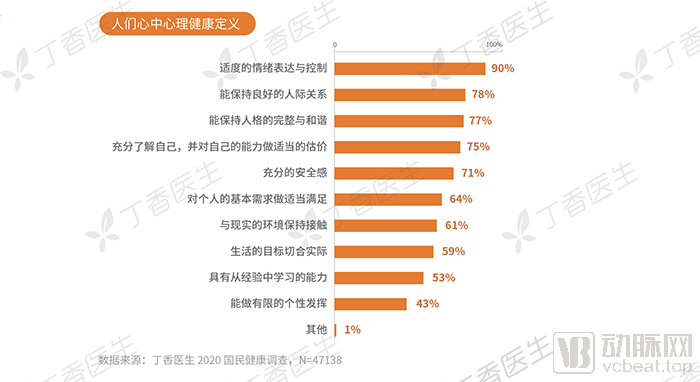
“The Report” indicates that the concept of “health” in people’s minds is no longer as closely tied to “being disease-free” as it once was; instead, it is becoming increasingly associated with “lifestyle.” In their view, the top three attributes labeled as indicative of health are good mental well-being, quality sleep, and healthy digestion. “Not getting sick” ranks only fourth, followed even by attributes related to esteem needs, such as good skin, a fit physique, and healthy hair.
The subtle shift in health evaluation dimensions stems from rising material living standards and the wave of consumption upgrading in recent years. In today’s social media landscape, this evolving demand for health is set to drive new trends, serving as a guidepost for quality living.
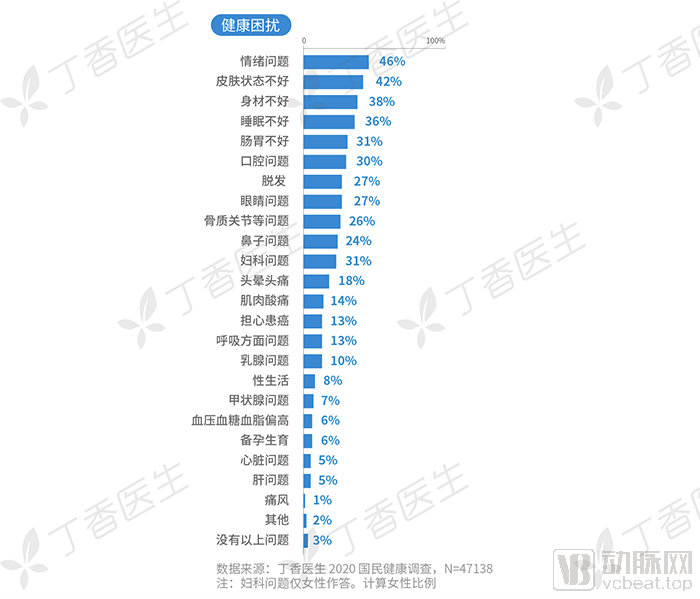
Data on “Health Concerns” reveal that 97% of respondents reported experiencing health-related issues, with the top three being emotional problems, poor skin condition, and dissatisfaction with body shape.
While skin problems were the top health concern in 2018, emotional issues rose to the forefront in 2019, making it no surprise that “I’m having such a hard time” briefly became a popular social media catchphrase.
Data shows that 85% of people believe they may have or may have had one or more mental disorders, including depression, bipolar disorder, obsessive-compulsive disorder (OCD), anxiety disorders, substance use disorders, and other mental health conditions. Among these, the three most prevalent are depression, anxiety disorders, and obsessive-compulsive disorder (OCD).
Chen Haixian believes that these data likely reflect not objective mental health status, but rather people’s perceptions of their own psychological well-being. In a sense, this is also the result of the success of mental health science popularization in recent years. This success has led people to become accustomed to using diagnostic labels of mental disorders to name their vague inner unease. Furthermore, the ranking of self-perceived mental disorders can likewise be interpreted as a reflection of the popularity of these conditions in mass media.
Data shows that among various events affecting people’s emotions, “work and study conditions” have emerged as the most significant factor. When coping with suboptimal mental health or psychological disorders, individuals most frequently choose lower-cost, more controllable methods to relieve stress, such as sleeping, online shopping, playing video games, and eating. Experts suggest that these approaches to alleviating psychological distress may also reflect the underlying issue troubling them: loneliness.
Milk Tea May Become the Biggest Threat to Health, with Over 70% of People Opting for Low-Sugar or Sugar-Free Options
Contemporary lifestyles are fraught with contradictions. While we know that a healthy diet should be low in sugar and salt, we still find it hard to resist milk tea, hot pot, and barbecue. We understand the importance of going to bed early and waking up early to ensure adequate sleep, yet we often end up scrolling through our phones late into the night. We recognize that maintaining a healthy physique requires regular exercise, but sticking to a consistent workout routine is easier said than done.
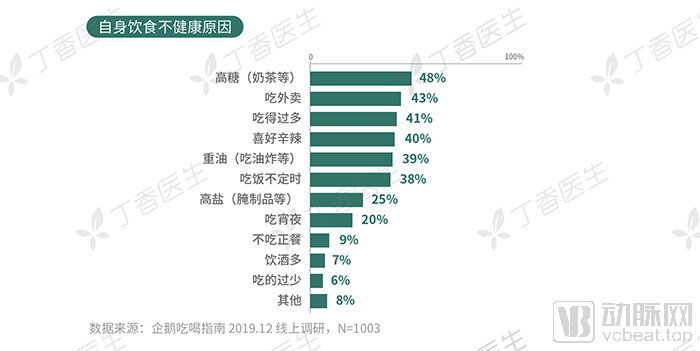
The Report shows that 99% of people have requirements for a reasonable diet. However, high-sugar foods such as milk tea and cakes are traps that people in all weight ranges find difficult to avoid, followed by food delivery. 48% of people believe that the source of unhealthy eating is high-sugar foods such as milk tea. Compared with women, men are better able to resist the temptation of milk tea, but 49% of men still drink at least one cup of milk tea per week. Among women, 62% consume at least one cup of milk tea per week.
Thus, people often compensate for the guilt of drinking milk tea by choosing lower sweetness levels, using sugar-free or low-sugar options to comfort and numb themselves. The largest proportion of consumers, 41%, opt for 30% sugar, while 31% choose sugar-free milk tea. In terms of gender differences, men are more willing to face their desires; having chosen to drink milk tea, they do not restrain themselves. The proportion of men who select milk tea with 50% sugar or higher is 26 percentage points greater than that of women.
More Than Half of People Have Worried About Sudden Cardiac Death, with 60% of Those Born After 2000 Having Had This Concern
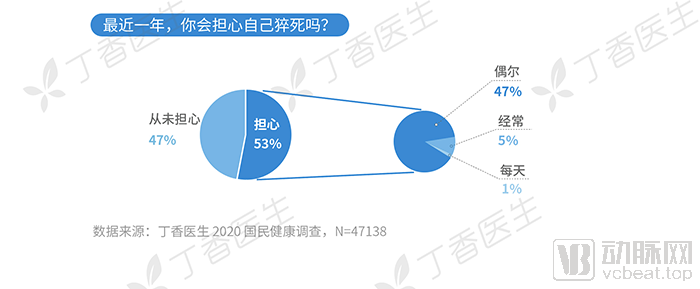
In 2019, topics such as the sudden death of actor Godfrey Gao in the early hours of the morning, the sudden deaths of three doctors in Shanghai within two months, and “post-90s generations being afraid to check their medical examination reports” sparked heated discussions on social media. The latest statistics from DXY Doctor are also far from encouraging: 53% of respondents have experienced concerns about sudden cardiac death, with 6% reporting frequent or even daily worries.
Contrary to conventional wisdom, older individuals exhibit a lower level of concern about sudden cardiac death, whereas younger generations, specifically those born after 1995 and 2000, report higher levels of such anxiety. Notably, 60% of individuals born after 2000 and 59% of those born after 1995 have expressed concern about experiencing sudden cardiac death.
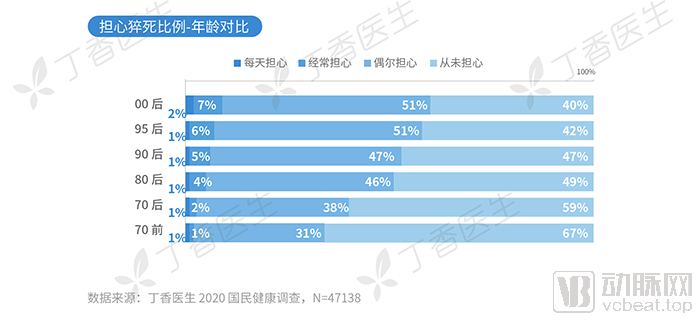
Although these statistics are not medical data, they reveal the widespread concern and dissatisfaction among the general public regarding their personal health status. From a macro perspective, this is not only a public health issue but also a true reflection of contemporary young people facing dual pressures from life and work.
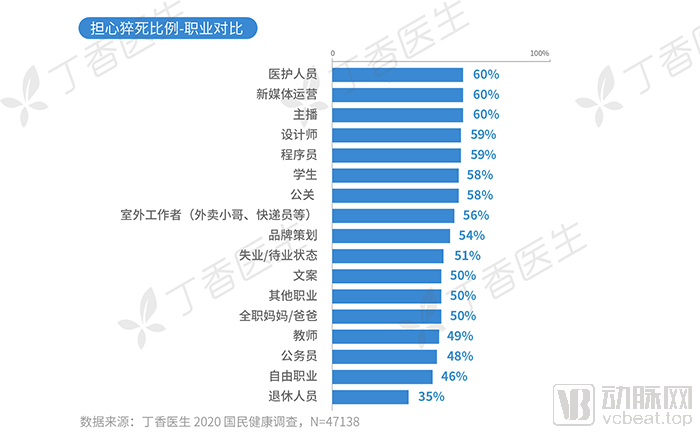
Individuals with longer working hours harbor greater concerns about sudden cardiac death. Medical professionals, new media operators, and live streamers who face high work intensity, as well as designers and programmers who engage in prolonged sedentary desk work, exhibit a higher prevalence of such concerns. Notably, the proportion of students worried about sudden cardiac death is also significant, reaching as high as 58%.
Furthermore, the "2020 National Health Insight Report" also conducted a detailed survey on the public's sleep and exercise habits. Whether it is the notion that "Beijing, Shanghai, and Guangzhou don't believe in early bedtimes" or the trend that "both men and women are fond of intense abdominal workouts," these findings reflect the contemporary paradox where individuals pursue health while simultaneously grappling with contradictory behaviors.
Encouragingly, the term “health” has gained increasing popularity on public social media platforms. From the 2017 trend of “brewing goji berries in thermos flasks,” to the 2018 hit film “Dying to Survive,” and then to the 2019 concept of “punk wellness,” the internet has broken down geographical barriers. While narrowing the gaps between higher-tier and lower-tier cities in terms of consumption patterns and health perceptions, it has also heightened public attention to health. Consequently, national health literacy has been continuously improved through repeated exposure to trending topics on Weibo.