

China's First AI-Powered Medical Imaging Product 'DeepVessel FFR' Receives NMPA Approval for Clinical Use

Alwin Capital
Investment Institution in the Frontier Fields of Life Sciences
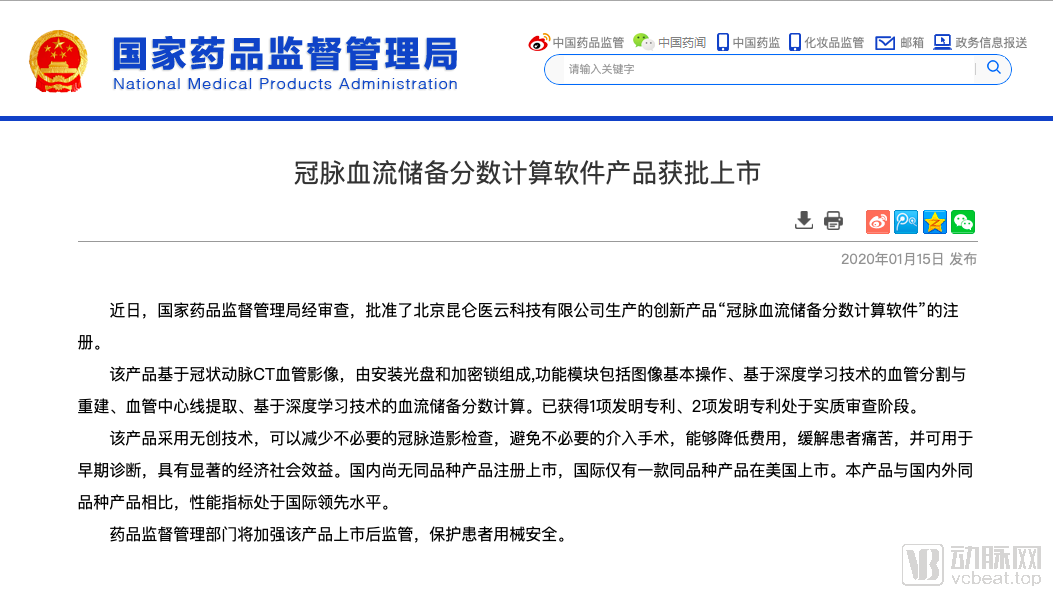
January 15, 2020, “DeepVessel Score®"Obtained the first Class III medical device registration certificate for artificial intelligence from the National Medical Products Administration (NMPA), approved for clinical application!"
"As the world's first non-invasive coronary functional assessment product fully based on deep neural networks, 'DeepPulse Fraction"®“It is the first AI-based medical product to enter the NMPA’s Green Channel for Innovative Medical Device Approval. Currently, no similar products have been registered and marketed in China, while only one comparable product has been launched in the United States. Compared with its international counterparts, DeepPulse Fraction® demonstrates internationally leading performance across all key metrics.”
Cardiovascular disease is the leading cause of death worldwide, with nearly 300 million affected individuals in China, posing a severe threat to public health. Clinically, cardiovascular diseases are commonly diagnosed using imaging techniques to assess the degree of stenosis in coronary arteries. However, an increasing body of clinical research indicates that the degree of vascular stenosis does not directly reflect disease severity; rather, evaluating the blood supply function of the vessels is key to assessing the extent of myocardial ischemia.
Currently, invasive pressure wires are commonly used in clinical practice for functional assessment of blood vessels. The main issues are the high cost of the wires and the need for patients to undergo interventional procedures, which hinders the large-scale application and widespread adoption of vascular functional assessment. To address this problem, Keya Medical has assembled a team of 20 Ph.D. holders who returned to China after studying in the United States, along with nearly 100 top-tier domestic researchers, and collaborated with leading cardiovascular disease experts and hospitals across China. By leveraging world-leading deep learning algorithms and medical image analysis technologies, they jointly developed the “Coronary Flow Reserve Fraction Calculation Software” (trade name: “DeepFFR”).®”). This system leverages deep learning algorithms to achieve a technological breakthrough in non-invasive coronary functional assessment based on medical imaging data, thereby avoiding unnecessary coronary angiography and eliminating the need for pressure wires. It is the world’s first non-invasive coronary functional assessment product entirely based on artificial intelligence deep neural networks.
DeepPulse Fraction, the first AI-based medical device in China to receive NMPA Class III certification®All technical performance indicators have reached world-leading levels. Results from a prospective, multicenter clinical trial led by Professor Zhou Yujie of Beijing Anzhen Hospital, Capital Medical University, indicate that the deep vein fraction®Its accuracy, key performance indicators, computational speed, and turnaround time for results all surpass those of comparable foreign products. Notably, the turnaround time has been reduced from 3–8 hours to under 10 minutes compared with similar international offerings. The product obtained EU CE certification in 2018 and has been successfully deployed in more than ten countries overseas, including nations in Europe and Southeast Asia.
It is reported that Keya Medical has completed a financing round worth hundreds of millions of yuan, with the Series A round led by Alwin Capital.
Since 2015, the State Council, the National Development and Reform Commission (NDRC), and other departments have continuously issued multiple policy documents covering various fields of artificial intelligence (AI) penetration. In May 2016, the NDRC, the Ministry of Finance, and the Ministry of Industry and Information Technology jointly released the Three-Year Action Plan for “Internet Plus” Artificial Intelligence. In 2017, the Development Plan for New-Generation Artificial Intelligence outlined the blueprint for the development of new-generation AI. In 2018, the Government Work Report, delivered at the First Session of the 13th National People’s Congress, once again included AI. The issuance of these favorable policies has further promoted the deep integration of R&D, application, and industry in new-generation AI, making AI an important national development strategy in China.
Deep Vein Score®By leveraging its independently developed DeepVessel and DeepFFR deep learning algorithms, the system performs non-invasive functional analysis (CT-FFR) using coronary computed tomography angiography (CTA) images. This integrates artificial intelligence technology into the clinical diagnosis and treatment workflow for coronary heart disease, effectively enhancing the diagnostic and therapeutic capabilities of medical institutions in China and achieving genuine technological innovation in the healthcare sector. The successful development of DeepPulse Fraction® aligns with China’s national strategy and overall planning for artificial intelligence, serving as a strong demonstration of AI applications in the field of precision medicine.
According to the "Report on Cardiovascular Diseases in China," the prevalence and mortality rates of cardiovascular diseases in China continue to rise, with 290 million affected individuals, posing severe challenges to public health and healthcare initiatives.
Deep Vein Score®The successful development and approval for clinical use of DeepVessel FFR will provide a new non-invasive testing method for functional ischemia assessment in patients with suspected coronary heart disease.®Characterized by its non-invasive, precise, convenient, and efficient nature, this technology can avoid unnecessary coronary angiography and interventional procedures, thereby reducing surgical pain and risks. It is also applicable for the early diagnosis of coronary heart disease (CHD), benefiting tens of millions of CHD patients and suspected cases in China. At the national and societal levels, this technology can significantly reduce costs associated with angiographic examinations, pressure guidewires, and subsequent interventional treatments, thus saving national medical insurance expenditures and delivering substantial economic benefits and social value.