

Engu Information Technology: Leveraging 'Tech + Service' to Pioneer Smart Elderly Care in China
From entering the elderly care sector to focusing on smart elderly care, the Engu team has undergone a decade-long journey.
Mr. Yu Fa, Co-founder and General Manager of Engu, took us back to 2006, when the entire core team was still at the Chinese Academy of Sciences, conducting fundamental research and practical applications related to the Internet of Things (IoT), then known as sensor networks. During that period, the team completed numerous national- and provincial-level key IoT projects, including intelligent security for the Shanghai World Expo, electronic perimeter systems for Pudong International Airport, and water quality monitoring in Lake Taihu, covering application scenarios across various industries such as security, transportation, environmental protection, tourism, and power.
“We have been implementing IoT technology across various industries, deriving satisfaction from constantly challenging ourselves on the technical front. However, our understanding of the industries themselves was not sufficiently profound. Our first exposure to the elderly care sector came through a health management project for retired employees of a large central state-owned enterprise. At that time, we felt this field was highly meaningful and filled with compassion,” Yu Fa continued. “Later, we implemented sojourn-based elderly care and health management projects for a real estate developer specializing in senior living. Subsequently, our team finally determined its strategic direction.” Yu Fa smiled, saying, “All told, it has been ten years since we first encountered smart elderly care to becoming fully focused on it.”
At the end of 2011, the team selected smart elderly care as its strategic direction and formally established Shanghai Engu Information Technology Co., Ltd. The core founding members gradually left their positions within the Chinese Academy of Sciences system to devote their full attention to the elderly care industry.
Establish a Closed-Loop Smart Elderly Care Operation Service Based on the Six-Domain Model Architecture Standard
Yu Fa, who comes from a scientific research background, speaks with pride about innovations in smart elderly care technology: his team was among the earliest to participate in the development of China’s six-domain model architecture standard for the Internet of Things (IoT), and they applied this six-domain model to the smart elderly care industry, establishing a closed-loop operational service system for smart elderly care.
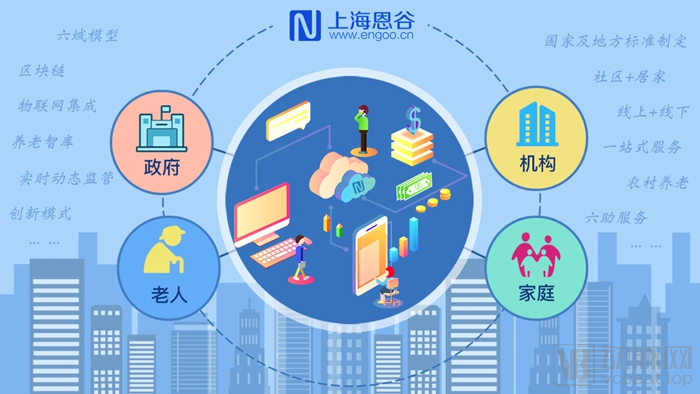
Within this closed-loop ecosystem, Engu connects key stakeholders—including the government, care institutions, and the elderly—with end-user hardware devices and third-party service providers. Through this platform, the government can monitor in real time the operational dynamics of elderly care enterprises, fund flows, and elderly-related data via intuitive data dashboards. Elderly care service providers on the platform can gain deeper insights into seniors’ health conditions and institutional operational metrics, thereby standardizing their management practices. Seniors and their family members can access comprehensive health records across multiple devices at any time and request services with a single click.
The platform has also independently developed a range of “Xiao Mian’ao®” smart terminal products tailored to three scenarios—community-based, home-based, and in-home services—for monitoring, tracking, emergency alerts, and other functions. It is understood that these devices are seamlessly integrated into the Engu platform ecosystem. However, Yu Fa told reporters, “Selling hardware products is not our objective; what we aim to do is leverage our platform and systematic solutions to facilitate the industry’s transformation, upgrading, and sustainable development.”
“Technology + Services”: A Powerful Combination for Elderly Care
As the market evolved, it placed higher demands on Engu. “After our platform architecture was established, it indeed had no major issues and received positive feedback from clients. However, through in-depth communication, we discovered that clients wanted more than just a standalone software system; they did not want a ‘build-and-abandon’ approach but instead required operational support, offline services, and one-stop solutions,” said Yu Fa.
The Engu team promptly adjusted its strategy, beginning in 2015 to establish offline service centers, thereby creating an integrated online-to-offline (O2O) service model through physical, on-site services.
Regarding offline services, Yu Fa stated that there are currently three main forms,First, physical entities such as community health service centers, providing elderly care services to the surrounding communities. It is understood that Engu has currently built and operates multiple physical offline service center facilities, incorporating various elderly care amenities, smart devices, and services within these centers.
The second form is through platform-integrated service providers., providing services to specific populations. For instance, Engu currently offers “six-assistance” services to elderly individuals under the government’s social safety net in certain cities, with the government ultimately paying based on the total number of service encounters.
The third form is through mobile service vehicles, covering a larger area and reaching more people at a lower overall cost. Yu Fa told reporters that elderly care in rural areas is currently a major concern for the government. As this population is relatively dispersed, the use of mobile service vehicles has significantly enhanced service coverage. According to the service plan, if one village is visited each day, a full rotation can be completed within one to two months, providing seniors with basic services such as health management and policy education, while continuously expanding other services based on the mobile service vehicle platform.
Regarding specific payment arrangements, a portion is covered by government procurement to provide basic care services for elderly individuals in the community who require a safety net; the remaining portion is paid directly by the elderly and their families through the platform.
Under this model, the government not only addresses the urgent need for elderly care services for vulnerable seniors by purchasing platforms and services, but also implements dynamic oversight of the service quality and safety provided by elderly care institutions.
Currently, Engu has established a comprehensive business portfolio comprising four core segments: the development and operation of smart elderly care platforms, smart monitoring systems for civil affairs departments, offline elderly care services, and an elderly care think tank. Its full range of products and services has undergone rigorous market validation and, following comprehensive evaluations by experts from the Ministry of Industry and Information Technology, the Ministry of Civil Affairs, and the National Health Commission, was included in the inaugural “Catalogue for the Promotion of Smart Health and Elderly Care Products and Services” jointly issued by these three ministries.
Building a Smart Elderly Care Standard System
As an enterprise established by a team from the Chinese Academy of Sciences, Engu has consistently promoted the development of the smart elderly care industry chain through its values of openness and sharing. Yu Fa stated, “We aim to collaborate with the government and partners across the upstream and downstream sectors to jointly establish a standard system for smart elderly care. In the process of advancing smart elderly care infrastructure, we hope this system will help steer the industry toward standardization, further integrate elderly care resources, and enhance the quality and efficiency of smart elderly care services.”
To date, the Engu team has led and participated in the development of more than 20 national, provincial, and municipal group standards related to smart elderly care, with several of these standards filling gaps in China’s relevant fields.
“From the initial awkwardness of stepping out of the laboratory to becoming a well-known enterprise in the industry, Engu has achieved remarkable results through continuous efforts.” Yu Fa showed reporters a series of certificates: High-Tech Enterprise, Double-Soft Enterprise (certified for both software product and software enterprise), “Specialized, Refined, Differential, and Innovative” Enterprise, AAAA-certified Elderly Care Service Provider, one of the first batch of National Smart Elderly Care Demonstration Enterprises jointly recognized by three national ministries and commissions, and the only enterprise selected under the Ministry of Industry and Information Technology’s “2018 IoT Integration Innovation and Convergent Application Project” in the field of smart health and elderly care.
A Decade of Dedication: By early 2020, Engu’s footprint had extended across China. Through the continuous recruitment of diverse professional talents from society, Engu’s team has grown from its initial 20 members at inception to nearly 300 today.
“Grace as profound as a valley, embracing the world; unity of knowledge and action, courage to pioneer”—this is the origin of the name “EnGu” and also the company’s path to development. Moving forward, EnGu aims to steadily expand its city-level operations and strive to collaborate with local governments to jointly promote the development of the elderly care industry.