2020 J.P. Morgan Healthcare Conference Highlights: Capital Rebound and Rising Innovation Trends Reshape the Medical Industry
San Francisco, USA — The Westin St. Francis Hotel is as bustling as ever this year, as the annual J.P. Morgan Healthcare Conference kicked off on schedule on January 13. The event has drawn hundreds of companies, thousands of investors, and nearly 10,000 attendees.
From startups to industry leaders with market capitalizations exceeding $300 billion, and from biopharmaceutical companies and medical device manufacturers to healthcare service providers, the J.P. Morgan Healthcare Conference has gradually become a globally recognized strategic bellwether within the industry, owing to its extensive coverage and strong convening power. At this premier event, major pharmaceutical companies have pulled out all the stops to showcase their core competencies, investment firms are actively scouting for “ideal projects,” and analysts outside the conference halls are on high alert, racing against time to produce “first-hand reports.”
At such a grand event, VCBeat (WeChat ID: vcbeat) has compiled key highlights from the 2020 J.P. Morgan Healthcare Conference, aiming to help readers discern the future blueprint of the biopharmaceutical industry.
On the first day of the conference, Hernan Cristerna, Global Co-Head of M&A at JPMorgan Chase, provided a holistic outlook on the global M&A market for 2020. He stated that while the transaction volume in 2020 was not expected to differ significantly from that of 2019, the complex and volatile factors affecting global trade and the economy in 2019 were likely to weaken in 2020. Therefore, it is reasonable to forecast a more optimistic global M&A market in 2020, with M&A activity expected to increase particularly in countries outside North America.
Chris Ventresca, another co-head of JPMorgan’s global M&A practice, further elaborated on his outlook: “We expect some companies to adopt more aggressive M&A strategies in 2020, including pursuing new growth initiatives, entering untapped markets, expanding operational capabilities, and even increasing debt levels or leverage to finance transactions.” He noted, “Going forward, a growing number of companies will seek stock-for-stock merger opportunities as a potential acquisition currency, aiming to create combined entities with stronger credit profiles.”
This statement is not an exaggeration. On the first day of the J.P. Morgan Healthcare Conference, more than 20 investment, financing, and M&A deals were finalized on-site, with women’s health diagnostics provider Sera Prognostics securing $151 million in financing to become the largest funding round of the day. Reportedly, Sera Prognostics is a biotechnology company specializing in blood tests, aiming to help women predict preterm birth and other pregnancy complications by detecting specific biomarkers in the blood. The company’s flagship product, PreTRM®Already approved in the United States for testing preterm birth.
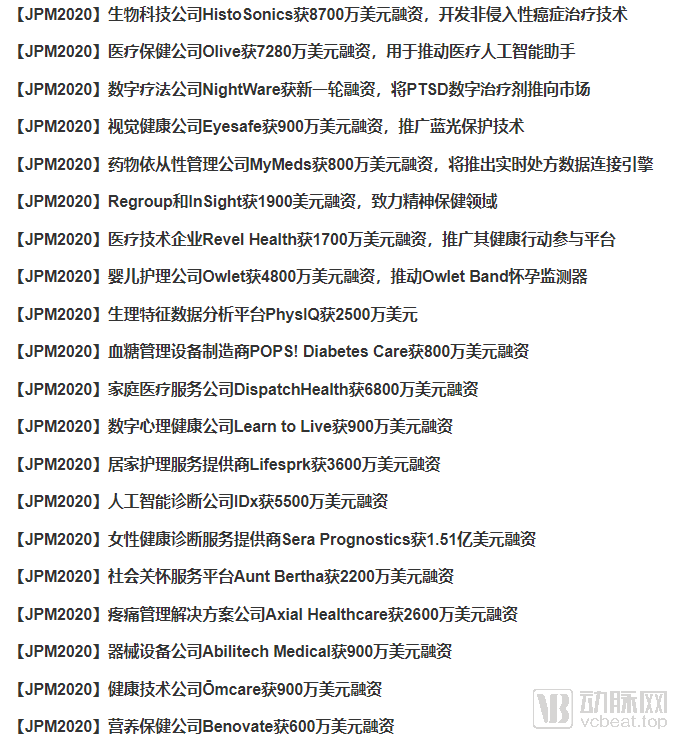
Selected Financing Deals Completed at the 2020 J.P. Morgan Healthcare Conference
Among the financing deals completed at this year’s J.P. Morgan Healthcare Conference, only Sera Prognostics secured funding exceeding $100 million, while the majority of deals ranged from several million to tens of millions of dollars. Notably, just ahead of the conference, Eli Lilly acquired biopharmaceutical company Dermira for $1.1 billion, and telehealth provider Teladoc Health acquired virtual care company InTouch Health for $600 million—two transactions that stood out even more prominently.
The “deal of the century,” which has drawn significant industry attention since the 2019 J.P. Morgan Conference—Bristol Myers Squibb’s (BMS) $74 billion acquisition of Celgene—has largely concluded by the time of the 2020 J.P. Morgan Conference. At the 2020 conference, BMS stated that it would actively accelerate integration efforts, with the new company’s leadership team already in place and smooth progress being made in areas such as the new operational/business model and clinical R&D. Currently, the company is actively integrating processes and systems between Bristol Myers Squibb and Celgene. Reporters also noted that, according to the personnel changes announced by BMS, former Celgene CEO Mark Alles has been removed from the new company’s executive roster; meanwhile, BMS’s former Chief Financial Officer Charlie Bancroft will step down and retire, to be succeeded by former Celgene CFO David Elkins.
A company’s clinical R&D capabilities serve as a key metric for investment institutions and represent one of the enterprise’s strategic priorities. This perspective is corroborated by Bruce Broussard, CEO of insurance giant Humana: “From the standpoint of the entire health insurance industry, insurers are actively enhancing their ability to keep members healthy.”
This trend is not confined to the health insurance sector; it is also evident across the broader biomedical industry, where an increasing number of companies are actively seeking clinical collaborations with firms possessing strong R&D capabilities to enhance their overall clinical competencies.
Genentech, a well-established and powerful genetic engineering technology company, has long been highly regarded by industry insiders, who actively seek deep strategic collaborations with it. Previously, Genentech and Gilead Sciences reached a 10-year global research and development partnership. As a large, research-driven biopharmaceutical company in the United States, Gilead is also actively seeking to partner with strong enterprises like Genentech. At the J.P. Morgan Healthcare Conference, Gilead’s CEO Daniel O’Day explicitly stated, “We are very eager to find complementary companies similar to Galapagos for collaboration.”
Partnering with companies that possess strong R&D capabilities is one of the key development directions actively pursued by pharmaceutical companies. At the 2020 J.P. Morgan Healthcare Conference, Genentech announced a new strategic collaboration with Adaptive Biotechnologies, an immune sequencing company. Under this partnership, Genentech will utilize Adaptive Biotechnologies’ blood sample testing services to evaluate the efficacy of venetoclax in detecting minimal residual disease (MRD), with the aim of securing FDA approval.
The collaborations struck at the 2020 J.P. Morgan Healthcare Conference went far beyond these, with strategic alliances between industry leaders emerging as a highlight of the event. World-renowned gene sequencing company Illumina announced a 15-year partnership agreement with Roche, aimed at accelerating the clinical accessibility of NGS-based in vitro diagnostic tests using Illumina’s diagnostic sequencing systems. The two companies will leverage their complementary strengths, with Roche and Illumina jointly developing new companion diagnostic methods to supplement the TruSight Oncology 500 (TSO 500) comprehensive cancer genomic testing kit.
On the government front, the UK government reached an agreement with Novartis at the conference, under which the company will provide its late-stage cholesterol-lowering drug, inclisiran, to patients at high risk of heart disease. The drug is currently awaiting approval in the United States. Once it undergoes large-scale clinical trials and receives regulatory approval in the UK, it could offer a potential cure for patients with atherosclerosis (AS).
On the international front, Takeda Pharmaceutical Company announced a preclinical collaboration with large CRO Charles River Laboratories. The two companies will launch multiple integrated programs centered on Takeda’s four core therapeutic areas: oncology, gastroenterology, neuroscience, and rare diseases. Drug discovery experts and researchers at Charles River will support Takeda in advancing preclinical candidates into clinical trials through its end-to-end drug discovery and safety assessment platforms.
Cancer has long been a key area of heightened focus in the medical community, with cancer immunotherapy currently being the most prominent direction for research and development.
At the 2020 J.P. Morgan Healthcare Conference, we also witnessed the latest advances in cutting-edge cancer immunotherapies. Prominent biopharmaceutical company Adaptimmune Therapeutics announced updated data on its TCR-T therapies developed using the SPEAR T-cell technology platform. Among patients with solid tumors treated, one patient with hepatocellular carcinoma and one with melanoma achieved confirmed partial responses (PR), while one patient with gastroesophageal junction cancer and one with head and neck cancer achieved unconfirmed partial responses.
Notably, biotechnology company NantKwest presented the first case of complete remission in a pancreatic cancer patient as part of its “Moonshot” initiative at the conference, demonstrating the efficacy of PD-L1.t-haNK cells combined with N-803 therapy in a case of metastatic pancreatic cancer. This marks the world’s first trial combining haNK cells expressing a chimeric antigen receptor (CAR) targeting PD-L1 (PD-L1.t-haNK) with the IL-15 superagonist complex N-803 in patients with metastatic pancreatic cancer.
Oncology drugs with commercial potential have also become highly sought-after assets in the industry. At the 2020 J.P. Morgan Healthcare Conference, biopharmaceutical company Incyte announced an upfront payment of $750 million to MorphoSys to acquire rights to tafasitamab, an anti-CD19 antibody primarily used for the treatment of lymphoma. Tafasitamab enhances patients’ immune responses against cancer cells, thereby promoting tumor cell death. Under the agreement, Incyte also made a $150 million equity investment in MorphoSys and committed to up to $1.1 billion in milestone payments. Upon completion of the transaction, Incyte will hold the majority interest in tafasitamab.
Collaborations around oncology pipelines are in full swing. Galapagos has announced an expanded partnership with Fibrocor, through which it will secure exclusive licenses to four drug development programs for fibromas. Two of these candidates have already been identified; Fibrocor’s disease experts will continue to optimize them, while Galapagos retains the option to approve and further develop the drugs.
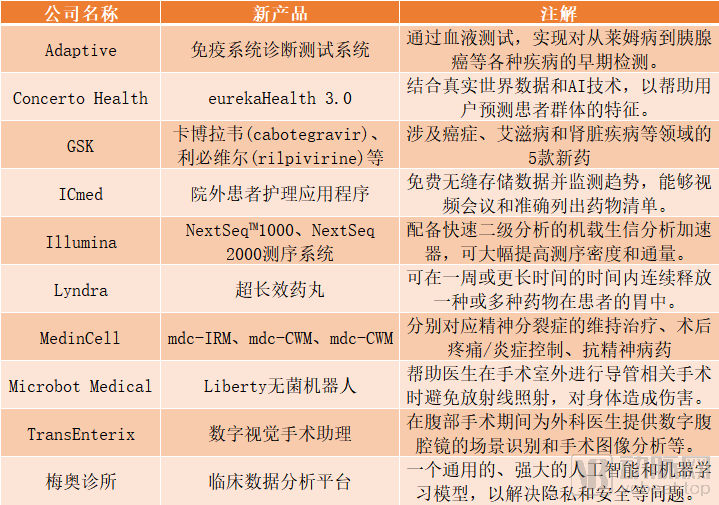
Other Products Released at the 2020 J.P. Morgan Conference
As the developer of the cancer immunotherapy Keytruda, Merck & Co. is naturally keeping pace. At the conference, CEO Ken Frazier introduced five new candidate drugs currently under development by the company following “Keytruda,” including the targeted therapy Lynparza (olaparib) for breast cancer and other indications, the kinase inhibitor Lenvima (lenvatinib) for thyroid cancer and other indications, the pneumococcal conjugate vaccine V114, a HIF-2α inhibitor for renal cell carcinoma, and a non-covalent BTK inhibitor as a novel therapy for lymphoma.
In terms of capital, the venture capital arm of the University of Pittsburgh Medical Center (UPMC) has committed to investing $1 billion by 2024 in the development of new drugs, diagnostics, and medical devices. In a statement, representatives noted that these investment priorities will complement ongoing research at the University of Pittsburgh. UPMC Enterprises initially focused on tumor immunotherapy, organ transplantation, and age-related diseases, but the organization is expanding its scope to include research into retinal and respiratory diseases, autoimmune disorders, and neuroinflammation.
Innovative exploration has gradually become an industry consensus. In addition to UPMC, many well-known pharmaceutical companies announced their entry into new fields at the 2020 J.P. Morgan Conference.AmgenCEO Bob Bradway went further, stating: “The focus in the biopharmaceutical sector is innovation, innovation, and innovation!”
PfizerCEO Albert Bourla also emphasized the importance of innovation at the 2020 J.P. Morgan Healthcare Conference. Based on Pfizer’s current pipeline, maintaining an annual growth rate of 6% would be no challenge; however, Pfizer will place greater emphasis on innovation in the future.
Exploring new indications is also a key path for innovation and R&D among major pharmaceutical companies.Johnson & Johnson(Johnson & Johnson)At the 2020 J.P. Morgan Conference, although it was stated that 75% of the company’s growth by 2023 would come from existing drugs, Jennifer Taubert, Chairman of the company’s Global Pharmaceuticals division, also noted that future growth opportunities would primarily focus on the approval of new indications, increased market share, and enhanced therapeutic positioning.
At the meeting,Novo Nordisk (Novo Nordisk)Chief Technology Officer Mads Krogsgaard Thomsen and Senior Vice President of Global Drug Development Marcus Schindler also highlighted the potential of their existing drug, semaglutide, beyond its indication for diabetes. They stated that the company is conducting prognostic trials to evaluate the drug’s effects on cardiovascular outcomes, diabetic retinopathy, and chronic kidney disease, while exploring its efficacy in non-diabetic patients with obesity and those with non-alcoholic steatohepatitis (NASH). Meanwhile, external investigators have begun exploratory studies on Alzheimer’s disease and Parkinson’s disease.
A Global Leader in Multiple Sclerosis TreatmentBiogenAlso following closely on the path of innovative exploration, the company has placed another bet on Alzheimer’s disease R&D, prepaying Pfizer $75 million for the development of PF-05251749, an early-stage neurodegenerative drug. PF-05251749 is a CK1 inhibitor with evidence suggesting it can cross the blood-brain barrier and modulate circadian rhythms, thereby improving behavioral and neurological symptoms in patients with diseases including Alzheimer’s.
Exploration of new frontiers has not ceased, biopharmaceutical companiesVertex Pharmaceuticals (Forté Pharma)At the conference, Reshma Kewalramani, Executive Vice President and Chief Medical Officer (CMO), stated that Vertex Pharmaceuticals will not only continue to focus on cystic fibrosis but also expand into new therapeutic areas, including APOL1-mediated kidney disease, pain, alpha-1 antitrypsin deficiency (AATD), sickle cell disease, beta-thalassemia, Duchenne muscular dystrophy (DMD), and type 1 diabetes.
In addition, major pharmaceutical companies in attendance included BMS (Bristol-Myers Squibb), Novartis, and Eli Lilly and Company.
BMS (Bristol Myers Squibb)Cutting $800 Million in Costs in 2020: The company had previously committed to reducing costs by $2.5 billion by 2022, and its CEO stated during the conference that approximately one-third of this reduction would be achieved in this year alone.
Novartis (诺华)Making the restoration of user trust a strategic objective: Following the exposure of the data manipulation scandal involving Novartis’s blockbuster drugs, the company issued an apology at this year’s J.P. Morgan Healthcare Conference. As Novartis actively works to rebuild its reputation, it has tied the strategy for restoring corporate reputation and public trust to executive compensation.
Eli Lilly and Company (Lilly)Confident in Trulicity Amid Price War Pressures: Eli Lilly’s Weekly Diabetes Injection Trulicity and Novo Nordisk’s Newly Launched Oral Rybelsus Are in the “Early Stages” of the GLP-1 Showdown. Eli Lilly CEO Dave Ricks stated, “Novo Nordisk is ‘to some extent’ gaining market share at the expense of other GLP-1 options, but I remain confident in Eli Lilly’s once-weekly injectable Trulicity.”
Seven sessions at this year’s J.P. Morgan Conference were directly related to China, including two satellite meetings independently hosted by WuXi AppTec and GenScript, as well as five other satellite sessions discussing China-related topics. VCBeat has curated and compiled selected information for our readers.
Mr. Hu Zhengguo, Co-CEO of WuXi AppTec, shared his insights on China’s pharmaceutical industry at the conference. He noted that numerous new healthtech innovations are currently under development in China, such as AI-driven big data analytics, which can play a pivotal role in drug discovery. He predicted that more effective approaches to drug discovery will emerge in the future.
For these emerging therapeutic modalities, manufacturing has become a bottleneck. The enhancement of capabilities in this area now relies on the drive from the CDMO industry. Currently, China’s CDMO sector is growing and expanding its production capacity. Hu Zhengguo believes that an increasing number of small companies no longer need to incur high costs to build such facilities.
In recent years, cell and gene therapy has swept the globe. At the conference, Zhang Fangliang, Founder and CEO of GenScript, shared his insights on the field: “It is foreseeable that cell and gene therapies will achieve significant breakthroughs in treating cancer and other diseases. Recently, the FDA approved four gene and cell therapies, bringing substantial hope to patients. This is merely the prelude to a major industry expansion. We look forward to leveraging the advantages of cell and gene therapies to transform the treatment of cancer, autoimmune diseases, and other conditions, thereby removing cancer from the list of incurable diseases.”
From a government perspective, China has introduced policies to support innovative drugs, with expectations of a further increase in the number of clinical trials and innovative immuno-oncology drugs domestically. Furthermore, by expanding reimbursement coverage, China has accelerated patient access to innovative oncology medicines. Through reimbursement negotiations in 2018 and 2019, 41 innovative oncology drugs (including PD-1 inhibitors) were added to the National Reimbursement Drug List (NRDL), with price reductions for 10 of these drugs averaging between 44% and 61%.
At the conference, Mi Zihou, President of IQVIA Greater China, stated that under the support of policies and reforms in drug regulatory policies, emerging biopharmaceutical companies in China are rising to become a new force for global innovation.
At the 2020 J.P. Morgan Healthcare Conference, Zhang Tianze, Founder and CEO of LinkDoc Technology, also shared his insights: Amidst the global wave of pharmaceutical innovation, China’s new drug research and development (R&D) is increasingly aligning with international standards. On one hand, as the world’s second-largest pharmaceutical market, China is garnering growing attention from global biotechnology and pharmaceutical companies, which are incorporating China into their global new drug R&D strategies. On the other hand, China continues to deepen its healthcare system reforms and actively encourage innovative R&D. Chinese innovative pharmaceutical enterprises are beginning to expand globally, bringing unprecedented opportunities to pharmaceutical companies worldwide.
At the 2020 J.P. Morgan Healthcare Conference, Subtle Medical also announced several of its latest partnerships: the company has signed an agreement with DASA, the largest healthcare services provider in Latin America, to clinically deploy and collaborate on SubtlePET, SubtleMR, and SubtleGAD, leveraging DASA’s medical resources to test and clinically validate new AI technologies.
Furthermore, the company announced a partnership with India’s leading Mahajan Imaging Caring Center to promote the use of products such as SubtleMR. The Caring Center has established data platforms in imaging, neuroscience, and genomics, and will collaborate with DeepWise Medical to develop and validate additional applications of AI-driven imaging and precision medicine.
For more coverage of the 2020 J.P. Morgan Healthcare Conference, VCBeat’s Pro section is continuously providing updates.