

First AI-Powered Imaging Decision Support Software Receives China's Class III Medical Device Certification
On December 29, at a small symposium held after the conference of the AI Medical Device Innovation Cooperation Platform in Boao, an official from the Center for Medical Device Evaluation (CMDE) casually revealed to the audience: “At the earliest, two AI-based medical products will be approved before the Chinese New Year.” With only two weeks remaining until Lunar New Year’s Eve, the National Medical Products Administration (NMPA) confirmed the veracity of this statement by issuing approval certificates.
As early as the beginning of 2018, whispers began circulating about when the first medical AI imaging product would gain regulatory approval. Two years later, just as public patience with the approval process was wearing thin, this prolonged battle over AI approvals suddenly came to a close. On January 15, 2020, Keya Medical emerged as the first to secure approval.
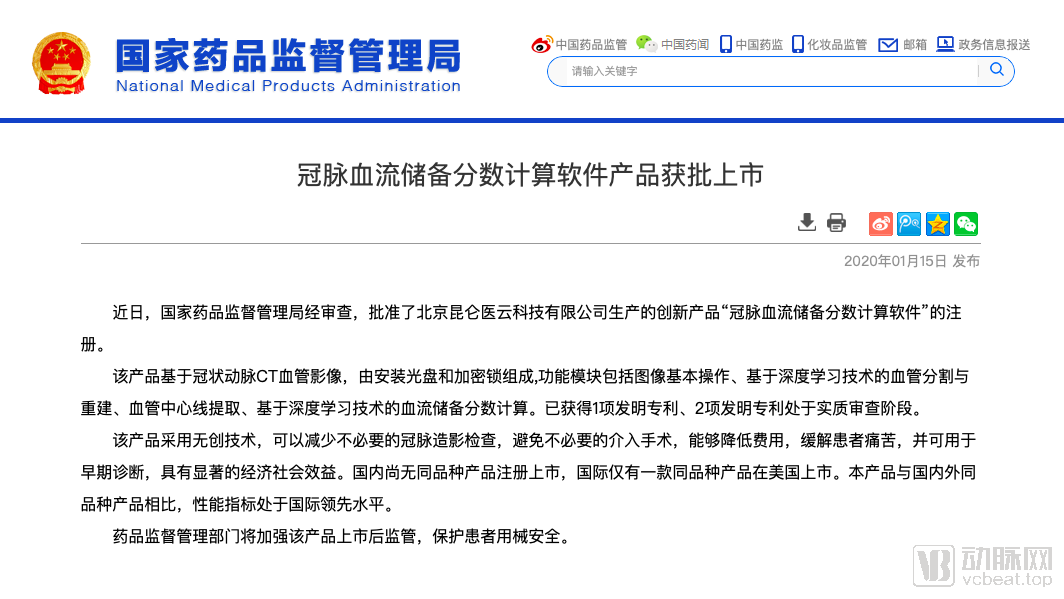
KeYa Medical’s product that has received Class III medical device approval is named “Coronary Flow Reserve Fraction Calculation Software,” commonly referred to as non-invasive functional analysis (CT-FFR). Its underlying principle involves performing CT-FFR assessments using coronary computed tomography angiography (CTA) images, thereby integrating artificial intelligence technology into the clinical diagnosis and treatment workflow for coronary artery disease to enhance both processing speed and accuracy. For patients, this product enables a non-invasive approach that reduces unnecessary coronary angiography examinations and helps avoid certain interventional procedures. The National Medical Products Administration characterized the product with the nine-character phrase “significant economic benefits.”
The outcome was somewhat unexpected: the first product to obtain a Class III medical device registration certificate for AI-based imaging was neither pulmonary nodules, a widely recognized high-maturity application, nor fundus screening, which has been extensively deployed at the grassroots level, but rather CT-FFR, an area with few market entrants. Furthermore, approval was granted to a single product, rather than a batch of products as many had anticipated.
So, why has Keya Medical managed to “win the battle” amidst the fierce competition among AI imaging companies? VCBeat interviewed Keya Medical and several other artificial intelligence imaging enterprises in an attempt to answer the following questions:
1. Is the Class III medical device registration certificate obtained by Keya Medical for an AI-based computer-aided diagnosis imaging system?
2. Why Did Keya Medical Take the Lead?
3. What Does the Approval of the First AI Medical Device Signify?
4. How will AI-driven approval processes evolve in the future?
According to the description provided by the Center for Medical Device Technical Evaluation of the National Medical Products Administration in February 2019: AI medical devices refer to medical devices that utilize artificial intelligence technologies, including standalone AI software and AI software components. The application of AI technologies in medical devices mainly encompasses pre-processing (e.g., enhancing imaging speed), workflow optimization (e.g., one-click operation), routine post-processing (e.g., image segmentation), and decision support (e.g., assisted screening, assisted detection, assisted diagnosis, and assisted treatment). Among these, AI software intended for decision support must obtain Class III approval before it can be marketed.
Upon carefully reviewing the National Medical Products Administration’s announcement regarding software approval, VCBeat noted that the text only included phrases such as “deep learning-based vessel segmentation and reconstruction,” “extraction of vessel centerlines,” and “deep learning-based calculation of fractional flow reserve,” but did not specify the type of certificate.
Due to previous practices where companies skirted regulatory boundaries—specifically, although the declared medical device products incorporated deep learning algorithms as aids, they did not highlight “artificial intelligence” as a key element during the approval application—the Class III medical devices obtained by these companies, despite being supported by algorithms such as deep learning and machine learning, were approved merely through standard regulatory procedures.
In light of this, VCBeat promptly sought verification from relevant personnel at the Center for Medical Device Evaluation (CMDE), who confirmed that the certificate is indeed a “Class III AI medical device approval.” Subsequently, regulatory affairs staff at Keya Medical explicitly informed VCBeat that this certificate represents China’s first “AI-based medical imaging auxiliary decision-making product.”
On January 16, 2020, the official WeChat account “Beijing Drug Administration” published an article stating that,This product is the first AI-based medical imaging computer-aided diagnosis (CAD) system to enter the National Medical Products Administration’s Green Channel for Innovative Medical Devices and receive approval, as well as the first AI medical product to obtain a Class III Medical Device Registration Certificate.
So, why did CT-FFR products obtain Class III AI medical device approval ahead of fundus imaging and pulmonary nodule solutions? The “Special Approval Pathway for Innovative Medical Devices” may be one of the reasons.
In April 2018, Keya Medical was approved to enter the “Special Approval Channel for Innovative Medical Devices,” becoming the first medical artificial intelligence product to enter this channel. As of December 2019, in the field of medical AI, the Center for Medical Device Evaluation had received a total of 21 applications for special review of innovative medical devices (covering 15 products), completed reviews for 17 applications, and approved 3 (two in ophthalmology and one in cardiology), resulting in an approval rate of only 17.6%.
According to the Center for Medical Device Evaluation, for a product to be designated as an innovative medical device, it must meet three criteria: possessing intellectual property rights, having a finalized design, and being the first of its kind in China with significant clinical value. Once a product is recognized as an innovative medical device, the manufacturer can benefit from policies such as early intervention, dedicated personnel support, prioritized processing, and waivers of initial registration fees for small and micro enterprises. However, subsequent review standards will not be lowered, nor will the procedural requirements be reduced.
Keya Medical’s CT-FFR product undoubtedly meets many of the aforementioned requirements.
Clinically, patients with suspected related conditions should first undergo coronary CT angiography (CTA) for initial screening to exclude the absence of coronary artery stenosis; subsequently, those who screen positive should proceed to further invasive investigations, including invasive coronary angiography (ICA) and fractional flow reserve (FFR) measurement, followed by percutaneous coronary intervention (PCI) as indicated.
However, clinical studies have shown that using coronary CTA-based assessment of vascular stenosis alone for initial screening is not highly accurate—more than 70% of patients who test positive in the initial screening do not actually have functional ischemia. Subjecting this population to subsequent unnecessary invasive procedures such as ICA and FFR measurements, as well as PCI treatment, increases medical risks and burdens for patients and results in a waste of healthcare resources.
Non-invasive CT-FFR is based on non-invasive coronary CTA images, improving the accuracy of coronary CTA in assessing coronary artery disease and evaluating whether stenosis causes myocardial ischemia through a non-invasive approach. "DeepVessel Fraction," a non-invasive CT-FFR product developed by Keya Medical, applies non-invasive CT-FFR assessment metrics to significantly reduce the proportion of unnecessary invasive coronary angiography procedures and subsequent PCI treatments.
Keya Medical told VCBeat, “The ‘Review Points for Medical Device Software Assisted by Deep Learning in Decision-Making’ had not yet been released during our product development. Lacking authoritative review guidelines or comparable products for reference, we proceeded through trial and error, encountering some detours along the way.”
Fortunately, through innovative communication channels, the regulatory submission of the “DeepPulse Score” product received careful guidance and support from the competent authorities. During meetings with the review panel, the panel identified areas where the product’s considerations were insufficiently comprehensive. At an expert meeting convened by the Center for Medical Device Evaluation, experts provided important recommendations regarding clinical application and study protocols. These opinions and suggestions offered substantial guidance and assistance for the product’s regulatory submission, ultimately enabling it to successfully obtain approval.
After entering the green channel for approval, Keya Medical obtained EU CE certification in August of the same year, which may also be one of the reasons why this company was the first to gain approval.
As the saying goes, “The bird that sticks its head out gets shot.” Keya Medical’s first-ever regulatory approval this time represents both a gain and a risk.
Let’s begin with the key takeaway: Kea Medical’s recent product approval signifies that it has taken a lead in commercialization efforts within its niche sector and is poised to attract greater resources in the short term. For the industry as a whole, Kea’s success undoubtedly serves as a much-needed boost to the otherwise sluggish medical AI capital market, demonstrating the viability of successful commercialization in the medical AI-assisted diagnosis market.
Regarding risks, the regulatory approval process for AI-based medical devices remains in an exploratory phase. Although Keya Medical has obtained Class III device approval, it will inevitably face stringent post-market surveillance, which, in turn, will drive the company to further refine and improve its products.
Some AI medical imaging companies told VCBeat: Judging from this year’s situation, it is highly likely that other AI-powered medical imaging products will also receive regulatory approval. As long as companies are confident in their products, they do not need to vie for the top spot in the broader AI healthcare sector; securing leadership in their specific niche is sufficient.
Current policies for the approval of AI-based medical devices mainly include the “Review Points for Deep Learning-Assisted Decision-Making Medical Device Software” and the “Appendix to the Good Manufacturing Practice for Medical Devices: Standalone Software.” Documents still in draft form and scheduled for release in 2020 include the “Guidelines for On-Site Inspection of Standalone Software under the Good Manufacturing Practice for Medical Devices” and the “Technical Review Guidelines for Human Factors Design Registration of Medical Devices.”
Furthermore, databases for coronary CTA, brain MRI, cardiac MRI, and ECG are still under construction; therefore, even products from Keya Medical that have already received regulatory approval will face further regulatory challenges.
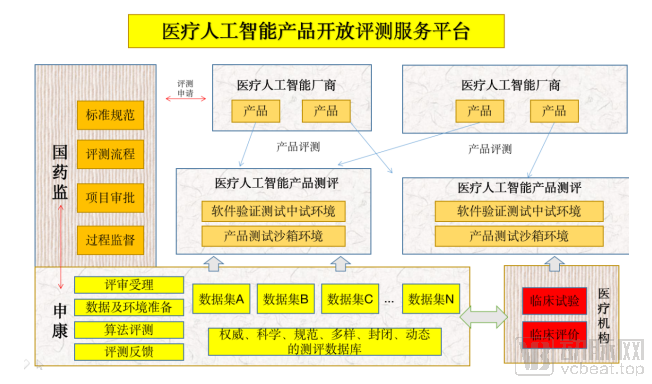
In terms of cybersecurity, the integration of medical artificial intelligence (AI) software inevitably involves numerous data transmission processes. However, the current network regulations used for approval purposes still require improvement. Specifically, in 2020, the Cybersecurity Working Group of the AI Medical Device Innovation Cooperation Platform will conduct research on the development of a platform for sharing cybersecurity vulnerability information related to AI medical software, as well as research on verification standards for the cybersecurity of AI medical software. Furthermore, the cybersecurity testing framework for AI medical devices—including confidentiality testing, integrity testing, availability testing, and audit function testing—will be progressively refined throughout 2020.
In the future, real-world studies (RWS) for medical devices are also in the pipeline. In 2020, the Real-World Data Application Working Group will place greater emphasis on clinical trials and medical ethics approvals for AI products. Under this premise, approval experiences from the U.S. FDA and the EU CE marking will become particularly important. AI companies with overseas operations will gain significant advantages in navigating the approval process, and foreign AI enterprises may leverage this pathway to enter the Chinese market. Perhaps in the near future, AI-based medical devices will be able to obtain regulatory approval through RWS, similar to pharmaceuticals.
Overall, the key areas where regulatory frameworks still need strengthening include major policy standards, the establishment of evaluation databases, and the advancement of cybersecurity research. Naturally, AI products launched this year will be subject to stringent post-market surveillance, with specific outcomes yet to unfold over time.
Going back to the beginning, relevant officials from the Center for Medical Device Evaluation mentioned that “two” medical AI products had received approval. According to VCBeat, a startup specializing in cardiovascular and cerebrovascular AI has already learned of this development, suggesting that the second Class III certification for AI-assisted diagnosis will be issued after the Lunar New Year.
With two AI products having obtained regulatory approval for clinical use, the approval of other applications—such as those for pulmonary nodules and fundus imaging—is merely a matter of time. In the coming year, artificial intelligence will undoubtedly enter a genuine phase of “commercialization,” and the ambiguous term “implementation” will gradually fade into obsolescence.
But as the saying goes, “Class III certification merely opens the door to the commercialization of artificial intelligence.” Perhaps at this juncture, the real battle has only just begun, and the victors and vanquished will be revealed one by one.
For hospitals, physicians, and patients alike, the advancement of commercialization will be accompanied by the refinement of clinical trial regulations, the enhancement of evaluation databases, and the strengthening of cybersecurity laws. We are moving toward a world that is more efficient, safer, and better regulated.