

GeneHarbor BioMed Files IPO Prospectus: Pioneering Plant-Based Humanized Biomaterials via Gene Editing
You must have never imagined,OriginalCan only be fromPigs, cattle, etc.Elastin and Collagen Derived from Animal Sourcesand other biomaterials, nowAlreadyCanWithConstructed using next-generation genetic engineering and synthetic biology, and obtained through plant-based systems.
In 2017, researchers Wu Youjun, Liao Bihong, and Cai Shijie, who were originally employed at the Animal Center of the Taiwan Institute for Experimental Research, recognized the future trend toward precision medicine and resolved to leave the institute to found Jike Biomedicine. Their strategic focus was on leveraging gene editing and synthetic biology to mass-produce humanized biomaterials for medical applications.
Drs. Wu Youjun, Liao Bihong, and Cai Shijie each possess over a decade of research and development experience in the fields of biomedical materials development, veterinary medicine, and genetic engineering, respectively.
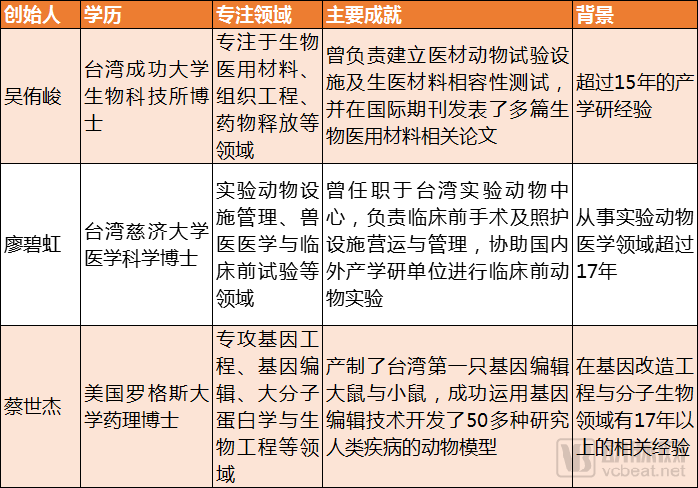
(Produced by VCBeat based on relevant content)
During their tenure at the research institute, the three individuals developed a strong collaborative synergy. Through extensive exchanges, they identified significant pain points and rare opportunities in the field of biomedical materials. With complementary expertise, they quickly reached an agreement, resigned from their positions, and embarked on their entrepreneurial journey in the industry. In the early stages of their venture, they leveraged their most familiar biological platform—specific pathogen-free (SPF) laboratory rats—to produce human-grade collagen.
Large-fragment gene editing technology for the development of humanized mouse platforms
At present, the primary sources of raw collagen are terrestrial livestock and poultry (predominantly pigs and cattle) skin and bones, freshwater fish skin, fish scales, and deep-sea fish skin. Zhang Xingdong, an academician of the Chinese Academy of Engineering, has publicly stated, “Collagen-based biomaterials hold broad development potential and economic value and have been designated as a key high-tech biomaterial for national priority development. To date, the vast majority of medical-grade collagen is derived from animal sources, and the elimination of its immunogenicity has long remained a bottleneck constraining its advancement.”
Wu Youjun stated, “The immunogenicity of animal-derived collagen limits the clinical application of such materials. Recombinant human collagen produced via genetic engineering is an ideal solution to address the issue of immunogenicity. Therefore, our initial plan is to utilize large-fragment gene editing technology to extract human-derived collagen from humanized mice.”
Upholding Animal Welfare: Establishing a Plant-Based Platform for Human Elastin Production
Just as the anthropomorphic mouse platform was being established to produce humanized collagen, Liao Bihong, founder of Jike Shengyi, decided to change the company’s production strategy. Influenced by years of cultural immersion at Tzu Chi University in Taiwan, along with international trends and global movements, she has increasingly prioritized animal welfare and environmental protection, advocating for reduced use and consumption of animals.
After more than a year of dedicated efforts, Jikesheng Biomedical has successfully directed its technology toward Taiwanese rice. By leveraging Taiwanese rice, the company has produced human-grade elastin, challenging the common perception that rice is solely for consumption and transforming it into a “bioreactor” for producing raw materials for the human body.
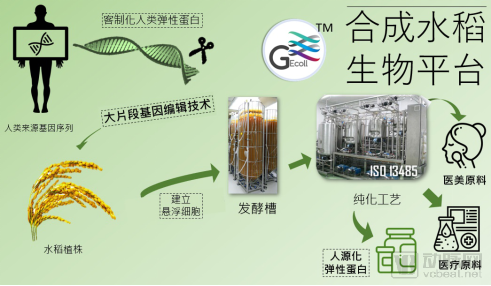
(Workflow of the Synthetic Rice Bio-Platform, image provided by the company)
JiKe BioMed utilizes genetic engineering to enable rice stem cells to secrete and express proteins, extracting human elastin from the suspension derived from these cells. This allows vegans to confidently use plant-based biomedical materials. In the future, in addition to developing vegan-friendly humanized collagen, JiKe BioMed will also offer contract manufacturing services for a range of growth factors and other medical-grade proteins.
Elastin is an elastic fiber protein widely distributed in various tissues and organs throughout the animal body. It is primarily found in elastic tissues such as the nuchal ligament, blood vessels, lungs, and skin, where it plays a crucial role in structural support. Although scarce and expensive, elastin serves as a vital raw material for tissue regeneration and repair.

Taking skin tissue as an example, although elastin accounts for only about 3–5% of its content, its robust extensibility and elasticity are key factors in maintaining skin elasticity. If skin tissue is compared to a spring mattress, collagen is like the foam widely distributed beneath the mattress surface, while elastin acts like the springs that support the entire structure. As the core component of this “spring mattress,” elastin determines the skin’s elasticity and softness.
Wu Youjun stated, “In addition to its use in dermal fillers for skin care, elastin is also an important medical raw material that can be applied in drug delivery carriers, tissue engineering, and 3D bioprinting of vascular tissues.”
From Taiwan, Expanding to the Global Market
JiKe Biomedicine’s core competitiveness lies in its leading LS-GeneEditing large-fragment gene editing technology and synthetic biology platform.
Currently, Jikesheng Biomedical operates under two primary business models: first, the direct sale of various biomedical materials to medical device developers; and second, establishing collaborative partnerships with mid- and downstream companies to jointly develop products—such as cosmetics, research-grade products, and medical devices—by leveraging their respective technological advantages.
JiKe Biomed’s reflections on its business model originated from a startup competition. To encourage young researchers to launch startups, guide universities and research institutions in fostering a culture of innovation and entrepreneurship, and create an environment conducive to commercialization, Taiwan has annually held the Innovation and Entrepreneurship Incentive Program. In 2017, the three founders, who had not yet established their company, decided to participate in this competition.
Wu Youjun remarked, “The competition judges and startup mentors pointed out that our blind spot lay in the team’s overemphasis on technology, with no detailed plans for market promotion or profit models. Guided by their insights, we finalized our business model. Leveraging our strengths in technology and team capabilities, we were awarded the Excellence Award in the Innovation and Entrepreneurship Incentive Program, along with a RMB 2 million startup prize.”
The Taiwanese market is ultimately too small, so Jikesheng Biomedical has turned its attention to the global market. Its founder once stated, “I had only one idea at the outset: Taiwan is very small; the total R&D expenditure of any random international new drug company exceeds all the resources Taiwan has invested in biotechnology.” Therefore, they aim to expand into larger markets.
After achieving mass production of humanized biomedical materials using the rice platform, Ji Kesheng Biomedical plans to develop follow-up products targeting the cosmetics, scientific research, and medical aesthetic device sectors. This endeavor requires regulatory certification, with the company aiming for U.S. standards and expecting to complete the process and launch its products within three to four years. “Internationally, there are currently few competitors in the field of humanized biomedical materials, and there are notable differences in pricing and quality. We are confident that we can meet the demands of specific markets.”
In addition to the U.S. market, Jike Biomedical also has high expectations for the nearby domestic market in China. In 2018, Jike Biomedical participated in the Hong Kong, Macao, and Taiwan Division of the China Innovation and Entrepreneurship Competition, winning first place in the startup category. In 2019, the company took part in the Guangzhou Youth Innovation and Entrepreneurship Competition, securing second prize in the startup category.
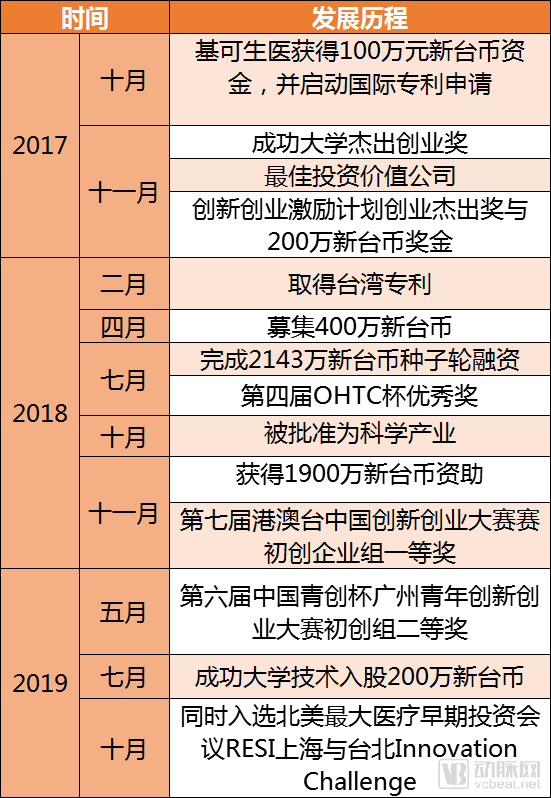
(Development History of Jikesheng Biomedical)
Participating in the competition twice has enabled the Jike Shengyi team to gain a deeper understanding of the domestic market and its landscape. They recognized that the Guangdong-Hong Kong-Macao Greater Bay Area should prioritize accelerating the development of the health services industry, strengthening the deep integration of industry, academia, and research, and enhancing the commercialization of scientific and technological achievements. Wu Youjun stated, “Jike Shengyi aims to produce humanized biomaterial ingredients and become an upstream supplier for precision medical aesthetics. Relevant bioparks are clustered in Huangpu and Nansha districts of Guangzhou. The Guangdong-Hong Kong-Macao Greater Bay Area provides an environment conducive to scaling up ideals and ambitions, as well as a solid foundation for nurturing projects.”
Therefore, Jike Biomedical has established an office in the Nansha Industrial Park of Guangdong Medical Valley and plans to set up local operations. Meanwhile, the Jike Biomedical team stated that it will establish production facilities in the future, depending on market conditions and partnerships.
In addition to producing human elastin via rice, Jike Biomedical will continue to develop other applications for stem cell therapy. In response to the growing momentum in the fields of stem cell therapy and regenerative medicine, Jike Biomedical has established product development plans and a global operational strategy. The company aims to collaborate with partners across the upstream, midstream, and downstream segments of the precision medicine industry, seeking to transform the global biomedical raw materials sector by providing safer, more effective, and traceable biomedical products.
At this stage, Jikesheng Biomedical plans to launch a new round of financing, raising RMB 80 million, primarily for the construction of a production facility for rice-derived humanized biomedical raw materials, as well as for medical raw material certification and marketing initiatives.