

I-Mab Biopharma Successfully Lists on NASDAQ as the First Chinese Innovative Biopharma Company of 2020

NovaBridge Biosciences
Biological Agent Developer
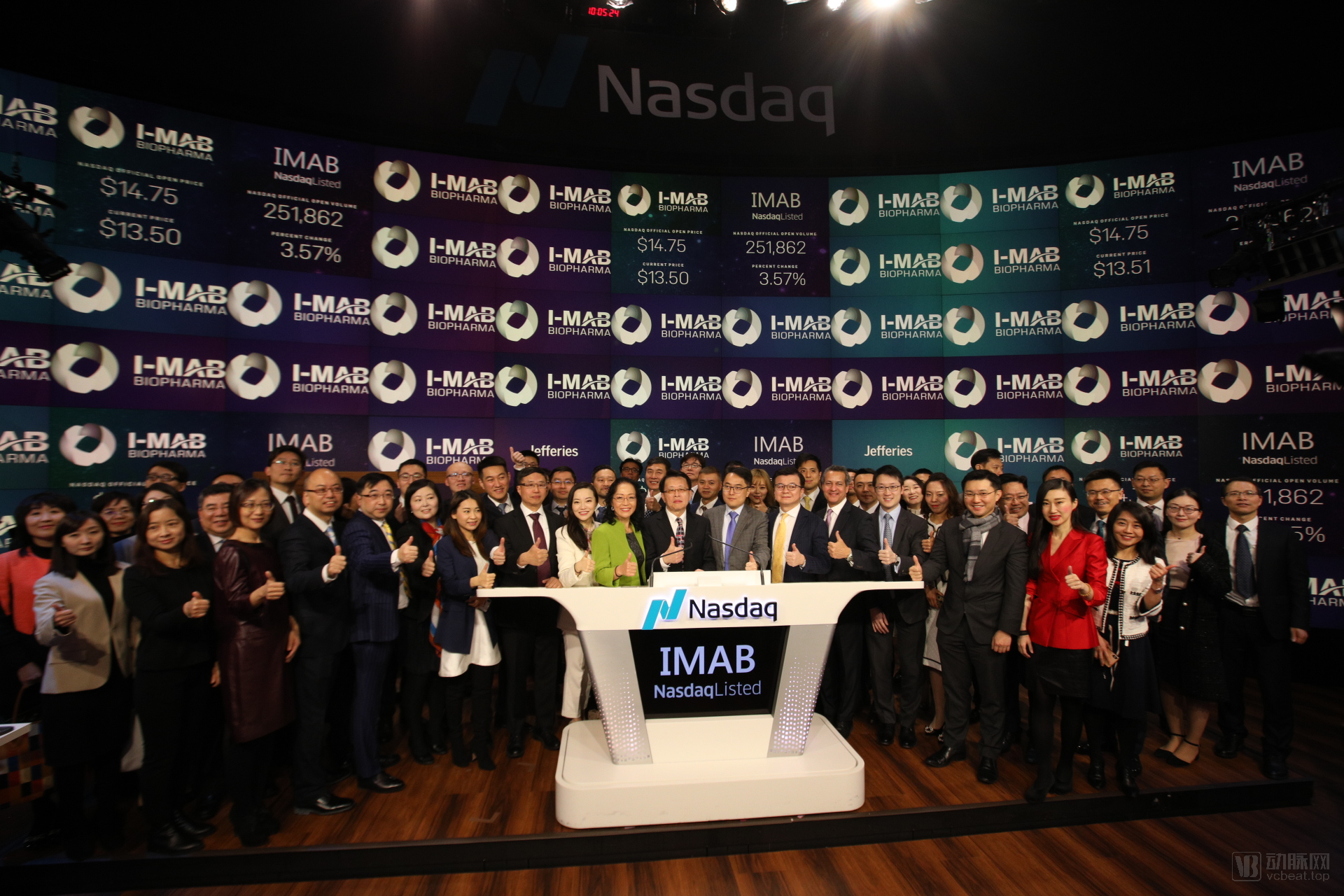
VCBeat learned that on January 17, 2020 (U.S. time), I-Mab Biopharma listed on the NASDAQ, becoming the first Chinese innovative drug company to go public in 2020. In this IPO, I-Mab Biopharma issued a total of 7.4074 million shares at an offering price of $14.00 per share, raising a total of $103.7 million.
Tianjing Biotech opened at $14.75 on its listing day, up 5.36%. The high reached $15.79. By the close, Tianjing Biotech’s stock price stabilized at $12.50.
As an innovative pharmaceutical company, I-Mab has experienced extremely rapid growth. Its predecessor, Sanjing Biopharma, was established in 2014; in 2017, it secured the Greater China rights to MorphoSys’s CD38 monoclonal antibody, TJ202; financing rounds in 2017 and 2018 raised $120 million and $200 million, respectively; by the end of 2019, it had been listed among the top ten global immuno-oncology startups by GEN, a renowned international biopharmaceutical media outlet.
On the eve of the company’s initial public offering, Dr. Zang Jingwu, Chairman of I-Mab; Dr. Shen Huaqiong, CEO; and Mr. Zhu Jielun, CFO, granted an exclusive interview to VCBeat. During the interview, Dr. Zang Jingwu highlighted three key pillars for I-Mab’s future development: first, advancing its self-developed product pipeline into clinical stages to enrich the overall portfolio layout; second, moving imported products through regulatory approval into commercialization to drive corporate growth; and third, expanding collaborations with international enterprises, primarily through product licensing and co-development.
“The company’s development has far exceeded our expectations.” Reflecting on the progress of Tianjing Biotechnology in recent years, Dr. Zang Jingwu, founder of Tianjing Biotechnology, spoke with deep earnestness.
In November 2014, Dr. Zang Jingwu, Tigermed, and Simcere Pharmaceutical’s subsidiary Baijiahui Precision Medicine jointly founded Sanjing Biopharma. Following a restructuring in 2016, the company was renamed I-Mab Biopharma. In 2017, I-Mab Biopharma merged with Tianshizhen, a company co-founded by Qiao Capital Group, Tasly, and the South Korean listed company Genexine. In the same year, I-Mab secured RMB 120 million in Series B financing from investors including Qiao Capital Group, Tasly, Qianhai Fund of Funds, and Rainbow Capital.
Tianjing Biotechnology chose to enter the immunotherapy market at this juncture because it recognized the opportunities arising from the convergence of two major developments: first, the standardization and scaling of China’s innovative drug market; and second, revolutionary scientific breakthroughs in drugs for cancer and autoimmune diseases. Tianjing Biotechnology believes that, leveraging its expertise in immuno-oncology, experience in drug development, and leading antibody research platform, it has the capability to become a leading enterprise in immunotherapy drug development in China.
“Our founders and R&D team members all have backgrounds in immunology. This places our team’s capabilities among the top tier of startups in China. Therefore, our core competitiveness lies in our expertise in immunology. On one hand, we possess a deep understanding of novel immune targets and pathways; on the other, we have the capability to advance these drug mechanisms into clinical development,” said Dr. Shen Huaqiong, CEO of Tianjing Biotechnology.
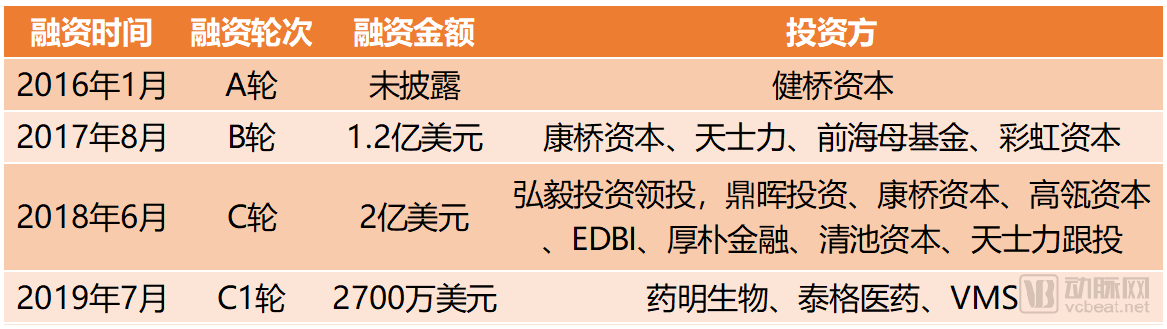
Tianjing Biotechnology's Pre-IPO Financing History
In June 2018, Tianjing Biotechnology completed a $200 million Series C financing round. This round attracted top-tier domestic investment institutions such as Hony Capital, Hillhouse Capital, CDH Investments, and Hopu Financial, further underscoring the corporate value of Tianjing Biotechnology.
“We began preparations for our initial public offering in May 2019, with the Hong Kong and U.S. stock markets as our two primary options. For us, the IPO is merely the first step; we place greater emphasis on our ability to secure follow-on financing. The Nasdaq biotechnology sector has a history spanning more than three decades, featuring a mature investor base and providing greater assurance for subsequent fundraising capabilities. Taking these factors into account, we believe Nasdaq is a more suitable market for us,” added Zhu Jielun, CFO of Tianjing Biotechnology.
“We have held the view since our inception that China already possesses the capability to develop highly differentiated investigational drugs. It now appears that this has been preliminarily validated by our in-house pipeline. Our self-developed pipeline consists entirely of First-in-Class or Best-in-Class products, placing us on par with the world’s leading R&D innovators. This is also a key factor driving investor confidence in us,” said Dr. Zang Jingwu.
Guided by this industry insight, Tianjing Biotechnology embarked on its journey to specialize in the research and development of novel drugs for the global market. Due to the success of PD-1/PD-L1 therapies, the focus of oncology immunology in recent years has been almost exclusively centered on T cell-related treatments. However, the patient response rate to PD-1 or PD-L1 therapy is only 20%–30%, and drug resistance often develops.
“Therefore, three years ago, we shifted our focus more toward other immune cells beyond T cells and toward novel targets associated with modulating the tumor microenvironment. At the same time, we began strategically developing bispecific antibodies, and these projects will soon advance from the preclinical stage to clinical trials,” added Dr. Jingwu Zang.
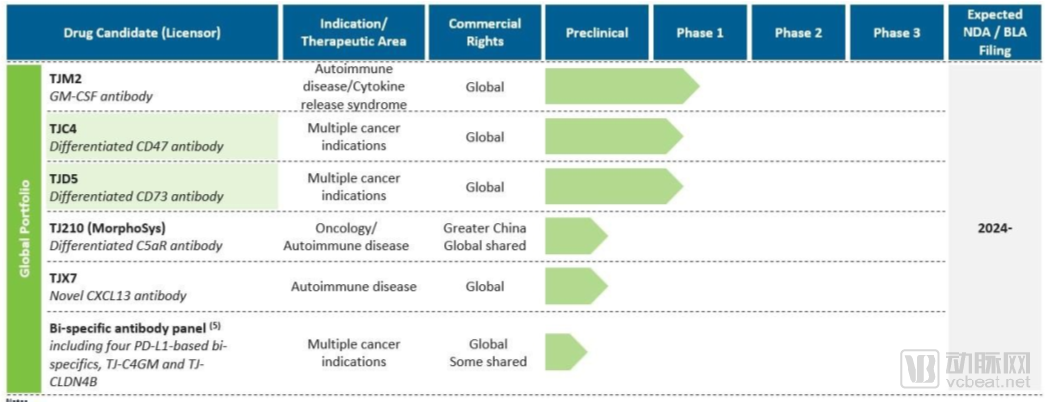
Tianjing Biotech’s In-House Drug Pipeline
In terms of self-developed products, I-Mab possesses four advanced technology platforms for biologic drug development, dedicated to the research and development of monoclonal antibodies, bispecific antibodies, HyFc fusion proteins, and antibody-cytokine conjugates. Regarding its product pipeline, three leading candidates have already initiated clinical trials in the United States.
In fact, the development pace of Tianjing Biotechnology’s in-house pipeline should have been faster than it is today. However, during its growth, Tianjing Biotechnology strategically divested certain parts of its product portfolio, such as transferring its PD-L1 monoclonal antibody to Lepu Medical, assigning the hGLP-1-Fc fusion protein product TJ103 to CSPC Pharmaceutical Group, and licensing out the ex-Greater China rights to its bispecific antibody project to the South Korean biotech company ABL Bio. These strategic decisions are closely aligned with Tianjing Biotechnology’s original mission and core values.
“Developing highly differentiated drugs means we must compete with companies worldwide. Many of the projects we out-license are not inherently flawed; although they remain highly valuable, our R&D efforts revealed that they no longer align with our strategic positioning. In such cases, we choose to out-license them,” said Dr. Zang Jingwu.
During the Sanjing Biopharma era, the company’s primary focus was on the research and development of its proprietary pipeline. However, following the restructuring of Sanjing Biopharma into Tianjing Biopharma in 2016, the corporate strategy underwent a significant shift, transitioning from exclusive reliance on in-house drug development to incorporating in-licensed drugs.
The development of innovative drugs requires prolonged accumulation of expertise and lengthy clinical trial processes. Tianjing Biotechnology needs a suitable approach to ensure that it can generate revenue to offset losses incurred during its long-term R&D efforts, while continuing its independent research and development. Most innovative drug companies face similar challenges, yet their chosen solutions vary. Some opt to collaborate with other pharmaceutical companies to share R&D costs, while others choose to develop generic drugs. Tianjing Biotechnology, however, has made the strategic choice to in-license drug products from external sources.
“Independent R&D is our strategy, but we must also consider how to accelerate corporate growth and expedite entry into the commercialization phase. Therefore, our tactical approach involves in-licensing drugs and rapidly conducting clinical trials in China, with the aim of addressing more unmet clinical needs within a short timeframe,” said Dr. Zang Jingwu.
Leveraging its strong industry insights and project sourcing capabilities, Tianjing Biotechnology targets the time lag between the international and domestic launches of innovative drugs. By partnering to introduce globally clinically validated innovative drug products, and capitalizing on its strengths in clinical development and regulatory submission, the company accelerates the market entry of these products. These licensed drugs will offset the long commercialization cycle of Tianjing Biotechnology’s in-house pipeline in the short term, enabling the company to reach profitability sooner.
In December 2016, I-Mab Biopharma entered into a strategic collaboration with Ferring Pharmaceuticals, securing exclusive rights to develop, register, manufacture, and commercialize the autoimmune disease drug Olamkicept (IL-6) in Greater China and South Korea. Subsequently, I-Mab acquired the Greater China rights to four additional products. Notably, TJ202/MOR202 (CD38), licensed in November 2017, has become a cornerstone of I-Mab’s R&D pipeline and is poised to become the company’s first marketed product.
Dr. Shen Huaqiong, CEO of Tianjing Biotechnology, shared with us that the company has developed its own methodology for selecting in-licensed products: “In the long term, the primary purpose of licensing in drugs is to fill the product gaps during our independent R&D process. When licensing in drugs, we select new drug candidates that align with our drug pipeline, demonstrate value within our investment portfolio, and can be launched in the Chinese market within a relatively short timeframe, based on our specific characteristics. Therefore, our selection of licensing targets is highly targeted. Moreover, drug licensing helps us train our team and validate our R&D capabilities. Several of our current projects have reached a relatively mature stage, with three having advanced to Phase II or even Phase III clinical trials, keeping the corresponding R&D risks within our controllable range.”
Regarding in-licensed products, all five of Tianjing Biotechnology’s major in-licensed drug pipelines have entered clinical development, with the most advanced candidate, TJ202, having reached Phase III clinical trials and expected to submit a Biologics License Application (BLA) in 2021.
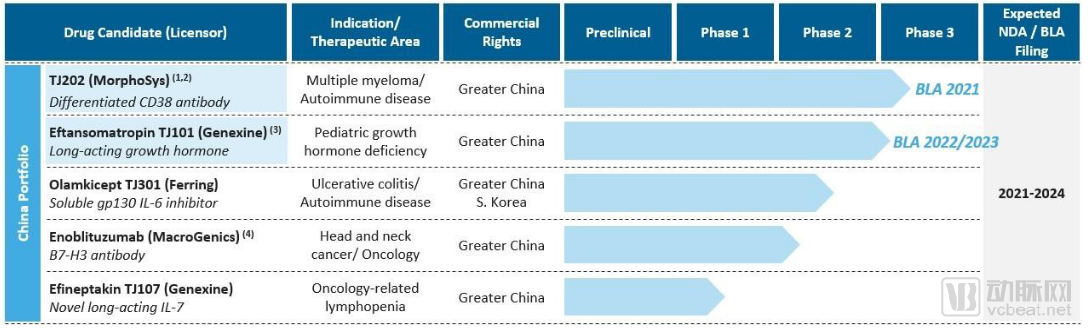
Tianjing Biotechnology's In-Licensed Drug Pipeline
TJ202 is undoubtedly one of Tianjing Biotechnology’s core products. It is a potential best-in-class therapeutic: TJ202/MOR202 is a human monoclonal antibody exclusively developed by MorphoSys using its HuCAL technology. The antibody targets CD38, a surface antigen on multiple myeloma cells, which is among the most strongly and uniformly expressed tumor antigens on malignant plasma cells. Its mechanism of action involves killing CD38-positive tumor cells through antibody-dependent cellular cytotoxicity (ADCC) and antibody-dependent cellular phagocytosis (ADCP), without involving complement-dependent cytotoxicity (CDC).
“We estimate that the market size for CD38 monoclonal antibodies in multiple myeloma in China is approximately RMB 4–5 billion. Currently, there is only one CD38 monoclonal antibody product available on the Chinese market: Janssen Pharmaceuticals’ Darzalex (daratumumab injection), which was officially launched and marketed in October 2019. As a highly differentiated product, we are very optimistic about the future performance of TJ202,” said Mr. Zhu Jiélún.
The other licensed product pipelines of I-Mab are also progressing smoothly. Five major product pipelines have successfully entered the clinical stage. In addition to TJ202, TJ101, a long-acting growth hormone product licensed by I-Mab from Genexine, has completed Phase II clinical trials abroad for the treatment of growth hormone deficiency. In this clinical trial, TJ101 administered once weekly or once every two weeks demonstrated efficacy comparable to that of daily short-acting growth hormone, with tolerability similar to that of commercially available short-acting products.
Tianjing Biotechnology currently has eight products in clinical development, with four additional projects scheduled to advance from preclinical to clinical stages in 2020. Its bispecific antibody is also expected to enter clinical trials by late 2020 or early 2021. As a result, Tianjing Biotechnology’s overall R&D pipeline is now robust and well-stocked.
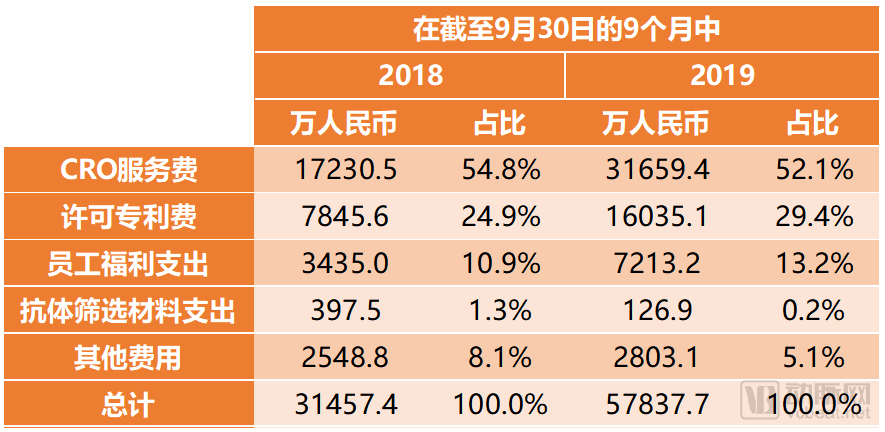
Tianjing Biotech's Detailed R&D Expenditures (Data Source: Prospectus)
A robust product pipeline also entails substantial R&D investment. R&D spending for new drugs rises rapidly as the drug pipeline advances. For in-licensed drugs, which bypass the preclinical development stage, the growth in R&D expenditure is particularly pronounced. In the first nine months of 2019 alone, Tianjing Biotechnology’s R&D expenses reached RMB 578 million, with CRO service fees accounting for the largest share, followed by patent licensing fees. Together, these two categories constituted 81.5% of total R&D expenditures.
In 2020, with the full-scale launch of two clinical trials for TJ202, I-Mab’s R&D expenditures are expected to continue rising. However, Zang Jingwu stated that there is no cause for concern, as the company’s financial position remains robust: “Particularly following this IPO fundraising, the capital raised will ensure we have sufficient funds to advance our projects over the coming period.”
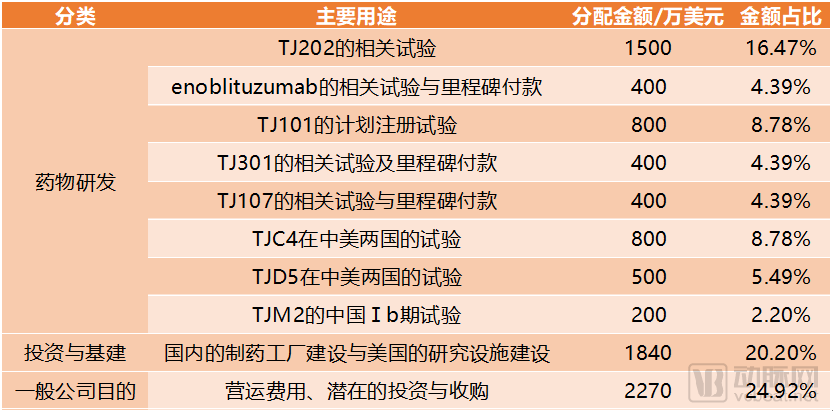
I-Mab’s IPO raised a total net amount of $91.1 million. Of this, 54.8% will be allocated to clinical trial expenses for its drug pipeline, while approximately 20.2% will be used for the construction of research and manufacturing facilities to prepare for future growth. The remaining funds will be directed toward other general corporate purposes, primarily working capital expenses, as well as potential future investments and acquisitions. (Subject to the final prospectus filed by the company.)
Regarding the more distant future, I-Mab has long had its plans in place. “Over the past two years, we have been actively considering how to establish cash flow. In recent years, we have out-licensed three projects, with total potential proceeds of up to $150 million. Between this year and next, we will have additional product out-licensing deals and external collaborations. These transactions and partnerships will help us recoup a portion of our R&D investment. We expect our TJ202 to be launched in China by 2022, at which point cash flows from sales and from R&D collaborations will together become key sources of funding for our future development,” said Dr. Zang Jingwu.