

Lachesis Mobile Health Secures RMB 150 Million Series B+ Funding Led by Shenzhen Capital Group and HighTone Investment
On January 20, 2020, Shenzhen Lachesis Mhealth Co., Ltd. (hereinafter referred to as “Lachesis”) held a signing ceremony for its strategic financing round, announcing the completion of RMB 150 million in Series B+ funding. The investors in this round were Shenzhen Capital Group Co., Ltd. (hereinafter referred to as “SCGC”) and GTJA Investment Group Co., Ltd. (hereinafter referred to as “GTJA Investment”). This marked the first financing deal in the smart healthcare sector in 2020. Previously, Lachesis had secured Series B financing from GTJA Investment and Source Code Capital in August 2018.
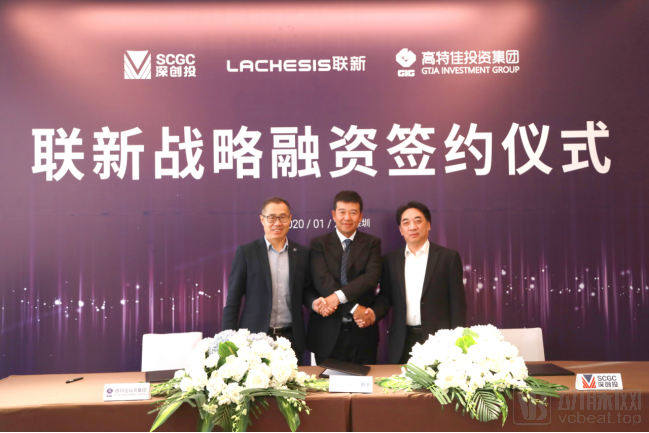
Guests attending the signing ceremony included: Ni Zewang, Chairman of Shenzhen Capital Group (SCGC); Zhang Jian, Vice President of SCGC Group; Yi Hongxiang, Partner of SCGC Health Industry Fund; Cai Dajian, Chairman of GTJA Investment; Zeng Xiaojun, Managing Partner of GTJA Investment; Miao Yujia, Business Partner of GTJA Investment; Zhuo Fumin, Chairman of Source Code Capital; Liu Senlin, Executive General Manager of CICC Capital; Huang Shu, Assistant to the President of Shenzhen Institutes of Advanced Technology, Chinese Academy of Sciences; and Zhao Guang, Chairman of Shenzhen Hengyou Investment Development Co., Ltd.
Create an Integrated Hardware-Software Solution
Lachesis is positioned to provide smart ward and chronic disease management solutions for hospitals, consistently adhering to a clinical-centric approach by delivering intelligent, integrated hardware-software holistic solutions. Its business scope covers medical-grade smart hardware, application software, system platforms, IoT, and big data healthcare clouds, spanning multiple domains such as smart ward interaction platforms, clinical medicine, teaching and research, intelligent nursing, intelligent vital signs acquisition, early condition assessment, closed-loop infusion management, bedside information interaction, mobile medical/nursing workstations, point-of-care payment, intelligent equipment management, intelligent medication management, perioperative closed-loop management, in-hospital Bluetooth IoT, and intelligent diabetes management. It has established the core ecosystem for building smart hospitals.
From its initial focus on single products and product portfolios to the development of comprehensive solutions centered around a smart ward interaction platform, Lachesis has undergone a significant strategic transformation. Currently, Lachesis is virtually the only company in the smart healthcare sector capable of providing an integrated hardware-software solution, with the vast majority of its products being independently developed.
Lachesis in the Eyes of Investors
Mr. Ni Zewang, Chairman of Shenzhen Capital Group (SCGC), stated: “Lachesis is a rapidly growing leading enterprise in its niche market. Under the leadership of a first-class management team headed by Chairman Zhu Shuangquan, the company has demonstrated strong competitiveness and creativity. As the most powerful and influential domestic venture capital firm in China, SCGC has always prioritized the life and health industry as a key investment sector. We are highly optimistic about Lachesis’s future development. We will continue to provide robust support to Lachesis Medical, working hand in hand to overcome challenges and facilitate its successful entry into the capital markets, thereby making greater contributions to global health and smart healthcare services for hospitals.”
As an existing shareholder participating in this round of additional investment, Cai Dajian, Chairman of GTJA Investment Group Co., Ltd., stated on site: “Over the past two years or so, we have witnessed the rapid development of Shenzhen Lachesis Mhealth Co., Ltd. We are delighted that Shenzhen Capital Group has joined us in this endeavor. Healthcare is an eternal cause for humanity; therefore, regardless of the challenges facing the industry, we have every reason to be confident in its future prospects. GTJA Investment greatly appreciates and feels fortunate to partner with a company like Lachesis.”
Zhang Jian, Group Vice President of Shenzhen Capital Group (SCGC) in charge of the health industry fund, stated, “The smart healthcare sector in which Lachesis operates is an exceptionally promising niche market with vast prospects and immense scale. If viewed as a consumer product, Lachesis’s offering would be considered a ‘wow’ product due to its outstanding user experience; nurses are particularly delighted when using it. Such high-quality products that effectively integrate technology with user needs are highly anticipated. The Lachesis team possesses a deep understanding of market demands and clinical pain points, along with strong technical expertise. Crucially, they excel at seamlessly integrating these elements to successfully commercialize their products.”
Lachesis’s growth in recent years has been inseparable from the steadfast companionship and support of its existing shareholders. The signing ceremony also specially invited representatives of the Series A and Series B investor-shareholders to attend and share their expectations for Lachesis’s future development.
Zhuo Fumin, Chairman of Source Star Capital, stated, “I believe that this industry will inevitably see the emergence of a group of pioneering leaders. Lachesis Mhealth is such an enterprise. The team led by our Chairman, Zhu Shuangquan, possesses three distinctive qualities. The first is perseverance; the second is the craftsmanship spirit of a major power; and the third is the spirit of diligent, unglamorous innovation. The development process will inevitably involve setbacks and fluctuations. The key question is whether you can persist through these ups and downs to see it through to the end. Therefore, these three spirits are the primary reasons why I am bullish on Lachesis.”
Liu Senlin, Executive General Manager of CICC Capital, stated: “The first keyword is ‘air.’ I believe that one of the best forms of post-investment management is sometimes to let things be without unnecessary interference. The second keyword is ‘forge ahead with passion.’ The diversified shareholders of Lachesis bring years of experience and visionary insights into the future, serving as a solid backing that allows you to move forward with confidence and freedom. The third keyword is ‘securitization.’ Medical companies essentially evolve from developing products to building commercial systems, ultimately forming a platform-based multi-product layout. I am confident that on our journey forward, we will contribute to the industry’s development, enhance the quality of medical services in hospitals amid staffing shortages, and ultimately guide this mobile health platform company to the capital markets.”
Under Policy Guidance, Smart Healthcare Will Embrace New Opportunities
China’s healthcare service development is at a critical stage of transition from informatization to intelligentization. Striving to make the construction of informatized and smart hospitals an important engine for high-quality development of healthcare services can significantly enhance public satisfaction and sense of gain. The development of smart hospitals will become the core trend in modern hospital construction.
In October 2019, the National Healthcare Security Administration issued the Technical Specifications for DRG Grouping and Payment under the National Healthcare Security System and the CHS-DRG Grouping Scheme. It required accelerating the modification of information systems related to the national pilot program for DRG-based payment, improving the implementation and supervision of key stages such as scheme design, bidding, procurement, and deployment, and enhancing data management capabilities.
In March and April 2019, the National Health Commission (NHC), in conjunction with the National Administration of Traditional Chinese Medicine, successively issued the “Notice of the General Office of the National Health Commission on Printing and Distributing the Graded Evaluation Standard System for Hospital Smart Services (Trial)” and the “Notice on Launching Related Work for the 2019 National Performance Assessment of Tertiary Public Hospitals.” These documents required tertiary hospitals to participate in the evaluation of electronic medical record (EMR) application functionality levels and incorporated this evaluation into their performance assessments, reflecting the state’s emphasis on EMRs. The release of the graded evaluation standards for smart services aims to guide hospitals in continuously strengthening information technology construction and providing smart services in a problem- and demand-oriented manner, thereby laying the foundation for the further development of smart hospitals.
Furthermore, as early as 2017, the national “Assessment Scheme for the Standardization and Maturity of Regional (Hospital) Health Information Interoperability” explicitly stipulated a comprehensive evaluation covering data resource standardization, interoperability standardization, infrastructure construction, and the effectiveness of interoperability applications, to assess the maturity level of hospital information interoperability standardization.
Under the guidance of national policies, key performance indicators for hospitals now include levels of interoperability, electronic medical record (EMR) system maturity, and the degree of informatization for Diagnosis-Related Group (DRG)-based payment. “Smart Healthcare” for medical professionals, “Smart Services” for patients, and “Smart Management” for administrators have gradually become official evaluation criteria for smart hospitals. The introduction of these standards has provided hospital administrators with clearer direction for future smart hospital development, while also presenting new challenges and opportunities for enterprises operating in the smart healthcare sector.
“Flying Against the Wind Amidst a Capital Winter”
Amid the new round of adjustments in China’s economic landscape, corporate financing remained challenging throughout 2019. Nevertheless, Shenzhen Lachesis Mhealth Co., Ltd. defied the headwinds and successfully closed its Series B+ funding round, fully demonstrating the company’s core strengths. Its product innovation and marketing capabilities in the smart healthcare sector have created substantial growth potential, earning strong favor from the capital market.
Since its establishment, Shenzhen Lachesis Mhealth Co., Ltd. (hereinafter referred to as "Lachesis") has maintained steady growth and developed into one of the leading enterprises in China's smart healthcare sector. In the vertical niche market of smart wards, its marketing network currently covers more than 6,000 hospitals across China, with over 900 accumulated clients. Among these clients, 15 are ranked among the top 20 comprehensive hospitals nationwide; 10 have achieved Level 5 Grade B in the National Health and Medical Information Interconnectivity Standardization Maturity Assessment; 2 have attained Level 7, the highest rating, in the National Electronic Medical Record (EMR) System Grading; and 8 have reached Level 6 in the same grading system. The company’s client portfolio includes many renowned tertiary A-grade hospitals in China, such as Peking Union Medical College Hospital, Peking University People’s Hospital, Beijing Hospital of the Ministry of Health, Shengjing Hospital of China Medical University, Nanfang Hospital of Southern Medical University, Ruijin Hospital Affiliated to Shanghai Jiao Tong University School of Medicine, Zhongshan Ophthalmic Center of Sun Yat-sen University, Xiangya Hospital of Central South University, and Peking University Shenzhen Hospital, thereby demonstrating a strong exemplary effect in the field of smart healthcare.
As the development of smart hospitals deepens, tangible data demonstrates to an increasing number of hospital administrators that smart hospital initiatives can standardize and optimize processes across pre-consultation, intra-consultation, post-consultation, and medical support stages. These initiatives effectively ensure medical safety, significantly improve operational efficiency, and enhance the quality of medical services. With technologies such as big data, the Internet of Things (IoT), and artificial intelligence (AI) becoming increasingly mature, and 5G commercialization becoming a reality, the smart healthcare industry is poised to maintain its rapid growth trajectory in 2020. Shenzhen Lachesis Mhealth Co., Ltd. has successfully completed its Series B+ financing round. This infusion of capital will support the innovative research and development of smart healthcare products, while also expanding research into emerging business areas such as medical big data and intelligent diagnostics. On the new frontier of smart healthcare, Lachesis stands on equal footing with global companies, jointly pioneering a new industry landscape and facilitating the transformation and healthy development of the healthcare sector.
Shenzhen Capital Group Co., Ltd.
Shenzhen Capital Group Co., Ltd. (hereinafter referred to as “SCG”), established in 1999, is committed to its mission of discovering and empowering great enterprises. Dedicated to identifying and nurturing innovative value, SCG has evolved into a comprehensive investment group with venture capital at its core. It currently has a registered capital of RMB 5.42 billion and manages funds totaling approximately RMB 347.174 billion. As of the end of November 2019, SCG ranked first in China’s venture capital industry in terms of both the number of portfolio companies and the number of listed investee companies. It had invested in 1,051 projects, with cumulative investments amounting to approximately RMB 47.6 billion. Among these, 157 portfolio companies have been listed on 16 major capital markets worldwide, and 263 projects have achieved exits (including IPOs). Through professional investment strategies and in-depth services, SCG has fueled the growth of numerous star enterprises such as Mindray Medical and Royole Technology, thereby delivering outstanding performance for itself.
Red Soil Medical Fund
Shenzhen Hongtu Medical Health Industry Equity Investment Fund Partnership (Limited Partnership) (hereinafter referred to as “Hongtu Medical Fund”) is the first medical and healthcare equity investment fund initiated and established by Shenzhen Capital Group Co., Ltd. (hereinafter referred to as “SCGC”), with a total fund size exceeding RMB 2 billion. The Hongtu Medical Fund focuses on innovation and growth in China’s medical and healthcare sector, covering high-quality projects across all stages and niche segments of the industry. Its portfolio companies include BGI Genomics, Zhenghai Biotechnology, Mindray Medical, YHLO, Hangzhou Guangdian, Wuhan Degabier, Lidakang, and others.
GTJA Investment Group
Founded in Shenzhen in 2001, GTJA Investment Group focuses on investments in the healthcare industry, with strategic equity investment as its core approach. Its investment portfolio covers all stages, including mergers and acquisitions (M&A), private equity (PE), venture capital (VC), and angel investing. The group boasts China’s largest professional healthcare investment team and has built an ecosystem platform for healthcare industry investment, striving to become a globally influential healthcare investment institution. With assets under management totaling RMB 20 billion and 24 healthcare-focused funds, GTJA has invested in over 130 companies, including more than 60 in the healthcare sector. It has facilitated the successful listing of 11 portfolio companies, notably through its controlling investment in Boya Bio-pharmaceutical Group Co., Ltd., a leading domestic blood products company, which it helped list on the stock exchange.