

Medical Policy Green Lights During the Pandemic: Full Coverage of Treatment Costs, Emergency Approval of Test Kits, and Expedited Use of Medical Devices
Emergency approval was granted for seven viral testing reagent products; unregistered imported medical devices were permitted for emergency use; clinical treatment guidelines were updated to the fourth edition; and both confirmed and suspected cases were covered by medical insurance. Since the outbreak of the novel coronavirus (2019-nCoV) pneumonia, particularly after it was classified as a Class B infectious disease but managed under Class A protocols on January 20, the healthcare sector has intensively rolled out relevant policies to rapidly respond to epidemic prevention and control efforts.
According to incomplete statistics, as of February 2, the National Health Commission, the National Medical Products Administration, and the National Healthcare Security Administration have collectively issued more than 30 notices, announcements, work plans, and guidelines.
Before the novel coronavirus was initially identified, the condition it caused was described as “viral pneumonia of unknown etiology.” Even after its initial identification, scientific understanding of the virus and healthcare workers’ awareness of the epidemic continued to evolve, with uncertainty present at every stage.
In the face of uncertainty, national policies have not only adhered to established emergency protocols but have also introduced targeted breakthroughs in response to evolving epidemic dynamics.
On January 7, experts preliminarily identified the pathogen causing Wuhan’s “pneumonia of unknown etiology” as a novel coronavirus. This marked a phased advance in the understanding of the virus, enabling more targeted subsequent diagnosis and treatment. However, as the epidemic spread, viral testing capacity and the supply of urgently needed medical devices became significant challenges.
Emergency Approval of Diagnostic Reagents: Breaking Through Diagnosis and Treatment Bottlenecks
Taking Wuhan as an example, the official website of the Wuhan Municipal Health Commission indicates that during the early stage of the outbreak, the sample testing process for suspected cases was as follows: Primary care hospitals conducted standardized pre-examination and triage, combined with clinical examinations, laboratory tests, and chest imaging. Suspected cases were confirmed and sampled following consultation by an expert panel. The district-level Center for Disease Control and Prevention (CDC) then transported the samples to the municipal CDC, which subsequently forwarded them to the provincial CDC for nucleic acid testing, with a daily testing capacity of over 200 samples. The entire process, from sample collection to result reporting, took approximately two days. Prior to January 16, however, Hubei Province lacked test kits, necessitating that samples be sent to nationally designated testing institutions for virus isolation and nucleic acid testing, with results taking approximately 3–5 days to be returned.
Viral testing and case confirmation are fundamental steps critical to epidemic control. If suspected cases are not diagnosed in a timely manner, targeted treatment cannot be administered promptly, resulting in delayed therapeutic intervention.
Meanwhile, domestic in vitro diagnostic companies have rapidly committed to reagent development and achieved phased results. The National Medical Products Administration has simultaneously taken action by initiating an emergency approval process.
Pursuant to the “Emergency Approval Procedures for Medical Devices,” when there is a threat of a public health emergency, drug regulatory authorities may implement emergency approval for medical devices required for emergency response. The National Medical Products Administration shall determine the timing for initiating and terminating such procedures based on the nature and development of the public health emergency.
Under the classification of the "Measures for the Administration of Registration of In Vitro Diagnostic Reagents," novel coronavirus testing reagents are categorized as reagents related to the detection of antigens, antibodies, and nucleic acids of pathogenic pathogens, and are classified as Class III in vitro diagnostic products.
Based on the aforementioned Measures and Procedures, we have outlined the key differences between emergency approval and standard approval for Class III in vitro diagnostic products:
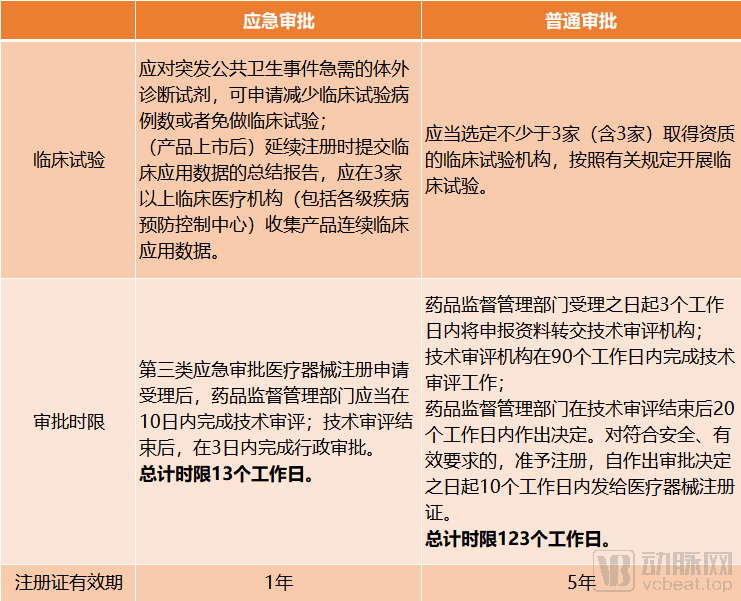
Comparison Between Emergency Approval Procedures and Standard Approval Procedures. Source: National Medical Products Administration; Chart by VCBeat
As shown in the figure above, emergency approval reduces clinical trial requirements and significantly shortens the review and approval timeline during the registration process. However, the validity period of the registration certificate is limited to one year, and manufacturers are required to submit supplementary materials and clinical application data after the product is marketed. These differences reflect the principle of balancing emergency use with safety assurance.
Under the emergency approval procedure, the National Medical Products Administration approved four products, two products, and one product on January 26, 28, and 31, respectively.
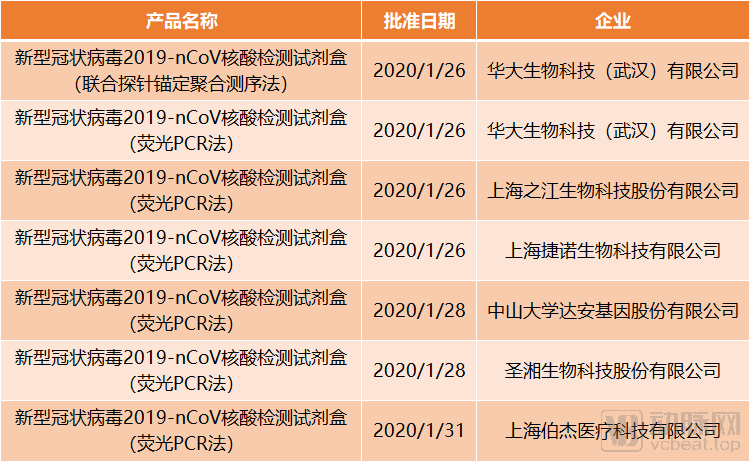
Reagent Products Approved Under Emergency Review by the National Medical Products Administration; Source: Center for Medical Device Evaluation, National Medical Products Administration; Graphic by VCBeat
Following its market launch, the test kit was successively distributed to centers for disease control and prevention (CDCs) and medical institutions at all levels, significantly enhancing testing capacity across various regions. Taking Wuhan as an example, from January 22 to 27, the city’s daily viral testing capacity increased from 200 to 2,000 samples, with 10 institutions authorized to conduct testing. Starting January 28, eight additional designated testing institutions were added in Wuhan, further improving testing efficiency.
On January 27, China reported 1,771 newly confirmed cases, an increase of 1,002 from January 26, representing a 130% rise. Starting January 27, the daily number of new confirmed cases surged from hundreds to over 1,000 and then 2,000.
Tian Yulong, Member of the Leading Party Members Group and Chief Engineer of the Ministry of Industry and Information Technology (MIIT), stated that by February 1, the daily production capacity of test kits had reached 773,000 person-tests, equivalent to 40 times the number of suspected cases.
According to epidemic reports from multiple regions and expert interpretations, the significant surge in new cases is attributed not only to the gradual onset of symptoms among individuals during the incubation period but also, importantly, to a substantial enhancement in testing capacity.
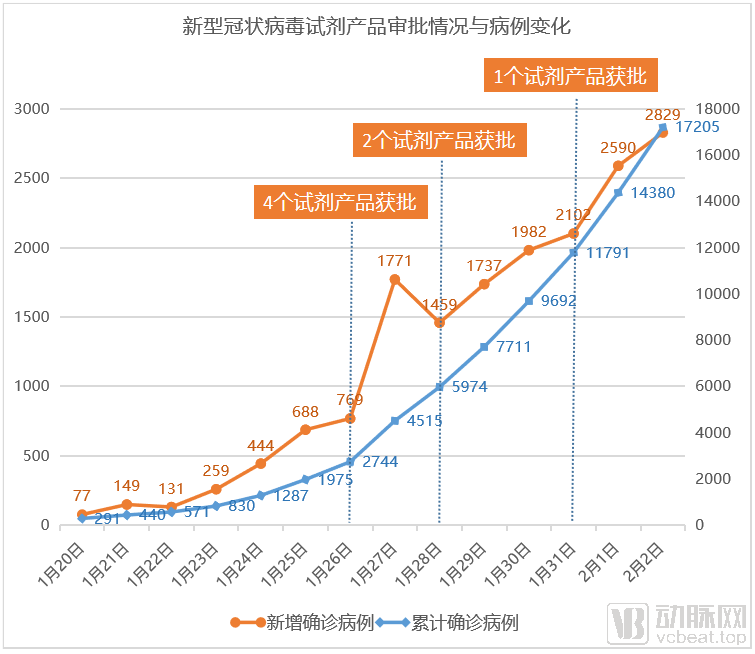
Trends in Confirmed Cases and Milestones for Diagnostic Reagent Product Approvals
Data source: National Health Commission, official website of the National Medical Products Administration; chart by VCBeat
As shown in the figure above, the inflection points in the growth of confirmed cases are synchronized with the approval milestones of the reagent products.
With the outbreak already underway, the immediate priority is prevention and control rather than panic over data. The successive rapid approval and deployment of test kits have undoubtedly removed a bottleneck in the diagnosis and treatment process.
Unregistered Imported Medical Devices Can Be Used in Emergencies, with Expedited Customs Clearance for Supplies
In addition to making breakthroughs on the supply side of domestic medical devices, the National Medical Products Administration (NMPA) has also given the “green light” to imported devices by issuing the “Opinions on the Emergency Import of Medical Devices Not Registered in China.” To meet the needs of the epidemic response, medical devices that comply with relevant standards in the United States, the European Union, and Japan may be imported urgently from abroad for emergency use, provided that enterprises can submit overseas marketing authorization documents and inspection reports, and make commitments regarding product quality and safety.
Following the issuance of the “Opinions,” provinces and municipalities including Chongqing, Yunnan, and Jilin successively released relevant announcements to promote implementation. As the province most severely affected by the epidemic, Hubei, in order to alleviate the shortage of medical masks in the market and meet residents’ urgent needs, saw its Provincial Administration for Market Regulation and Provincial Drug Administration jointly issue a document permitting the sale of imported masks and export-to-domestic-market masks that were not listed domestically within the provincial market.
Furthermore, the General Administration of Customs has issued an announcement to fully ensure the rapid customs clearance of epidemic prevention and control supplies, including imported drugs, disinfectants, protective equipment, and medical treatment devices. Dedicated service windows and green channels for the rapid clearance of imported donated materials have been established at customs sites to facilitate expedited inspection and release. For medical supplies used in epidemic prevention and control that require an Import Drug License, Customs may grant provisional release based on certification from the competent pharmaceutical authorities, with relevant procedures to be completed retrospectively.
The implementation of this series of measures will further alleviate the shortage of urgently needed medical devices and supplies during the pandemic.
The overall progress of epidemic prevention and control, which involves the general public, healthcare workers, medical institutions, and many other complex aspects, is led by the National Health Commission.
On January 20, the National Health Commission of China issued Announcement No. 1 of 2020, classifying pneumonia caused by novel coronavirus infection as a Class B infectious disease and implementing prevention and control measures applicable to Class A infectious diseases. Previously, there were 26 statutorily designated Class B infectious diseases, including severe acute respiratory syndrome (SARS), AIDS, and viral hepatitis, while Class A infectious diseases comprised plague and cholera.
Inclusion of pneumonia caused by novel coronavirus infection in Category B infectious diseases, with management measures equivalent to those for Category A diseases, means that local governments, relevant departments, and medical and health institutions at all levels may legally implement fever screening, isolation and treatment of confirmed and suspected cases, isolated medical observation of close contacts, and other stricter prevention and control measures to curb the spread of the epidemic.
Meanwhile, the National Health Commission took the lead in establishing the Joint Prevention and Control Mechanism for the Novel Coronavirus Pneumonia Epidemic (hereinafter referred to as the “Joint Prevention and Control Mechanism”), comprising 32 member departments. Under this mechanism, working groups were established for epidemic prevention and control, medical treatment, scientific research, public communication, foreign affairs, logistical support, and frontline operations, ensuring coordinated efforts and effective synergy through clear division of responsibilities.
Since then, the National Health Commission has participated in the formulation of various normative documents, work plans, and guidelines, focusing on four key areas: public health and public protection, community prevention and control and grassroots screening, medical treatment and scientific research breakthroughs, and healthcare worker support and incentives, while driving implementation at all levels.
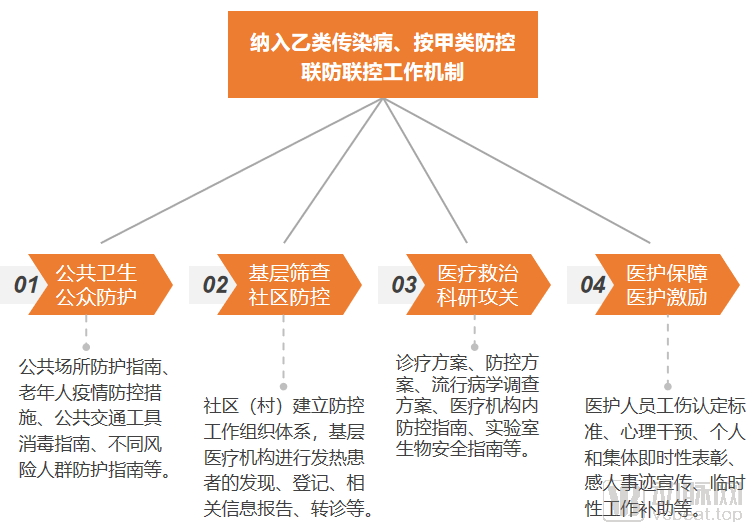
Key Stages Covered by National Health Commission Policies. Source: Official Website of the National Health Commission; Graphic by VCBeat
Safeguarding Public Physical and Mental Health, Laying the Foundation for Prevention and Control
To date, the National Health Commission has issued public prevention guidelines covering various settings, including public places, public transportation, and home-based observation, and has formulated corresponding prevention and control requirements for special populations such as the elderly, children, and pregnant and postpartum women.
On February 2, the Joint Prevention and Control Mechanism also issued the “Notice on Establishing Psychological Assistance Hotlines for Epidemic Response,” requiring all localities to set up epidemic-specific psychological assistance hotlines in addition to their existing ones.
In fact, since the pandemic began to spread across China, the public has responded to the call for epidemic prevention and control, with most people adhering to stay-at-home orders and avoiding gatherings. However, during traditional festivals, the absence of family reunions and offline social interactions, coupled with the psychological impact of various pandemic-related information circulating online, may indeed cause mental distress among the general population. To prevent extreme incidents triggered by psychological stress, timely psychological intervention is indeed necessary.
Only by promoting daily protective measures and physical and mental well-being among the general public through the aforementioned measures can a solid foundation be laid for epidemic prevention and control.
Mobilize Grassroots Efforts to Continuously Advance the Screening Gateway
For the prevention and control of infectious diseases, “early detection, early reporting, early isolation, early diagnosis, and early treatment” are the most fundamental, common, and critical measures. To ensure sufficiently broad coverage of prevention, control, and screening efforts, leveraging community-based management is of paramount importance.
In response, the Joint Prevention and Control Mechanism formulated the "Work Plan for Community Prevention and Control of the Novel Coronavirus Pneumonia Epidemic (Trial)," which clarifies concepts such as community epidemic classification, community transmission of the epidemic, and close contacts for sub-district offices, urban communities, and villages. It proposes prevention and control strategies and specific measures at three levels—communities with no identified cases, communities with identified cases or outbreaks, and communities with epidemic transmission—implementing grid-based and comprehensive management.
To facilitate more effective community-based prevention and control, the National Health Commission issued the "Notice on Strengthening the Prevention and Control of Novel Coronavirus Pneumonia in Primary Healthcare Institutions," requiring primary healthcare institutions to participate in online training, promptly master basic knowledge of epidemic prevention and control, and ensure the identification, registration, and reporting of relevant information for febrile patients. Additionally, these institutions are required to strengthen screening of febrile patients and conduct pre-examination triage, outpatient registration, and referral.
Community-based prevention and control, along with primary care screening, can shift the screening process upstream, alleviate overcrowding in large hospitals, and maximize screening coverage. VCBeat has previously used Wuhan as an example in “Grid-based Screening to Combat the Epidemic: Tiered Diagnosis and Treatment Playing a Key Role in Wuhan” article.
However, community workers and medical staff at primary healthcare institutions are limited in number, making it impossible to manage community residents on a 24/7 basis. How can we further strengthen the screening of febrile patients?
On January 29, Chongqing began implementing a registration and reporting system for the purchase of relevant medications by patients with fever or cough at retail pharmacies during the epidemic prevention and control period. Subsequently, Zhejiang Province implemented a similar registration system starting February 1 to enhance screening of patients with fever or cough. Statistical data from retail pharmacies are reported daily to the district- and county-level departments responsible for epidemic prevention and control.
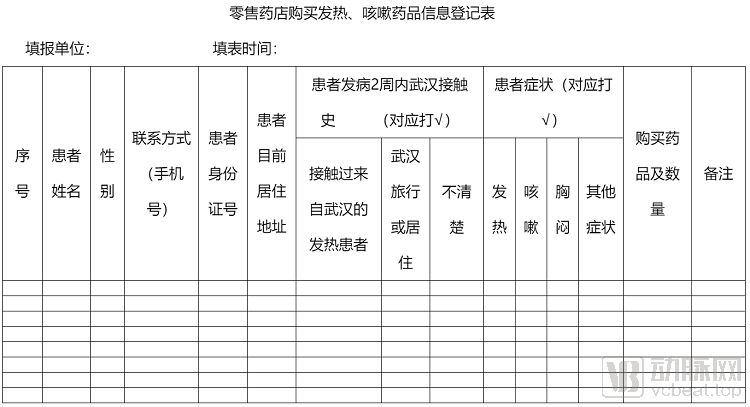
Information Required for the Purchase of Fever and Cough Medications in Zhejiang Province, Source: Zhejiang Provincial Healthcare Security Administration
This approach requires no additional manpower; it merely entails adding statistical tasks to the existing workforce. It fully leverages the extensive network coverage of retail pharmacies, complements community-based prevention and control as well as primary-level screening, and effectively shifts the screening checkpoint further upstream, making it a model worthy of emulation.
Standardized Diagnosis and Treatment, Rapidly Updated Clinical Protocols
For confirmed cases, the National Health Commission adheres to the principle of “centralizing patients, experts, resources, and treatment,” transferring severe cases to designated medical institutions with comprehensive capabilities for treatment. By integrating superior resources and assembling leading experts, and combining traditional Chinese medicine with Western medicine, every effort is made to minimize severe cases and fatalities.
On the basis of provinces and municipalities across China successively announcing designated hospitals within their jurisdictions, the National Health Commission centrally released on January 27 a list of 1,512 designated hospitals and 11,594 fever clinics in 363 cities nationwide, with updates provided in real time via a mini-program as epidemic control measures evolve.
With deepening understanding of the disease and accumulation of clinical experience, the National Health Commission has, to date, organized experts to develop treatment protocols for severe and critically ill cases, as well as four versions of comprehensive treatment guidelines, to facilitate standardized diagnosis and treatment across medical institutions in China and enhance patient care capabilities.
In addition, the National Health Commission has issued multiple protocols and guidelines, including the Case Monitoring Protocol, the Epidemiological Investigation Protocol for Cases, the Technical Guidelines for Laboratory Testing, and the Guidelines for Laboratory Biosafety, to provide guidance to various medical and laboratory institutions.
Strengthening Economic Security and Psychological Incentives for Healthcare Professionals
Amid the severe epidemic prevention and control situation, frontline medical staff and disease control personnel deserve maximum protection and incentives. In response, the Ministry of Human Resources and Social Security, the Ministry of Finance, and the National Health Commission jointly issued a document to safeguard the rights and interests of those engaged in prevention and treatment efforts.
In the prevention and treatment of novel coronavirus pneumonia, medical personnel and related staff who contract novel coronavirus pneumonia or die from such infection while performing their job duties shall be recognized as having suffered work-related injuries and are entitled to work-related injury insurance benefits in accordance with the law.
After ensuring basic protections for medical personnel, the Ministry of Finance and the National Health Commission jointly issued the “Notice on Guarantee Policies for Funds Related to the Prevention and Control of Novel Coronavirus Pneumonia,” which provides temporary work subsidies to medical staff and epidemic prevention workers involved in prevention and control efforts, with funding arranged by the central government.
To address the mental health of healthcare workers, the National Health Commission has issued guidelines for psychological intervention, designating frontline medical staff and disease control personnel involved in epidemic prevention and control as priority groups for intervention and outlining specific measures. Meanwhile, policies have been established to provide immediate commendations to outstanding individuals and collectives, as well as to publicize the inspiring stories of medical workers, thereby fostering moral encouragement.
The National Medical Products Administration (NMPA) and the National Health Commission (NHC) have separately formulated policies to address issues in the diagnosis and treatment phases, while the National Healthcare Security Administration (NHSA) has implemented measures in the payment phase: drugs and medical services that comply with the NHC’s diagnosis and treatment guidelines may be temporarily included in the coverage of the basic medical insurance fund.
For confirmed patients, the National Healthcare Security Administration and the Ministry of Finance jointly issued the Notice on Ensuring Medical Security for the Novel Coronavirus Pneumonia Epidemic, stipulating that after medical expenses are covered by basic medical insurance, critical illness insurance, and medical assistance in accordance with regulations, the portion borne by individuals shall be subsidized by fiscal funds.
For suspected patients, medical expenses determined in accordance with the diagnosis and treatment guidelines issued by the National Health Commission shall be covered through a comprehensive assurance mechanism. After payments are made by basic medical insurance, critical illness insurance, and medical assistance as prescribed, the portion borne by individuals shall be subsidized through fiscal policies and funding arrangements established by the local government where medical care is received, with appropriate subsidies provided by the central government as circumstances warrant.
The aforementioned measures have addressed the treatment costs for two key patient groups, thereby alleviating patients’ concerns about seeking medical care.
Certainly, to ensure the normal operation of medical institutions, the policy clearly states that partial funds can be prepaid to medical institutions with a large number of admitted patients to alleviate their advance payment pressure; at the same time, adjust the total budget indicators for medical institutions and set up a separate budget for the medical expenses of patients infected with the novel coronavirus pneumonia.
As of February 2, China had recorded 17,205 confirmed cases and 21,558 suspected cases. Even if the epidemic reaches its inflection point, the number of cases will continue to rise. Although data on per-capita medical expenses and health insurance payments are not yet available, the overall cost is undoubtedly substantial.
Ensuring timely treatment for patients is undoubtedly the top priority during the ongoing pandemic. However, in the post-pandemic era, to maintain the sound operation of the basic medical insurance fund, the National Healthcare Security Administration may take more frequent actions in areas such as centralized procurement of drugs and medical consumables, and negotiations for inclusion in the national reimbursement drug list, so as to reduce medical insurance expenditures.
In summary, the healthcare sector has achieved multifaceted policy breakthroughs in responding to the epidemic, with continuous adjustments made in accordance with evolving circumstances. Given the current uncertainty regarding potential changes in the disease, timely and ongoing policy adjustments, coupled with precise top-down implementation, constitute a critical component in overcoming the epidemic.