

ADC Therapeutics Advances ADC Drug Development with $558 Million in Funding and Robust Pipeline
ADC Therapeutics
Clinical Oncology Drug Developer
In July 2019, Swiss biotechnology company ADC Therapeutics (hereinafter referred to as “ADCT”) secured an additional $25 million in Series E financing, bringing its total Series E funding to $303 million. ADCT specializes in the development of antibody-drug conjugates (ADCs) and non-antibody drug conjugates, with its core pipeline covering hematologic malignancies and solid tumors.
Antibody-Drug Conjugates (ADCs) are a class of therapeutics that have garnered significant attention in the field of oncology. ADCs consist of biologically active small-molecule drugs linked to monoclonal antibodies via chemical linkers, with the monoclonal antibody serving as a carrier to deliver the small-molecule drug specifically to target cells. This conjugation of small-molecule chemicals and antibodies enables ADCs to combine the specificity and stability of antibody-based therapies with the potent tumor-killing efficacy of cytotoxic small-molecule drugs.
Research on antibody-drug conjugates (ADCs) dates back to the 1980s, but it was not until 2000 that Mylotarg, the first ADC developed by Pfizer, received FDA approval for the treatment of acute myeloid leukemia. However, due to limitations in conjugation technology, targeting specificity, and efficacy, the intact ADCs were unstable in the bloodstream, leading to fatal toxicities. In 2010, Mylotarg was withdrawn from the U.S. market, casting doubt on the prospects of ADC drug development.
The establishment of ADCT coincided with the resurgence of antibody-drug conjugate (ADC) therapies. In 2011, Takeda Pharmaceutical and Seattle Genetics developed a novel ADC, Adcetris, by refining existing ADC technologies. The drug received FDA approval for the treatment of Hodgkin lymphoma and systemic anaplastic large cell lymphoma. In the same year, ADCT was established as a subsidiary of the private equity firm Auven Therapeutics (hereinafter referred to as “Auven”). Subsequently, in 2013, Kadcyla, the first ADC targeting solid tumors jointly developed by Roche and ImmunoGen, gained FDA approval for HER2-positive breast cancer, reigniting a wave of research and development in the ADC field.
Since its inception, ADCT has secured a cumulative total of $558 million in financing and is advancing more than ten ADC drug candidates in its pipeline. The development of ADCT owes much to a key figure—Dr. Chris Martin, its current CEO and co-founder. Dr. Martin held a prominent position on the board of directors when ADCT was first established. He is also the CEO and co-founder of Spirogen, a biotechnology company specializing in ADC drug development that has pioneered PBD-based ADC therapeutics. A member of the Institution of Chemical Engineers and a leading figure in the ADC field, Dr. Martin saw his company Spirogen receive the “Best Scientific Innovation Award” in 2014.

ADCT Leadership Team
In 2012, Spirogen entered into a collaboration with ADC Therapeutics (ADCT), under which ADCT would share Spirogen’s pyrrolobenzodiazepine (PBD)-based antibody-drug conjugate (ADC) technology. In 2013, under the leadership of Chris Martin, MedImmune, AstraZeneca’s global biologics R&D arm, acquired Spirogen for $440 million and made a $20 million equity investment in ADCT, establishing commercial collaborations with two of ADCT’s investigational ADC pipelines. Chris Martin played a pivotal role in advancing ADCT’s core pipeline and securing support from the pharmaceutical giant AstraZeneca.
With ample funding, ADC Therapeutics’ top priority was to expand its team. In 2014, the company recruited nearly ten core senior executives, including former leaders from pharmaceutical giants such as AstraZeneca, Novartis, Merck & Co., and Amgen. These hires comprised scientists and experts covering areas such as antibody drug development, pharmacology and toxicology, biologics manufacturing, legal affairs, and finance. Among them were:
Dr. Jay Feingold will serve as Chief Medical Officer and Head of Oncology Clinical Development at ADC Therapeutics. Dr. Feingold brings over 25 years of industry, academic, and clinical experience, having previously served as Vice President of U.S. Medical Affairs and Chair of the Global Medical Affairs Oversight Committee at First Health Corporation, as well as Vice President of Clinical Development at Wyeth.
Dr. Karin Havenith, who will serve as Senior Bioanalytical Scientist in the Bioanalytics Group at ADC Therapeutics, was formerly a Principal Scientist at Genmab, where she focused on bioanalytical methods for antibody therapies;
Dr. Simon Chivers, who will serve as the Head of Pharmacology for R&D at ADC Therapeutics, previously held the positions of Global Head of Biologics Safety Assessment and Executive Director at Novartis, and served in executive roles at AstraZeneca, Quintiles, and other companies;
Dr. Michael Mulkerrin will join the CMC (Chemistry, Manufacturing, and Controls) department. He has previously held executive positions at companies such as Amgen and Roche, bringing over 20 years of experience in biologics manufacturing.
Dr. Lisa Skelton will serve as Senior Project Manager for ADCT-301, one of ADC Therapeutics’ core pipeline assets. Dr. Skelton brings over 20 years of industry experience, having previously served as Director of Project Management at Norgine and as Senior Project Manager at Amgen.
In 2015, Chris Martin was appointed CEO of ADCT, while former CEO Michael Forer assumed the role of Executive Vice President, overseeing corporate financing, business collaborations, and related matters.
Funding History
Since its inception, ADCT has raised a total of $580 million in financing (as disclosed on its official website). Overall, ADCT’s operating capital has primarily come from its founding shareholders, Auven Therapeutics and AstraZeneca, with later-stage funding provided by Redmile Group. From a timeline perspective, ADCT secured a cumulative $385 million in financing between 2015 and 2017, which was closely tied to the positive clinical data generated by its investigational pipeline.

ADCT's Financing History
ADC drugs consist of three structural components: an antigen-specific antibody, a stable linker, and a potent cytotoxic payload (warhead drug).
The properties of the antibody play a decisive role in key steps of ADC entry into target cells, such as antibody binding to surface antigens on target cells and antibody internalization. Therefore, antibodies with high tumor specificity should be selected, while also ensuring that the antibodies have high affinity.
Suitable linkers must possess two key characteristics: 1) Stability in the human circulatory system, ensuring that no cleavage occurs and cytotoxic molecules (warhead drugs) are not released before the ADC reaches the target cells, thereby avoiding off-target toxicity; 2) Rapid and efficient cleavage upon entry into the target cells, enabling the effective release of cytotoxic molecules to exert their intended pharmacological activity.
The warhead drug is the core component responsible for the activity of ADC drugs, and therefore must possess extremely high potency. Since the warhead drug needs to be conjugated with an antibody, it must also have certain chemical modifiability and water solubility to ensure that the warhead drug can be carried by the antibody into cells and exert its efficacy.
Among existing drugs in the ADC field, the cytotoxic molecules are mostly maytansine and auristatin analogs. The distinctive feature of ADC therapeutics developed by ADCT is the use of next-generation, highly potent pyrrolobenzodiazepine (PBD) dimer toxins as the warhead payload.
PBDs are a class of antitumor antibiotics composed of two PBD monomers that bind to the DNA minor groove, forming persistent adducts. As warheads in antibody-drug conjugates (ADCs), PBDs are delivered to tumor cells via monoclonal antibodies, where they inhibit tumor cell replication and induce apoptosis. Their mechanism of action is independent of the cell cycle, does not distort the DNA double helix, and, unlike maytansinoid warheads, does not cause DNA double-strand breaks. Consequently, PBDs effectively evade DNA repair mechanisms, resulting in DNA damage that is difficult to repair and demonstrating superior cytotoxicity.
ADCT has developed a robust pipeline of antibody-drug conjugate (ADC) candidates based on its pyrrolobenzodiazepine (PBD) dimer technology, targeting CD19, CD25, CD22, AXL, DLK1, and KAAG1, with coverage across both hematologic malignancies and solid tumors. Among these, five candidates are in clinical development, while two solid tumor programs remain in preclinical studies.
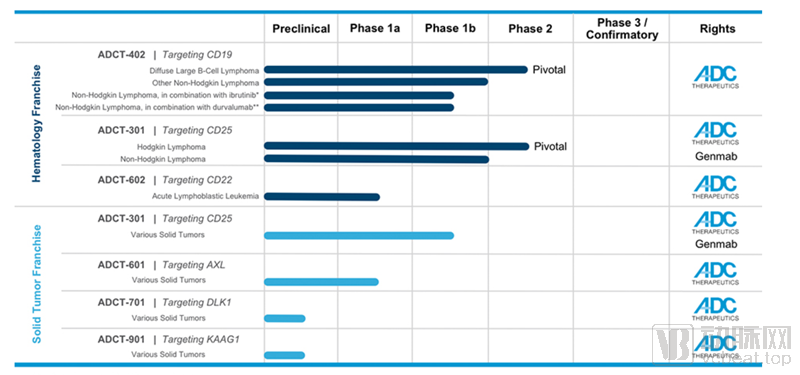
ADCT's Pipeline in Development
Although ADC Therapeutics obtained a license from Spirogen for its core PBD technology, as previously mentioned, the activity of ADC drugs is closely related to specific antibodies and linkers. Since 2013, ADC Therapeutics has been seeking suitable targets and their specific antibodies through licensing agreements and co-development initiatives to address its shortcomings in antibody therapeutics and linker technologies.
In June 2013, Genmab entered into an agreement with ADC Therapeutics to jointly develop an antibody-drug conjugate (ADC) based on Genmab’s HuMax-TAC antibody and ADC Therapeutics’ PBD warhead drug (ADCT-301).
In July 2013, ADCT obtained an exclusive license and collaboration agreement from BZL Biologics for an antibody-drug conjugate (ADC) targeting PSMA-positive prostate cancer. PSMA is a cell-surface antigen highly expressed in prostate cancer cells, making it an ideal target for monoclonal antibody-based ADCs. (ADCT-401)
In November 2013, ADC Therapeutics entered into a collaboration with Five Prime Therapeutics, under which ADC Therapeutics obtained exclusive licenses to five antibody drugs targeting undisclosed antigens in various tumors.
In October 2016, ADC Therapeutics obtained a patent license for GlycoConnect and HydraSpace from the Dutch biotechnology company Synaffix. GlycoConnect is a site-specific, stable antibody conjugation technology, and HydraSpace is an enhanced linker technology for antibody-drug conjugates.
In April 2019, ADC Therapeutics entered into a collaboration with Adagene, pursuant to which ADC Therapeutics obtained a license for Adagene’s independently developed SAFEbody® technology, an antibody precision masking platform that enables antibodies to be specifically activated within tumor tissues, thereby reducing the systemic toxicity of the drug.
In August 2019, ADCT entered into a collaboration with Freenome, whereby ADCT would leverage Freenome’s comprehensive multi-omics testing platform to identify patients sensitive to ADCT-402 therapy.
In October 2019, ADC Therapeutics obtained an exclusive license from Avacta for the use of Affimer proteins in the development of antibody-drug conjugate (ADC) therapeutics. Avacta will provide ADC Therapeutics with optimized Affimer binders targeting three undisclosed cancer targets.
Since 2014, ADC Therapeutics’ investigational pipeline has progressively entered clinical trials, yielding positive results. In 2014, ADCT-401, an antibody-drug conjugate (ADC) targeting PSMA-positive prostate cancer and co-developed by ADC Therapeutics and AstraZeneca, entered human clinical trials.
In December 2015, ADCT-402, a CD19-targeting antibody-drug conjugate (ADC) developed by ADC Therapeutics for the treatment of non-Hodgkin lymphoma (NHL) and B-cell acute lymphoblastic leukemia (ALL), was approved to enter Phase I clinical trials. In June 2017, ADCT-402 received orphan drug designation from the U.S. Food and Drug Administration (FDA) for the treatment of relapsed or refractory diffuse large B-cell lymphoma (r/r DLBCL) and mantle cell lymphoma (MCL).
In February 2016, ADCT-301, an antibody-drug conjugate (ADC) developed by ADC Therapeutics for the treatment of acute myeloid leukemia (AML), entered Phase I clinical trials.
In October 2016, ADCT obtained a patent license for GlycoConnect and HydraSpace from the Dutch biotechnology company Synaffix. GlycoConnect is a site-specific, stable antibody conjugation technology, and HydraSpace is an enhanced spacer technology for antibody-drug conjugates.
In 2017, ADCT actively participated in national and international conferences, including the AACR Annual Meeting, the International Conference on Malignant Lymphoma, and the 2017 American Society of Hematology (ASH) Annual Meeting, showcasing positive clinical results from its pipeline programs. These favorable data attracted significant investor interest, enabling ADCT to raise a cumulative total of $380 million in financing between 2014 and 2017.
However, drug development is not always smooth sailing. In April 2018, ADC Therapeutics announced the termination of the development of ADCT-502, an antibody-drug conjugate (ADC) for HER2-positive cancers. In September 2019, following the completion of its Series E financing, ADC Therapeutics initially planned to launch an initial public offering (IPO) in the United States, but ultimately withdrew the listing plan on the afternoon before the scheduled listing date, citing unfavorable market conditions.
The prospectus shows that ADC Therapeutics has been in a net loss position since its establishment. In 2017 and 2018, the net losses of ADC Therapeutics were $89.9 million and $123.1 million respectively, with most of the losses attributed to research and development (R&D) expenses and labor costs. During these two years, the company's R&D expenditures amounted to $85.83 million and $118.3 million respectively. As of June 30, 2019, ADC Therapeutics had accumulated a net loss of $381.9 million.
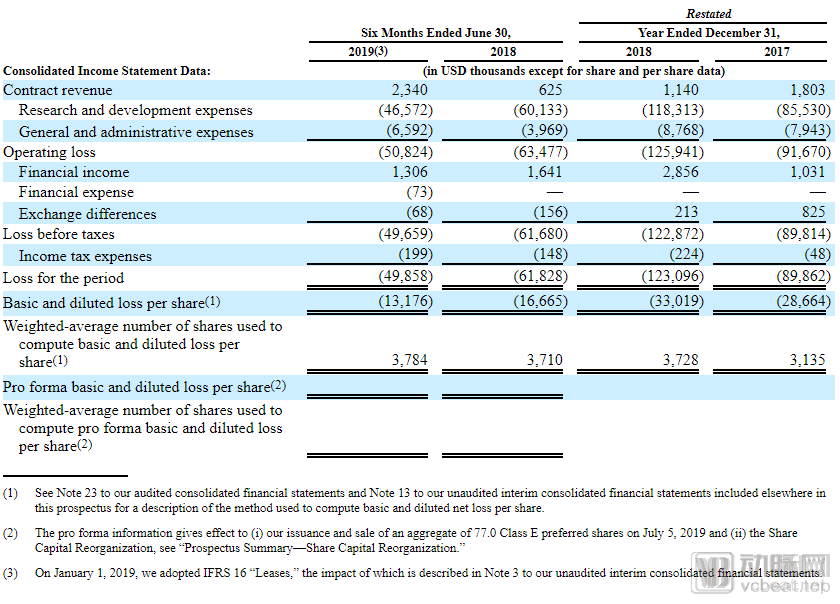
Data sourced from Meigu Zhijia
In January 2020, ADC Therapeutics announced the Phase II clinical trial results of ADCT-402, its pipeline candidate for the treatment of relapsed or refractory diffuse large B-cell lymphoma (r/r DLBCL). The data demonstrated that ADCT-402 had met its primary endpoint, exhibiting single-agent antitumor activity and a manageable safety profile. ADC Therapeutics is expected to submit a Biologics License Application (BLA) in the third quarter of 2020.
Summary
As a highly promising direction in oncology R&D, antibody-drug conjugates (ADCs) have seen four products approved globally, with nearly 100 new ADC candidates currently in clinical trials. In China, multiple companies—including Bio-Thera Solutions, Jiangsu Hengrui Medicine, Zhejiang Hisun Pharmaceutical, and Shanghai Pharmaceuticals—have entered this field. Notably, BAT8001, an ADC developed by Bio-Thera Solutions, is the first HER2-targeting antibody-drug conjugate to enter Phase III clinical trials.
From the development trajectory of ADCT, it is evident that the positive outcomes in its R&D pipeline are closely tied to its research strategy, patented technologies, multidisciplinary and well-rounded team, and robust funding. In key stages of ADC drug development, ADCT has sought multi-party collaborations through “patent licensing” to address technical gaps, rather than developing all core patented technologies from scratch. The establishment of a high-caliber, multidisciplinary team has played a crucial role in advancing drug development. With multiple pipelines progressing simultaneously, favorable clinical results have enabled ADCT to continuously attract capital investment.