

Integrated BioTherapeutics Advances Pan-Filovirus Therapeutics and Submits IPO Filing

Integrated BioTherapeutics
Developer of Novel Vaccines for Infectious Diseases
The start of 2020 was shocking and distressing, as the sudden emergence of an infectious disease put people on high alert and in full protective gear. For centuries, humanity’s fight against infectious diseases has never ceased. From a historical perspective, however, humans have accumulated valuable experience in this struggle and achieved tremendous breakthroughs in life sciences. Even those notorious infectious diseases have eventually subsided over the course of history, and the leading cause of human mortality has shifted from infectious diseases to conditions such as cardiovascular diseases and cancer.
Just as a hunter in the jungle must remain vigilant even in the absence of jackals, wolves, tigers, or leopards, humanity has not relaxed its efforts in infectious disease research. Even for highly contagious and feared diseases such as Ebola and SARS, which have temporarily become things of the past, the life sciences community has never ceased its daily research endeavors. Infectious pathogens are primarily categorized into viruses and bacteria. For bacterial infections, antibiotics are the first-line treatment that comes to mind; whereas for viral infections—caused by pathogens composed solely of nucleic acids and a protein capsid—the primary therapeutic strategy revolves around vaccines.
Integrated BioTherapeutics (hereinafter referred to as “IBT”) is a biotechnology company focused on the development of therapeutics targeting two major categories of infectious pathogens: viruses and bacteria. The company specializes in researching and developing novel vaccines and therapies for emerging infectious diseases. It operates three core technology platforms: the “Engineered Vaccine Design Platform,” the “Rhesus Macaque-Derived Human Monoclonal Antibody Platform,” and the “Platform for Developing Engineered Surface-Toxin Antibodies (ISTAbs) Targeting Bacterial Surfaces.” These platforms aim to develop therapeutic agents for infections caused by pathogens such as Ebola virus, Marburg virus, and Bacillus anthracis.
IBT, founded in 2005 and headquartered in Rockville, Maryland, USA, was initially launched with seed funding jointly provided by the National Institute of Allergy and Infectious Diseases (NIAID), the U.S. Department of Defense (DoD), and the Technology Development Corporation of Maryland (TEDCO), and was established by Dr. M. Javad Aman.
Dr. M. Javad Aman earned his Ph.D. in Molecular Biology and Immunology from the University of Mainz. He has conducted in-depth research on the role of cytokines in the stromal cell microenvironment during hematopoietic lineage development, demonstrating the profound impact of interferon-alpha on bone marrow stromal cell factors. Additionally, he provided supportive laboratory analyses for multiple clinical trials of interferon-alpha in patients with chronic myeloid leukemia.
In 1998, Dr. M. Javad Aman pursued postdoctoral training in molecular immunology at the University of Virginia, conducting in-depth research on the signaling mechanisms of B-cell antigen receptors. Prior to founding Integrated BioTherapeutics (IBT), Dr. Aman served as Chief Scientist at the U.S. Army Medical Research Institute of Infectious Diseases (USAMRIID), where he led vaccine development efforts against Ebola and Marburg viruses, laying the scientific foundation for the subsequent establishment of IBT.

Some Core Members of the IBT Team
In addition to Dr. M. Javad Aman, the IBT team includes dozens of full-time PhDs holding core positions within the company (as shown in the figure above), enabling IBT to expand its reach more rapidly and extensively across the infectious disease sector. Among its entities, IBT Bioservices is a subsidiary operated by IBT that specializes in contract research organization (CRO) services related to infectious diseases, providing industrial and academic clients with cutting-edge infectious disease discovery and animal model testing services.
IBT has divided its clinical pipeline into two major directions: antiviral and antibacterial. The antiviral product line mainly includes unique pan-filovirus antibody candidate drugs, which can provide broad-spectrum therapeutic effects against viruses such as Ebola, Sudan, and Marburg; the antibacterial product line primarily targets toxoid vaccines related to Staphylococcus infections, capable of treating toxic shock syndrome caused by SEB (Staphylococcal Enterotoxin B) infection.
Anti-Viral Infection: Development of Broad-Spectrum Therapeutics for Filoviruses
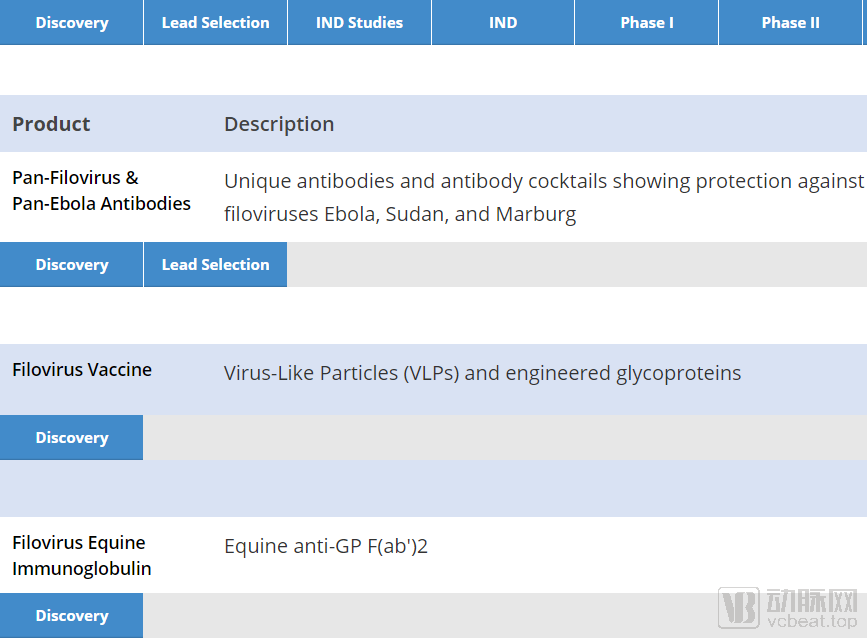
IBT’s Partial Antiviral Pipeline
In terms of antiviral product pipelines, IBT currently has five antiviral pipelines. Three of these target filoviruses, while the remaining two are an alpha virus antibody development pipeline in collaboration with Mapp Biopharmaceutical and a hepatitis C virus (HCV) antibody development pipeline in collaboration with Stanford University.
The development of therapeutic agents for filoviruses is a major highlight of IBT’s antiviral pipeline. Filoviruses belong to the order Mononegavirales and are viruses that infect vertebrates; known filoviruses include Ebola virus, Marburg virus, and Cuevavirus, among others. Notably, there are currently no approved therapeutics or vaccines for filoviruses.
Integrated BioTherapeutics’ most rapidly advancing pipeline is the development of “pan-filovirus antibodies,” which offer broad-spectrum treatment against filoviruses and have now progressed to the lead selection stage. Given the unpredictable nature of future filovirus outbreaks, these broadly therapeutic pan-filovirus antibodies will hold greater value and significance for future medical practice and infectious disease prevention and control.
IBT’s “pan-filovirus antibody,” capable of providing broad-spectrum treatment against filoviruses, is essentially an immunotherapy in the form of a monoclonal antibody (mAb) targeting filoviruses. It can be used for prophylaxis in individuals at potential risk of filovirus infection and for therapeutic intervention in infected patients. IBT has identified a unique cocktail of antibodies from numerous candidate compound combinations, which demonstrates broad-spectrum efficacy against Ebola virus, Sudan virus, and Marburg virus simultaneously.
Currently, IBT has tested its pan-filovirus antibody drug candidates in mouse models, demonstrating favorable affinity and therapeutic efficacy. The company will further evaluate their efficacy in non-human primates and conduct additional characterization and assessment of the pan-filovirus antibody candidates to select either a single monoclonal antibody (mAb) or a cocktail for Investigational New Drug (IND) application and clinical trials.
In addition to the development of pan-filovirus antibodies, IBT is also developing vaccines against pan-filoviruses. Leveraging its engineered vaccine design technology platform, the company has developed a prototype pan-filovirus vaccine and entered into a strategic partnership with the biotechnology company Agilvax. Under this collaboration, Agilvax will utilize IBT’s Pan-Ebola and Pan-Filovirus monoclonal antibodies (mAbs) to select virus-like particle (VLP) vaccines with high affinity and favorable therapeutic profiles from its extensive VLP library.
In addition to the development of filovirus antibodies and vaccines, IBT is also exploring therapeutic development from a third angle: equine immunoglobulins. This project is a collaboration between IBT, Auburn University, and Emergent Biosolutions (EBSI) to jointly develop an equine immunoglobulin therapeutic product targeting filoviruses (anti-GP F(ab’)2). IBT and its partners have designed a novel equine immunization protocol capable of generating high-titer plasma against Ebola, Sudan, and Marburg viruses, which has already demonstrated promising therapeutic efficacy in mouse models.
Combating Bacterial Infections: Focus on the Treatment of Staphylococcus aureus Infections
In the field of anti-infectives, IBT has four core pipelines covering infections caused by pathogens such as Staphylococcus aureus, Clostridioides difficile, and Bacillus anthracis. The most advanced program is the development of StebVax, a toxoid vaccine against Staphylococcal enterotoxin B (SEB), which has completed Phase I clinical trials, with the company preparing to enter Phase II clinical studies.
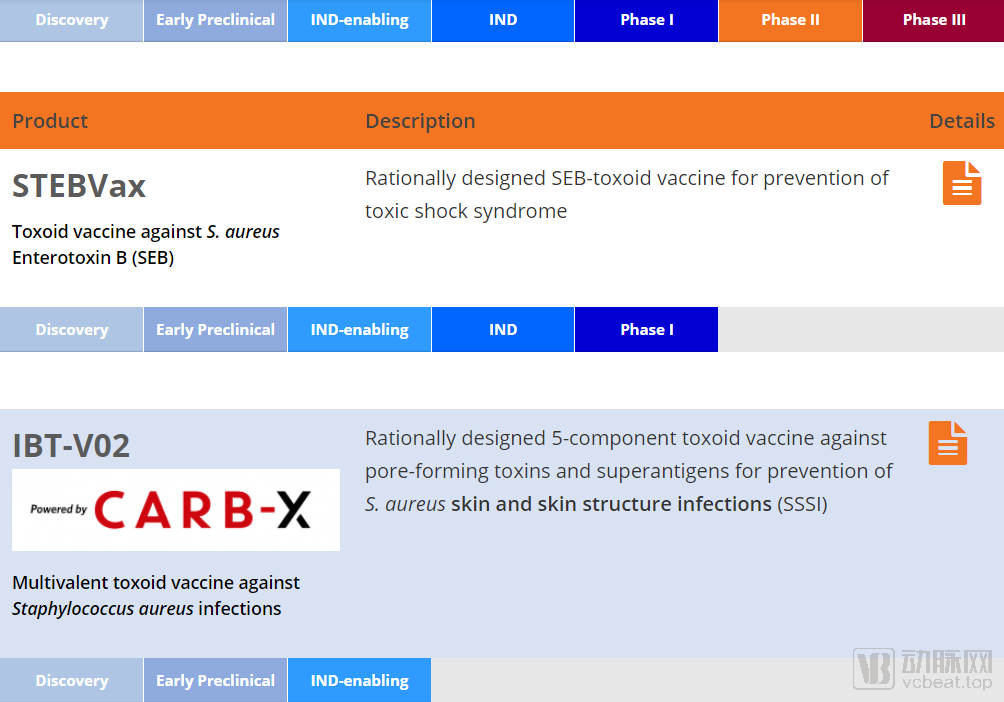
IBT's Partial Anti-Infective Pipeline
*Staphylococcus aureus* is a common foodborne pathogenic microorganism that frequently colonizes the skin, nasal passages, pharynx, gastrointestinal tract, carbuncles, and purulent wounds of humans and animals. Infection symptoms typically manifest as localized suppuration. STEBVax, a vaccine currently under development by Integrated BioTherapeutics (IBT), is designed to prevent toxic shock syndrome caused by infection with staphylococcal enterotoxin B (SEB). Reportedly, IBT obtained the development rights for STEBVax from the U.S. Army Medical Research Institute of Infectious Diseases (USAMRIID).
STEBVax is a novel recombinant form of SEB containing three point mutations that disrupt the interaction between the toxin and human major histocompatibility complex (MHC) class II receptors, rendering the protein non-toxic while preserving its immunogenicity. STEBVax is currently the world’s only advanced SEB vaccine candidate.
In mouse and non-human primate studies, the STEBVax vaccine demonstrated higher immunogenicity, safety, and stability.
Targeting Staphylococcus aureus, IBT has also launched a new vaccine pipeline, IBT-V02, a multivalent toxoid vaccine designed to prevent recurrent skin and skin structure infections (SSSI) caused by S. aureus. This vaccine differs significantly from previous S. aureus vaccine candidates, avoiding many of the adverse effects associated with earlier approaches. For instance, while targeting surface antigens of S. aureus can trigger harmful immune responses, the IBT-V02 toxoid vaccine elicits protective immunity.
Currently, IBT-V02 has emerged as a Staphylococcus aureus vaccine candidate strongly supported by clinical and epidemiological evidence. Integrated BioTherapeutics (IBT) has also demonstrated significant efficacy in eight different animal models, including mice and rabbits, in previous studies. The company plans to initiate Phase I clinical trials to assess safety and immunogenicity in 2020.
It is reported that IBT-V02 is the only fully toxoid vaccine against Staphylococcus aureus developed by Integrated BioTherapeutics (IBT) with funding from CARB-X and NIAID.
The remaining two anti-bacterial clinical pipelines are IBT’s Cd-ISTAb engineered antibody for the treatment of Clostridioides difficile infection (CDI) and Ba-ISTAb engineered antibody for the treatment of Bacillus anthracis infection. The development of both engineered antibodies leverages IBT’s proprietary ISTAb technology—a novel approach utilizing infection-site-targeted neutralizing antitoxin antibodies. Currently, both pipelines are still in the preclinical stage.
Financing and Future Development
In August 2017, IBT completed a $6.6 million financing round supported by the U.S. National Institutes of Health (NIH). Subsequently, in August 2019, Dr. Rajan Adhikari and Dr. Ramin Hakami of IBT, together with Dr. Daniel Nelson, a researcher at the Institute for Bioscience and Biotechnology Research (IBBR), formed a special task force to develop a therapeutic approach for a bacterial disease. This effort secured a second-phase Small Business Technology Transfer (STTR) award of $3 million from the NIH to support the optimization and development of their therapy in non-human primate studies.
This therapy is an immunotherapy comprising a humanized antibody that binds to toxins and a protein that tightly adheres to the bacterial surface, enabling specific targeting of antibodies to the site of infection, where they neutralize toxins and signal the immune system to eliminate the bacteria.
Regarding collaboration, Dr. M. Javad Aman stated in an interview that they look forward to partnering with academic institutions or biotechnology companies possessing complementary technologies, and to establishing long-term partnerships focused on translational research. Reportedly, IBT’s current academic partners include the U.S. Army Medical Research Institute of Infectious Diseases, the Scripps Research Institute, Harvard University, and the University of California.
“Faced with infectious diseases that may erupt at any moment, humanity’s greatest challenge lies in how to timely and effectively formulate prevention and treatment strategies against novel infectious diseases,” stated Dr. M. Javad Aman. “Circulating strains may mutate over time and across different regions, a phenomenon that is particularly evident in the evolution of bacteria such as Staphylococcus aureus. Integrated BioTherapeutics’ approach involves identifying virulence factors in viral and bacterial pathogens. This method has proven highly effective against the Ebola virus, enabling us to identify broadly neutralizing antibodies that can combat all strains of the Ebola virus.”
Dr. M. Javad Aman added, “For Staphylococcus aureus, the challenge in formulation development lies in its numerous virulence factors. We have begun to neutralize these virulence factors through the rational design of toxoids. Currently, our antibodies/vaccines cover 15 viral and bacterial pathogens, and we aim to expand coverage to include more circulating strains as well as those that may emerge or re-emerge in the future.”