

Humana and WCAS Launch $600M Joint Venture to Expand Senior-Focused Primary Care Clinics
Humana
Health Insurance Service Provider
Recently, U.S. commercial insurance giant Humana and WCAS (Welsh, Carson, Anderson & Stowe) announced that the two companies have jointly invested $600 million to establish a joint venture to operate primary care clinics.
The joint venture will develop and operate clinics targeting elderly patients, which will be managed by Humana’s primary care subsidiary, Partners and Primary Care, and operated under the Partners and Primary Care brand. Under this partnership, WCAS will hold a majority stake in the joint venture, and the entity will not be consolidated into Humana’s future financial statements.
However, although it will not impact Humana’s earnings in 2020, it will still contribute to the growth of its overall revenue. Partners and Primary Care will receive management fees, performance incentives, and a series of options from the joint venture. In addition, clinic operations will also generate insurance-related revenue.
Partners and Primary Care, established in July 2019 as a joint venture between Humana and the pharmacy chain Walgreens, currently operates 47 clinics across Kansas, Missouri, North Carolina, South Carolina, Texas, and Florida. Following Humana’s partnership with WCAS, Partners and Primary Care plans to more than double the number of clinics managed by the joint venture over the next three years.
Humana, founded in 1964 and headquartered in Louisville, Kentucky, is a U.S. health insurance giant and one of the largest health benefits companies in the United States. As a health insurer specializing in Medicare Advantage plans, Humana offers customers a diverse range of healthcare programs, including Medicare insurance, group life insurance, and dental insurance, serving 13 million members nationwide. The company ranked 179th on the 2019 Fortune Global 500 list, with 41,600 employees and annual revenue of $56.9 billion in 2018.
WCAS is a leading private equity firm focused on healthcare and technology. Since its founding in 1979, the company’s strategy has been to partner with exceptional management teams and create value for investors through operational improvements, growth initiatives, and strategic acquisitions. The firm has raised and managed more than $27 billion in capital.
This is not the first time Humana and WCAS have collaborated. In 2017, Humana, WCAS, and TPG jointly invested $4.1 billion to acquire Kindred Healthcare, a provider of home health and hospice care. By the end of 2017, Kindred Healthcare was split into two separate entities: Kindred at Home and Kindred Healthcare. Kindred at Home, which retained the original company’s home health, hospice, and community-based care businesses, was owned 40% by Humana and 60% by TPG and WCAS. The other entity, Kindred Healthcare, which operates inpatient rehabilitation hospitals, long-term acute care hospitals, and rehabilitation management services, was jointly held by TPG and WCAS, with no participation from Humana. Thus, Humana’s interest in offline healthcare services is far from a fleeting impulse.
# Addressing the Medical Needs of the Elderly
Humana was founded in 1961 under the original name Heritage House, initially focusing on nursing home operations before rebranding as Humana in 1974. Thus, Humana’s focus on the senior market is embedded in its DNA. Today, Humana has grown into one of the largest health insurance providers in the United States, offering a wide range of products and services to customers across multiple market segments, with Medicare Advantage insurance as its core offering. To cater to different customer groups, the company divides its business into three segments: Retail, Group, and Healthcare Services.
Medicare is a health insurance program for U.S. citizens and legal residents who have lived in the United States for at least five years and are aged 65 or older, as well as for individuals under 65 with certain disabilities or end-stage renal disease (ESRD). Medicare coverage includes Medicare Advantage (which covers all benefits under Part A and Part B, with some plans offering additional benefits such as vision, dental, and hearing aids), Medicare Prescription Drug Coverage (Part D), and Medicare Supplement Insurance (Medigap).
Humana is committed to a strategy of improving the health of older adults through a value-based health ecosystem that brings new connectivity to the healthcare experience. Currently, Humana has two programs targeting seniors: in addition to Partners and Primary Care, it operates Conviva in Florida and Texas. Overall, the insurer reported service revenues of $1.99 billion and 3.56 million members from these two entities in its 2018 annual report. Notably, Conviva, another wholly owned subsidiary of Humana, is not participating in this collaboration.
Significant Growth in Insurance Performance in 2019
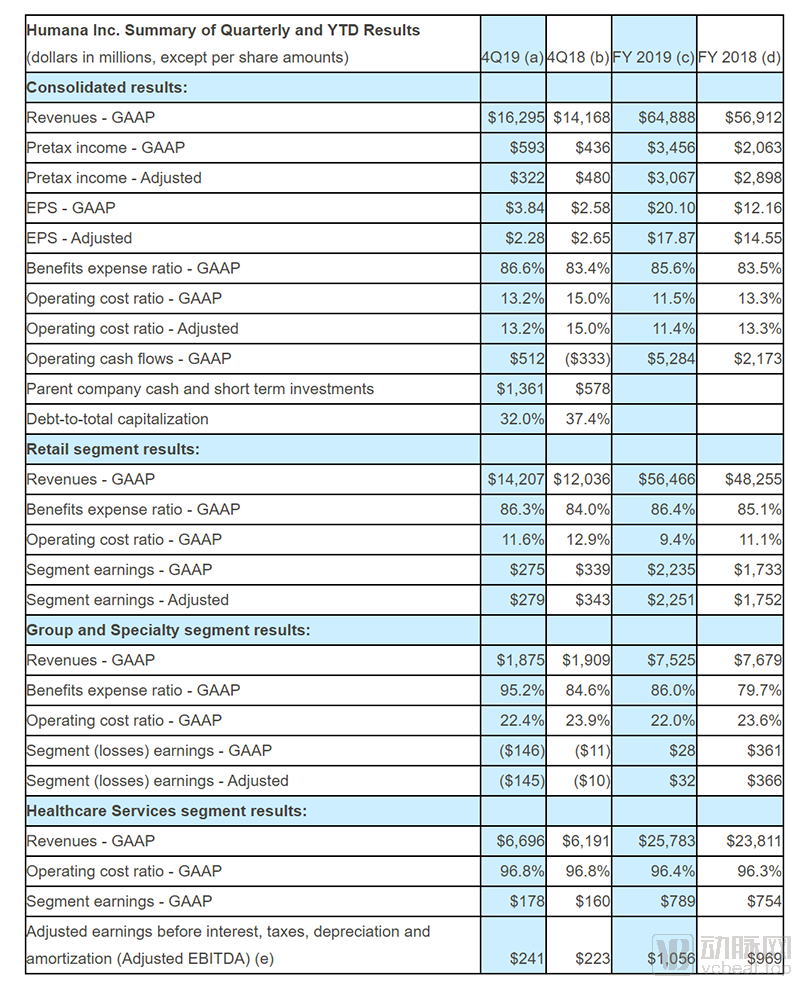
Humana held a conference call on February 5 to disclose its fourth-quarter 2019 financial results and address analysts’ questions regarding the establishment of the joint venture. Prior to the release of its 2019 annual report, Humana provided an initial overview of its operational performance for the previous year. Enrollment in its Medicare Advantage plans increased by 17% compared with 2018, reaching $56.47 billion. By the end of 2019, the number of Medicare Advantage members stood at 3.59 million. Its Medicare Part D prescription drug plan lost approximately 550,000 enrollees. The decline in Medicare Part D enrollment was anticipated. In February of the previous year, the insurer had projected that 700,000 individuals would disenroll from its Medicare Part D plans in 2019, citing intensified competition among insurers that eroded its market share.
In the fourth quarter of 2019, Humana’s revenue reached $16.2 billion, up from $14 billion in the fourth quarter of 2018, with quarterly profits amounting to $512 million. The company’s Retail segment generated $14.21 billion in revenue for the fourth quarter, an increase of $2.17 billion, and reported adjusted earnings per share (EPS) of $2.28, surpassing its earnings forecast for the period. This performance was driven by membership growth in its Medicare Advantage plans.
Humana's 2019 Performance Disclosed in Q4 Earnings Call
Payors Have Precedent in Opening Clinics
Compared with 2018, Humana’s retail insurance business grew by 17% in 2019; however, Humana continues to prioritize investment in its expanding clinical services.
Another key focus of the conference call was this newly established company. Bruce Broussard believes that for insurance companies, clinics should be regarded as a long-term investment. In addition to serving as a revenue stream for Humana, they can also help reduce healthcare costs for its insured members.
Humana CEO Bruce Broussard stated at the J.P. Morgan 2020 Healthcare Conference that growth and enhancing clinical capabilities are key investment priorities for Humana. He said, “The entire insurance industry is strengthening its ability to keep members healthy and out of hospitals. The recent M&A transactions in the insurance sector attest to this.”
Of course, Humana is not the only payer operating its own clinics. Other major insurers have also been acquiring medical practices. For instance, CVS’s acquisition of Aetna combined a large national health insurer with a vast pharmacy chain and healthcare providers. This trend also includes UnitedHealth Group’s $4.9 billion acquisition of DaVita Medical Group, as well as Centene’s acquisition of Community Medical Group to gain care delivery capabilities. Humana has followed suit, including its acquisition of hospice provider Kindred Healthcare and investments in other primary care centers and physician groups.
The difference is that Humana will establish clinics from scratch.
Broussard believes that clinics should become a key business line for insurance companies. “We view this as a highly effective care model. We have been expanding our operations in this area for some time and have achieved many robust results,” he said during Wednesday’s earnings call. “If we continue to push forward, we hope to double the number of clinics in this program.”
Providing Value-Based Healthcare Services for the Elderly
An increasing number of seniors are opting for Humana’s Medicare Advantage plans. Humana projects that its individual Medicare Advantage membership will grow by 270,000 to 330,000 from the 3.59 million recorded this year, representing a 9.2% increase compared with the previous year.
Currently, Humana operates a total of 262 clinics, either directly or through joint ventures. Through these clinics, the company provides care to approximately 250,000 Medicare Advantage enrollees.
Over the next three years, the newly established joint venture is expected to more than double the footprint of its elderly-focused clinics, adding 50 locations to the current base of 47.
Although Humana achieved strong operational performance and solid member satisfaction in its Partners and Primary Care segment, continued expansion and physician recruitment remained highly challenging endeavors, at times even risky ones. Therefore, to ensure success, Humana chose to partner with WCAS, which represents a key area where WCAS delivers value.
David Caluori, a partner at WCAS, stated, “In the United States, there is significant unmet demand in the value-based, senior-centered primary care market.” With a 40-year track record of successfully building world-class healthcare companies, WCAS can leverage ample resources through this joint venture to deliver effective nursing and medical services to seniors in the regions across China where they are needed most.
Under the current business model, Partners and Primary Care charges WCAS a management fee. As more members shift toward value-based care, Humana will continue to benefit from its clinics within its insurance operations. Moreover, within five to ten years, Humana will have the opportunity to repurchase the clinics through put and call options, akin to its 2017 transaction with WCAS and TPG Capital to acquire a minority stake in Kindred.
In addition to targeting the elderly population, the news report noted that the clinic aims to serve communities currently underserved by primary care, where service levels are low. Location is also a critical consideration; Humana is seeking communities lacking nearby primary care clinics or hospitals. Humana’s clinics are designed to be affordable options for Medicare Advantage members, although these members are not necessarily required to choose them.
At Wednesday’s close, Humana’s stock price rose more than 6%, to $364.80. The company reported 2019 revenue of $64.88 billion, a 14% increase from 2018, with pre-tax income of $3.46 billion, up from $2.06 billion the previous year.