

Chengdu Weikang Biotech: Pioneering Flow-Capture Microfluidic POCT for High-Efficiency, Low-Cost Chip Mass Production to Empower Point-of-Care Testing in Primary Healthcare
The outbreak of the Novel Coronavirus Pneumonia (NCP) epidemic has driven people back to their homes and quieted the streets, yet it has kept frontline healthcare workers busier than ever. Rushing to the forefront of the fight against the epidemic are not only the white-clad angels giving their all, but also tens of thousands of Chinese biomedical enterprises that have been working tirelessly to develop NCP-related diagnostic and therapeutic products.
Among the numerous biomedicine enterprises, VACURE l Biotechnology Co.,Ltd. (hereinafter referred to as "Chengdu VACURE"), leveraging its years of experience in antigen development and integrating protein structural bioinformatics and big data algorithms to efficiently produce relevant antigens and antibodies, recently announced the successful R&D of SARS-CoV-2 N antigen, S antigen, and SARS-CoV-2-specific epitope antigens. The company has committed to providing SARS-CoV-2-specific antigens and antibodies free of charge to research institutions and enterprises across China, supporting their development of diagnostic products, new drugs, and vaccines for COVID-19.
It is reported that VACURE l Biotechnology Co.,Ltd. in Chengdu is also developing test kits for the detection of specific antigens of COVID-19, demonstrating its commitment to fighting the epidemic through science and technology and contributing to the nation, thereby making its contribution to the early eradication of the epidemic across China.
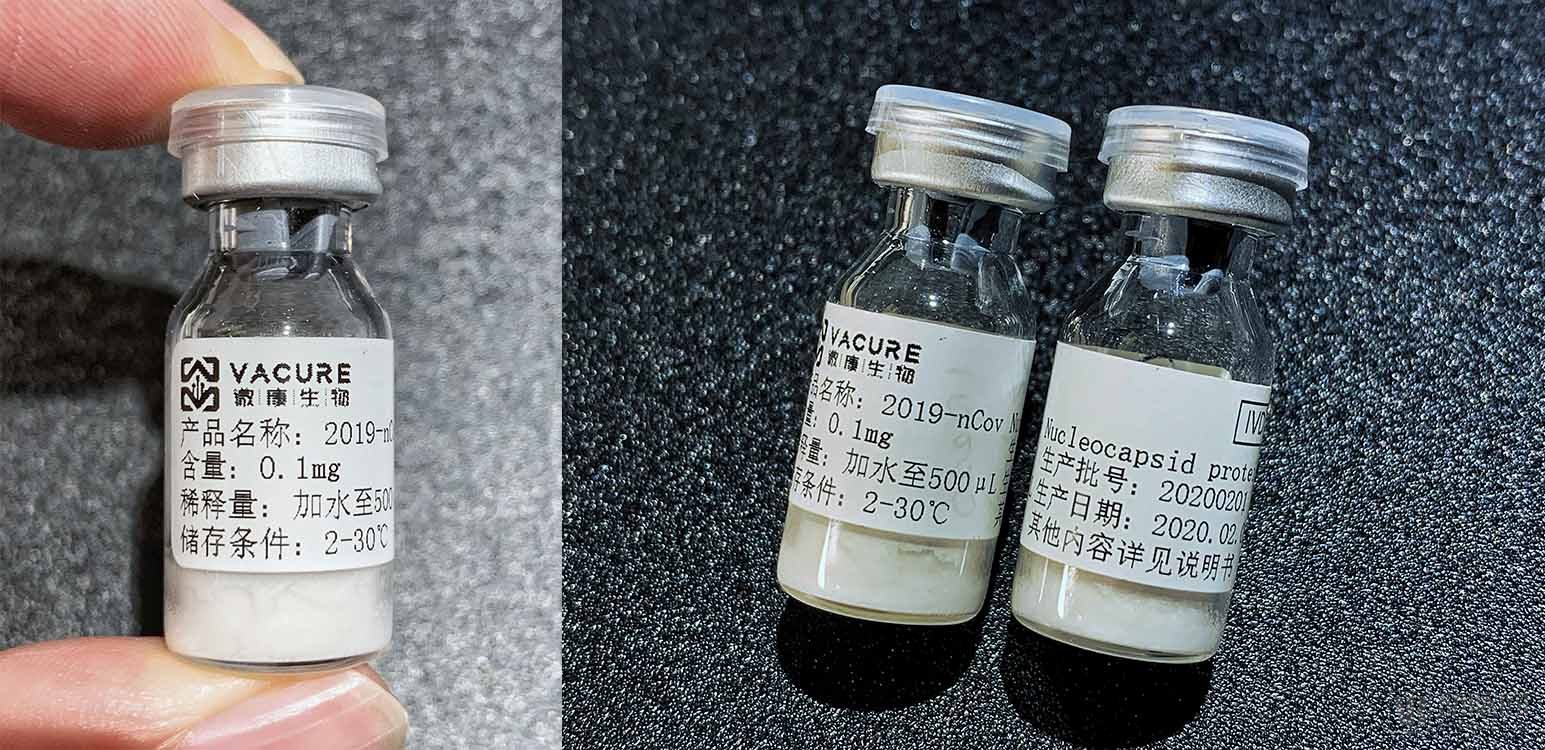
Antigen and antibody tests for COVID-19 developed by VACURE l Biotechnology Co., Ltd. (Image provided by the company)
In fact, antigen and antibody development is only part of the technical strength of VACURE Biotechnology’s proprietary microfluidic POCT diagnostic platform. As the most cutting-edge technology in the field of in vitro diagnostics (IVD), microfluidics has been increasingly adopted by R&D professionals across various IVD sub-sectors. Microfluidic technology integrates complex experiments, which traditionally required laboratory settings, onto a micron-scale chip. Due to its portability and high efficiency, it holds the broadest prospects for application in point-of-care testing (POCT).
However, microfluidics technology is not “cheap.” The micron-scale dimensions inherently complicate chip fabrication, and the intricate, interdisciplinary knowledge required places substantial demands on the capabilities of R&D personnel. “Yield rate” and “mass production cost” have become two major obstacles to the commercial adoption of microfluidics in the in vitro diagnostics (IVD) industry. Most companies in the market are seeking “affordable” and “practical” microfluidic chips, which has become a consensus within the industry: whoever achieves low-cost, high-efficiency mass production of microfluidic chips first will secure their ticket to the market.
VCBeat (WeChat ID: vcbeat) recently reported that Chengdu VACURE Biotechnology has pioneered a flow-capture microfluidics technology, enabling low-cost, high-efficiency mass production of microfluidic chips. Leveraging this technology, VACURE Biotechnology has developed nearly 20 in vitro diagnostic (IVD) products, which are currently undergoing registration and approval. These products closely align with the demand for rapid testing of acute and chronic diseases within the tiered diagnosis and treatment system.
Dr. Tang Yong, founder of VACURE l Biotechnology Co., Ltd., earned his Ph.D. in Molecular Genetics from the Shanghai Institutes for Biological Sciences. He conducted research on protein-protein interactions in signaling pathways under the supervision of Academician Xu Zhihong at the State Key Laboratory of Molecular Genetics, Chinese Academy of Sciences. After completing his doctoral studies, Dr. Tang co-founded Nanjing Normann Biotechnology Co., Ltd., where he spearheaded the development of more than 50 POCT products, generating over RMB 200 million in sales revenue for the company.
Dr. Tang Yong, who has been deeply engaged in the field of in vitro diagnostics (IVD) for many years, has gained profound insights into cutting-edge IVD technologies through direct exposure. He noted that during his tenure at Nuorman Biology, he had already encountered and applied microfluidics technology in the development of point-of-care testing (POCT) products. This experience allowed Dr. Tang to recognize the broad application prospects and future market potential of microfluidics. “I believe that microfluidic POCT products can address the practical needs and pain points of primary healthcare, offering significant growth potential and representing a promising direction for the future. Therefore, I embarked on my second entrepreneurial venture centered around microfluidics technology,” recalled Dr. Tang.
In 2018, the market size of POCT in China reached the tens of billions of yuan level, with a rapid annual growth rate of nearly 30%. Despite such a large market, its share was mostly occupied by imported products. Some traditional domestic POCT products had poor accuracy and limited quantitative testing capabilities, thus failing to meet the needs of primary hospitals and the five major centers. The contradiction between high precision in testing, low cost of reagents, and portability seemed to have become an insurmountable challenge.
“POCT chips developed based on microfluidics technology seem to offer a solution to this pain point, which is also the original aspiration behind the founding of VACURE l Biotechnology Co., Ltd. ‘Our goal is to address the industrialization challenges of microfluidic POCT, bring rapid testing products that truly align with tiered diagnosis and treatment to the market, and empower primary healthcare institutions. We aim primarily to meet the need for precise quantitative testing of infectious diseases, positioning ourselves as experts in the field of infectious disease diagnostics and striving to become China’s bioMérieux,’ said Dr. Tang Yong.”
Chengdu VACURE Biotechnology boasts a team with extensive industrialization experience. Its core members are mid-to-senior level executives from listed companies such as Wondfo, CapitalBio, and Maccura. This team not only possesses rich expertise in product commercialization but is also one of the few in China with proven experience in the mass production of microfluidic chips.
To address the two core pain points of microfluidic POCT products—namely, the difficulty in achieving stable mass production and high costs—Dr. Tang Yong introduced to reporters the underlying innovative technologies behind Chengdu VACURE Biotechnology’s domestically pioneering flow-capture microfluidic POCT diagnostic platform:
First, VACURE l Biotechnology Co.,Ltd. has transformed the traditional heterogeneous or static capture methods by innovatively developing a proprietary homogeneous flow capture technology with autonomous flow control. This technology completes immune reactions in 5 minutes that previously required 15 minutes, while achieving exceptional reproducibility and precision.
Secondly, VACURE l Biotechnology Co., Ltd. has developed time-resolved fluorescent nanomaterials with high quantum yield and low non-specific adsorption, achieving detection sensitivity at the picogram (pg) level, thereby reaching the lower limit of detection comparable to that of large-scale automated chemiluminescence immunoassay systems.
Thirdly, VACURE l Biotechnology Co., Ltd. pioneered the inkjet freeze-drying technology for nanomaterials in China. This technology enables the solidification of reaction reagents, decoupling chip manufacturing from reagent production, which significantly improves the yield rate of chip production. Additionally, the products can be stored at room temperature for one year, eliminating the need for expensive cold-chain transportation and reducing costs.
Compared with the capture time of traditional solid-phase chips, VACURE Biotechnology’s products from Chengdu can achieve a continuous capture time of up to 5 minutes, with a detection sensitivity reaching the 1 pg/mL level and a coefficient of variation (CV) for repeatability of only about 5%, thereby offering a broader scope for clinical diagnostic applications. Dr. Tang Yong revealed that, by employing novel flow-capture microfluidic technology, VACURE Biotechnology requires only 1 μL of sample volume and delivers results within 8 minutes, achieving a high throughput of 60 tests per hour. The performance rivals that of imported large-scale automated chemiluminescence immunoassay analyzers, while the cost is less than one-fifth that of conventional microfluidic POCT products.
By applying this technology, VACURE Biotechnology has enabled immunoassay reactions that were previously difficult to perform on centrifugal microfluidic chips. The DISKFLU disc-shaped microfluidic chip facilitates rapid multiplexed testing of 8–10 analytes from a single drop of blood, covering panels such as the Preoperative Eight (including hepatitis B surface antigen and hepatitis B surface antibody), the Cardiopulmonary Five (including creatine kinase-MB and myoglobin), and the Respiratory Nine (including Legionella pneumophila and Mycoplasma pneumoniae). It is reported that VACURE Biotechnology has initiated pilot-scale production of the DISKFLU disc-shaped microfluidic chip, and the prototype of the corresponding disc-based microfluidic analyzer has completed proof-of-concept validation.
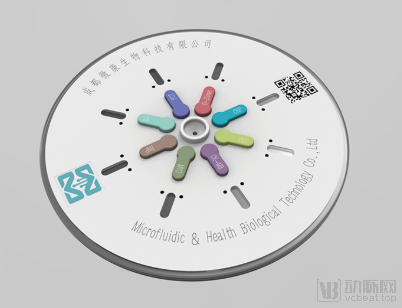
Schematic Diagram of the DISKFLU Disc Microfluidic Chip (Image Source: Official Website)
The DISKFLU disc-based microfluidic chip is primarily targeted at the clinical laboratories of secondary hospitals and lower-tier medical institutions. With an annual population of 130 million hospitalized and surgical patients in these facilities, the market size is approximately RMB 2 billion. This product is one of the five product lines offered by VACURE l Biotechnology Co., Ltd. In addition, VACURE l has launched a series of microfluidic liquid-phase fluorescence immunoassay products, which are mainly used for detecting inflammation-related markers and are oriented toward primary healthcare institutions such as township health centers. The Micro-Capture microfluidic chip is designed for use in certain clinical departments of tertiary (Grade IIIA) hospitals. The integrated molecular microfluidic chip focuses on precise detection of specific infectious agents. Lastly, the home-use electrochemical microfluidic rapid diagnostic products are tailored for home healthcare scenarios.
Currently, in addition to the disc-based microfluidic chips achieving small-batch mass production, VACURE l Biotechnology Co., Ltd. (Chengdu) has also completed small-batch production for 10 projects involving its microfluidic liquid-phase fluorescent immunoassay products and strip-based microfluidic products. These products are currently undergoing registration applications, while integrated molecular microfluidic chips are under development.
In terms of business model, given the vast market potential in central and western China, significant disparities in healthcare capabilities across different regions, and the absence of large-scale POCT companies in these areas, VACURE l Biotechnology Co.,Ltd. will initially establish a strong foothold in central and western China before gradually expanding its reach nationwide. In the market, VACURE l has already secured distribution rights for nearly 100 secondary hospitals and has reached a cooperation intention with Germany’s human GmbH to jointly develop international markets.
Regarding the future, Dr. Tang Yong stated that the company would continuously develop new projects around its five major platforms: microfluidic liquid-phase fluorescent immunoassay, strip-based microfluidics, disc-based microfluidics, integrated molecular microfluidics, and home-use electrochemical microfluidics. This effort aims to gradually expand the number of available tests to hundreds, covering the vast majority of in vitro diagnostic (IVD) items, and to progressively establish a home healthcare ecosystem. Chengdu VACURE Biotechnology Co., Ltd. also planned to obtain registration certificates for 10 products by the end of 2020, achieve annual sales of RMB 200 million within four years, and become a domestic leader in microfluidic chip technology.
It is reported that Chengdu VACURE Biotechnology completed a RMB 12 million angel financing round in 2018, led by Beijing Huade Capital. The company launched its Series A financing round at the end of 2019, aiming to raise RMB 30 million. The proceeds are primarily intended for the research and development of new products, regulatory registration and filing of existing products, and the establishment of a sales team. Currently, multiple institutions have expressed interest in investing.