Ping An Good Doctor Reports 2019 Revenue of RMB 5.065 Billion, Up 52% YoY, Validating Its Internet Healthcare Business Model

PINGAN GOOD DOCTOR
Internet Medical Health Platform
On February 11, PINGAN GOOD DOCTOR released its 2019 annual performance report. Due to the COVID-19 epidemic, the press conference for the report was changed from an offline event to an online one as originally planned, and four senior executives attended wearing masks.
In 2019, PINGAN GOOD DOCTOR’s total revenue reached RMB 5.065 billion, a year-on-year increase of 52%. Of this, revenue from its core online healthcare business amounted to RMB 858 million, representing a year-on-year growth of 109%.
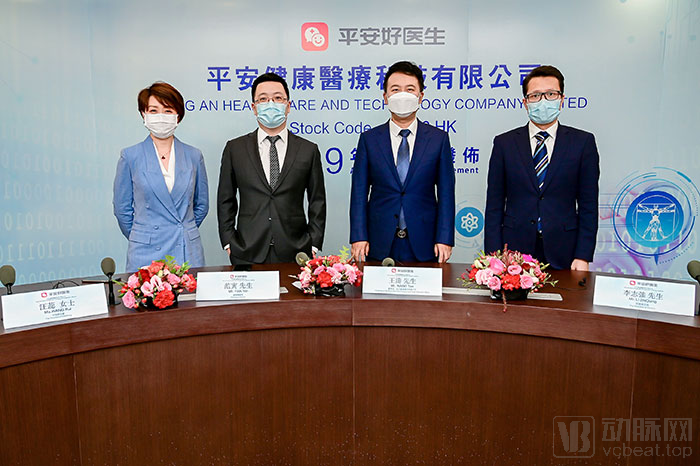
Press Conference for PINGAN GOOD DOCTOR's 2019 Annual Performance Report
As China is currently making all-out efforts to combat the COVID-19 pandemic, internet healthcare has played a role as a “second battlefield” in epidemic prevention and control. With two rounds of encouraging policies issued by the National Health Commission, and active promotion by physical hospitals and internet healthcare enterprises, the overall service volume of the industry has increased significantly. PINGAN GOOD DOCTOR is no exception.
During the pandemic, the PINGAN GOOD DOCTOR platform recorded a cumulative total of 1.11 billion visits. The number of newly registered users on its app increased tenfold, while the average daily number of consultations by new app users was nine times higher than usual. Related videos accumulated over 98 million views.
How Does PINGAN GOOD DOCTOR Leverage Existing Medical Resources for Epidemic Prevention and Control? How Did It Achieve Rapid Growth Over the Past Year? What Is the Status of Its Business Model Validation? This Article Provides an Interpretation Based on PINGAN GOOD DOCTOR’s 2019 Annual Report and Press Conference Content.
Recently, China has been making all-out efforts to prevent and control the novel coronavirus pneumonia epidemic. While the epidemic has increased physical distancing between individuals, internet healthcare is well-positioned to bridge this gap, with its advantages of high efficiency and low risk becoming more pronounced than ever before.
The National Health Commission issued two consecutive directives within four days, calling for the vigorous development of internet-based diagnosis and treatment services. The directives require the organization of specialists from respiratory medicine, infectious diseases, emergency medicine, critical care medicine, mental health, and general practice to provide online consultation services for patients with fever, thereby providing precise guidance to ensure orderly medical visits and alleviating the pressure on hospital treatment resources.
Prior to this, the internet healthcare industry had already taken swift action. Major platforms launched services including COVID-19 consultation and diagnosis, guidance for home isolation and observation, science popularization and rumor refutation, and follow-up visits for chronic diseases, thereby becoming the “second front” in epidemic prevention and control. PINGAN GOOD DOCTOR also joined these efforts.
It is reported that PINGAN GOOD DOCTOR has established a special task force for the prevention and control of COVID-19, working closely with relevant agencies of governments in 56 provinces, cities, and regions, including Wuhan, Fujian Province, Beijing, and Chongqing. The company provides real-time online consultation services for COVID-19, has launched dedicated hotlines for free clinical consultations in various provinces and cities, and offers free COVID-19-related inquiries and guidance on epidemic prevention.
Meanwhile, it ensured ample supply of pharmaceuticals, health supplements, and other products on its online marketplace; it also organized live-streamed sessions with renowned physicians and experts to interpret key points of epidemic prevention and control, and collaborated with the Beijing Medical Doctor Association to conduct medical science popularization and education.
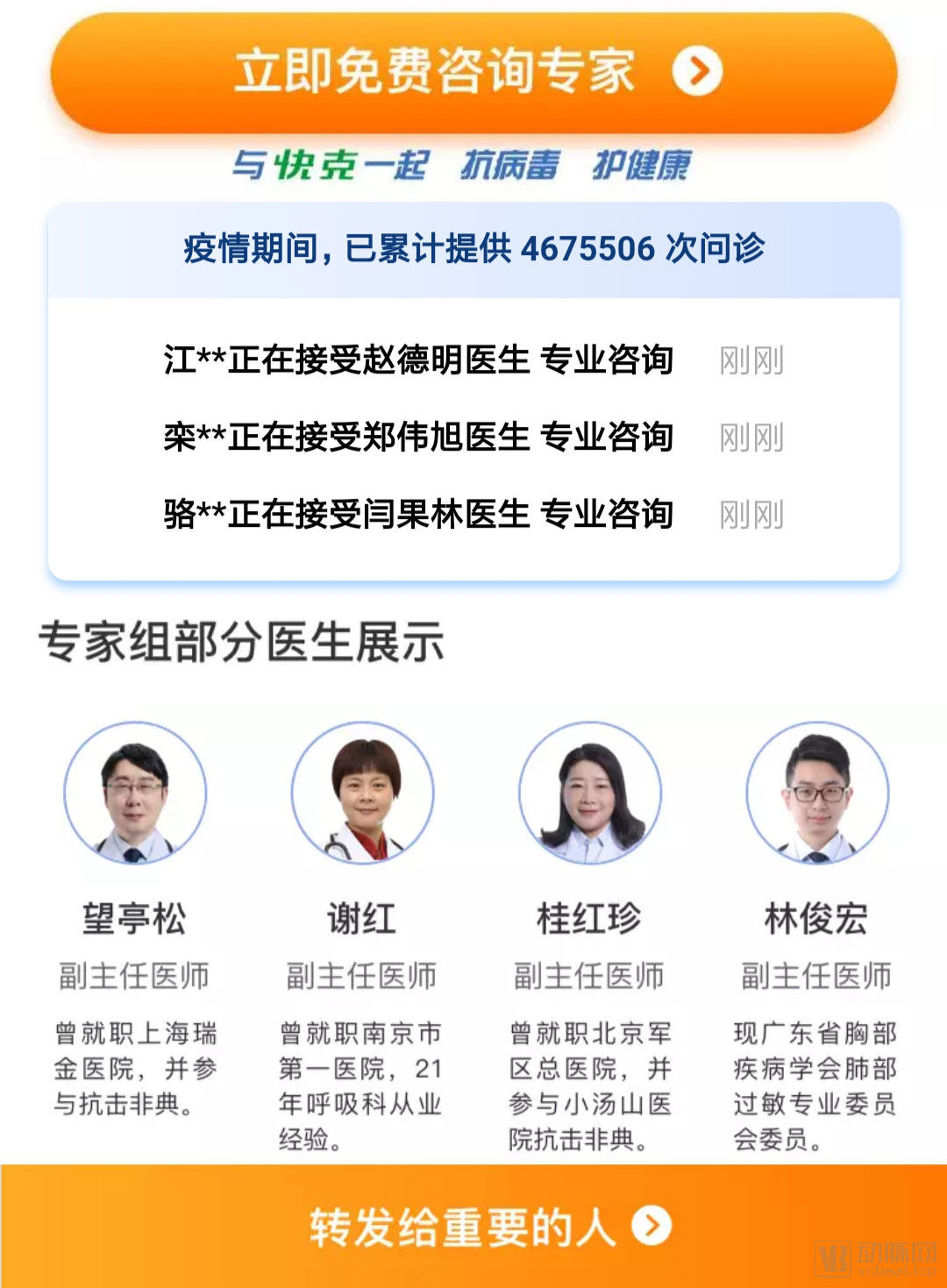
PINGAN GOOD DOCTOR's Free Clinic Zone for COVID-19, Data as of 23:30 on February 11
Furthermore, PINGAN GOOD DOCTOR has integrated with more than 30 industry-leading enterprises, including Baidu, WeCom, Pinduoduo, Meituan-Dianping, Kuaishou, Weibo, Moji Weather, Zhihu, Ximalaya, and Gaotie Guanjia. While providing services such as 24/7 online consultations, pandemic updates, and medical science popularization, it has also gained significant traffic and user growth.
During the pandemic, the PINGAN GOOD DOCTOR platform recorded a cumulative total of 1.11 billion visits. The number of newly registered users on its app increased tenfold, while the average daily number of consultations by new app users reached nine times the usual level. Related videos accumulated over 98 million views.
The operational data of PINGAN GOOD DOCTOR during the pandemic is not an isolated case. Since the outbreak, WeDoctor, DXY, Chunyu Doctor, Haodf Online, and other platforms have all launched dedicated sections for pandemic prevention and control, opening up consultation access to news, entertainment, lifestyle, social media, and other platforms. In total, these services have been integrated with hundreds of third-party platforms, with some internet healthcare platforms’ pandemic-related sections reaching 1.8 billion page views.
In the face of epidemic prevention and control, the internet healthcare industry has fully demonstrated its social responsibility and value, while also gaining recognition from key stakeholders, including the government, hospitals, physicians, and users. In particular, the cultivation of user habits is crucial to the new round of development in the internet healthcare sector.
However, at the same time, how to continuously optimize user experience during the pandemic and how to maintain user retention after the pandemic ends are also issues that the entire industry needs to face.
Wang Tao, Chairman, Executive Director, and Chief Executive Officer of PINGAN GOOD DOCTOR, believes that the internet healthcare industry holds immense potential. In the wake of the COVID-19 pandemic, both the government and users have demonstrated greater recognition and acceptance of the efficiency and convenience offered by online diagnosis and treatment. “We will continue to strive to enhance our online medical service capabilities, improve the capabilities of our AI-assisted diagnosis and treatment systems, and elevate user experience and patient satisfaction, which have long been our focal points.”
Let’s take another look at PINGAN GOOD DOCTOR’s performance over the past year.
In 2019, PINGAN GOOD DOCTOR reported total revenue of RMB 5.065 billion, a year-on-year increase of 52%, with a net loss of RMB 747 million, representing an 18.2% reduction in losses compared to 2018. From 2015 to 2019, the company’s compound annual growth rate (CAGR) for annual revenue reached 106%.
PINGAN GOOD DOCTOR comprises four business segments: online healthcare, consumer healthcare, health mall, and health management & engagement. In 2019, revenue from each segment maintained growth.
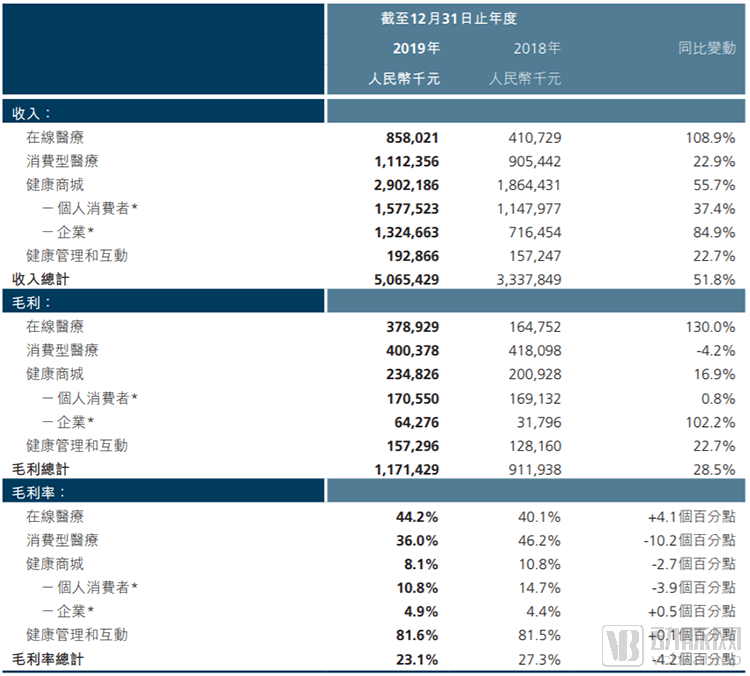
Financial Data of PINGAN GOOD DOCTOR’s Business Lines, Source: 2019 Annual Report
The Core Status of Online Healthcare Continues to Rise
Online healthcare is the core business of PINGAN GOOD DOCTOR, which leverages its self-developed AI-assisted diagnosis and treatment system to support its in-house medical team. This enables the company to provide users with a range of medical services, including 24/7 online consultations, referrals, appointment registration, online medication purchases, and one-hour medication delivery. Centered on its in-house medical team, PINGAN GOOD DOCTOR also offers diversified one-stop membership services.
As of December 31, 2019, PINGAN GOOD DOCTOR’s in-house medical team comprised 1,409 members, representing a year-on-year increase of 17.8%. The AI-assisted diagnosis and treatment system has been deeply integrated across all 22 departments of the in-house medical team, covering diagnostic knowledge for 3,000 diseases. Additionally, medical knowledge in the field of Traditional Chinese Medicine (TCM) has been structurally organized to enhance consultation efficiency.
In 2019, PINGAN GOOD DOCTOR continued to expand its external cooperative medical network. It had signed contracts with 5,381 external doctors, all of whom held the title of associate chief physician or above at Grade 3A hospitals. These external doctors primarily provided non-core services such as asynchronous online consultations and offline second opinions from renowned specialists. The number of partner hospitals exceeded 3,000, including over 1,900 Grade 3A hospitals.
As of the end of 2019, PINGAN GOOD DOCTOR had partnered with 94,000 pharmacies, covering 375 cities, representing a significant increase from the 15,000 pharmacies at the end of 2018.
By integrating the aforementioned internal and external resources, PINGAN GOOD DOCTOR launched its strategic product, “Private Doctor,” in 2019, with signed contract values exceeding RMB 300 million on the first day of launch. In 2019, total revenue from online healthcare services reached RMB 858 million, representing a year-on-year increase of 108.9%. Of this, revenue from membership products—namely “Private Doctor” and “Medical Care 360”—exceeded RMB 400 million. In addition, businesses such as electronic prescription sales generated through online consultation services also experienced significant growth.
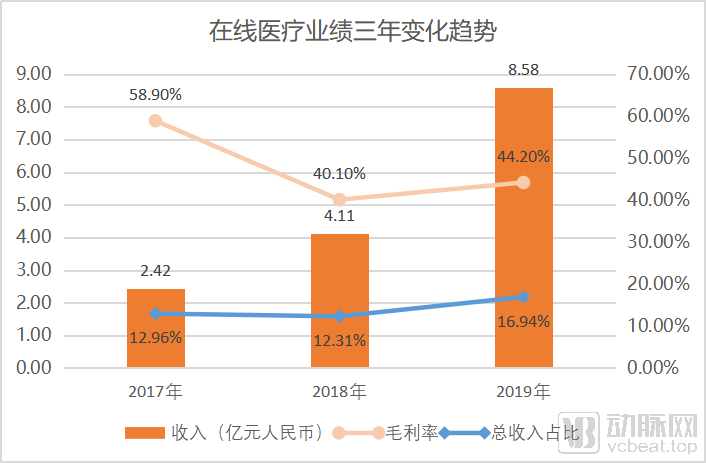 Three-Year Changes in PINGAN GOOD DOCTOR’s Online Healthcare Performance; Data Source: 2018 and 2019 Annual Reports
As can be seen from the chart above, revenue from online healthcare has maintained rapid growth over the past three years. The gross profit margin declined in 2018 but began to recover in 2019.
This was primarily due to a significant increase in service usage and the number of clients under the consultation service agreements between PINGAN GOOD DOCTOR and its partner clients in 2018. While this demonstrated growing user recognition of PINGAN GOOD DOCTOR, it also drove up costs, leading to a decline in the gross profit margin of this business segment, thereby affecting the overall gross profit margin of the online healthcare sector.
In early 2019, PINGAN GOOD DOCTOR renewed its consultation service agreement with Ping An Life Insurance and raised the service fees to align with the volume of consultations, leading to a gradual recovery in gross profit margin.
“As an internet healthcare company, our revenue model has always been clear and well-defined,” said Wang Tao.
We also observed that the proportion of online medical service revenue in PINGAN GOOD DOCTOR’s total revenue increased from 12.96% in 2017 to 16.94% in 2019, further solidifying the positioning of its core business.
Rising Healthcare Expenditure Among Residents Drives Significant Growth in Consumer-Oriented Businesses
Consumer-oriented healthcare services provide individual and corporate clients with standardized health solutions, including physical examinations, medical aesthetics, dental care, and genetic testing. Additionally, these services offer value-added benefits such as interpretation of examination reports and offline re-examinations.
As of December 31, 2019, the consumer healthcare provider network covered 430 traditional Chinese medicine (TCM) clinics, over 2,000 medical examination centers, nearly 1,800 dental clinics, more than 150 medical aesthetics institutions, and over 48,000 clinics. PINGAN GOOD DOCTOR integrates these abundant offline service resources, leveraging health examinations as an entry point and health information integration as a foundation. Through its in-house medical team, it provides users with one-stop healthcare services, including comprehensive and professional disease risk analysis and assessment, as well as post-examination follow-up guidance.
In 2019, the service revenue from consumer healthcare business reached RMB 1.112 billion, a year-on-year increase of 22.9%.
The Health Mall operates under both self-operated and marketplace models, offering a wide range of products including Western and traditional Chinese medicines (over-the-counter drugs), nutritional supplements, medical devices, maternal and infant care items, and sports and fitness equipment. As of December 31, 2019, the Health Mall had nearly 1,400 partner merchants, covering approximately 1.31 million SKUs, representing an increase of about 500 merchants and 700,000 SKUs compared to the same period in 2018.
Building on a diverse product portfolio, PINGAN GOOD DOCTOR strengthened its traffic operations and implemented precision marketing through personalized recommendation algorithms, thereby continuously enhancing user experience and conversion rates. As a result, the Health Mall generated RMB 2.902 billion in revenue in 2019, representing a year-on-year increase of 55.7%.
According to data from the National Bureau of Statistics, in recent years, the per capita disposable income of residents across China has risen year by year. From 2014 to 2019, even after adjusting for price factors, the per capita disposable income maintained a real growth rate of 5%-7.5%.
Meanwhile, the share of consumer spending and healthcare expenditure within total consumption is also on the rise. The proportion of healthcare expenditure in total consumer spending increased from 7.2% in 2014 to 8.8% in 2019. This trend may be attributed to rising healthcare costs, but it also reflects growing health awareness among the public. In the future, as living standards continue to improve, consumer demand for medical services focused on comfort and aesthetics will further increase.
Innovative Pharmaceutical Marketing Models Against the Backdrop of a Reshaped Drug Distribution Landscape
Health management and interactive business units generate revenue by providing corporate clients with professional advertising products and services, leveraging the precise medical and health traffic aggregated through online platforms.
In 2019, PINGAN GOOD DOCTOR innovated its marketing model, upgrading from pharmaceutical product promotion to comprehensive strategic cooperation, and providing pharmaceutical enterprise clients with multi-dimensional services including scenario-based user education.
In December 2019, PINGAN GOOD DOCTOR entered into a partnership with Merck to jointly develop integrated digital healthcare solutions. This collaboration leverages PINGAN GOOD DOCTOR’s strengths in AI-driven medical technology R&D, its proprietary medical team, large user base, partnerships with insurance companies, online and offline medical resources, and its comprehensive health and wellness ecosystem, while also incorporating Merck’s extensive expertise in medical knowledge, high-quality pharmaceuticals, and innovative solutions.
The aforementioned digital solutions will focus on assisted diagnosis and targeted disease management for chronic diseases and infertility, aiming to address patients' pain points.
As of 2019, PINGAN GOOD DOCTOR’s advertising clients included internationally renowned pharmaceutical companies such as Merck KGaA, Pfizer, MSD, and Sanofi.
PINGAN GOOD DOCTOR creates precise user profiles and delivers personalized information based on health data uploaded by users and their behavioral data on the platform. Meanwhile, leveraging a recommendation engine to predict users’ potential interests and preferences, it designs and optimizes health plans, assessments, and courses, and pushes relevant products and services to targeted users.
Amid the severe downturn in revenue from the pharmaceutical advertising sector, health management and interactive services generated RMB 192 million in revenue, representing a year-on-year increase of 22.7%.
In 2019, the Chinese government rapidly advanced centralized drug procurement, expanding the participating regions from the “4+7” cities to nationwide coverage and increasing the number of drug varieties from 25 to 32, leading to a significant reduction in generic drug prices.
Furthermore, the National Healthcare Security Administration spearheaded the largest-scale medical insurance negotiation since the establishment of China’s medical insurance system. The 70 newly added drugs that successfully passed the negotiation saw an average price reduction of 60.7%. For new drugs, inclusion in the reimbursement list means accepting price cuts in exchange for guaranteed sales volume, while exclusion implies maintaining prices at the cost of losing market share.
The implementation of policies such as centralized drug procurement and national reimbursement drug list negotiations has profoundly reshaped the landscape of pharmaceutical distribution and drug pricing in China, thereby influencing the marketing strategies of pharmaceutical companies. As an efficient digital bridge connecting patients and physicians, internet healthcare is well-positioned to redefine the pharmaceutical distribution ecosystem, offering pharmaceutical companies more precise sales channels while enhancing patient access to high-quality medications.
User base is a key indicator for measuring the scale of internet healthcare companies. In 2019, PINGAN GOOD DOCTOR’s registered users reached 315 million. “This means that one in every three internet users in China is a user of PINGAN GOOD DOCTOR,” said Wang Tao.
As of the end of 2019, PINGAN GOOD DOCTOR had accumulated over 670 million consultation records, with a daily average of 729,000 consultations. Despite the continuous expansion in consultation volume, user satisfaction reached 98%.
Wang Tao stated that to address the challenges of high consultation volumes, high patient satisfaction, and a limited number of doctors, PINGAN GOOD DOCTOR has been committed to the independent research and development of AI technology. This initiative aims to reduce repetitive manual labor for physicians and shorten the time required for disease diagnosis and prescription issuance. The AI-assisted diagnosis and treatment system is integrated with the intelligent critical care monitoring system, the intelligent rational drug use detection system, and the intelligent medical safety monitoring platform, significantly enhancing the efficiency and quality of physicians’ work while improving patients’ healthcare experience.
PINGAN GOOD DOCTOR leverages its existing membership service offerings, particularly its Private Doctor product, to provide customizable healthcare and medical membership services to clients across various industries.
In 2019, the five largest customers of PINGAN GOOD DOCTOR were Ping An Life Insurance, Ping An Property & Casualty Insurance, Ping An Bank, Ping An Health Insurance, and Ping An Puhui, all subsidiaries of Ping An Group. Revenue from these five major customers accounted for approximately 39.7% of the total revenue. “Our relationship with Ping An Group is very stable and close. Various business collaborations are progressing steadily and are continuously deepening and upgrading,” introduced Wang Tao.
At the same time, PINGAN GOOD DOCTOR has successively acquired dozens of corporate clients, including Founder Meiji Life Insurance, Zhujiang Life Insurance, China CITIC Bank, China Everbright Bank, Wyeth Nutrition, China Mobile, and China Unicom. Leveraging its core strengths in online medical services and aligning with the specific scenarios of each business partner, the company has effectively penetrated the promotion and sales of its suite of offerings, such as the “Private Doctor” service.
Furthermore, PINGAN GOOD DOCTOR is exploring innovative cooperation models, such as flexible packaging of membership benefits and mutual traffic generation between online and offline channels, striving to achieve complementary advantages and a win-win partnership.
While PINGAN GOOD DOCTOR delivers medical services, provides one-stop membership services, expands its service radius, and empowers its partners, the rich traffic and customer resources of its ecosystem partners also feed back into the PINGAN GOOD DOCTOR platform.
PINGAN GOOD DOCTOR leverages QR code-based online consultations as a breakthrough to empower traditional offline pharmacies in upgrading to integrated pharmacy-clinic models, providing high-quality consultation services to in-store customers and facilitating their medical visits and medication purchases. As users of the PINGAN GOOD DOCTOR app, individuals can also enjoy the convenience of online consultations and medication purchases, with delivery or pickup available at nearby pharmacies.
As of the end of 2019, PINGAN GOOD DOCTOR had 94,000 partner pharmacies, a significant increase from 15,000 at the end of 2018. Leveraging its robust ecosystem collaborations—such as “PINGAN GOOD DOCTOR + Pharmacies” and “Medical Services + Pharmaceuticals”—PINGAN GOOD DOCTOR will further expand the scope of its partnerships in the future.
Traditional industries with massive user bases, such as consumer goods and finance, are facing the challenge of enhancing customer stickiness and leveraging high-value-added services to strengthen product differentiation. Empowering partners in these sectors presents PINGAN GOOD DOCTOR with further opportunities to demonstrate its value and expand its user base.
Thanks to its unique and efficient user development strategy, which reduced costs associated with user engagement, combined with its implementation of precision advertising, PINGAN GOOD DOCTOR’s sales and marketing expenses decreased by 2.6% year-on-year in 2019. The ratio of annual sales and marketing expenses to revenue stood at 23.8%, representing a year-on-year decline of 13.3 percentage points. While revenue growth served as a means of “expanding sources,” the proactive cost-cutting strategy also contributed to the narrowing of PINGAN GOOD DOCTOR’s net loss.
Regarding future plans, Wang Tao stated that the strategic product, Private Doctor Service, is of epoch-making significance. On one hand, it delivers an unprecedented service experience for both users and patients; on the other, it lays a solid foundation for the business model and sustainable, healthy development of PINGAN GOOD DOCTOR. “At the initial launch of the Private Doctor Service, we set a five-year goal to serve over 10 million households in China. Current data shows that key metrics for Private Doctor users—including user feedback, average monthly consultation volume, engagement levels, prescription conversion rates, and e-commerce order volumes—are several times higher than those of non-Private Doctor customers. This demonstrates that pharmaceutical and medical product sales driven by established relationships and trust have achieved higher conversion rates and customer stickiness. It also confirms that our product direction has achieved initial success and gained user recognition.”
Wang Tao stated that PINGAN GOOD DOCTOR has a very clear profitability model and will continue to enhance its various business operations, with operating losses expected to decline steadily. “We maintain our projection of achieving break-even in 2021.”
Following the trials of the pandemic, PINGAN GOOD DOCTOR will continue to explore future cooperation models with its partners, including provincial and municipal governments across various regions, relevant government agencies, and partnered traffic platforms.
For more information on the latest developments, business matrix, partnership ecosystem, and major healthcare events related to PINGAN GOOD DOCTOR, please scan the QR code below. VCBeat’s Special Report Pro provides real-time updates, offering you a comprehensive and timely understanding of PINGAN GOOD DOCTOR.