

China Dental Medical Group Files for Hong Kong IPO Amid Surge of Private Dental Chains into Capital Markets
Recently, China Oral Healthcare Group Co., Ltd. submitted its IPO prospectus to the Hong Kong Stock Exchange. Despite bearing a name with the “China” prefix, the company is a private dental care provider rooted in Wenzhou, Zhejiang Province. Nevertheless, in the highly fragmented and fiercely competitive oral healthcare industry, China Oral Healthcare Group has managed to solidify its position as “Wenzhou’s largest private dental hospital” and maintain stable cash flows, thanks to its distinct operational strategies.
As disclosed in the prospectus, China Oral Healthcare Group was incorporated in the Cayman Islands on October 18, 2019, following a complex restructuring process. The company’s current shareholders are primarily four entities: JTC BVI, Ricon BVI, Meihao BVI, and HDS BVI, holding 75%, 10%, 10%, and 5% of the shares, respectively. Among these, JTC BVI, Ricon BVI, and Meihao BVI are owned by Mr. Wang and Ms. Deng, who indirectly control hospitals such as Wenzhou Hospital, Cangnan Hospital, Lucheng Hospital, and Lucheng Children’s Hospital, which serve as the operational entities of China Oral Healthcare Group. This indicates that China Oral Healthcare Group has made considerable efforts in preparation for this initial public offering.
Nowadays, riding the wave of rapid development in dental treatment and orthodontics, China Dental Medical Group may be only a matter of time away from a successful IPO.
According to the 2019 revenue statistics, China Oral Healthcare Group is the largest private dental service provider in Wenzhou, holding approximately 24.1% and 11.9% of the market share in the private and overall dental service markets in Wenzhou, respectively. These revenues are primarily derived from providing comprehensive dental services to individuals, mainly covering four dental departments: general dentistry, prosthodontics, implant dentistry, and orthodontics.
As of 2017, 2018, and the first nine months of 2019, China Oral Care Group recorded revenues of RMB 48.179 million, RMB 73.637 million, and RMB 63.209 million, respectively; gross profits of RMB 24.53 million, RMB 41.402 million, and RMB 34.823 million, respectively; and net profits of RMB 8.706 million, RMB 22.676 million, and RMB 18.053 million, respectively.
Market development has, to a certain extent, driven the growth of China’s dental healthcare groups. According to a report by Frost & Sullivan, private dental hospitals have gained widespread acceptance among residents due to their provision of more advanced equipment, more convenient healthcare plans, and comfortable environments. The market for dental services provided by private dental hospitals grew rapidly from RMB 61.6 million in 2014 to RMB 172.9 million in 2018, representing a compound annual growth rate (CAGR) of 29.4%. During this period, the share of private dental hospitals in Wenzhou’s total dental services market increased from 21.2% to 28.0%. This market size is expected to continue expanding, reaching RMB 591.9 million by 2023, with the proportion of Wenzhou’s private dental hospitals in the city’s total dental services market projected to rise to 33.5%.
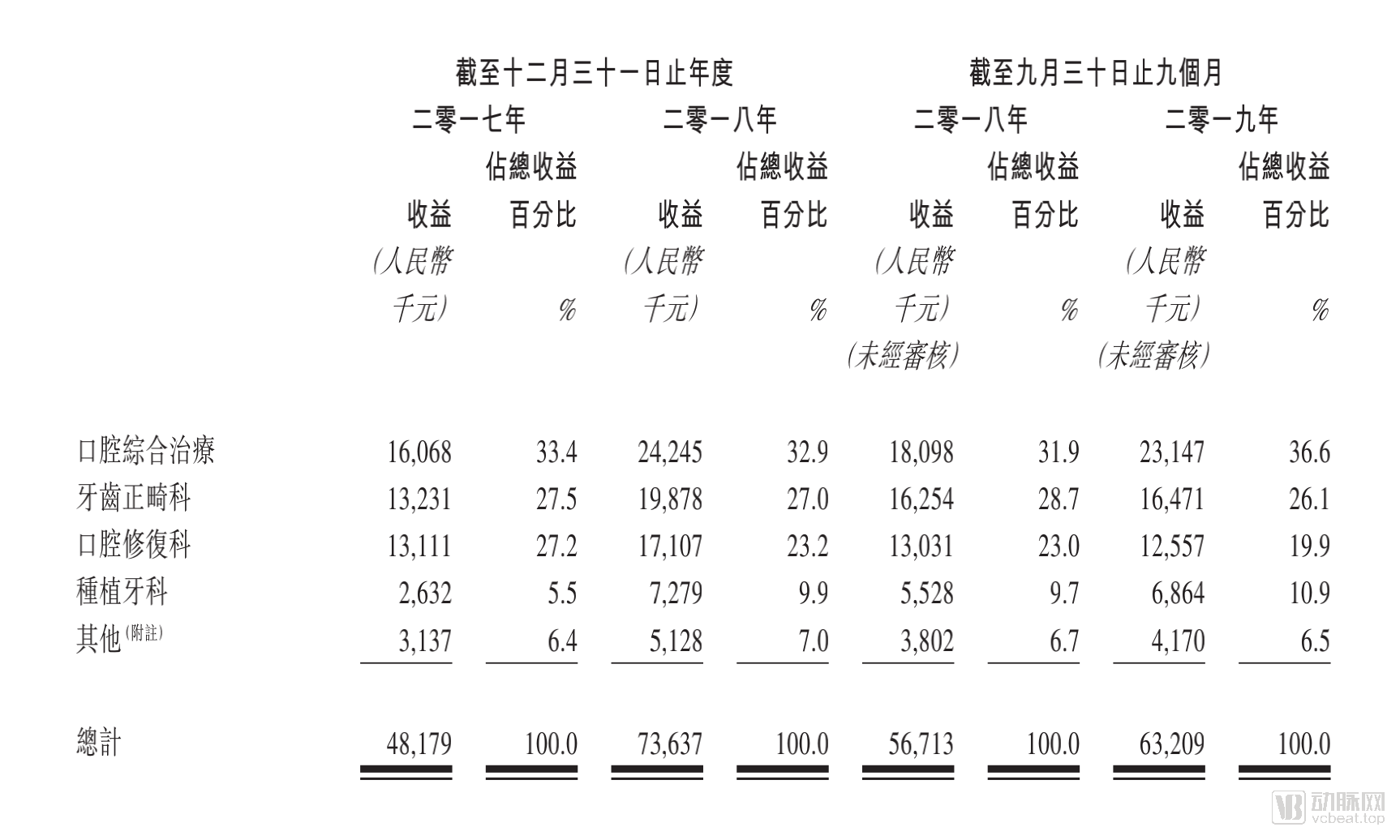
From a revenue perspective, although the prospectus states that the company’s orthodontics department has seen continuous revenue growth driven by the development of the orthodontics industry, actual data show that in the first nine months of 2019, revenue from the orthodontics department did not keep pace with the company’s overall earnings growth, and its share of total revenue declined. However, the rapid development of comprehensive dental treatment has significantly improved the operational performance of China Oral Healthcare Group and continues to be its largest source of revenue.
Furthermore, China Oral Care Group’s net profit also declined year-on-year in 2019. VCBeat speculates that this may be attributed to the company’s upgrade of dental medical equipment and strengthened internal personnel management in 2019.
To thrive in the fiercely competitive private dental care industry, companies must build their own competitive advantages. For China Dental Pharmaceutical Group, its existing strengths can be summarized in three key points.
As China Oral Medicine Group’s current business operations are relatively concentrated and all located within the Wenzhou region, the development environment in Wenzhou influences the group’s scale to a certain extent.
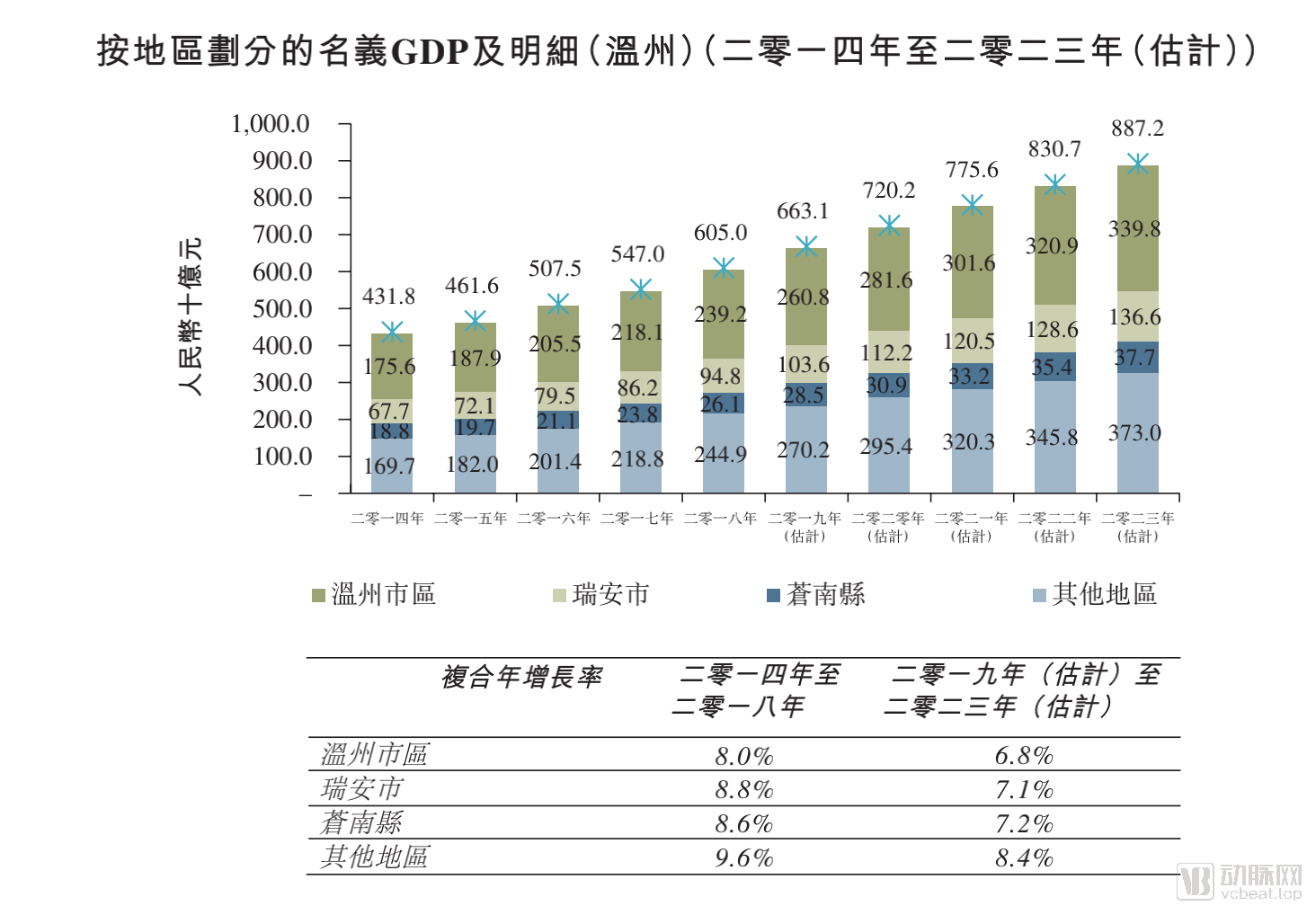
According to Frost & Sullivan data, Wenzhou’s nominal GDP grew steadily from approximately RMB 431.8 billion in 2014 to RMB 605.0 billion in 2018, representing a compound annual growth rate (CAGR) of 8.8%, slightly higher than that of the national nominal GDP. Consequently, Wenzhou’s per capita nominal GDP increased from RMB 53,100 in 2014 to RMB 73,000 in 2018, with a CAGR of 8.3%, outperforming the national per capita nominal GDP, which rose from RMB 47,000 to RMB 64,600 over the same period. Based on this trend, Wenzhou’s nominal GDP and per capita nominal GDP are projected to reach approximately RMB 887.2 billion and RMB 104,500, respectively, by 2023.
Overall, the urban area of Wenzhou, including Lucheng District, Ouhai District, Longwan District, and Dongtou District, saw its nominal GDP increase from RMB 175.6 billion in 2014 to RMB 239.2 billion in 2018, representing a compound annual growth rate (CAGR) of 8.0%. Among these, Ruian, a county-level city under Wenzhou’s administration, achieved a CAGR of 8.8% during the same period.
Therefore, if Wenzhou continues to develop at the projected economic growth rate and enterprises do not alter their operational structures, China Dental Care Group will also continue to grow at a similar pace.
China Oral Healthcare Services Group places great emphasis on the selection of medical professionals, employing experienced and well-trained dentists to provide and oversee dental services, as well as to participate in senior management decision-making. As of September 30, 2019, the group’s dental hospitals employed 54 licensed practicing dentists, 81 nurses, and 40 other medical specialists, including licensed dental assistants, radiologists, radiologic technologists, and pharmacists. The licensed practicing dentists had an average of eight years of clinical experience.
Furthermore, the company has established a systematic training program that provides comprehensive training to practicing physicians, delivered by both internal and external experts. Additionally, weekly dental practitioner meetings are held within the organization to discuss critical medical issues and facilitate knowledge sharing.
Due to the inherent stickiness of oral healthcare services, once a company accumulates its own base of loyal users, it establishes a solid competitive barrier. Based on statistics for three periods—full year 2017, full year 2018, and January to September 2019—China Oral Healthcare Group had approximately 41,998, 56,757, and 48,691 active patients, respectively (defined as patients who visited dental hospitals and received at least one dental treatment during the relevant financial period). Among these, repeat visitors accounted for 27.5%, 33.4%, and 34.7%, respectively. These sticky users provide the company with a stable source of revenue.
As disclosed in the prospectus, following the completion of the IPO, the funds raised by China Oral Healthcare Group will be allocated to the following eight purposes:
1. Potential acquisition targets for strategic expansion in Chinese dental hospitals;
2. Capitalize the capital expenditures and initial operating costs required for establishing a new dental hospital in Wenzhou
3. Capital allocation for the capital expenditures and initial operating costs required to establish Lucheng Children's Hospital in Wenzhou
4. Fund the capital expenditures and initial operating costs required to establish chain dental clinics under a new trademark in regions outside Wenzhou
5. Renovate and expand Wenzhou Hospital to increase service capacity;
6. Acquire new dental instruments and consumables to provide enhanced dental services;
7. Establish a dental training center to gather dental talent and enhance the quality of dental services;
8. Working capital and other general corporate purposes.
In addition to the aforementioned eight uses, China Oral Healthcare Group will place greater emphasis on brand building and business expansion in the future. According to the prospectus, the company aims to expand its existing operations in Wenzhou and establish a foothold in other cities across China through organic growth, strategic acquisitions, and the establishment of chain dental clinics.
Although China Oral Healthcare Group is attempting to expand its reach, it will still face numerous risks before doing so.
As all of the group’s hospitals are currently located in Wenzhou, its operational performance will largely depend on the economic development and policy direction of the Wenzhou region. Taking the currently rampant novel coronavirus (COVID-19) outbreak as an example, this event has not only forced hospitals under China Dental Care Group to suspend operations but also reduced residents’ income in the Wenzhou area, thereby decreasing demand for dental medical services and significantly impairing the company’s business development in 2020.
Meanwhile, if China Dental Care Group is to expand beyond Wenzhou and establish a foothold in new cities, it will need to make substantial capital investments. Given the fiercely competitive landscape of the private dental sector and the prior closure of its Yuhai Dental Clinic, the group may require additional time to replicate the success of its flagship “Wenzhou Hospital” model elsewhere.