

22 Institutions, 17 COVID-19 Vaccine Candidates in Development: Who Will Deliver the Pandemic Solution?
Humanity’s struggle against viruses spans thousands of years. As early as in ancient Greek records, we can see epidemics sweeping through one city after another, yet physicians at the time were powerless to intervene.
The advent of vaccines enabled humanity to triumph over viruses from a preventive perspective for the first time. When the WHO declared smallpox eradicated, people around the world rejoiced at the news. With the continuous rollout of vaccine products, infectious diseases that once struck terror into hearts have ultimately been consigned to the pages of history books.
From SARS and MERS to the novel coronavirus, this outbreak marks the third time in the new century that we have faced a sudden assault by coronaviruses. In the face of such a formidable adversary, can vaccines demonstrate their full potential in combating this pandemic? And which type of vaccine is poised to be the first to complete development and reach the market?
Since the rapid spread of the pandemic, more than a dozen companies and institutions have initiated research and development of vaccines against the novel coronavirus. Among them, some companies with faster progress have completed early-stage research and entered the animal testing phase.
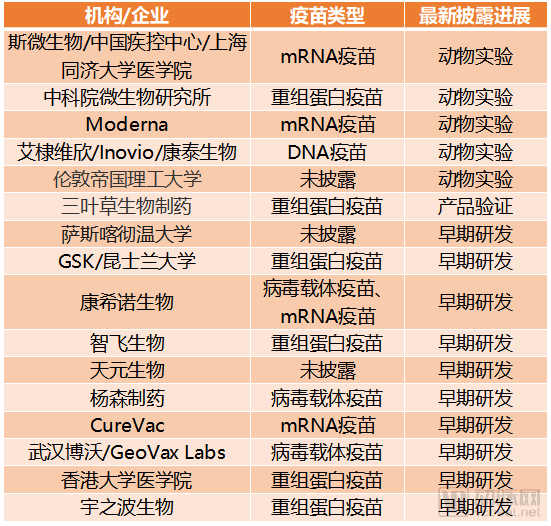
Companies and Institutions Currently Developing COVID-19 Vaccines, Compiled by VCBeat
Currently, some vaccine products with relatively rapid progress have entered the animal testing phase. Statistics show that vaccine products in the animal testing phase mainly include three major categories: recombinant protein vaccines, DNA vaccines, and mRNA vaccines.
In the field of recombinant protein vaccines, the team from the Institute of Microbiology, Chinese Academy of Sciences, undertook the research and development tasks for this type of vaccine. They have completed the design of the vaccine product, which is currently being tested in animals, while process development work is also underway.
Clover Biopharmaceuticals has developed an “S-protein trimer” antigen vaccine based on the spike (S) protein of SARS-CoV-2. Although the company has not yet announced that the product has entered in vivo clinical trials, virus-specific antibodies have been detected in the convalescent sera of multiple patients who recovered from viral infection after exposure to this antigen.
In the field of DNA vaccines, candidates jointly developed by Inovio Pharmaceuticals, Advaccine Biotechnology, and Kangtai Biological Products have entered the animal testing phase. It is reported that Inovio’s technology platform can complete the sequence design for a DNA vaccine in just three hours. The company has previously conducted vaccine development against epidemic viruses such as Zika virus, Ebola virus, and MERS-CoV. These vaccines demonstrated favorable efficacy in mouse studies.
In the field of mRNA vaccines, China’s Stemirna Therapeutics and the U.S.-based Moderna nearly simultaneously announced the initiation of research on mRNA vaccines for COVID-19. Subsequently, they separately announced on February 7 and February 10 that their candidate vaccines had entered the animal testing phase.
Other vaccine development efforts, for which further details have not yet been disclosed, are also largely focused on these three vaccine types. In particular, recombinant protein vaccines and mRNA vaccines have become the central focus of research during this pandemic.
During the previous SARS outbreak, vaccine development was also a major focus of public attention. However, due to technological limitations, the choice of vaccine platforms at that time was very limited, and research and development progress was relatively slow. China’s Phase I clinical trial of the SARS inactivated vaccine was not announced as completed and its results disclosed until December 2004. Although the clinical trials demonstrated that the vaccine had a favorable safety profile and provided preliminary evidence of efficacy, a year and a half had already passed since the end of the SARS epidemic.
During the MERS outbreak, high hopes were also placed on the vaccine industry. Since its initial discovery in 2012, the MERS virus has caused sporadic infectious cases for seven consecutive years. However, it was not until 2015 that U.S. researchers announced their progress in MERS vaccine development, which showed promising results in animal studies. The pace of clinical trials was further hindered by the scattered distribution of patients, and it was not until 2019 that The Lancet Infectious Diseases published the first report on the Phase I clinical trial results of a MERS vaccine.
Having weathered two coronavirus outbreaks, we now have a deeper understanding of our adversary. Research experience from previous SARS and MERS vaccine development has been applied to the R&D of COVID-19 vaccines, accelerating their development pace.
In a related interview, Yan Jinghua, a researcher at the Institute of Microbiology, Chinese Academy of Sciences, mentioned that her team had been studying MERS vaccines over the past two years and achieved promising results in the design process. When the novel coronavirus emerged, they quickly applied these strategies and methods to the design of COVID-19 vaccines.
Dr. Li Hangwen, CEO of Stemirna Therapeutics, also mentioned in an interview with VCBeat: “We have been conducting research on MERS virus, influenza virus, and tuberculosis since 2017. In particular, the MERS virus belongs to the same coronavirus family as the novel coronavirus responsible for the current outbreak. Our research experience with MERS has been highly beneficial to the development of vaccines for this pandemic. For example, in the design of antigens and formulations during our MERS protein vaccine development, we selected the S protein as the primary antigen and optimized the related formulation design. During the current epidemic, we immediately identified the S protein as a key antigen of interest, and we were able to directly apply the formulation platform developed for our MERS vaccine.”
The S protein, short for spike protein, is key to the novel coronavirus infecting human cells through its binding with the ACE2 protein. In both SARS and MERS viruses, the S protein performs the same function.
Over the past decade, scientists have conducted extensive research on the spike (S) proteins of SARS-CoV and MERS-CoV. Consequently, during the current COVID-19 pandemic, research institutions rapidly responded by initiating structural analyses of the SARS-CoV-2 S protein. On February 15, a team from the University of Texas at Austin published a paper on bioRxiv in which they resolved the structure of the SARS-CoV-2 S protein using cryo-electron microscopy and analyzed its binding affinity to ACE2. The ability to complete this study in such a short timeframe was attributable not only to the assistance of new technologies but also to the critical accumulation of prior knowledge on S proteins.
In addition to the previously mentioned SteadyMed Therapeutics and Clover Biopharmaceuticals, Moderna’s candidate vaccine, mRNA-1273, also encodes the S protein. All three companies have previously engaged in the development of MERS virus vaccines and possess extensive expertise in the S protein.
Empowered by both new technologies and prior experience, researchers were able to complete the early-stage development of vaccines within two to three weeks after obtaining the viral sequences, rapidly advancing to animal testing. Several candidates currently in animal studies are expected to enter clinical trials as early as mid-April.
Over the past few decades, we have witnessed the development of a wide variety of new vaccine technologies. From live attenuated vaccines, which are weakened through specific treatments to reduce their virulence, to peptide antigen vaccines produced using bioengineering techniques, and further to nucleic acid vaccines based on nucleic acid delivery technologies, new biotechnologies are being increasingly applied in the vaccine research and development process. Each of these different types of vaccines has its own advantages and disadvantages, and there is no universally optimal solution.
Inactivated viral vaccines use heat or chemical methods to inactivate viruses obtained from culture. The inactivated virus loses its pathogenic toxicity while retaining the major antigenic characteristics of the viral capsid, thereby eliciting a specific immune response in the human body.
The development process for inactivated virus vaccines is straightforward and well-defined, eliminating the need for conceptual design and validation phases. By identifying an appropriate viral inactivation method, vaccine products can be rapidly manufactured. However, historical experience indicates that inactivated vaccines may cause severe adverse reactions.
For instance, clinical trials of the inactivated vaccine for respiratory syncytial virus (RSV) were conducted in the mid-1960s, but the vaccine exacerbated the condition of the participants. More than half of the vaccinated children returned to the hospital for treatment, and there were even cases of participant deaths. Therefore, although inactivated virus vaccines achieved certain successes in clinical trials for SARS, their use during the COVID-19 pandemic must be approached with extreme caution.
Attenuated live vaccines are produced by treating pathogens through specific methods to induce mutations, followed by serial passage of the virus. Strains with reduced virulence are selected from subsequent generations and subjected to repeated cycles of this process until a strain that does not cause disease is obtained.
Live attenuated vaccines elicit stronger and longer-lasting immunity than inactivated virus vaccines. However, their drawbacks are also significant. The preliminary processes of pathogen passage and screening are extremely lengthy, making it difficult to complete early-stage product development within a short timeframe. Given these characteristics, live attenuated vaccines may not meet the current needs for epidemic control.
Recombinant protein vaccines are produced by inserting gene sequences encoding viral surface antigens into prokaryotic organisms via genetic engineering techniques, enabling large-scale expression of the antigenic proteins. The expressed antigenic proteins are then extracted and purified for use in vaccination.
Recombinant protein vaccines have already seen relatively broad clinical application; for instance, the commonly used hepatitis B vaccine employs the hepatitis B surface antigen (HBsAg) as a recombinant protein vaccine. Their greatest advantage lies in the fact that enriched or even engineered recombinant antigen proteins exhibit potent immunogenicity, and their manufacturing processes are currently quite mature. However, on the other hand, recombinant protein vaccines are currently limited to using only a single protein antigen and can trigger partial non-specific immune responses in the body, both of which are factors constraining the development of recombinant protein vaccines.
Leveraging mature sequencing and analysis technologies, major research institutions led by the Chinese Academy of Sciences isolated SARS-CoV-2 strains from patients and conducted relevant sequencing analyses at the early stage of the pandemic. Antigen sequences identified from the sequencing results can be directly used for the production of recombinant antigen proteins. Consequently, the development of recombinant antigen protein vaccines has progressed smoothly, with related achievements by Researcher Yan Jinghua’s team having entered the animal testing phase.
These three distinct vaccines are similar in their biological mechanisms, as they all deliver gene sequences encoding antigenic proteins into the human body, leveraging host cells to produce viral antigens and thereby eliciting a specific immune response.
Both DNA vaccines and mRNA vaccines primarily rely on non-biological delivery methods, such as encapsulation using nanomaterials. In contrast, viral vector vaccines package nucleic acids within virus capsids that have been rendered non-pathogenic, delivering the genetic material into cells through biological mechanisms. Commonly used viral vectors include adenoviruses and measles viruses.
Among these three novel biological vaccines, the development of viral vector vaccines is the most complex. It requires not only the identification of suitable antigens but also the selection of appropriate viral vectors. Furthermore, since the viral vector itself can elicit an immune response in the host, its impact on the human immune system is significantly more complex.
DNA vaccines and mRNA vaccines utilize universal delivery vectors, significantly shortening the formulation development timeline. Meanwhile, leveraging the body’s own cells to produce viral antigens ensures a more robust specific immune response, rather than a non-specific immune response triggered by external factors. However, no DNA or mRNA vaccines have yet been approved for human use (although veterinary vaccines have been approved), and public understanding of the potential issues associated with nucleic acid vaccines remains insufficient.
Specifically regarding the two types of nucleic acid vaccines, the DNA fragments delivered by DNA vaccines exhibit long-term persistence, with some studies indicating that these DNA sequences can persist for up to two years. The presence of foreign genetic material in the nucleus carries the risk of integration into the host genome, which may induce mutations and even lead to cancer. In contrast, mRNA is inherently susceptible to degradation; therefore, it does not pose concerns related to genetic recombination. However, clinical trials of mRNA vaccines have reported adverse reactions of varying severity in some patients, suggesting potential risks associated with their widespread use.

Comparison of the Advantages and Disadvantages of Different Types of Vaccines
In summary, we have reviewed various types of vaccines. In response to the current outbreak, live-attenuated vaccines and viral vector vaccines, which have the slowest development timelines, can essentially be ruled out. No progress has been disclosed yet for inactivated virus vaccines; however, according to relevant reports from the Ministry of Science and Technology, inactivated virus vaccines are included among the technological approaches under its arrangement. The remaining three types—recombinant protein vaccines, mRNA vaccines, and DNA vaccines—are being rapidly pursued by related companies and research institutions, with phased achievements already attained.
Following the completion of early-stage R&D, there were no significant differences among these three vaccines in subsequent animal studies and clinical trials. However, recombinant protein vaccines still require development of manufacturing processes, which may delay their clinical trial progress. Therefore, we believe that mRNA vaccines and DNA vaccines are more likely to be the first vaccine products to complete clinical validation in this epidemic.
The rapid progress in the development of COVID-19 vaccines is indeed highly encouraging. However, amidst the excitement, it is important to recognize that vaccine development is by no means an overnight endeavor. Compared with the complete vaccine development process, the creation of vaccine candidates in early-stage research merely represents the first step.
After a vaccine completes early-stage proof-of-concept studies in the laboratory, it must still undergo multiple subsequent steps—including complex process development, animal studies, clinical trials, and regulatory submission and review—before it can ultimately receive approval from the National Medical Products Administration for use in specific prevention or treatment applications.
For example, on February 7, Stemirna Therapeutics announced that small-batch samples of its candidate vaccine had been sent to the National Institute for Viral Disease Control and Prevention under the Chinese Center for Disease Control and Prevention (China CDC) and Shanghai East Hospital affiliated with Tongji University for further animal studies. If all goes smoothly, the vaccine could enter clinical trials as early as mid-April. Assuming that the duration of Phase I clinical trials is limited to three months, depending on the evolution of the epidemic, we would not obtain preliminary clinical results until July at the earliest. However, based on historical patterns of epidemic progression, the COVID-19 outbreak may end by this summer, meaning the vaccine might ultimately not be deployed for epidemic control.
Regarding this point, Li Hangwen shared his perspective: “Developing a vaccine before the end of the outbreak is indeed a significant challenge. We certainly hope that the current epidemic will come to an end as soon as possible. However, several unusual characteristics observed thus far—such as the yet-unidentified intermediate host and the presence of asymptomatic infections—may pose potential risks for widespread transmission. Therefore, our vaccine development efforts are essentially preparing for the worst-case scenario in the evolution of the epidemic.”
In fact, beyond controlling the current outbreak, the development of vaccines against the novel coronavirus (SARS-CoV-2) will also serve as a strategic reserve to prevent future large-scale epidemics. Therefore, regardless of the circumstances, the research and development (R&D) of SARS-CoV-2 vaccines holds substantial practical value. The urgency in completing vaccine R&D stems not only from the need to deploy them before the epidemic subsides but also from considerations regarding clinical trials. If the R&D timeline is excessively prolonged and exceeds the duration of the outbreak, the lack of available patients could stall clinical trials, potentially leading to the termination of the development process.
On the other hand, even if vaccine products can complete validation within the duration of the current outbreak, whether large-scale vaccine production can be achieved in the short term is another issue worthy of attention. Recombinant protein vaccines have already been widely used in clinical practice, and their related production technologies are relatively mature. However, for new technological products such as viral vector vaccines, DNA vaccines, and mRNA vaccines, the relevant production capacity may struggle to meet clinical demands.
Regarding this issue, Li Hangwen expressed a different perspective: “Although mRNA vaccines represent an emerging field, significant progress has been made in mass production in recent years due to the adoption of novel formulation and synthesis technologies. For instance, in terms of mRNA synthesis, we are currently able to preliminarily meet the demands for large-scale clinical trials, and our production capacity can be rapidly scaled up. Therefore, we remain quite confident about the future supply of vaccines.”