

Hygeia Medical Submits IPO Prospectus: Pioneer of Cryoablation Device Kangbo Knife Receives CE Certification and iF Design Award
Hygea
Developer of Tumor Treatment Equipment
Cryoablation is one of the minimally invasive treatments for tumors. It utilizes modern imaging modalities, such as CT and ultrasound, to induce tumor necrosis through extreme physical hypothermia. Compared with surgical resection, cryoablation offers advantages including minimal invasiveness, safety, high operability, good repeatability, and rapid postoperative recovery, demonstrating favorable efficacy in comprehensive cancer management. Since the 1990s, cryoablation and other ablation techniques have gradually gained increasing recognition among clinicians.
Hygea specializes in the research and development, manufacturing, and sales of medical devices for combined cryo-thermal ablation. Its independently developed Combo Knife series, a global first for minimally invasive tumor treatment, obtained Class III medical device registration certification in 2017 through the “green channel” for special approval of innovative medical devices. In the second half of 2019, Hygea completed a Series B financing round of nearly RMB 200 million, led by Jianxing Medical Fund managed by CCB International and co-invested by Kunying Capital and Shuncheng Capital, marking high recognition of the company’s technologies by both users and investors.
In early 2020, the Combo-Cryo Ablation System, China’s first high- and low-temperature combined cryoablation device, received CE certification from the European Union for the first time, granting approval for market launch and formal clinical commercial use in Europe. In early February, Hygea’s next-generation AI Epic series of Combo-Cryo products stood out among more than 7,200 entries from 56 countries, winning the prestigious 67th iF International Design Award. The German iF Design Award is one of the world’s three most professional and reputable industrial design awards, widely recognized as one of the top three global design prizes.
However, these impressive achievements did not happen overnight, Huang Qianfu, CEO and founder of Hygea, told VCBeat. A graduate of the School of Economics and Management at Tsinghua University, Huang initially engaged in the agency sales of large imported medical equipment after starting his business, accumulating over a decade of experience in the operation and management of medical devices. “At that time, domestic substitution was prevalent, yet imported devices accounted for more than 90% of the equipment in top-tier (Grade 3A) hospitals within the high-end medical device sector. The industrialization of original medical technologies undoubtedly held great promise,” Huang recalled.
In 2010, Huang Qianfu learned about Professor Liu Jing’s high- and low-temperature combined cryoablation device (the “Combo Knife”), which was primarily used in a minimally invasive tumor treatment R&D project, and was immediately struck by its potential. “My years of sales intuition told me that this is a rare original product, leading both domestically and internationally in terms of therapeutic concept as well as product development and manufacturing,” stated Huang Qianfu. Subsequently, he co-founded Hygea Medical with four other co-founders, establishing it as a dedicated industrialization platform for the Combo Knife project. Over the past decade, Hygea Medical has established long-term collaborations with academic and research institutions such as the Technical Institute of Physics and Chemistry of the Chinese Academy of Sciences and Tsinghua University, aiming to rapidly translate cutting-edge technologies into innovative products.
In 2012, Hygea Medical and the Technical Institute of Physics and Chemistry of the Chinese Academy of Sciences jointly established the Beijing Key Laboratory of Cryobiomedical Engineering. In December 2013, Professor Liu Jing’s team completed the development of the second-generation Combo Knife, achieving an integrated design for the Combo Knife console and a flexible design for the ablation needles, and conducted the first human clinical trial.
Professor Liu Jing holds dual appointments as a professor at Tsinghua University and the Chinese Academy of Sciences. He has published over 380 SCI-indexed papers and filed more than 180 patent applications. As the Chief Scientist at Hygea Medical, he is the inventor of the company’s core product, the Combo Knife. In 2014, Professor Liu was awarded the William Begell Medal at the International Heat Transfer Conference for his independently developed technologies related to the Combo Knife product series. He became the first Chinese scholar to receive this honor and the youngest recipient worldwide. The William Begell Medal is recognized as one of the highest awards in the international heat transfer community.
Hygea’s core team members come from diverse professional backgrounds, including clinical practice, R&D, and marketing, covering the entire industry chain of medical device development, manufacturing, and sales. The R&D team is primarily composed of graduates from prestigious institutions such as Tsinghua University, Peking Union Medical College, the Chinese Academy of Sciences, and Zhejiang University. Individuals with master’s or doctoral degrees account for 60% of the R&D staff, who possess an average of over ten years of specialized R&D experience.

In the field of minimally invasive oncology, argon-helium cryoablation and radiofrequency ablation (RFA) are widely used and clinically mature. The principle of argon-helium cryoablation involves rapidly lowering the temperature around the target area through the throttling of high-pressure argon gas, followed by rapidly raising the temperature through the throttling of high-pressure helium gas. This cycle is repeated to ultimately cause tumor cells to rupture and die. During this process, temperatures typically range from a maximum of 40°C to a minimum of -150°C. Radiofrequency ablation uses RF energy to generate high temperatures (above 80°C) in local tissues at the lesion site, resulting in coagulation and inactivation of soft tissues and tumors. Due to significant pain during RFA procedures, general anesthesia is required, and the localized high temperatures can also cause thermal injury to blood vessels.
Hygea’s independently developed Combo-Knife primarily consists of a main unit, composite cryo-thermal ablation probes, and multi-point temperature sensors. Under imaging guidance, ultra-fine probes are percutaneously inserted into the body to achieve targeted energy release of liquid nitrogen at the probe tip, subjecting tumor tissue to alternating cold and thermal injury ranging from -196°C to 80°C. Compared with pure cryoablation or thermal ablation, this alternating cold-thermal cycle induces reperfusion injury, increases vascular permeability, causes more severe endothelial damage, and thereby exacerbates tumor ischemia and necrosis.
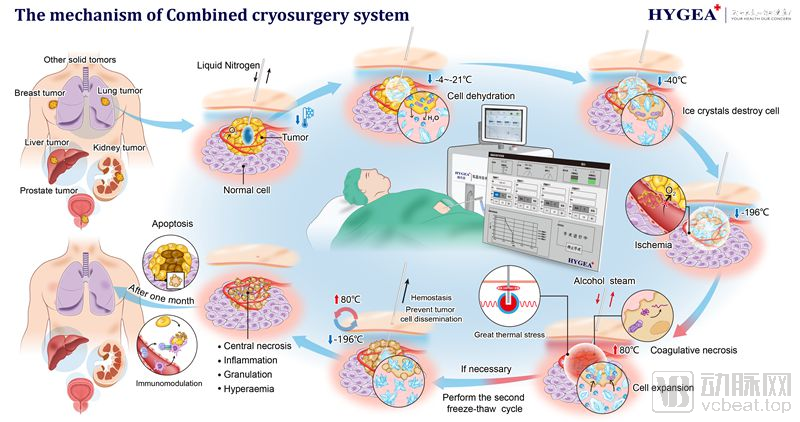
Schematic Diagram of the Working Principle of Combo Knife Therapy
“The Kangboda product has achieved technological breakthroughs in three aspects. First, this composite tumor ablation therapy solution integrates deep cryogenic freezing and high-intensity heating, combining the advantages of both cryoablation and thermal ablation while eliminating the drawbacks of single-function devices. This approach ensures more thorough tumor destruction; the high-temperature heating significantly reduces bleeding along the needle track and effectively prevents seeding metastasis, thereby achieving superior safety and efficacy. Second, regarding the main unit, precise synergistic flow control of deep-cryogenic and high-temperature working fluids enables uniform and stable multi-channel transport. Additionally, the optimized design of the transport pathway allows for rapid, independent switching between intense cold and heat, resolving the ‘cold blockage’ issue prevalent in liquid nitrogen cryosystems both domestically and internationally. Third, concerning the ablation needles, overall ultra-low heat leakage and localized high-intensity heat exchange have been achieved within micro-fine ablation needles. Hygea Medical has repeatedly broken its own global record for the thinnest liquid nitrogen ablation needle, with the minimum diameter now reduced to 1.7 mm, enabling a broader therapeutic temperature range spanning from -196°C to +80°C,” introduced Huang Qianfu.
As a minimally invasive tumor treatment device, the Kangbo Knife requires no general anesthesia, features small incisions (approximately 2 mm), causes minimal tissue damage and little to no bleeding, and induces virtually no pain during the procedure. It offers rapid recovery and good tolerability, making it suitable for patients with implanted pacemakers, as well as elderly patients or those with advanced-stage tumors who are ineligible for chemotherapy, surgery, or other conventional therapies. The treatment process can be monitored in real time using imaging modalities such as CT and ultrasound, ensuring well-defined treatment margins and a high safety profile.
In terms of consumables and equipment, the Combo Knife utilizes readily available consumables such as liquid nitrogen, resulting in low costs—with consumable expenses per procedure amounting to less than RMB 100. It operates at low pressure, ensuring safety and reliability. In contrast, commercially available argon-helium cryoablation devices rely on helium, a national strategic resource that is costly, dependent on imports, and subject to import quotas, thereby limiting their widespread adoption. Furthermore, the high-pressure gases used in argon-helium cryosurgery pose safety hazards during both transportation and operation. The entire Combo Knife system, including its probes, has been independently developed by Hygea Medical, offering a more cost-effective solution compared to traditional surgery, radiotherapy, and chemotherapy.
Currently, Hygea has launched three models of its ComboCare cryoablation system along with multiple compatible probe products. Two of these ComboCare systems have received approval from the National Medical Products Administration (NMPA) for entry into the Chinese market, where they are indicated for cryoablation therapy of various solid tumors, including lung cancer, liver cancer, pancreatic cancer, renal cell carcinoma, prostate cancer, and breast cancer. The latest generation of the ComboCare system and its associated probes has obtained European CE certification. Suitable for medical institutions at Level II Grade A and above, the ComboCare system has been clinically applied in more than 40 renowned hospitals across China, including Peking University Cancer Hospital, Cancer Hospital of the Chinese Academy of Medical Sciences, Tianjin Medical University Cancer Institute and Hospital, and Fudan University Shanghai Cancer Center, with over one thousand tumor patients treated to date.
In the future, Hygea will promote its Combo Knife product series across China through a top-down approach, leveraging direct sales and partnerships with leading distributors. The company will also invest significant resources to provide training services and clinical support to physicians. “The learning curve for physicians is short, and the Combo Knife is expected to eventually reach primary care hospitals, thereby enhancing their capabilities in tumor diagnosis and treatment,” stated Huang Qianfu.