

FanZhi Medical: Enabling Integrated, Rapid Genetic Testing for Efficient and Affordable Access in Primary Healthcare
In recent years, China’s genetic testing market has experienced rapid growth, with expanding application scenarios. Significant attention has been directed toward key areas such as tumor targeted diagnosis, pathogen detection, personalized medication, and early cancer screening, creating substantial opportunities for the development of genetic testing enterprises.
On the other hand, China’s upstream genetic testing industry chain still faces “chokehold” issues in key technological areas such as sequencing instruments and reagents, with heavy reliance on imports and persistently high costs. This has resulted in low technical barriers and profitability challenges for a large number of domestic genetic testing companies. Meanwhile, due to high costs and weak medical evidence, the clinical application of gene sequencing faces significant bottlenecks.
Song Keqing, Chairman of Fanzhi Medicine, stated, “For gene sequencing to make further progress in focusing on and resolving medical issues, it is essential to further clarify its application scenarios and extend its reach into the primary healthcare system.”
Since its inception, FanZhi Medicine has been dedicated to the development of rapid genetic diagnostic products, aiming to achieve import substitution by mastering core upstream technologies and promoting the integration of rapid genetic diagnostics into primary healthcare systems. Currently, the company has developed a comprehensive product portfolio covering sample collection, nucleic acid extraction, one-step library preparation, and targeted capture.
Fanzhi Medicine has developed an integrated rapid gene testing system, including instruments, chips, and reagents, based on its independently innovated technologies such as lyophilized reagent technology, isothermal amplification technology, and microfluidic chip technology. This solution requires minimal technical expertise from operators, completes the entire process in just 20 minutes, shortens patient waiting times, and reduces costs, thereby facilitating the efficient, low-cost integration of genetic testing into primary healthcare systems.
Bringing Advanced Technologies from the Lab to Primary Care
For patients in primary care regions, undergoing genetic testing is extremely difficult.
In primary care settings, there is a shortage of specialized equipment and technical personnel. After sample collection, samples must be mailed to large hospitals or laboratories. Upon receipt, physicians or laboratory staff perform a series of procedures, including impurity removal, lysis, and library preparation, followed by sequencing on instruments. Finally, professionals interpret and analyze the data to generate a report.“Traditional genetic testing involves cumbersome procedures and lengthy turnaround times, often taking several days to even a month to complete. Furthermore, the heavy reliance on imported sequencers and reagents in China has led to high testing costs.”Song Keqing stated.
Cumbersome procedures, long turnaround times, and high costs constitute the current state of China’s genetic testing industry. These three major burdens weigh heavily on domestic enterprises and patients alike, resulting in low operational efficiency, profitability challenges, and fierce competition among Chinese genetic testing companies. Furthermore, these issues hinder the widespread adoption of genetic testing in primary healthcare settings, with some technologies remaining confined to laboratories and failing to translate into clinical applications.
To address the pain points in China’s genetic testing industry and facilitate the transition of advanced technologies from laboratories to grassroots medical settings, Fanzhi Medical has implemented numerous innovations.
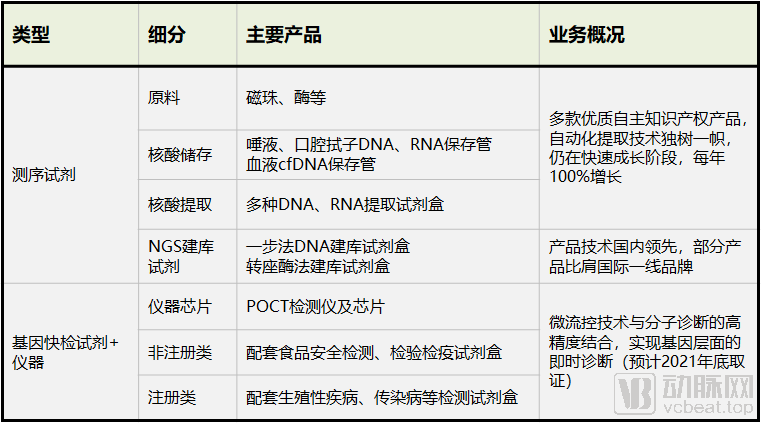
Overview of Medical Business Knowledge
Achieve in-house R&D and manufacturing of test kits.Currently, Fanzhi Medicine has achieved independent research and development and in-house production of the reagent kits required for sample collection, gene extraction, and library preparation, including large-sample cfDNA extraction kits for liquid biopsy, RNA extraction kits, and one-step library preparation kits, generating substantial revenue for the company.
Developed the fully enclosed, integrated detection chip FireChip, realizing a "lab on a chip."The FireChip is cost-effective and easy to operate, requiring no specialized personnel. It supports sample input volumes of up to 200 μL and utilizes pre-packaged reagents, eliminating the need for cold-chain logistics and enabling storage and transportation at ambient temperature. Nucleic acid amplification products and waste are sealed within the chip, preventing cross-contamination.
Launched the integrated rapid testing instrument, FirePOC.This instrument is compact and easy to operate. By leveraging innovative fully automated sample lysis technology, one-step nucleic acid extraction and purification technology, and fluidic process heating technology, it significantly reduces amplification detection time while ensuring high precision and high sensitivity after nucleic acid purification.
In simple terms, a single FirePOC device can complete all steps of genetic testing—from sample collection to report generation—eliminating the need to mail samples to large medical institutions. The entire testing process takes only 20 to 30 minutes, significantly reducing turnaround time and costs, making it widely applicable in primary healthcare settings.
When used with compatible reagents, FirePOC can be employed for genetic testing to guide targeted cancer therapy, as well as for the detection of infectious diseases and reproductive disorders. It is also applicable in the field of food safety, enabling rapid detection of pathogens such as African swine fever virus and porcine reproductive and respiratory syndrome virus (PRRSV) for import and export quarantine at customs.
Currently, the company’s FireChip and FirePOC are awaiting approval from the National Medical Products Administration (NMPA); once registered, they will benefit a large number of primary healthcare institutions.
Furthermore, in response to this epidemic, Fanzhi Medicine leveraged its precision medicine and antiviral nucleic acid R&D support platform to successfully develop a high-sensitivity, high-specificity RT-PCR system for the 2019-nCoV novel coronavirus detection kit. When used in conjunction with FirePOC, it enables rapid point-of-care testing, providing swift and robust support for efforts to combat the virus.
Original Aspiration: To Build a National Medical Brand in the Field of Rapid Genetic Diagnosis
As the founder and chairman of Fanzhi Medicine, Song Keqing’s original aspiration was simple:Make genetic testing convenient, fast, and affordable to facilitate its integration into primary healthcare systems.
Song Keqing holds a Ph.D. from the Chinese Academy of Sciences and serves as an Associate Research Fellow. In 2013, while pursuing his doctoral studies, the father of a close friend was diagnosed with late-stage lung cancer, leaving no therapeutic options available. This incident had a profound impact on Song Keqing.“Most Chinese people, especially those in remote areas, rarely undergo health checkups throughout their lives, pay little attention to early diagnosis and treatment, and have weak prevention awareness, leading to many diseases being detected only at advanced stages. The rapid development of genetic testing technology holds significant importance for the early diagnosis and treatment of diseases.”
Song Keqing has many years of experience in the research and development of bioinformatics technologies, with expertise in targeted gene detection and capture techniques. He possesses profound insights into applying these technologies to early cancer screening and targeted therapy. Song Keqing decided to step out of academia to explore opportunities for translating technology into products, aiming to enable convenient and rapid early diagnosis and treatment for people in grassroots medical areas, thereby simplifying disease diagnosis.
In June 2014, after making a difficult decision, Song Keqing gave up the opportunity to remain at the Chinese Academy of Sciences and pursue advanced studies at Harvard University, embarking on an entrepreneurial journey. In 2016, Song Keqing founded Fanzhi Medical, independently developing sequencing instruments, chips, and reagent kits to enable rapid genetic diagnosis of major diseases.
Gene sequencing instruments, chips, and reagent kits represent promising “gold rush” startup opportunities; however, they entail high technical barriers and require the recruitment of internationally seasoned talent with substantial technical expertise.Fan Zhi Medicine has attracted PhD holders returning from overseas institutions such as Columbia University, the University of Kansas, and the State University of New York, and has also secured the participation of executives from internationally renowned pharmaceutical companies and overseas physicians. Notably, the company’s Chief Scientist holds a Ph.D. from Columbia University and an MBA from the Wharton School, with nearly 30 years of experience in oncologic pathology and the development of targeted therapeutic products.
Song Keqing stated, “The five partners overseeing corporate management, operations, R&D, the domestic market, and the international market possess highly complementary capabilities and experience, demonstrating strong team synergy from the outset.”
Over the past few years, Fan Zhi Medicine has weathered a capital winter and hovered on the brink of collapse on several occasions.Today, the company has overcome numerous challenges and completed four rounds of financing, involving renowned investors such as CCB International and Hairong Capital. It is now entering a fast track of standardized development, holds over 100 patents, and has established high-standard GMP manufacturing facilities that meet the registration requirements of China’s CFDA, the EU CE marking, and the US FDA.Furthermore, the company has established collaborative partnerships with multiple Grade A tertiary hospitals in China and Anderson Hospital abroad to conduct targeted gene screening in the Chinese population, develop microfluidic chips, and perform clinical data mining.
In terms of sales and marketing, the reagent kits, magnetic beads, enzymes, and other products developed by Fanzhi Medical have gained recognition from numerous hospitals, medical testing institutions, CROs, genetic testing companies, pharmaceutical enterprises, and research institutes. These products are sold in nearly 30 countries overseas, generating a steady stream of cash flow for the company. It is reported that the company achieved profitability in 2018.
Within three years, Fanzhi Medicine will achieve regulatory registration and market promotion for its integrated rapid gene detectors, chips, and test kits for infectious diseases, reproductive disorders, and food safety, thereby elevating the company’s revenue to a significantly higher level. While prioritizing the domestic market, the company will also sign agreements with numerous international distributors to accelerate its brand’s global expansion.
Song Keqing stated, “At the appropriate time, the company will consider extending into the mid- and downstream segments of the industry chain by establishing medical testing centers. We will also integrate internet modules into our instruments to provide remote diagnosis and treatment services.” In the future, the company will remain committed to pragmatically addressing real-world medical needs, upholding healthcare initiatives that benefit the general public, and building a national medical brand in the field of rapid genetic diagnostics.