

How Zhuojian Tech Enabled Internet-Based Medical Services Within Half a Day During the Pandemic: Three Rapid Deployment Solutions
Prior to the Spring Festival, the COVID-19 epidemic rapidly spread from Hubei Province to the rest of China alongside returning travelers, resulting in a severe situation for prevention and control.
“Break down development tasks again; the online clinic can be launched in as little as half a day!” On January 23, Zhuojian Technology urgently convened an online management meeting, where its core management team of more than ten members swiftly defined the key objectives.
On that day, Wuhan’s airport and railway stations suspended all outbound travel, and the areas affected by the COVID-19 outbreak expanded from Hubei Province to more than 20 provinces, autonomous regions, and municipalities across China. Inter-regional and interpersonal isolation inevitably became fundamental measures for epidemic control. Under such large-scale quarantine protocols, there was an urgent need in the healthcare sector to leverage internet-based solutions to minimize person-to-person contact.
Zhuojian Technology’s founder and CEO, Wei Jianfeng, predicted that since a large number of physical hospitals have not yet launched online consultation services, the demand for building online healthcare platforms would inevitably surge if the pandemic were to worsen.
“However, clients need time to go through the processes for financial projections and expense approvals, so even if we want to move fast, we may not be able to.” At the meeting, someone raised this concern.
“Then let’s make it free! Let’s just ensure the system goes live first.” Wei Jianfeng made a decisive decision. “Amid the pandemic, healthcare workers are fighting on the front lines. All industries and enterprises are doing their part by contributing financially or with resources, and we can do the same.”
At this time, the company was on holiday, and employees had returned to their homes across China. After the overall direction was determined, the company issued a notice requiring all staff to return to duty and remain on standby, particularly teams from the Project Delivery Center, Product Center, R&D Center, and Marketing Center.
A pressing practical issue soon emerged. As the pandemic was not yet severe when the company announced its holiday, some employees had not taken their laptops home. Colleagues based in Hangzhou immediately returned to the office and mailed over ten laptops to their out-of-town counterparts. However, subsequent lockdown restrictions prevented timely shipment of additional devices, forcing remote employees to scramble for alternatives—some purchased laptops locally, while others borrowed them from neighbors or relatives.
With personnel and equipment largely in place, the entire company entered the busiest period since its establishment during Chinese New Year’s Eve, the Spring Festival, and the days that followed.
As the number of confirmed and suspected cases rises across China, ordinary people experiencing fever or cough are increasingly concerned about whether they have contracted the novel coronavirus. Physical hospitals face an urgent need to establish online fever clinics, resulting in a continuous stream of orders.
Based on its prior business experience and an assessment of hospitals’ immediate needs, Zhuojian Technology has launched three fever clinic solutions: (1) a text-and-image consultation-based fever clinic; (2) a multifunctional fever clinic offering text-and-image consultations, video consultations, and health education; and (3) a regional fever clinic platform that integrates regional medical resources.
Meanwhile, a streamlined setup process was developed:
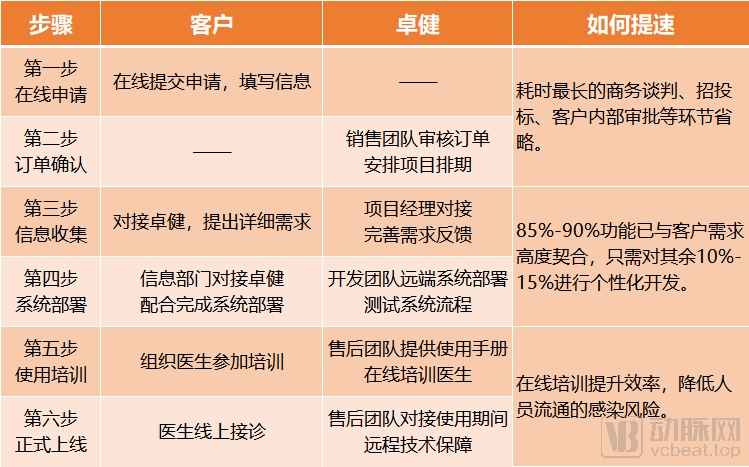
VCBeat Chart: Zhuojian Technology’s Workflow During the Pandemic
Zhai Xuelian, Vice President and Chief Strategy Officer of Zhuojian Technology, stated that in the past, individual projects lasted anywhere from two to three months to half a year or even a year. Throughout the process, the majority of time was spent on preliminary business negotiations, bidding and tendering, internal client approvals, integration with hospital information systems, and development of customized features.
Meanwhile, as the R&D team continuously refines the product, 85%–90% of its features align with customer requirements. This means that once an order is signed, only the remaining 10%–15% needs to be developed to meet specific personalized needs. Consequently, system development and deployment account for a relatively small proportion of the overall project timeline.

Zhuojian Technology's Core Physician Team
The six-step process streamlines time-consuming procedures, clearly outlining customer requirements and internal inter-departmental coordination at Zhuojian, thereby eliminating redundant communication and enhancing overall efficiency.
Zhao Jinlong is the General Manager of the Project Delivery Center at Zhuojian Technology. The center has a total staff of 80 and primarily provides mid-to-back-end services, specifically: project managers liaise with clients to address personalized requirements; developers complete development based on these requirements; and after-sales personnel are responsible for post-sales services such as product usage training. In other words, the center covers steps two through six of the rapid workflow.
Nearly all of the company’s projects are handled by the Project Delivery Center, meaning Zhao Jinlong and his team are in a state of continuous work.
“We hold meetings on WeCom every morning and evening to ensure that any issues arising during the day are resolved by the end of the day; project workflows are managed using the TPA tool, with clear steps and designated responsibilities; documents are also updated online in real time,” said Zhao Jinlong. He noted that remote work was already the norm for the team, so it did not compromise efficiency. However, due to a surge in orders, the workload has doubled, requiring approximately half of the team members to often work until 2 or 3 a.m.
As a manager, Zhao Jinlong primarily coordinated and advanced various tasks through meetings and phone calls. “At peak times, he made 50 to 60 phone calls in a single day.”
Heilongjiang Provincial Hospital is one of the earliest hospitals to launch an online fever clinic, powered by Zhuojian Technology.
On January 26, all medical staff at Heilongjiang Provincial Hospital canceled their leave and convened an emergency meeting to arrange work related to the epidemic period.
“Winter is the peak season for influenza in Heilongjiang, and patient visits to fever clinics are already at their highest. Due to the impact of the COVID-19 pandemic, more patients with fever and cough symptoms have sought medical attention, increasing pressure on offline outpatient services.” At the meeting, hospital management identified the establishment of an online fever clinic as one of the urgent tasks, with the goal of launching it within 24 hours.
On January 8 of this year, Heilongjiang Provincial Hospital established and launched its internet hospital. Initially, it opened four departments specializing in chronic diseases, and after a period of operation, the internal processes have been successfully streamlined.
On January 27, following the initiation of the online fever clinic project, Zhuojian Technology established a 10-member team to handle technical development and user training. Wang Ping, Director of the Internet Hospital Office at Heilongjiang Provincial Hospital, liaised with the team on remote development of the technical platform, coordinated with the Information Center to ensure comprehensive support throughout the process, and organized physicians to participate in the training.
Through close collaboration between both parties, the fever clinic was rapidly launched within just half a day.
After the launch of the online fever clinic, physicians noted significant patient anxiety during consultations, along with a high volume of inquiries regarding daily preventive measures and nutritional health. In accordance with its established implementation protocol, Heilongjiang Provincial Hospital subsequently launched three additional specialized outpatient clinics focused on the COVID-19 epidemic—namely, Psychiatry and Psychology, Infection Prevention and Control, and Clinical Nutrition—within the following two to three days.
“To meet epidemic prevention and control requirements and avoid cross-infection among patients during in-person visits, other hospital departments have also successively launched their online services,” said Wang Ping, Director of the Internet Hospital Office. As of February 17, all clinical departments of the hospital had gone online, with more than 500 physicians on standby, accumulating over 6,000 consultations.
Not only Heilongjiang Provincial Hospital, but the entire health system of Heilongjiang Province regards online medical services as a crucial component of epidemic prevention and control.
On January 28, the Health Commission of Heilongjiang Province announced at a press conference on joint epidemic prevention and control that, as of 24:00 on January 27, a total of 30 confirmed cases of pneumonia caused by novel coronavirus infection and 67 suspected cases had been reported across eight cities in the province.
At that time, the assessment and strategic approach of the Heilongjiang Provincial Health Commission were as follows: All regions with imported cases faced risks of local transmission and widespread dissemination; however, given that transmission routes and pathogenic mechanisms were not yet fully understood, it was essential to anticipate greater challenges. By applying high-probability thinking to address low-probability events, comprehensive efforts were made to strengthen epidemic prevention and control, thereby minimizing the risk of cross-infection in various settings to the greatest extent possible.
Starting January 29, the Health Commission of Heilongjiang Province partnered with Zhuojian Technology to jointly build the Heilongjiang Provincial Internet Fever Clinic Emergency Platform, issuing official directives requiring hospitals at all levels to integrate with the platform in a timely manner. Through the full-scale deployment and overtime efforts of both parties, the technical platform was established in just three days. The platform officially went live on February 1, with more than 70 hospitals in the province joining as the first batch of participants. Within the following week, nearly 200 hospitals had rapidly come on board.
Zhai Xuelian stated that the efficient progress of projects across various regions, including Heilongjiang, should be viewed from two perspectives:
On the one hand, this is a highly efficient collective process. “Hospitals also operate 24 hours a day; if needed, each hospital can always find personnel available for coordination at any time. Meanwhile, regional platforms in various localities have dedicated staff assigned by local Health Commissions to liaise with individual hospitals.”
On the other hand, to ensure rapid deployment during the pandemic, only the most urgently needed basic features were launched initially. There was limited integration with multiple hospital internal systems, such as Hospital Information Systems (HIS) and Electronic Medical Records (EMR), and no extensive customized functionalities were developed.
During the pandemic, Zhuojian Technology maintained continuous communication with health commissions and medical institutions across various regions, conducting analysis and forecasting of the situation.
Wei Jianfeng noted that with the rapid increase in suspected cases and close contacts, the epidemic prevention and control situation has undergone new changes. Using online fever clinics to alleviate offline pressure has gradually become a basic function. Hospitals are also facing two problems: First, as the epidemic spreads, there is a high risk of infection for other patients seeking offline medical treatment; Second, there is a shortage of protective supplies, which affects not only patients but also doctors. A large amount of protective materials is being transported to core epidemic areas, and doctors face a high risk of infection when providing offline consultations.
Therefore, hospitals across various regions have successively adjusted their offline outpatient services, suspending a large number of non-urgent consultations. This implies that to meet the needs of these patients, more outpatient services need to shift online, particularly those for chronic diseases.
Zhuojian Technology has upgraded its three previous solutions, with a focus on building a comprehensive online outpatient service.
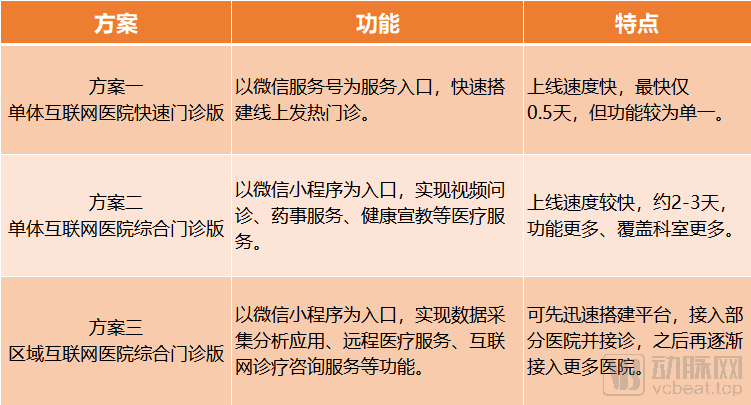
Zhuojian Technology's Upgraded Online Outpatient Solution for Epidemics, Chart by VCBeat
Taking Heilongjiang Province as another example, hospitals such as Heilongjiang Provincial Hospital, the First Affiliated Hospital of Harbin Medical University, and the Cancer Hospital of Harbin Medical University have successively issued announcements stating that starting from February 1 or February 3, their emergency departments will operate normally, while outpatient services in stomatology, otolaryngology, ophthalmology, dermatology, gynecology, and other specialties will be suspended. For certain departments that remain open, services will be limited to prescription refills for patients with special diseases or chronic conditions.
On February 5, the Health Commission of Heilongjiang Province promptly issued the "Notice on Launching the Construction of an Internet-based Comprehensive Outpatient Platform in Heilongjiang Province." Subsequently, Zhuojian Technology rapidly upgraded its previous emergency platform for fever clinics into an internet-based comprehensive outpatient platform, gradually integrating additional departments and physicians.
In addition to establishing a unified portal, the Heilongjiang Provincial Integrated Internet Outpatient Platform empowers hospitals to set up their own internet-based fever clinics via their official WeChat accounts or mini-programs. Consequently, patients can quickly access online services from multiple hospitals and outpatient departments through the unified portal.
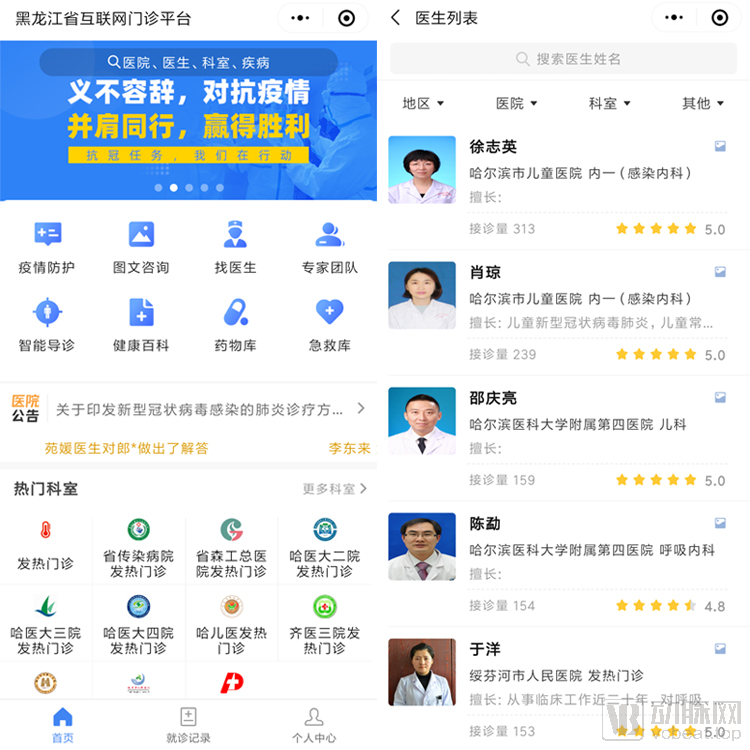
Heilongjiang Internet Integrated Outpatient Platform
With the support of health commissions at all levels and medical institutions in Heilongjiang Province, 201 hospitals had completed system integration on the Heilongjiang Provincial Internet General Outpatient Platform as of February 18, with more than 20 additional hospitals in the process of going online.
With the support of Zhuojian Technology and Tencent’s technical team, the Heilongjiang Internet Comprehensive Outpatient Platform has also launched the Heilongjiang Service Platform for COVID-19, providing residents with epidemic-related protective services. Suspected patients can first conduct self-screening for fever symptoms, thereby reducing resource utilization caused by indiscriminate outpatient visits through intelligent triage.
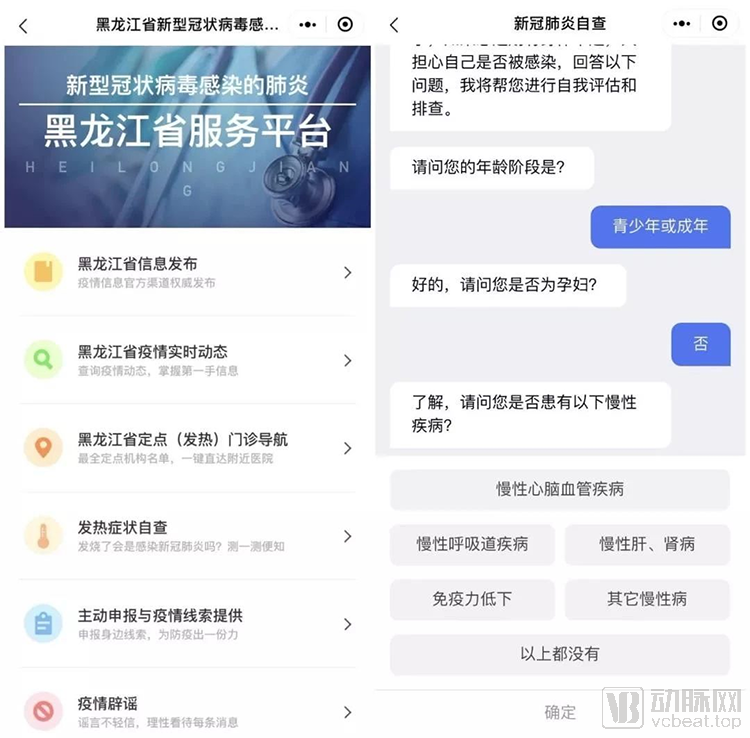
Heilongjiang Province COVID-19 Service Platform
In addition, residents can monitor real-time information releases from Heilongjiang Province, stay updated on epidemic trends, access navigation to designated fever clinics, and receive educational resources on pneumonia prevention through the Heilongjiang Province COVID-19 Service Platform, thereby providing more practical support for personal prevention of pneumonia infection.
Overall, from the onset of the pandemic through February 18, Zhuojian Technology has supported online outpatient services for more than 470 hospitals and institutions, with nearly 100 additional facilities currently in the process of going live. These include the First Affiliated Hospital of Zhejiang University School of Medicine, Henan Provincial People’s Hospital, Heilongjiang Provincial Hospital, Lianyungang First People’s Hospital, Dongying Health Commission Platform, and Heilongjiang Internet Integrated Outpatient Platform, among others. Among these initiatives, internet-based consultation services have been the most widely implemented function, followed by online education platforms for medical staff and patient education tools—functionalities primarily used by doctors and nurses within hospitals during the pandemic.
During this period, the majority of Zhuojian Technology’s employees continued to work remotely, with one-third still yet to return to Hangzhou. This is a true testament to the efficiency of internet-based operations in emergency situations.
Regarding the value of internet healthcare during the pandemic, we previously in “Approval Completed in 11 Minutes: How Do Internet Diagnosis and Treatment Services Support Epidemic Prevention and Control Needs Amid the National Health Commission’s Call for Vigorous Development?》article, including home observation management, patient screening, emotional counseling, and routine follow-up visits.
Meanwhile, internet healthcare has received strong policy support from governments at all levels and in various regions during the pandemic. Hospitals have actively invested in its infrastructure, physicians have embraced its adoption, and the overall number of patients has increased significantly.
Wei Jianfeng believes that the future of internet healthcare should feature the coexistence of platform-based internet hospitals and hospital-led internet hospitals. The former aggregates physician resources from various regions and focuses on addressing patient needs, while the latter emphasizes building integrated online-offline patient management tools for hospitals, providing patients with localized, seamless closed-loop medical services that bridge online and offline care.
“After the pandemic, online hospital services are no longer optional,” said Wei Jianfeng. In addition to follow-up visits for chronic diseases, prescription renewals, and medication delivery, services such as appointment scheduling for examinations and hospital beds, payment processing, and patient follow-ups can be fully handled online. Whether delivered online or offline, these services do not exist in isolation but are integrated with one another. This integration not only improves the utilization of medical resources but also enhances patients’ healthcare experience.
In 2003, the prevention and control of SARS spurred the development of China’s internet sector, particularly e-commerce. Seventeen years later, e-commerce has become an indispensable part of daily life. During the recent COVID-19 pandemic, mature e-commerce and O2O (online-to-offline) services played a crucial role in home quarantine measures across first- and second-tier cities. Not only could consumer goods be purchased online and delivered to doorsteps, but as social management measures tightened nationwide, food and other daily necessities were increasingly procured through these channels.
“The aforementioned bottlenecks—such as temporary courier shortages, slow deliveries, stockouts of fresh produce, and contactless delivery—are all short-term impacts,” said Zhai Xuelian. She believes that internet infrastructure in the consumer lifestyle sector is already relatively well-developed and widely recognized by the public. In contrast, internet healthcare is still in its nascent stage. Although recent concentrated efforts to build and promote it have played a significant role in epidemic prevention and control, the value of the internet in this sector remains far from fully realized compared to the consumer lifestyle domain.
Zhai Xuelian introduced that, at present, in order to address medical consultation needs during the pandemic as quickly as possible, most hospitals have temporarily launched only basic online consultation features. To achieve true integration of online and offline services and fully leverage the value of internet-based healthcare, these functionalities must be continuously improved in the future. In the post-pandemic era, internet hospitals should become a standard component of physical hospitals, enabling them to meet the diverse needs of both patients and healthcare providers more calmly and comprehensively during emergencies, much like e-commerce platforms satisfy basic daily living needs.
The establishment of internet hospitals by physical hospitals largely depends on policy promotion. Since 2018, when internet healthcare received policy endorsement and regulations for the management of internet hospitals were established, followed by the introduction of medical insurance policies for internet healthcare in 2019, it can be said that the policy framework has become sufficiently clear. The practical needs during the COVID-19 pandemic, along with two official documents issued by the National Health Commission encouraging online diagnosis and consultation services, have been the most direct factors driving physical hospitals to build internet hospital platforms.
Recently, good news has continued to emerge from the front lines of treatment across various regions. The number of patients cured and discharged has exceeded 10,000, with daily discharges steadily remaining above 1,000. New confirmed cases outside Hubei Province have declined consecutively, and convalescent plasma therapy has proven safe and effective for treating severe cases. Overall, epidemic prevention and control have entered a critical phase, bringing us closer to defeating the outbreak.
To thoroughly prevent the spread of the epidemic, the current social management model may remain in place for some time. However, we must consider what technological platform should serve as the foundational infrastructure for internet hospitals in the post-pandemic era.
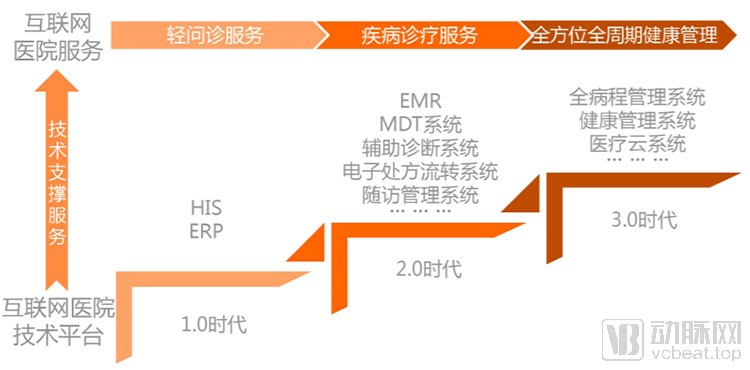
Upgrade Path for Internet Hospital Technology Platforms, Source: VCBeat
According to an analysis by VCBeat Research Institute: In the initial stage, internet hospital technology platforms primarily focused on core functions such as online consultations, appointment scheduling and fee payment, and information inquiries. Subsequently, patient needs evolved from lightweight consultations to comprehensive disease diagnosis and treatment, a phase that emphasizes deeper integration with more in-hospital systems. The electronic prescription circulation system enables an integrated service encompassing online prescribing, prescription review, dispensing, and medication delivery, thereby making medication access more convenient for patients. Meanwhile, the follow-up management system assists physicians in managing patients post-diagnosis, alleviating their workload.
Currently, the entire healthcare system is undergoing a shift toward “patient-centered” care. In the future, internet hospital technology platforms—exemplified by whole-course disease management systems, health management systems, and medical cloud systems—will not only enable end-to-end management of individual patients’ diagnosis and rehabilitation as well as full-cycle management of chronic diseases, but also break down hospital boundaries to facilitate sharing of laboratory and diagnostic test information within and across regions, thereby integrating the most appropriate medical resources from various hospitals to deliver patient services.
Currently, many internet hospitals have implemented partial functionalities of the 1.0 and 2.0 stages. However, to achieve full-cycle health management in the 3.0 stage, it is necessary to further enhance the capabilities of the first two stages and streamline workflows across both in-hospital and out-of-hospital settings, as well as online and offline channels.
In the future, as policies become more refined and technology advances, internet hospital technical platforms will continue to iterate and upgrade around patient needs, effectively addressing those needs. We also look forward to a future where patients can use the internet for medical consultations with the same convenience and practicality as online shopping.