

Robots in the Fight Against COVID-19: Highlighting Value and Exploring Industry Growth Opportunities
On January 21, the Wuhan Municipal Health Commission reported that 15 medical personnel had unfortunately contracted novel coronavirus pneumonia. On February 7, Dr. Li Wenliang, aged only 34, lost his life to COVID-19. On February 10, Professor Lin Zhengbin of Tongji Hospital passed away despite rescue efforts for COVID-19. At a press conference held by the State Council Information Office, Zeng Yixin, Deputy Director of the National Health Commission, disclosed that as of 24:00 on February 11, a total of 1,716 confirmed cases among medical personnel had been reported nationwide, including six deaths, accounting for 0.4% of the national death toll.
Given the human-to-human transmission nature of COVID-19, frontline healthcare workers faced an increased risk of infection due to their “close contact” with patients. After the policy of “one-on-one” support from 16 provinces to 16 cities in Hubei was established, doctors across China “went against the flow” to aid Hubei. The safety and well-being of medical personnel have touched the hearts of hundreds of millions of Chinese people.
It is a highly significant innovation to leverage technological means to reduce the likelihood of physicians’ direct contact, enabling robots to participate in testing, nursing care, treatment, and services, thereby minimizing the risk of infection among healthcare providers to the greatest extent possible.
In the medical field, the demand for robotic applications is growing rapidly. Data from the Qianzhan Industry Research Institute shows that the market size of medical robots in China increased from RMB 390 million in 2016 to RMB 410 million in 2017, and further rose to USD 510 million in 2018. The future market still holds significant potential for growth.
In 2007, China imported its first da Vinci surgical robot. However, for a long period, medical robots remained a luxury item with limited adoption. It is only in recent years that the sector has experienced rapid development. In addition to surgical robots, a diverse range of products—including orthopedic robots, neurosurgical robots, interventional robots, needle biopsy navigation robots, and rehabilitation robots—has successively entered the domestic market.
These robots possess strong medical attributes and are, in the strictest sense, medical robots. Their products require certification from the National Medical Products Administration (NMPA), and the processes for review and research and development are relatively more stringent. In contrast, the assistive robots widely deployed during the pandemic have lower requirements for “technical sophistication,” and their applicable environments are relatively limited; however, they cater to a broader user base.
The product landscape for assistive robots is relatively fragmented, primarily encompassing logistics robots, disinfection robots, triage guidance robots, and nursing care robots. Demand for these products varies significantly across scenarios, and synergy among them remains somewhat limited.
Taking logistics robots, which stand out for their practicality in the development of assistive robots in China, as an example. Hospitals require the internal transportation of a large volume of supplies every day, including pharmaceuticals, consumables, medical instruments, X-ray films, documents, laboratory specimens, soiled linens, meals, and both medical and general waste. These items vary in size and weight, with differing levels of urgency. Logistics personnel transport and deliver these goods using hand carts, baskets, and elevators, which constitutes a considerably arduous task.
Logistics robots can automatically load items, navigate to target locations, and transport goods within hospital premises, thereby replacing manual labor. Compared with other logistics systems used in hospital settings—such as pneumatic tube systems, rail-guided vehicle systems, and medium-sized box-type logistics systems—logistics robots offer greater payload capacity but have lower adoption rates.
Chen Xu, President of the Shenzhen Bao’an District Hospital Medical Group, stated that the Shenzhen Bao’an District Maternal and Child Health Hospital has deployed logistics robots for delivery across seven scenarios: inpatient pharmacy, operating rooms, PIVAS (outpatient), clinical laboratory, breast milk bank, intelligent disinfection, and cafeteria. The robots primarily handle emergency intravenous medication delivery, specimen transport to the clinical laboratory, inpatient medication delivery, intelligent disinfection, meal delivery, and linen transportation. In practical application, the average material delivery time is 5 minutes per trip, with zero incidents of misdelivery or lost packages. The daily delivery volume exceeds 50 trips, saving nurses 250 minutes per day. The robots travel over 600 kilometers per month, annually saving nurses a cumulative distance of 1,944 kilometers.
In fact, hospital logistics robots are an application of autonomous driving technology in the healthcare industry. Industry experts believe that the hospital environment presents unique challenges. To achieve strong performance in hospital logistics, relying solely on autonomous driving technology is insufficient; it is also necessary to consider aspects such as cargo compatibility, material safety, safety and efficiency, vertical transportation within the hospital, hospital Internet of Things (IoT), closed-loop material management, data recording and analysis, monitoring and alarms, the ratio of transport volume to battery endurance, and integration with medical information systems.
As far as we know, there are currently no standardized subcategories for hospital logistics robots, with each company maintaining its own product lines. An investor who has invested in logistics robot companies told VCBeat that the domestic logistics robot market is highly immature and current sales volumes remain limited.
However, logistics robots are already the best-selling category among assistive robots. This indicates that demand for assistive robots in China is not high. As an essential component of 5G-enabled smart hospitals, assistive robots will be increasingly deployed in hospital settings with the advancement of 5G technology.
During the epidemic prevention and control efforts, in addition to witnessing tens of thousands of medical personnel rushing from afar to provide support, disinfection robots, delivery robots, temperature-screening robots, patrol robots, and an increasing number of other robotic systems have also joined the fight.
Markets that were once difficult to penetrate saw an explosive surge in demand. It is reported that some robotics companies received more than twice the number of orders after the outbreak, and some enterprises chose to rapidly donate products depending on the specific circumstances.
Assistive robots possess inherent advantages in combating epidemics, primarily manifested in the following aspects:
Fully Automatic. Robots do not require manual intervention, which can minimize the probability of human infection due to work;
Standardization. Robots do not require pre-job training and can operate directly according to programmed settings;
Controllable. The robot is controllable and operates only within designated areas, reducing the risk of cross-contamination;
Traceable. Every step of the robot's operation is programmed, enabling timed and quantified traceability in the event of an error;
24/7 Intelligent and Efficient Operation. Robots do not require rest and can operate as long as they are powered, addressing the current shortage of manpower;
......
So, how did various types of assistive robots perform during the pandemic when analyzed in detail?
Logistics Robots
In the past, the primary demand for logistics robots in hospitals was to achieve fast, accurate, automated, and safe material transportation. During this pandemic, the use of logistics robots has not only alleviated the severe shortage of medical staff by replacing manual transport but also reduced the risk of nosocomial infections.
As of February 16, VCBeat has compiled a list of companies providing logistics robots to epidemic-affected areas during this outbreak, based on publicly available information (if any are omitted, please feel free to add them. Author’s WeChat: Shirley_CaiAx).
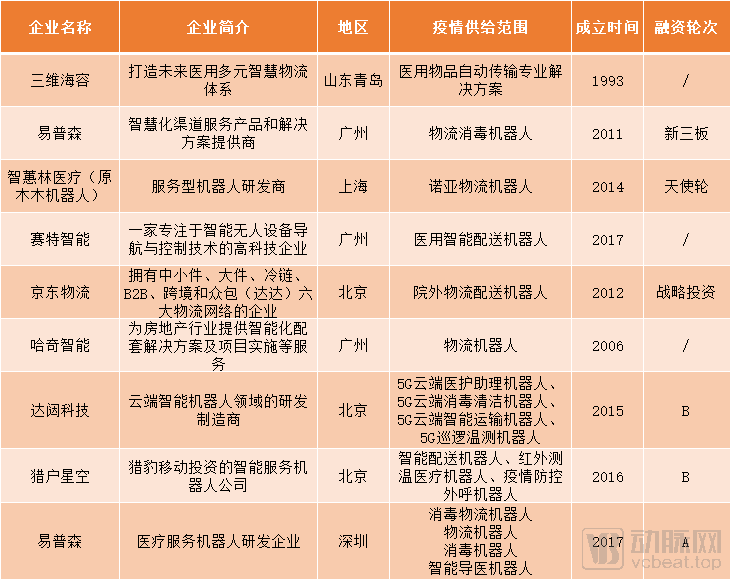
Logistics Robot Companies Contributing to Pandemic Control (Source: Compiled by VCBeat from Public Information)
“We already had more than a dozen units deployed at Wuhan Asia Heart Hospital, Tongji Hospital, and Wuhan Central Hospital. Our senior management attached great importance to the development of the epidemic. On the first day of the Lunar New Year, we urgently assessed the situation to ensure the stable and efficient operation of our robots in the epidemic-stricken areas and all hospitals, while simultaneously accelerating production,” Hu Bin, Vice President of Products at Zhihuilin Medical (formerly known as Mumu Robotics), told reporters. “Noah is the only brand in the hospital logistics robot industry that owns its own factory. Both Noah’s factory and products have obtained the national CR certification (China Robot Certification). Due to the urgency of the epidemic, the local government in Rugao, Jiangsu Province, granted special approval for the Noah Robotics factory to resume operations. We then initiated round-the-clock shift work, increasing our production capacity to more than twice the normal level.”
As early as October 2017, Noah Hospital Logistics Robots were deployed in hospitals. Since then, their application scenarios within healthcare facilities have been continuously expanded, evolving from initial IV admixture delivery for Pharmacy Intravenous Admixture Services (PIVAS) to encompassing a wide range of tasks, including the delivery of oral medications, specimens, high-value consumables, sterile packs, and the collection of contaminated instruments for reprocessing. Currently, intelligent delivery across all hospital scenarios has been achieved. Notably, in early April 2019, Noah integrated 5G technology into its hospital logistics robots, enabling compatibility with both 4G and 5G hospital networks.
In response to the current epidemic, Noah has rapidly developed a corresponding self-disinfection function for its robots. The company has launched a professional cabinet-style logistics robot equipped with an internal disinfection module. Utilizing light-based disinfection technology, this new type of logistics robot ensures a clean interior environment while simultaneously disinfecting items placed inside, thereby further preventing viral transmission. It is reported that the product has essentially completed testing and is poised for market release. Furthermore, Noah is currently developing three-dimensional automatic surface disinfection technology for the robot’s exterior. At the interfaces between areas with differing cleanliness requirements (such as ICUs, infection wards, and operating rooms), a small physical space will be designated for the robot to undergo automatic disinfection, thus meeting hygiene standards and ensuring safe delivery.
During this epidemic outbreak, Noah robots have been operating at full capacity. To prevent equipment failure, Noah has deployed after-sales service personnel to conduct remote monitoring of online status, ensuring stable operation. As of now, the system remains stable.
Among logistics robots, there is also a specialized subcategory—Meal Preparation Robot. Previously, such robots were primarily deployed in consumer service industries, such as restaurants and hotels. During the fight against the epidemic, we have also seen their presence in areas previously unrelated to healthcare.
On the evening of the first day of the Lunar New Year, Zhang Tao, founder of Shenzhen Pudu Technology Co., Ltd., received two phone calls from quarantine facilities in Hangzhou and Shenzhen. He learned that delivering meals and medications to these isolation sites had become a significant challenge. In response, Zhang Tao promptly convened other senior executives of Pudu Technology for an emergency high-level meeting, where they decided to deploy robots to support epidemic-affected areas.
The next day, Pudu Technology dispatched engineers to the front lines, delivering six robots to a hotel quarantine facility in Shenzhen. After brief on-site debugging, the robots quickly commenced delivery tasks within the patient rooms.
During the Spring Festival, logistics companies were largely suspended, and many regions imposed city lockdowns and traffic controls, making it extremely difficult to allocate supplies and personnel. Zhang Tao told VCBeat, “Personnel movement was very challenging; people could neither enter nor leave. Various certificates were required, and in some epidemic areas, staff had to undergo a 14-day quarantine upon arrival before they could begin work. The deployment of robots at hospitals or quarantine sites took only one to two hours to complete, but moving to the next location required another 14-day quarantine period.”
Pudu Technologies’ food delivery robots were originally supplied exclusively to restaurants, including Haidilao. The recent pandemic enabled this catering robotics company to enter the healthcare sector for the first time. Founded in 2016, Pudu Technologies has completed three rounds of financing and launched five models of food delivery robots. The company achieved break-even and even profitability last year.
Zhang Tao stated that Pudu’s food delivery robots operate very smoothly in hospitals, and for them, deploying robots in hospital settings represents a case of technological simplification. Because restaurant aisles are narrow, table and chair arrangements are complex, layouts vary significantly across different restaurants, and there is high pedestrian traffic, Pudu’s algorithms designed for restaurant scenarios are more complex in terms of localization, mapping, path planning, scheduling, perception, and obstacle avoidance.
To better adapt to hospital environments and reduce infection risks, Pudu has further enhanced its robots by replacing previous touchscreen operations with contactless methods such as voice control and delayed execution. Additionally, storage boxes for food or medications are placed on the trays, facilitating regular replacement and disinfection by users. In epidemic areas, Pudu robots’ sensors automatically perceive the environment, construct map scenarios, and adjust speed autonomously, reaching a maximum speed of 1.2 m/s.
In addition, Keenon Robotics has deployed hundreds of food delivery robots to date, serving dozens of hospitals (including two makeshift cabin hospitals), quarantine sites, and schools across more than ten provinces and municipalities in China.
Disinfection Robot
Disinfection Robot: Leveraging robotic platforms, this system effectively and comprehensively eradicates pathogenic microorganisms in the air and on floors through vaporized hydrogen peroxide disinfection, ultraviolet (UV) disinfection, and wiping disinfection. The disinfection robot can automatically, efficiently, and precisely disinfect indoor environments along predefined routes for epidemic prevention and control.
As of February 16, VCBeat has compiled a list of companies providing disinfection robots to epidemic-affected areas during this outbreak, based on publicly available information.
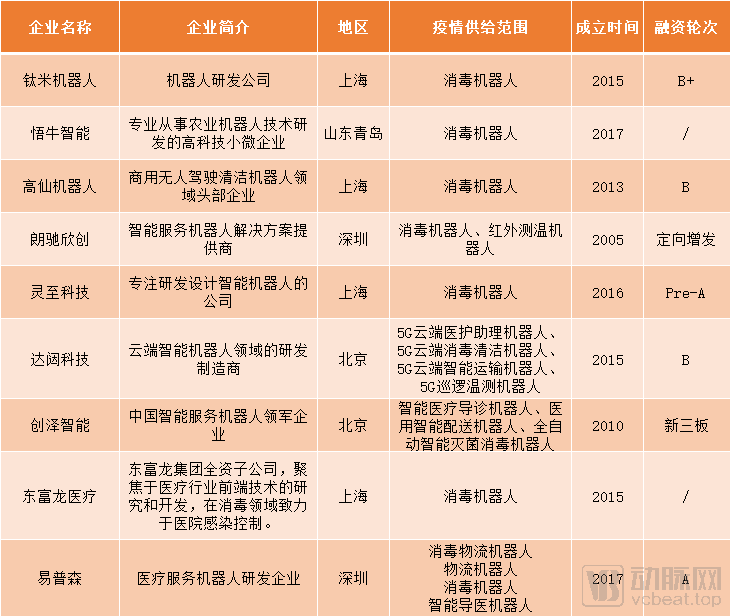
Disinfection Robot Companies Contributing to Pandemic Control (Source: Compiled by VCBeat from Public Information)
Yipsen activated its emergency response plan on January 21; on January 22, it completed the deployment of the epidemic prevention and health education feature for its patient-guidance robots across all client hospitals; on January 23, Yipsen engineers urgently commenced the commissioning of hospital disinfection and logistics robots; as of today, dozens of disinfection and logistics robots have been dispatched to major hospitals.
Li Xiaojun, Chairman of Epsom, told VCBeat that the company had stocked up sufficiently before the Lunar New Year, ensuring ample product supply to the market even before upstream factories resumed operations. Li stated that Epsom offers a diverse range of robots capable of comprehensively covering all hospital scenarios, with disinfection and logistics robots being the most widely utilized during the recent epidemic.
Yipsen’s independently developed disinfection logistics robot can autonomously deliver medical consumables, pharmaceuticals, and instruments, while also performing ultraviolet (UV) disinfection of the external environment. Equipped with external UV disinfection lamps, the robot complies with the “Disinfection Technical Specifications for Medical Institutions” and is capable of eliminating vegetative bacteria, spores, mycobacteria, coronaviruses, fungi, rickettsiae, and chlamydiae.
It is understood that Epsom’s disinfection logistics robots can perform scheduled and on-demand disinfection, plan disinfection times and operational routes based on the actual needs of hospitals, automatically take elevators, and achieve 360-degree comprehensive disinfection without blind spots.
Furthermore, in the race against the COVID-19 pandemic, Epsom has launched a robust epidemic prevention combination featuring an epidemic-prevention triage robot and a hospital disinfection robot. The epidemic-prevention triage robot offers services such as infrared forehead temperature measurement, public education on epidemic prevention, and contactless, voice-enabled intelligent triage. The disinfection robot is an intelligent, efficient, and safe medical device specifically developed for environmental disinfection in hospitals. It can replace manual labor in performing UV ultraviolet and hydrogen peroxide vapor disinfection in areas such as hospital fever clinics and isolation wards. This effectively eliminates various bacteria and viruses in the air and environment, improves hospital hygiene, reduces the spread of infectious diseases, and mitigates the risk of infection among healthcare workers associated with manual disinfection.
It is worth mentioning that, to ensure the normal operation of products during the Spring Festival, engineers from Epsom’s implementation department took turns on duty to guarantee the most timely service.
As the COVID-19 pandemic surged, commercial disinfection robot companies joined the front lines of the fight against the epidemic. Founded in 2013, Gaussine Robotics specializes in full-stack mobile robotics technologies for all scenarios (including localization and mapping, path planning, environmental perception, motion control, application-layer technologies, backend systems, and data). As a leading enterprise in the commercial autonomous cleaning robot sector, it has deployed nearly 1,000 robots across 15 countries and regions, serving industries such as healthcare, industrial facilities, transportation hubs, and commercial complexes and shopping malls.
During the outbreak, Gauss Robotics deployed several commercial cleaning and disinfection robots to frontline hospitals, including Wuhan Huoshenshan Hospital, the General Hospital of the Central Theater Command of the PLA, Xiangya Hospital, Chongqing Public Health Medical Center, and The University of Hong Kong-Shenzhen Hospital. Unlike most medical disinfection robots that rely on gaseous disinfectants, Gauss Robotics employs the hospital’s most traditional and effective method—mopping floors with disinfectant solutions—which can reduce viral load by 99.9%. Equipped with autonomous path planning, Gauss robots ensure uniform and comprehensive coverage without missing any areas, thereby playing a positive role in viral isolation and containment.
Gaoxian cleaning and disinfection robots do not require the evacuation of personnel during operation; they can autonomously plan routes and perceive their surroundings to achieve “automatic cruise disinfection.” Notably, Gaoxian robots work in conjunction with manual assistance for edges and vertical surfaces, thereby minimizing contact between logistical cleaning staff and hazardous environments.
Temperature-Measuring Robot
Fever is one of the clinical manifestations of COVID-19. One of the challenges in the prevention and control of COVID-19 is its high transmissibility during close contact. Traditional temperature-measuring tools, such as mercury thermometers, forehead thermometers, and spot thermometers, inevitably require close human contact, posing a risk of cross-infection. In contrast, temperature-screening robots can perform non-contact temperature measurements on multiple individuals simultaneously, making them more suitable for rapid screening in crowded places.
As of February 16, VCBeat has compiled a list of companies providing temperature-screening robots to epidemic-affected areas during the outbreak, based on publicly available information.
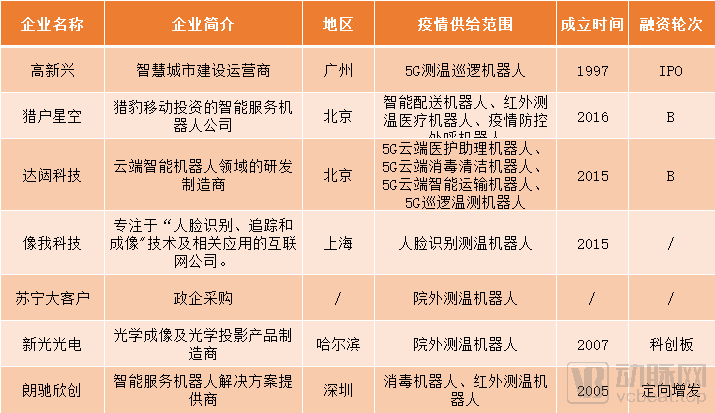
Temperature-Screening Robot Companies Contributing to Pandemic Control (Source: Compiled by VCBeat from Public Information)
CloudMinds, established in 2015, is a research and development manufacturer in the field of cloud-based intelligent robotics. On January 30, CloudMinds, in collaboration with China Mobile, urgently dispatched the first batch of donated 5G cloud-based medical assistant robots, 5G cloud-based disinfection and cleaning robots, 5G cloud-based intelligent transport robots, and 5G patrol temperature-measurement robots to hospitals in Wuhan and Shanghai, providing full support to medical staff in their efforts to combat the pneumonia epidemic.
Wang Bing, Co-founder and Vice President of CloudMinds, told VCBeat that the company urgently mobilized its team on New Year’s Eve to develop a 5G patrol and temperature-screening robot within just 10 days. The product integrates infrared thermometry with facial recognition systems and features cloud-based AI, long-range operation, non-contact measurement, wide-area coverage, and high efficiency.
During the R&D process, CloudMinds fully leveraged the technical advantages of its cloud-based intelligent architecture, adopted a novel facial recognition algorithm, and optimized algorithms for detecting face masks and hats. This enables rapid identification even in high-traffic scenarios, without requiring individuals to remove their hats or face masks.
It is worth noting that CloudMinds’ 5G cloud-based infrared temperature measurement and facial recognition system incorporates an early warning mechanism. When a body temperature exceeds the preset threshold, the system automatically triggers an alarm and simultaneously records both the infrared thermal image and visible-light image of the individual with elevated temperature. This facilitates rapid identification by medical personnel and staff of individuals with fever or those not wearing masks, enabling timely testing and isolation.
Robots for temperature screening and disinfection have gradually been deployed in high-traffic transportation hubs such as airports and railway stations. Outside hospitals, compared to ground-based robots, aerialDroneBroader coverage. During this epidemic, drones used for public announcements, temperature screening, and disinfection have also come into public view.
As of February 16, VCBeat has compiled a list of companies providing drone services to affected areas during this epidemic based on publicly available information (if any are omitted, please feel free to add them. Author’s WeChat: Shirley_CaiAx).
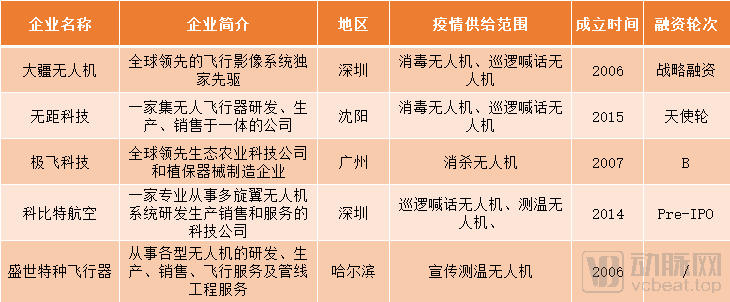
Drone Companies Contributing to Pandemic Response (Source: Compiled by VCBeat from Public Information)
Equipped with thermal imaging technology, drones add a “temperature-sensing eye” to their existing “sky-eye,” enabling long-range, comprehensive, and highly accurate measurement of body temperatures in designated areas or among specific individuals. By mounting a water tank containing disinfectant on the drone, the solution can be atomized and sprayed, thereby minimizing potential harm to humans. Additionally, installing a broadcasting system on the drone facilitates public announcements, offering a safe and efficient approach that reduces labor and financial costs.
In addition to disinfection robots, delivery robots, and temperature-checking patrol robots, VCBeat has also learned that other medical assistant robots, such as call-screening robots and consultation robots, have begun to be deployed in China’s ongoing fight against the epidemic.
Against the backdrop of a high-risk epidemic, traditional labor-intensive healthcare systems have failed to meet current medical demands. This outbreak has presented an opportunity for the assistive robotics industry. During the fight against the epidemic, assistive robots rapidly achieved market education and fostered the development of the domestic market in China.
Typically, hospitals outsource low-value-added manual labor tasks—such as disinfection, waste collection, and meal delivery—to reduce costs, improve efficiency, and optimize their workforce structure. Consequently, it has been difficult for assistive robots to gain market traction for a considerable period.
An industry insider told VCBeat that, during transportation, one logistics robot is equivalent to approximately four human workers, and the cost of one human worker over three to four years can be exchanged for a logistics robot system that operates for 20 years.
This is one of the calculation methods most hospitals use to decide whether to purchase assistive robots. However, in the wake of the pandemic, hospitals will significantly elevate their understanding, shifting from a perspective that measures only economic value to one that encompasses safety value, emergency response value, and technological value, in addition to economic considerations.
This sudden incident has brought to light the current pain points within hospitals. Based on extensive interviews, we anticipate the following changes in assistive robots:
First, the application scenarios have shifted.For example, traditional logistics robots have primarily handled the transport of heavy goods within hospitals. In the future, logistics robots will become more specialized, with distinct models dedicated to delivering medications, meals, and medical waste, among other tasks. Furthermore, their application scenarios will be more clearly differentiated, extending to out-of-hospital settings as well as specific in-hospital areas such as operating rooms, intensive care units (ICUs), and isolation wards.
Second, increased sales volume.Taking disinfection robots, which are needed by both tertiary hospitals and primary care facilities, as an example: there are currently over 1,300 tertiary hospitals in China. If each hospital is equipped with two to three units, and demand increases after initial trial use—potentially reaching a level where each operating room is equipped with two to three units—conservative estimates suggest that sales volume in 2020 will be three to five times that of 2019.
Third, the market space has expanded.. We interviewed multiple investors. Due to the late start, low sales volume, and significant price variations of assistive robots, there is currently no precise data on market size. However, it is widely anticipated that the market for assistive robots will experience explosive growth. This growth is driven by two factors: first, expansion within the existing market, with increased demand for triage robots and logistics robots; second, the emergence of new market segments, characterized by a greater variety of assistive robot types and new application areas such as disinfection robots, food delivery robots, and temperature-screening robots.
Fourth, accelerate the advent of the artificial intelligence era. Looking back to 2003, SARS spurred the advent of the internet era, e-commerce, and social networks. The current novel coronavirus will accelerate the arrival of the artificial intelligence era. It will become a trend for machines to replace humans in performing tasks that people are unwilling to do.
However, as the pandemic recedes, assistive robotics companies will face a true test. On one hand, more non-medical robotics firms have identified the “big health” market opportunity, bringing more robots “suitable for hospital settings” into actual hospital use, thereby intensifying competition.
Similar to Pudu Technology mentioned earlier, these companies were originally unrelated to the healthcare sector. However, they found new opportunities during the fight against the epidemic, contributing their technology and equipment. While they appeared to be passively drawn into this battle, it ultimately presented a new business opportunity.
On the other hand, the Chinese government has not yet established relevant compliance standards or corresponding certifications for medical-assistive robots. Many enterprises have obtained CE, CC, or CR certifications; however, regarding which specific medical standards must be met, it is believed that the state will provide clear guidance in the post-pandemic era.
Note: In this article, robots are defined as intelligent robots that possess at least three essential elements: perception, movement, and cognition.
References: iAsk Profiles, People's Daily, Times Weekly, CWW News, China News Service, 36Kr, etc.