

Huatai Ruihe Medical Industry Fund Completes Initial Investment with an Industrial Logic Approach to Brokerage Equity Investment
At the end of 2019, Geneseeq, a provider of oncology genetic testing services, announced the completion of a new RMB 800 million financing round. Led by China Reform Holdings Corporation and participated in by Lilly Asia Ventures, C&D Emerging Investment, E Fund, SoftBank China Capital, Ruihua Holding, Nanjing Jiangbei New Area, Longma Peak, Tianqin Junze, and Huatai Ruihe Healthcare Industry Fund, this round set an industry record for single-round RMB financing. The entry of China Reform Holdings Corporation and Nanjing Jiangbei New Area officially positioned Geneseeq as part of the “national team” in oncology genetic testing.
VCBeat’s review of Geneseeq’s financing history reveals that it is a company that has garnered recognition from shareholders at every stage of its development. Beilu Pharmaceutical (Series A and B), Denovo Capital (Series B+ and D), and Huatai Ruihe (Series C and E) have all made follow-on investments. Recently, we conducted an exclusive interview with Zhang Quanyuan, General Manager and Founding Managing Partner of Huatai Ruihe Healthcare Industry Fund, which invested in Geneseeq’s Series C and E rounds. He stated that Huatai Ruihe made additional investments in multiple projects during its first investment period and shared unique insights into investing in the healthcare industry as an equity fund with a securities firm background.
In 2015, Huatai Securities conducted an in-depth analysis of the development trends in China’s healthcare industry, aiming to identify investment opportunities in growth-stage and mature-stage companies that aligned with industrial logic. By establishing a robust platform and designing effective mechanisms, Huatai Securities recruited several investors with extensive industry experience, including Zhang Quanyuan, to form a specialized industrial investment fund—the Huatai Ruihe Healthcare Industry Fund—and participated as one of the major limited partners (LPs) by contributing capital to the fund. This marked an early attempt by a large domestic securities firm to enter the field of private equity investment in the healthcare vertical. By the end of 2019, Huatai Ruihe had completed its first investment period, having invested in eight projects in total. These included prominent portfolio companies such as Mindray Medical (300760.SZ), Pumen Technology (688389.SH), Happy Dental, Geneseeq, and MicroPort CardioFlow.
“We only invest in projects ranked among the top 10 within their respective niche sectors,” Zhang Quanyuan told VCBeat. Since 2015, he has led this specialized fund team in identifying investment targets in the broader healthcare industry. “Huatai Ruihe does not operate under the traditional investment model driven by investment banking transaction thinking; all investment decisions must align with our logical framework built upon meticulous industry observations.”
Zhang Quanyuan holds a degree in Clinical Medicine and earned Master’s degrees in Cellular Pharmacology and Healthcare Management from institutions in Illinois and Chicago, respectively. Prior to joining Huatai, he held key positions at China Resources Healthcare (01515.HK, formerly Phoenix Medical), Legend Capital (now Junlian Capital), and CITIC Medical Industry Fund, accumulating extensive experience in healthcare and pharmaceutical investment, hospital operations management, clinical center development, and the establishment of medical service platforms. Additionally, Mr. Zhang co-founded “Little Apple Pediatrics,” a major domestic pediatric healthcare chain, and remains a significant shareholder of the company.
At its inception, Huatai Ruihe’s team made three key judgments regarding investment opportunities in the healthcare industry. Over the following four years, they strategically positioned themselves in promising niche sectors:
First, there are investment opportunities in innovative medical device consumables;
Second, in the field of diagnostics, there are significant market opportunities driven by the emergence of new technologies and business models;
Third, innovative elements—including physician groups, internet-based healthcare, and third-party testing and inspection services at the primary care level—are transforming medical services.
Through in-depth industry research, the team identified dozens of sub-sectors with investment potential and, by dynamically tracking them, ultimately pinpointed investment opportunities.
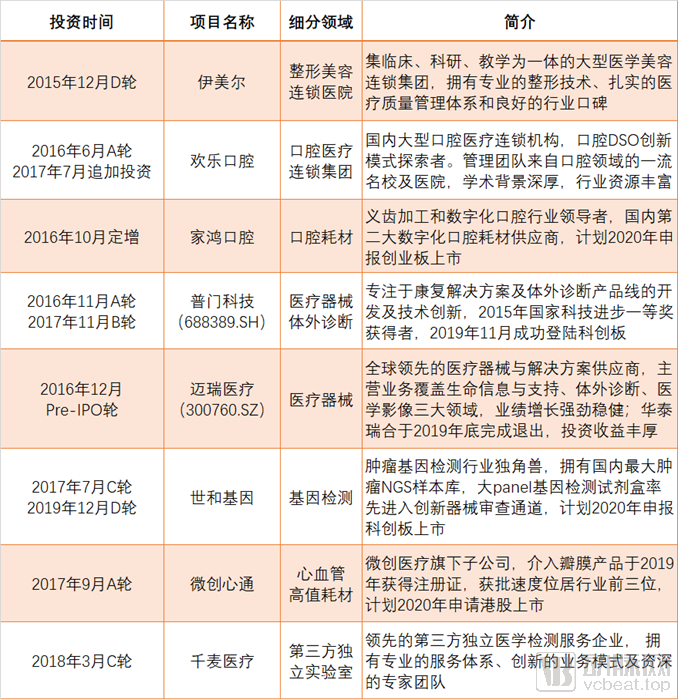
Investment Portfolio of Huatai Ruihe Phase I Fund
Medical devices represent a niche sector in which Huatai Ruihe made early strategic investments. At the end of 2016, the fund invested in Mindray Medical, a leading Chinese domestic medical device enterprise known as the “Huawei of the medical device industry.” This investment marked the sole opportunity for private equity capital to participate during Mindray’s delisting from the U.S. stock market and its return as a China-concept stock. Subsequently, Mindray Medical listed on the ChiNext Board in October 2018. Huatai Ruihe successfully exited its position after the lock-up period expired in 2019, generating an investment return of over 3.5x for its limited partners (LPs).
Zhang Quanyuan told VCBeat that Huatai Ruihe positions itself as a late-growth-stage fund, opting to invest in projects with relatively high certainty. The team believes that capital plays its most pivotal role when companies reach inflection points marked by significant business shifts, or when industry consolidation reaches a level that creates opportunities for horizontal or vertical integration.
Among the eight companies included in the initial investment portfolio, Huatai Ruihe has made additional investments in Happy Dental and Pumen Technology, aside from Geneseeq. In terms of exits, Mindray Medical has already completed its exit. Meanwhile, Jiahong Dental, MicroPort CardioFlow, and Geneseeq are currently pursuing IPO plans. “We will further enhance our post-investment management to help companies address practical challenges in their development, facilitate smooth access to the capital markets, and select appropriate opportunities to execute exits, thereby delivering strong returns to our limited partners (LPs).”
Discussing the two rounds of investment in Geneseeq, Zhang Quanyuan stated that the management of any disease revolves around diagnosis and treatment. Diagnosis serves as the prerequisite and foundation for all clinical interventions, requiring adherence to the principles of "early" and "accurate" detection, with substantial room for improvement in clinical practice.
Startups in the diagnostics sector should, on one hand, master foundational technologies that have achieved a certain degree of breakthrough in overcoming accuracy bottlenecks, by developing more precise reagents and employing advanced methods to measure biomarkers at trace levels. On the other hand, they must accurately identify pain points in application scenarios based on a deep understanding of diseases and clinical diagnosis and treatment workflows, and scientifically and rigorously evaluate the ability of new methods to enhance quality and efficiency in clinical practice.
Zhang Quanyuan pointed out that Genetron Health, leveraging NGS as its foundational technology, has been applied in clinical scenarios such as screening for oncology drug regimens, detecting microbial infections, evaluating precision radiotherapy, and monitoring postoperative tumor recurrence. These applications have tangibly improved or optimized existing methods, aligning with Huatai Ruihe’s selection criteria for such projects.
Another reason for Huatai Ruihe’s additional investment in Geneseeq is its optimism about the company’s continuously improving product-oriented marketing approach. At present, the genetic testing business is evolving from a pure clinical service model to a standardized kit-based product model. Geneseeq was among the first companies in China to obtain approval for lung cancer diagnostic kits and took the lead in entering the National Medical Products Administration’s Innovative Medical Device Review Channel for large-panel genetic testing.
Zhang Quanyuan told VCBeat that several sequencing companies, including Geneseeq, have already obtained product qualifications for small-panel tumor gene testing kits, but large-panel kit products remain a gap in the market.
Currently, Huatai Ruihe is launching the fundraising for its second fund and will continue to focus on seizing investment opportunities in the broader healthcare sector driven by technological innovation and business model transformation. Zhang Quanyuan stated that the main drivers of the development of the broader healthcare industry include technological and business model innovations, the unleashing of human potential, and the continuous improvement of the multi-tiered capital market. For instance, innovative elements in business models—such as novel diagnostic and therapeutic technologies, internet-based healthcare, independent third-party services, and digital healthcare—have changed many conventional practices in traditional medicine. Huatai Ruihe has been actively exploring investment opportunities centered around these driving factors.
Zhang Quanyuan pointed out that the policies allowing physicians to practice at multiple institutions and gradually move toward independent practice have had a significant and far-reaching impact on the healthcare industry. The broader trend of Chinese physicians leaving the public hospital system is now unstoppable. In many sectors, including dentistry, medical aesthetics, and women’s and children’s health, the mobility of physician talent has driven the robust growth of private healthcare, profoundly reshaping production relations within the medical industry. Furthermore, guided by national policies, academic researchers at universities and research institutes are accelerating the commercial translation of scientific achievements. “This is, in fact, a mature model seen in developed countries, fostering successive generations of innovative products as they transition from research institutions to true industrialization.”
The continuous improvement of the multi-tiered capital market has provided impetus for the accelerated development of China’s healthcare industry in recent years. In China, social capital now has the opportunity to drive industry-wide growth across the entire investment lifecycle—from early-stage angel investing and venture capital (VC) to growth-stage and mature-stage private equity (PE), and finally to mergers and acquisitions (M&A) and initial public offerings (IPOs). This enables companies to secure truly “high-quality” funding at each stage of their development. Experienced and capable institutional investors can channel capital to the most promising enterprises, a process that inherently fosters survival of the fittest by supporting genuinely strong companies.
Regarding the current epidemic, Zhang Quanyuan believes that, from a medium- to long-term perspective, the overall impact on the healthcare sector is positive rather than negative. On one hand, public awareness of health and disease prevention will be further strengthened among both the state and society. Healthcare companies—particularly those involved in health education, pharmaceuticals, and diagnostic test kits—have effectively completed a nationwide marketing campaign at no cost. On the other hand, restrictions on personnel mobility resulting from lockdown measures have created significant challenges for resuming work and reopening businesses, leading to tangible cash flow pressures. This strain will affect various industries, including healthcare enterprises. Therefore, it is crucial to prioritize short-term cash flow management. Taking decisive measures to endure this period will lead to success; in these times, survival is king.