

Recent Advances in COVID-19 Serological Diagnostics: Four Immunoassay Kits Approved, Over 20 Companies Launch Products and File IPO Prospectuses
In late 2019, an outbreak of pneumonia caused by the novel coronavirus emerged in Wuhan. As of March 7, more than 80,000 people had been infected across China, resulting in over 3,000 deaths.
Following the outbreak of the epidemic, numerous in vitro diagnostic (IVD) companies announced the development of test kits for diagnosing COVID-19. In the early stages of the outbreak, shortages of PCR test kits and limited testing capacity in Hubei Province resulted in difficulties in confirming suspected cases. Consequently, some patients were informed that viral testing was temporarily unavailable and were advised to self-isolate at home.
As an increasing number of in vitro diagnostic companies began supplying nucleic acid test kits, a large number of suspected cases were confirmed; however, concerns regarding false-negative results in nucleic acid testing for COVID-19 have also sparked discussion.
Furthermore, the application of nucleic acid testing is constrained by factors such as the quality of test kits, the limited number of Biosafety Level 3 (BSL-3) laboratories capable of conducting clinical diagnostics, the accuracy and stability of equipment in these laboratories, and the availability of medical personnel proficient in performing stable and standardized operations. In practice, to address the challenges of false negatives and limited applicability associated with sole reliance on nucleic acid testing during disease outbreaks, there is a need for diverse diagnostic methods that are rapid, sensitive, simple, and cost-effective.
Compared with nucleic acid testing, immunoassay is a method for detecting various diseases based on the specific immune reaction between antigens and antibodies. Different immunoassay techniques have been developed according to the type of labeling signal used. In terms of laboratory requirements, antibody testing imposes lower operational demands on clinical laboratories than nucleic acid testing, enabling rapid, high-throughput screening that can be performed in primary-care or grassroots laboratories.
The primary distinction between immunoassays and nucleic acid tests lies in the fact that nucleic acid testing is designed to detect SARS-CoV-2-specific nucleic acids. The technical principle involves first reverse-transcribing the novel coronavirus RNA into DNA, followed by amplification and detection of specific nucleic acid sequences in the specimen.
Immunological assays, based on the principle of specific antigen-antibody reactions, are widely used in the detection of major infectious diseases such as HIV, hepatitis B, and hepatitis C by detecting viral proteins (antigens) or specific antibodies against these viral proteins in the body.
Detection of viral proteins is generally performed using two approaches. The first involves using antibodies to detect antigens, which provides direct evidence; a positive antigen result confirms infection. The second approach uses antigens (typically recombinant) to detect antibodies, which serves as indirect evidence. The presence of such antibodies, if not acquired through vaccination, indirectly indicates infection with the pathogen. Antibodies are produced by the humoral immune response following viral infection.
It is worth noting that antigen testing and nucleic acid testing are not mutually exclusive, nor can they replace each other; both are important methods for diagnosing viral infections.
A positive result for specific antibody testing cannot serve as the “gold standard” for viral infection, unlike a positive result for viral nucleic acid testing. In the early stages of infection, patients may have low antibody concentrations or have not yet mounted an immune response, due to limitations imposed by the diagnostic window period. Furthermore, because antibody assays are susceptible to interference from certain substances in blood samples (such as rheumatoid factor, nonspecific IgM, and high concentrations of hemoglobin caused by hemolysis), which can lead to false-positive results, antibody testing must involve simultaneous detection of both IgM and IgG and typically requires multiple dynamic tests for confirmation.
The primary challenge in developing virus protein-based immunological assays lies in the production of antibody raw materials. Compared with nucleic acid testing kits, immunological assay kits require longer development timelines and incur higher production costs.
In terms of application scenarios, antibody testing offers rapid results and simple operation, which is of great significance for the quick screening and triage of suspected cases. It is more suitable for screening febrile individuals in primary healthcare institutions, communities, and township health centers, playing a crucial role in effectively controlling the large-scale spread of COVID-19.
Compared with nucleic acid testing, immunoassay kits can also rapidly screen asymptomatic virus carriers and are suitable for distributed screening in high-traffic public places such as airports, railway stations, and ports, thereby providing technical support for comprehensive epidemic prevention and control as well as baseline surveys.
According to statistics from VCBeat, more than 20 companies are currently engaged in the research and development of immune diagnostic reagents for the novel coronavirus (COVID-19).
On February 22, the National Medical Products Administration (NMPA) granted emergency approval for three novel coronavirus detection products from three enterprises, including two colloidal gold-based antibody test kits and one isothermal amplification chip-based nucleic acid test kit. This move has expanded the methods and means for detecting the novel coronavirus, fully supporting the needs of epidemic prevention and control. It also marks the first time that immunodiagnostic reagents have been approved for market launch and deployed on the front lines of the anti-epidemic effort.
It is reported that the two approved colloidal gold-based antibody test kits are from Wondfo Biotech and Innostep, respectively.
Subsequently, on March 1, the National Medical Products Administration (NMPA) issued a public announcement granting emergency approval for four novel coronavirus detection products from three manufacturers, including two chemiluminescence-based antibody detection reagents and two fluorescent PCR-based nucleic acid detection reagents.
On March 1, BioSis (Chongqing) Biotechnology Co., Ltd.’s Novel Coronavirus (2019-nCoV) IgM Antibody Detection Kit (Magnetic Particle Chemiluminescence Immunoassay) and Novel Coronavirus (2019-nCoV) IgG Antibody Detection Kit (Magnetic Particle Chemiluminescence Immunoassay) were approved through emergency review.
On March 6, the National Medical Products Administration granted emergency approval for one novel coronavirus (2019-nCoV) antibody test kit (chemiluminescent microparticle immunoassay) manufactured by Xiamen Wantai Cairui Biotechnology Co., Ltd.
To date, a total of 10 manufacturers have been approved for nucleic acid testing reagents for the novel coronavirus, and 4 for antibody testing reagents. The approved manufacturers for antibody reagents include Wondfo Biotech, Innovita, Boao Saisi (Chongqing) Biological Co., Ltd., and Taikai Rui Bio.
Immunodiagnostic methods mainly include: radioimmunoassay, colloidal gold immunochromatography, enzyme-linked immunosorbent assay (ELISA), time-resolved fluorescence immunoassay, and chemiluminescence immunoassay. VCBeat has compiled a list of companies that have developed products based on these different methodologies.
Colloidal Gold Immunochromatographic Assay Reagents
Hotgen Biotech Novel Coronavirus (2019-nCoV) IgM/IgG Antibody Detection Kit
On January 30, 2020, Hotgen Biotech successfully developed rapid immunological test kits and enzyme-linked immunoassay (ELISA) kits for the novel coronavirus.
In response to the novel coronavirus (SARS-CoV-2) outbreak, Hotgen Biotech’s laboratory initiated R&D on January 15, 2020. The company completed the development of nucleic acid reagents on January 20, commenced recombinant protein expression on January 21, and began developing immunoassay reagents on January 22. By January 30, it had successfully developed both rapid immunochromatographic tests and enzyme-linked immunoassay (ELISA) reagents. To date, three diagnostic kits targeting this virus have been developed. Currently, all commercially available diagnostic methods for SARS-CoV-2 infection rely on viral nucleic acid testing, which must be conducted in specialized PCR laboratories and has an average turnaround time of 120 minutes. Therefore, there is an urgent need for rapid and simple diagnostic kits to screen for SARS-CoV-2 infections in epidemic prevention and control efforts.
Hotgen Biotech has successfully cloned the envelope protein of the novel coronavirus. Using this viral protein as an antigen for immunodiagnostics, the company has developed colloidal gold immunochromatographic assays and up-converting phosphor immunoassays that deliver diagnostic results within 15 minutes.
Livzon Diagnostics Novel Coronavirus IgM/(IgG) Antibody Test Kit
Livzon Group announced on the evening of February 13 that the novel coronavirus IgM antibody test kits (colloidal gold method) and novel coronavirus IgG antibody test kits (colloidal gold method), developed by Livzon Diagnostics and the Wuhan Institute of Virology, Chinese Academy of Sciences, have passed the defense for emergency approval of in vitro diagnostic reagents and entered the fast-track approval process on February 11.
Meanwhile, the emergency project jointly submitted by the National Institutes for Food and Drug Control, the Wuhan Institute of Virology of the Chinese Academy of Sciences, and Livzon Diagnostics—the Novel Coronavirus IgM Antibody Detection Kit (ELISA)—also entered the national emergency approval channel on February 11.
Medicon Biotech: Novel Coronavirus Protein Detection Kit
Meikang Bio’s Rapid Test Kit for Novel Coronavirus Protein, developed using immunochromatography, is a point-of-care testing (POCT) method. This approach employs specific antibodies labeled on nanoparticles and immobilized in the test line region of a nitrocellulose membrane to form a double-antibody sandwich immune reaction with the novel coronavirus protein antigens present in the sample. The colorimetric properties of the nanoparticles enable qualitative detection of the specific novel coronavirus protein. This product is primarily used for preliminary rapid screening of the novel coronavirus in medical institutions, delivering results in as fast as 10 minutes.
Nanjing Vazyme Medical: Novel Coronavirus (2019-nCoV) IgG/IgM Antibody Combined Detection Kit
Leveraging its extensive experience in the development of quantum dot fluorescence immunoassay and colloidal gold products, Vazyme has successfully developed the Novel Coronavirus (2019-nCoV) IgG/IgM Antibody Combined Detection Kit (Colloidal Gold Method) and the Novel Coronavirus (2019-nCoV) IgG/IgM Antibody Combined Detection Kit (Quantum Dot Fluorescence Immunoassay Method). The combined test cards for SARS-CoV-2 IgM and IgG antibodies have passed the medical device registration testing in Jiangsu Province, and clinical validation of the kits is currently underway.
Vazyme’s SARS-CoV-2 IgG/IgM Antibody Combo Test Kit enables 10-minute preliminary screening of positive patients using whole blood; the quantum dot fluorescence immunoassay combo test kit facilitates large-scale patient screening and diagnosis for hospitals and centers for disease control; while the colloidal gold combo test kit is suitable for infection screening among populations served by numerous primary healthcare institutions, as well as employees returning to work and students resuming school.
Xinchao Bio: Novel Coronavirus (2019-nCoV) IgM Antibody Detection Kit
On January 29, Xinchao Biotech successfully developed the Novel Coronavirus (2019-nCoV) Antibody Test Kit (Colloidal Gold Immunochromatography Assay).
Xinchao Biology has successfully developed a POCT rapid test kit that employs colloidal gold immunochromatography technology to perform in vitro qualitative detection of novel coronavirus IgM/IgG antibodies in human serum, plasma, or whole blood. Results can be read within 15 minutes after sample application. This kit enables convenient and rapid early screening and diagnosis for infected patients at community health service centers and primary hospitals, thereby not only improving the timeliness of testing and clinical management but also effectively preventing cross-infection among the general public caused by crowded conditions in large hospitals.
Tongchuang Medical Novel Coronavirus (2019-nCoV) Test Strip
Following the outbreak of the novel coronavirus (SARS-CoV-2) epidemic, Tongchuang Medical engaged in close collaborative research and technological translation with the Collaborative Innovation Center for Diagnosis and Treatment of Infectious Diseases. Leveraging its prior technical reserves, the company developed a novel coronavirus detection strip suitable for on-site screening. The procedure involves collecting saliva or throat swabs, or nasal mucosal secretions, into an extraction tube, followed by testing with the strip. Within just 10 minutes, positive or negative results can be determined based on the appearance of two lines: the test line and the control line.
Currently, this achievement has entered the clinical trial phase and has been deployed free of charge at selected designated hospitals.
Kanghua Bio: Novel Coronavirus (2019-nCoV) IgM Antibody Test Kit
On January 31, 2020, the colloidal gold-based and immunochromatographic novel coronavirus (2019-nCoV) IgM antibody test kits developed by Weifang Kanghua Biotechnology Co., Ltd. passed inspection by the Jinan Medical Device Quality Supervision and Inspection Center under the National Medical Products Administration (NMPA), becoming the first rapid novel coronavirus IgM antibody detection product in China to be certified as qualified by a statutory testing institution. The company is currently applying for emergency approval from the NMPA; upon obtaining the registration certificate, the products will be launched for market sales.
Following approval for market launch by the National Medical Products Administration (NMPA), this rapid diagnostic kit will be distributed to hospitals nationwide for early screening and diagnosis of suspected cases in community health service centers, primary care hospitals, outpatient and emergency departments of tertiary hospitals, and fever clinics. The two products that have passed registration testing are easy to operate, compatible with whole blood, serum, and plasma samples, and can deliver results in as little as three minutes. Designed for single-use testing without the need for specialized equipment, they are well-suited for point-of-care screening.
Zhejiang Orient Gene Biotech Novel Coronavirus (2019-nCoV) Antibody Test Kit Method
Oriental Gene has successfully developed a novel coronavirus nucleic acid detection kit (extraction-free fluorescent PCR method) and a novel coronavirus antigen detection reagent (colloidal gold method), both of which have been used in clinical trials and scientific research. The clinical trial accuracy of the nucleic acid detection kit exceeds 97%, while the colloidal gold-based product offers simple operation and reduces the detection time to 10 minutes.
These two reagent products have been reviewed and recommended by the Provincial Medical Products Administration and are currently applying for registration with the National Medical Products Administration.
Geno Biotech: Novel 2019-nCoV Immunodiagnostic Kit
On February 8, 2020, GenScript Biotech and Nanjing University joined forces to accelerate the development of an immune diagnostic kit for the novel coronavirus. This product is a novel 2019-nCoV immune diagnostic kit developed by combining high-throughput nanobody screening technology with the colloidal gold method.
Keygen Biotech has leveraged immunological methods to develop more than ten assay kits, including those for galectin-3, soluble growth stimulation expressed gene 2 protein (ST2), D-dimer, and troponin I, thereby accumulating extensive expertise in immunotechnology. This kit further incorporates Nanjing University’s proprietary high-throughput nanobody screening technology, yielding nanobodies with high stability (resistant to degradation even at 90°C), high affinity, over 80% homology with human antibodies, and low toxicity and immunogenicity, thus ensuring the stability and accuracy of the assay kit.
Fluorescent Immunochromatography
Huaketai Biotechnology Novel Coronavirus (2019-nCoV) Antigen Test Kit
Huaketai boasts a mature POCT technology platform and is committed to leveraging this expertise to contribute to the fight against the epidemic. During the Spring Festival, Huaketai’s R&D team overcame technical challenges by evaluating 20 antibody pairs and hundreds of technical solutions. They successfully developed a POCT rapid immunodiagnostic kit for the 2019-nCoV coronavirus using fluorescent microsphere immunochromatography. Using throat swabs as samples for direct detection of SARS-CoV-2 antigens, the kit delivers results within 15 minutes, providing robust support for epidemic testing efforts.
Huaketai was founded in 2007 and has completed its Series C financing round.
Wondfo Biotech 2019-nCoV Novel Coronavirus Antigen/(Antibody) Test Reagent, 2019-nCoV Novel Coronavirus IgM Antibody Test Reagent
On January 20, 2020, Wondfo Biotech’s subsidiary, Wondfo Better, announced the successful development of a multiplex nucleic acid test card for respiratory pathogens, including the novel coronavirus. The test panel was designed in accordance with the Guidelines for the Diagnosis and Treatment of Novel Coronavirus Pneumonia (Trial Version 2) issued by the General Office of the National Health Commission, and includes SARS-CoV-2 along with other respiratory pathogens requiring differential diagnosis. By integrating this panel with Wondfo Better’s proprietary BoxArray fully automated multiplex nucleic acid testing platform, the company has established a fully automated, closed-system multiplex nucleic acid testing solution for novel coronavirus and other respiratory pathogens.
Immunochromatography
Meike Medical Novel Coronavirus (2019-nCoV) IgM/IgG Antibody Detection Kit
Meike Medical promptly convened its technical team to tackle the challenge of developing testing technologies for COVID-19. Targeting the IgM/IgG antibodies produced in patients’ bodies after SARS-CoV-2 infection, the team developed a test kit capable of delivering results within 15 minutes. This series of immunoassay reagents, when combined with other clinical indicators, enables rapid, effective, and qualitative clinical diagnosis in hospital settings.
Microfluidic Time-Resolved Fluorescence Immunoassay
Chengdu Weikang Biotechnology: Novel Coronavirus (2019-nCoV) IgM and IgG Antibody Detection Kit
Following the outbreak, Chengdu Weikang Biotech, in collaboration with West China Hospital of Sichuan University, developed this testing system based on its microfluidic POCT diagnostic platform. The system integrates self-developed SARS-CoV-2-specific epitope antigens and antibodies with a confocal time-resolved fluorescence immunoassay analyzer and microfluidic time-resolved fluorescence immunoassay technology. It uses blood samples, delivers results within 15 minutes, achieves a high detection sensitivity of 1 pg/mL, and maintains a coefficient of variation (CV) of approximately 5%. Leveraging proprietary spray freeze-drying technology, the chips can be stored at room temperature, making them suitable for a wider range of application scenarios.
Chemiluminescence Assay
BioSays Novel Coronavirus (2019-nCoV) IgM/IgG Antibody Test Kit
It is reported that Chongqing Medical University, in collaboration with Boses Biotechnology Co., Ltd., has successfully developed a chemiluminescence immunoassay kit for the novel coronavirus (2019-nCoV). This kit features rapid detection, high throughput, and low cost, making it suitable for early diagnosis of COVID-19, epidemiological screening, and prediction of clinical outcomes. The clinical validation of the kit, involving 200 cases, was conducted jointly by Yongchuan Hospital Affiliated to Chongqing Medical University, Chongqing Three Gorges Central Hospital, and the Municipal Public Health Clinical Center (all designated severe-case treatment hospitals in Chongqing Municipality).
Zecheng Bio Novel Coronavirus (2019-nCoV) IgG and IgM Antibody Diagnostic Kit
Following the outbreak of the novel coronavirus pandemic, Zecheng Biology rapidly initiated research and development related to the 2019-nCoV immunoassay kit, and swiftly completed the development of IgG and IgM serological diagnostic kits for 2019-nCoV (chemiluminescence assay) within a short period.
Snibe Biotech Novel Coronavirus (2019-nCoV) IgG Antibody and IgM Antibody Detection Kit
In July 2017, Snibe became the first Chinese manufacturer of chemiluminescence immunoassay (CLIA) systems to gain access to the U.S. FDA market. In 2018, Snibe successfully launched the MAGLUMI X8, the world’s fastest fully automated chemiluminescence immunoassay system.
Snibe Diagnostics has developed fully automated chemiluminescence immunoassay kits for the detection of novel coronavirus (2019-nCoV) IgG antibodies and novel coronavirus (2019-nCoV) IgM antibodies.
Snibe’s Novel Coronavirus Detection Kit delivers the first result in as fast as 25 minutes, processes up to 300 tests per hour, and supports fully automated, continuous 24/7 operation. Using blood samples, which are easy to collect, it facilitates the screening of suspected cases.
Yahuilong Bio: Novel Coronavirus (2019-nCoV) Antigen, IgM, and IgG Antibody Detection Reagents
Yahuilong promptly established a task force dedicated to the development of antigen and antibody detection reagents. Since the sudden outbreak of the epidemic, Yahuilong’s R&D team has overcome challenges in the genetic engineering expression, purification, and mass production of virus-specific proteins, and has completed the development of a series of products for the detection of novel coronavirus (2019-nCoV) antigens, IgM antibodies, and IgG antibodies.
Tianshen Medical Chemiluminescent Novel Coronavirus Antibody Detection Kit
On February 4, 2020, Shenzhen Tianshen Medical Devices Co., Ltd. announced the successful joint development with Shenzhen Third People's Hospital (National Clinical Research Center for Infectious Diseases) and Shenzhen University of a chemiluminescence-based kit for detecting IgM and IgG antibodies against the 2019 novel coronavirus.
The kit is currently undergoing clinical trials at Shenzhen Third People’s Hospital (National Clinical Research Center for Infectious Diseases). Preliminary clinical results demonstrated that, in clinical samples from patients with fever lasting 7–14 days, the clinical concordance rate was 96.6% (29/30) for IgM and 96.6% (29/30) for IgG. The company is also conducting validation studies on a larger cohort of clinical samples. Regulatory registration for the relevant kits is underway.
List of Manufacturers with Successfully Developed COVID-19 Immunodiagnostic Reagents
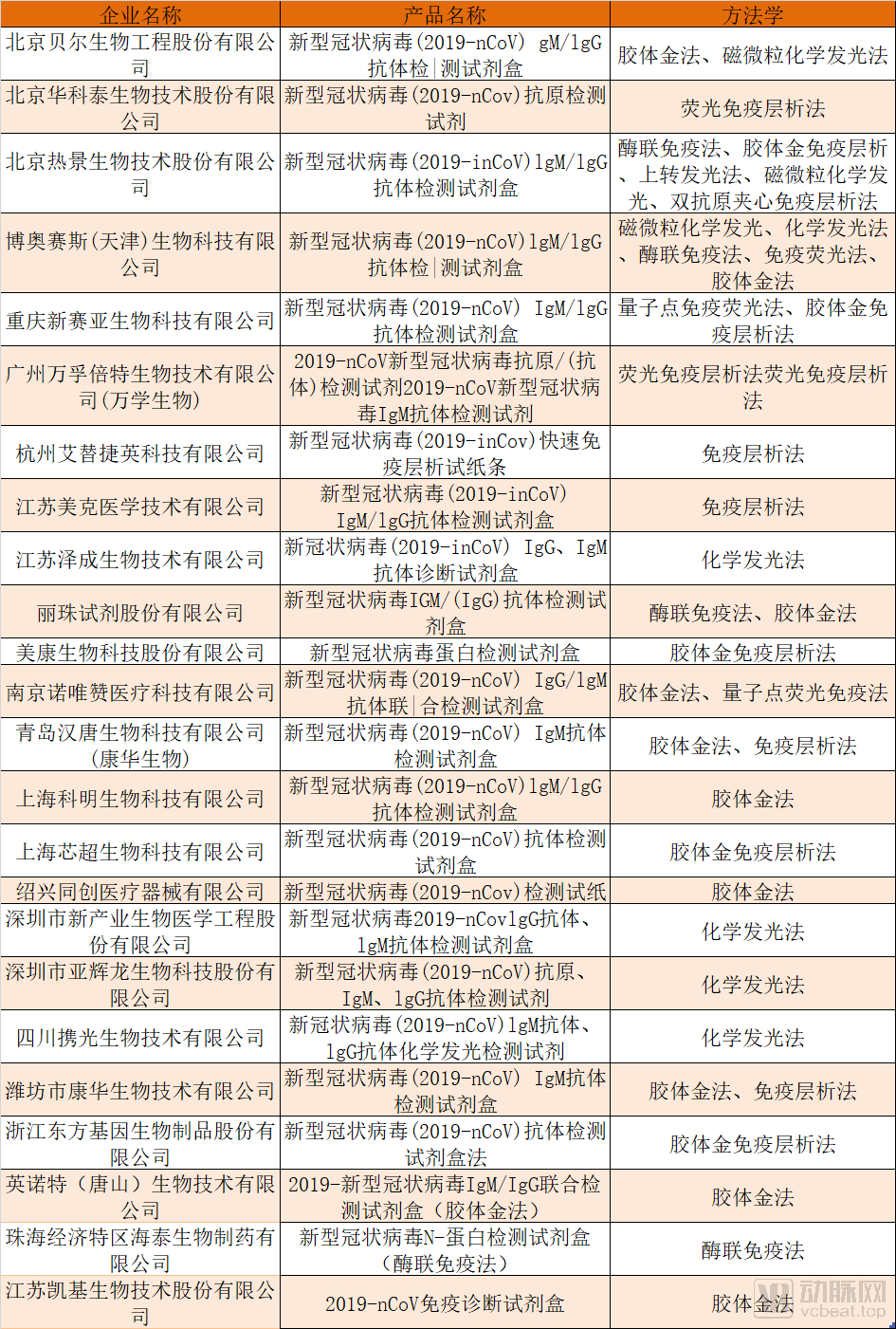
*Companies not included in this table may also contact VCBeat for further discussion.
For the novel coronavirus, it is generally difficult to rapidly produce antibodies due to the early stage of research.
Dr. Tang Yong, Founder and CEO of Chengdu Weikang Biotechnology Co., Ltd., told VCBeat: “The core challenge in developing rapid immunodiagnostic reagents for the novel coronavirus lies in identifying virus-specific antigens and highly specific epitope-targeting antibodies. Currently, most commercially available immunodiagnostic kits are based on conventional coronavirus antigens, lacking specificity, which can easily lead to misdiagnosis and missed diagnoses.”
In addition, he pointed out that the current stagnation in logistics will also pose challenges to the distribution of immunoassay products to primary healthcare institutions. He stated, “Currently, most immunoassay reagents require cold-chain transportation. Amid the outbreak, logistics and cold-chain services have largely come to a standstill, making it even more difficult for primary hospitals to maintain cold-chain transport, thereby failing to ensure reagent performance. However, many companies are unable to change the form and storage conditions of their reagents in the short term.”
Missed diagnoses occurring in nucleic acid testing can also arise in immunoassays. Currently, colloidal gold-based rapid tests for SARS-CoV-2 IgM or IgG exhibit low sensitivity, leading to false-negative results and an increased risk of missed diagnoses. Furthermore, since most colloidal gold assays target the nucleocapsid (N) protein, which shares high homology with other coronaviruses, their low specificity can result in false-positive outcomes, thereby contributing to diagnostic errors.
Currently, four immunodiagnostic reagents have been approved for market launch based on regulatory approvals.
Yao Tiancheng, Chairman of Tianshen Medical, told VCBeat: “Standard approval typically takes three years, whereas emergency approval requires one to two months. The factors considered during the approval process include whether a company’s product can be rapidly, extensively, and effectively deployed for epidemic prevention and control following emergency approval. Specific criteria must align with the requirements set by the National Medical Products Administration (NMPA).”
On February 12, 2020, the Center for Medical Device Evaluation of the National Medical Products Administration issued the "Technical Review Points for Registration of Nucleic Acid Detection Reagents for the 2019 Novel Coronavirus," but has not yet released relevant information on the review points for antigen/antibody detection reagents.
During the 2003 SARS outbreak, institutions such as the Academy of Military Medical Sciences, the Beijing Genomics Institute of the Chinese Academy of Sciences, and BGI developed ELISA kits capable of detecting either the SARS virus itself or patients’ immune responses to the virus. In the current outbreak, products from multiple companies have entered the approval pipeline. We hope that the market launch of a batch of immunoassay products will assist epidemic prevention and control agencies in rapidly screening for infected and potentially infected individuals, thereby clarifying the epidemiological situation.