Hansoh Pharma
Pharmaceutical Research, Production, and Sales

On January 27, 2026, Hansoh Pharma (03692.HK) announced on the Hong Kong Stock Exchange that it had reached an agreement with underwriters including Morgan Stanley Asia on January 26 to issue zero-coupon convertible bonds with a total principal amount of HKD 4.68 billion. The bond maturity is set for February 3, 2033.
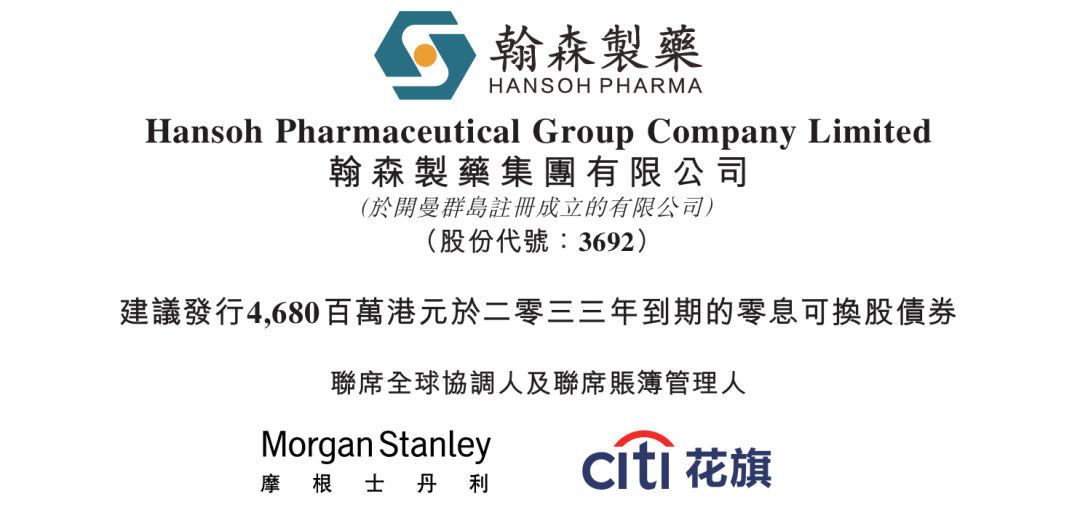
The core terms of this offering show that the initial conversion price is set at HK$57.39 per share, a 42.62% premium over the closing price of HK$40.24 on January 26. If fully converted, it will add 81,547,300 shares, representing 1.33% of the enlarged share capital.
The bonds adopt a zero-coupon design and will only accrue interest if repayment is overdue.1%Interest calculated on an annual rate, holders may2026Year3Month16Exercise conversion rights from the date.
The company has currently applied to the Vienna Stock ExchangeMTFApplication for the listing permission of bonds and exchangeable shares on the market and the Stock Exchange, subject to prerequisites such as due diligence and regulatory approvals.
It is reported that,A zero-coupon convertible bond is a type of bond that does not pay interest but can be converted into company shares under agreed conditions. For pharmaceutical companies, it allows them to raise long-term funds without increasing short-term financial burdens, making it especially suitable for innovative drug companies with high R&D investments and tight cash flows. It supports R&D activities, pipeline acquisitions, or international expansion while delaying equity dilution.
The announcement disclosed that after deducting the issuance expenses, the net proceeds of HKD 4.64 billion will be allocated in three major directions, among whichR&D and introduction account for 65% (approximately HKD 3.016 billion), with a focus on four key areas: anti-tumor, central nervous system, metabolism, and autoimmune diseases., while also covering the introduction and licensing of innovative drugs and R&D platforms in the mature stage.
This proportion has increased by 10 percentage points compared to the R&D investment ratio in the company's previous financing projects. It echoes the strategy of introducing the Phase III renal disease new drug SHR6508 from Hengrui Medicine in December 2025 with an upfront payment of 30 million yuan and milestone payments up to 190 million yuan, and also aligns with the global licensing collaboration for HS-20110 reached with Roche in October 2025, forming a synergistic R&D effort.
The remaining funds,25% (approximately HKD 1.16 billion) for the construction and upgrading of innovative drug research and development centers, production lines, and facilities; 10% (HKD 464 million) to supplement working capital.
From the financial report, Hansoh Pharma's performance in the first half of 2025 was stable: revenue reached 7.434 billion yuan, a year-on-year increase of 14.3%; net profit attributable to shareholders was 3.135 billion yuan, a year-on-year increase of 15.0%; basic earnings per share were 0.53 yuan, a year-on-year increase of 14.8%.
Profit growth was mainly driven by the sales volume increase of innovative drugs and contributions from BD collaboration revenues — in the first half of the year, Hansoh Pharma received a $1.12 billion upfront payment from Merck for the HS-10535 project license fee, and in July, it received an $80 million upfront payment from Regeneron for the HS-20094 project, significantly boosting profits through related collaboration revenues.
R&D Investment Intensifies: R&D expenditure reached 1.441 billion yuan in the first half of the year, increasing by 20.4% year-on-year, with an R&D expense ratio of 19.4%, up 1.6 percentage points from the whole year of 2024.
As of the end of June, the company has advanced more than 70 clinical trials for innovative drugs. Among over 40 candidate drugs, three have entered Phase III: B7-H3-targeted ADC (HS-20093), B7-H4-targeted ADC (HS-20089), and IL-23p19 monoclonal antibody (HS-20137). HS-20093 has received six Breakthrough Therapy designations in China, the U.S., and Europe. Additionally, eight new candidate drugs have been approved for clinical trials for the first time.
Financial data shows that the company's net cash flow from operating activities in the first half of the year was RMB 3.605 billion, with cash and bank deposits reaching RMB 27.104 billion. However, the net cash flow from investing activities was -RMB 1.506 billion, mainly used for pipeline advancement and platform construction. This financing can further replenish R&D "ammunition."
As of 15:00 on January 27, the share price of Hansoh Pharma was HK$38.60, a decrease of HK$1.64 compared to the previous day's closing price, with a decline of 4.08%. The total market value was HK$233.723 billion. On that day, the stock price broke down at the opening and reached a low of HK$38.06, with a maximum decline of 4.42% from the opening price, reflecting market concerns about short-term equity dilution (a 1.33% increase in converted shares) and the return cycle for R&D investment.
Notably, despite the single-day decline, its stock price has still risen 8.31% cumulatively over the past three months, indicating that the medium- and long-term trend remains unchanged.