

Gausium Deploys Autonomous Disinfection Robots on Pandemic Frontlines to Empower Intelligent Upgrades of Hospital Logistics Systems
In late 2019, an epidemic of pneumonia caused by the novel coronavirus broke out in Wuhan. Since the outbreak began, many frontline workers have used their own flesh and blood to build a safety line for us. According to Xinhua News Agency data, under the deployment of the CPC Central Committee, more than 30,000 medical personnel from 29 provinces, autonomous regions, municipalities directly under the central government, the Xinjiang Production and Construction Corps, and the military system have been dispatched to support Hubei (Wuhan).
During this outbreak, hospital robots, as a key technological force in the fight against the epidemic, were extensively deployed to the front lines. Working alongside frontline medical staff, they helped reduce the risk of infection among personnel and alleviate work intensity.
VCBeat (WeChat ID: vcbeat) has learned that during the current epidemic, Gaussian Robotics is providing cleaning robots free of charge to hospitals in need for automated disinfection purposes. These robots have already been deployed at several medical institutions, including the General Hospital of the Central Theater Command of the Chinese People's Liberation Army, Chongqing Public Health Center, The University of Hong Kong-Shenzhen Hospital, Shanghai Public Health Clinical Center, and Xiangya Hospital of Central South University in Hunan.
As a leading enterprise in the commercial autonomous cleaning robot sector, Shanghai Gaussian Robotics, founded in 2013, is one of the earliest robotics companies globally to engage in the research and application exploration of autonomous mobile technology. Since the launch of its commercial cleaning robots in 2014, Gaussian has earned the trust of over 300 clients across more than 15 countries and regions, thanks to the wide applicability of its solutions. In March 2019, Gaussian Robotics completed a RMB 100 million Series B financing round, led by Yuanyi Investment under Far East Horizon Group, with participation from KIP China and BlueRun Ventures.
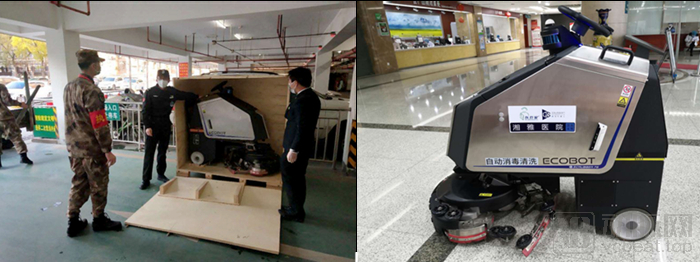
Gaussian Robotics in Hospital Use
Due to the unique characteristics of hospital environments, viruses settle along with respiratory droplets. Gaussian robots employ the most traditional and effective method in hospitals—wiping and disinfecting floors with disinfectant solutions—reducing viral density to one-thousandth of its original level.
Furthermore, leveraging autonomous driving technology, cleaning robots can minimize personnel entry into isolation zones, thereby reducing the risk of infection. Through path planning, they ensure uniform and comprehensive floor washing and disinfection, while automatic cruising for cleaning and disinfection eliminates the need to disperse crowds.
Gaussian Robotics CEO Cheng Haotian uses the metaphors of “offense” and “defense” to describe the role of cleaning and disinfection robots in hospitals. “Offense” refers to disinfection: Gaussian robots employ the most traditional and effective hospital disinfection method—mopping floors with disinfectant. Using a 0.05% sodium hypochlorite solution and allowing five minutes of contact time on floor surfaces can reduce viral load by 99.9%. “Defense” refers to isolation: Gaussian’s fully autonomous robots alleviate labor shortages by performing cleaning and disinfection tasks, thereby reducing the risk of infection among staff. By combining both offensive and defensive strategies, the company delivers a comprehensive and powerful solution.
In addition to hospitals, Gaussian intelligent disinfection robots can provide comprehensive coverage and perform disinfection along designated routes in crowded public spaces such as shopping malls and subway stations. One intelligent cleaning robot can handle the workload of two to three cleaners. Operation requires only a single mapping session to initiate service, while autonomous features such as self-charging and automatic water filling and drainage maximize independence from manual labor.
When news of Wuhan’s lockdown broke, Gaussian Intelligence immediately established a special task force to support the medical frontline in response to the high risks posed by the epidemic and the immense pressure on hospital support systems. The company initiated discussions and advanced plans for donations to affected areas. On Chinese New Year’s Eve, Gaussian’s executive team convened an emergency meeting. The executives determined that providing aid to the epidemic-stricken regions would also face challenges such as urban functional shutdowns and disruptions in the supply of spare parts.
Despite numerous challenges, Gaussian Intelligence decided during the meeting to mobilize all available resources to support hospital systems. The CEO took direct charge of the special epidemic assistance program, the Industry Vice President was reassigned to oversee the healthcare division, and the head of the healthcare division was deployed directly to the frontline. The senior management team of Gaussian Intelligence held an emergency meeting to discuss the pace of product line allocation, as well as the cost, timeline, and response speed of specialized R&D. It was unanimously agreed that supplies would be provided based on demand.
After committing to rapid deployment to the front lines, the Gaussian Intelligence team also recognized that beyond the pandemic, the long-term battle lies in upgrading routine cleaning and disinfection systems for public spaces. Consequently, Gaussian established a special R&D task force for disinfection modules (designed with detachable and installable components to meet users’ varying needs under both daily and emergency conditions). The company is simultaneously strengthening cleaning and disinfection standards and enhancing property management’s data-driven logistics capabilities through the upload of robotic data to an integrated management platform.
Cheng Haotian stated, “The current epidemic has struck with great force, and the Spring Festival period represents a high-risk phase characterized by significant population mobility, placing double the pressure on hospital support systems. The outbreak has revealed genuine application scenarios for artificial intelligence (AI) and tested the technological capabilities of AI enterprises. For Gaussian Robotics, this is both a responsibility and a mission, as well as an opportunity and a challenge. We will certainly respond to the ‘Initiative to Fully Leverage the Empowering Role of Artificial Intelligence and Join Forces in Combating the Novel Coronavirus Pneumonia Epidemic’ issued by the Ministry of Industry and Information Technology, taking proactive and full-scale action.”
2019 was a pivotal year for Gaussian Robotics in expanding its application scenarios, with hospitals being a key focus. Over the past year, Gaussian Robotics successfully implemented its initial hospital deployment plan and gained recognition from healthcare institutions. The sudden outbreak of the pandemic further accelerated market education.
Previously, Gaussian intelligent robots have been deployed in more than 20 hospitals, including the General Hospital of the Central Theater Command of the PLA (Wuhan), Xiangya Hospital (Changsha), Chongqing Public Health Clinical Center, The University of Hong Kong-Shenzhen Hospital, Shanghai Public Health Clinical Center, Tongji Medical College of Huazhong University of Science and Technology, The First Affiliated Hospital of Zhejiang University School of Medicine, The Second Affiliated Hospital of Zhejiang University School of Medicine, Huashan Hospital Affiliated to Fudan University, Jiangsu Province People’s Hospital, Shanghai Children’s Hospital, Guangyuan Fourth People’s Hospital in Sichuan, The Second Hospital of Tianjin Medical University, Wenling First People’s Hospital, Wenzhou People’s Hospital, Yuhang First People’s Hospital, and Peking Union Medical College Hospital.
The pandemic has also allowed Gaussian Robotics to sense shifts in demand. Cheng Haotian stated, “Hospitals are now taking a more proactive approach, reaching out to us for information and procurement. Additionally, some local governments have begun mandating that hospitals adopt automated equipment for their operations.”
In Gaussian Robotics’ strategic planning, the role of intelligent cleaning and disinfection robots extends beyond merely alleviating labor shortages; they serve as a critical infrastructure component in the development of smart hospitals.
The development of smart hospital logistics aims to enhance the overall operational efficiency of hospitals. This process inevitably relies on the empowerment of cutting-edge technologies such as the Internet, the Internet of Things (IoT), cloud computing, and AI robotics. It encompasses not only data-driven operational management achieved through software systems like information platforms but also the indispensable role of intelligent hardware devices, such as robots, in performing repetitive, basic, and labor-intensive tasks on-site.
Gaussian Robotics began developing commercial cleaning robots in 2013. As China’s aging population trend intensifies and property management remains highly labor-intensive, this has created business opportunities for commercial robots. Gaussian Robotics adheres to a deployment strategy driven by the scenario-based needs of industry users, integrating autonomous driving technology with upper-layer business applications to achieve mutual advancement. Through this process, the company has realized closed-loop iteration of its entire technological system.
In the future, Gaussian will continue to strengthen industry exchanges with hospitals, gain a deeper understanding of user needs, and work together to explore more possibilities for multi-functional use of robots in hospital scenarios, helping hospitals achieve intelligent upgrades in their logistics support systems.