

Amid the Pandemic, We Rediscover the Original Mission of Medical AI: Addressing China's Scarcity of High-Quality Healthcare Resources

SHUKUN
Provider of Intelligent Products and Innovative Solutions
At the end of the Ji Hai year and the beginning of the Geng Zi year, a major epidemic struck Jingchu; people confined themselves to their homes, and the entire nation mobilized for prevention and control.
Since the outbreak of the pandemic, Weibo’s daily trending searches have been dominated by pandemic-related information. Among them, one trending topic on “adult diapers” has moved countless people to tears. Frontline healthcare workers, in an effort to save time, basically refrain from drinking water while on duty. This is partly due to the scarcity of personal protective equipment (PPE) and partly because using the restroom while wearing PPE consumes a significant amount of time. As a result, most medical staff wear adult diapers during their shifts. Some female staff members have also cut their long hair short to facilitate their work.
Healthcare workers have exhausted every possible means to save time and devote themselves to their duties. However, high-quality medical resources in China are inherently scarce under normal circumstances. When a widespread epidemic erupts and patient numbers surge, these already limited resources become insufficient to cope with the demand. In response, we witnessed healthcare professionals from across China rushing to Wuhan to provide support. Nevertheless, human beings are prone to fatigue and exhaustion; maintaining sustained enthusiasm and physical stamina is exceedingly difficult during prolonged periods of saturated workloads.
As an observer who has long followed the medical AI industry, I cannot help but recall 2016, when medical AI saw a large-scale surge in China. At that time, many founders recounted the original intention behind the emergence of medical AI: to liberate doctors from repetitive tasks and address the scarcity of high-quality medical resources in China, which constitutes its greatest clinical significance.
Upholding this original aspiration, SHUKUN, a leading enterprise in the medical AI sector, has completed product development and debugging at the fastest pace since the outbreak of the pandemic. In this fight, it has stepped forward responsibly, striving to serve as a strong backbone for healthcare workers.
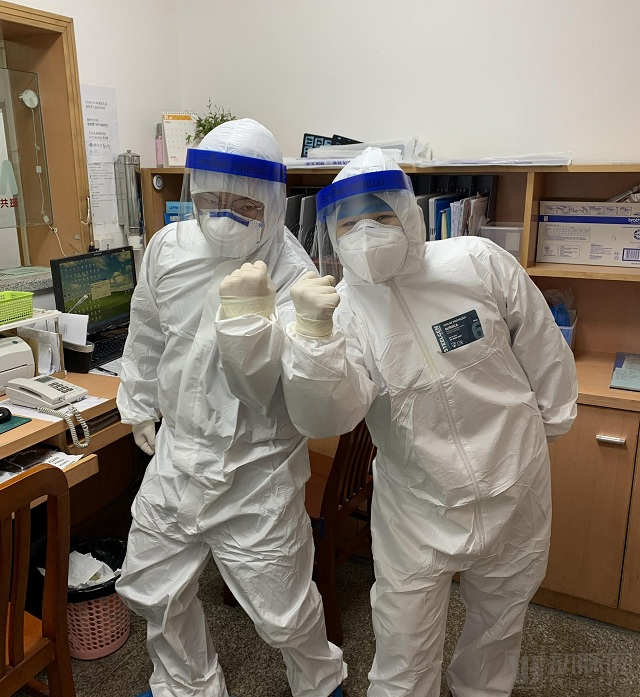
Radiologist at Wuhan Central Hospital
Wuhan Central Hospital, located just one stop away from the Huanan Seafood Wholesale Market, sits at the epicenter of the outbreak. As one of the 27 Grade A tertiary hospitals in Wuhan, it employs a staff of 4,300. During the treatment of COVID-19 patients, more than 230 medical personnel met the clinical diagnostic criteria for confirmed COVID-19 infection; among them, over 130 were hospitalized, and more than 100 underwent home isolation. Many department heads and hospital leaders were not spared. Li Wenliang, the “whistleblower” of the outbreak, ultimately died despite medical treatment, prompting citizens across China to hold an online “state funeral” in his memory.
On December 18, 2019, a 65-year-old male self-employed individual presented to the emergency department of the Nanjing Road Campus of Wuhan Central Hospital. This case was later confirmed as the first diagnosed case of COVID-19.
On December 27, Wuhan Central Hospital admitted its second case of this kind—a patient in his forties from a remote suburban area of Wuhan—who was confirmed to have COVID-19 on December 30. Subsequently, Wuhan Central Hospital successively treated thousands of confirmed COVID-19 patients. On January 27, the hospital was designated as a specialized facility for the treatment of febrile patients. Consequently, shortages of masks, protective suits, and medical staff emerged.
Fortunately, supplies such as face masks, protective suits, and goggles could be rapidly mobilized from across China and even worldwide to deliver to hospitals. However, imaging examinations, a critical diagnostic tool for COVID-19, cannot be quickly scaled up. The daily peak workload for CT scans in hospitals averaged over 1,000 cases. To cope with the surging demand in radiology departments, most frontline radiologists worked overtime, often reading images throughout the night. Nevertheless, relying solely on visual interpretation makes it difficult for physicians to perform rapid and accurate quantitative analysis, while traditional manual measurement and assessment are highly time-consuming.
In the latest Diagnostic and Treatment Protocol for Novel Coronavirus-Infected Pneumonia (Trial Version 5) issued by the National Health Commission, suspected cases within Hubei Province exhibiting characteristic imaging findings are defined as “clinically diagnosed cases,” affirming the critical role of medical imaging in the diagnosis of COVID-19. Behind these figures lie the immense efforts and hardships endured by countless radiologists in Hubei.
As a partner of Wuhan Central Hospital, SHUKUN immediately mobilized its R&D team and began work during the Spring Festival holiday upon learning of the severity of the epidemic.
Leveraging its long-standing collaboration with Wuhan Central Hospital, the product rapidly entered the refinement and debugging phase upon completion. SHUKUN’s AI-assisted diagnostic product for COVID-19 was deployed at Wuhan Central Hospital in early February. Ma Chun’e, CEO of SHUKUN Technology, stated,SHUKUN’s AI-assisted diagnostic product for COVID-19 can rapidly read chest X-rays, identify inflammatory lesions and perform segmentation and localization within 2–3 seconds, accurately delineate infected areas, and provide quantitative assessment of lesion regions. This facilitates rapid disease assessment and triage for large patient volumes, thereby assisting clinical diagnosis.。
Additionally,The system also provides follow-up functionality, enabling accurate comparison of lesion changes and automatically offering visual assessment references for physicians., helping physicians more accurately assess changes in patients’ conditions. Wang Xiang, Director of the Department of Radiology at Wuhan Central Hospital, stated that the SHUKUN AI system can improve physicians’ efficiency by 50% and provides significant assistance to frontline doctors during the epidemic.
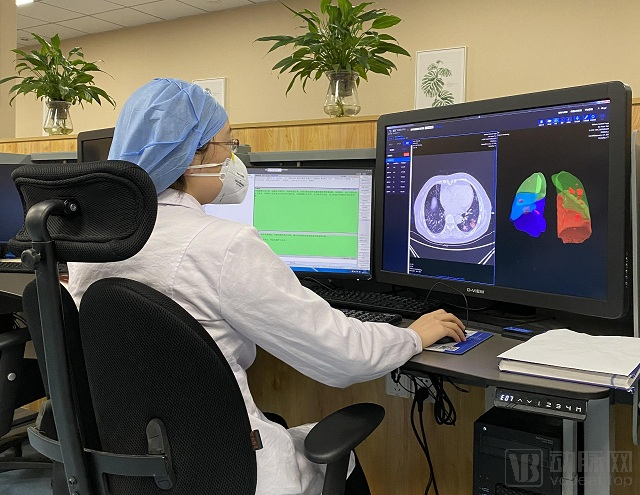
Wuhan Central Hospital Doctors Use SHUKUN’s AI for COVID-19
In addition to Wuhan Central Hospital, the AI system was deployed and put into daily use at Renmin Hospital of Wuhan University, Zhongnan Hospital of Wuhan University, and Wuhan Hospital of Traditional Chinese Medicine in early February. SHUKUN also donated the AI system to Leishenshan Hospital as a public welfare contribution, shortening the time required for patient case screening and enabling confirmed patients to receive treatment as early as possible.
After the product was deployed in a region of Wuhan, SHUKUN prudently sought out China’s leading infectious disease hospitals for further validation.
In late January, to address the progression of COVID-19 and improve patient care, Beijing designated 20 hospitals, including Beijing Ditan Hospital, Beijing Youan Hospital, and the PLA Fifth Medical Center, as municipal-level designated hospitals.
Beijing Ditan Hospital serves as the designated hospital for treating novel coronavirus (COVID-19) patients in Beijing. Seventeen years ago, when SARS swept across China, Ditan Hospital became the main battleground for Beijing’s fight against the epidemic. Seventeen years later, the battle has been reignited. Since January 12 this year, the hospital has undertaken the treatment, screening, and isolation of COVID-19 patients, admitting Beijing’s first confirmed case. Currently, five wards are dedicated to responding to the COVID-19 outbreak, with the largest ward capable of accommodating 44 patients. As of February 11, Ditan Hospital had treated approximately 80 COVID-19 patients, including the youngest patient, who was only nine months old. This infant has since recovered and been discharged, and is currently under isolated observation.
As the final “lifeline” for patients across China, hospitals in Beijing already operate at full capacity. It is easy to imagine the immense pressure faced by the radiology departments of Beijing Ditan Hospital and Beijing You’an Hospital, which served as leading designated hospitals during the outbreak. The SHUKUN AI product for COVID-19 gained recognition from physicians after being deployed at Wuhan Central Hospital.
Youan Hospital and Ditan Hospital tested the product, which passed the tests immediately. Currently, SHUKUN’s AI product for COVID-19 is being used at Youan Hospital, Ditan Hospital, and Beijing Friendship Hospital, and has gained recognition from frontline radiologists. In the future, it will also be deployed at the soon-to-reopen Beijing Xiaotangshan Hospital.
On February 23, a meeting on the coordinated advancement of COVID-19 prevention and control and economic and social development was held in Beijing. The central government mandated that all-out efforts be made to strengthen epidemic prevention and control in Beijing, resolutely focus on the two key aspects of preventing imported cases and curbing domestic transmission, enhance joint prevention and control mechanisms in the Beijing-Tianjin-Hebei region, and cut off sources of infection to the greatest extent possible. The deployment of SHUKUN’s AI solutions for COVID-19 in Beijing will contribute to the city’s epidemic prevention and control efforts.
After gaining recognition from frontline and leading hospitals, more hospitals across China have actively adopted SHUKUN AI for precise prevention and control. At this time, although many people believe that the epidemic has reached a turning point, as of February 20, the number of confirmed cases reported nationwide had reached 75,465, with 889 new cases added on that day. The pressure for epidemic prevention and control remains significant. Even after some time, as patients gradually recover, it is still necessary to use test kits and imaging examinations to determine whether patients have fully recovered.
Consequently, SHUKUN’s marketing team swiftly reached out to hospitals in regions heavily impacted by the epidemic, including Henan, Zhejiang, and Chongqing. Within a few days, the product was deployed and put into clinical use at several institutions, such as the First Affiliated Hospital of Zhengzhou University, Jinhua People’s Hospital, the First and Third Affiliated Hospitals of Chongqing Medical University, and Beijing Pinggu District Hospital. In the future, more hospitals will install SHUKUN’s AI-assisted diagnostic system for COVID-19.
Experts believe that as COVID-19 becomes a long-term chronic disease, SHUKUN’s AI-assisted diagnostic products for COVID-19 will continue to support frontline healthcare workers.
Since the outbreak, we have witnessed healthcare workers collapsing from exhaustion and falling ill, and seen the deep marks left by masks on the faces of doctors and nurses on the front lines. Once they enter isolation wards, they cannot leave at will. Although it is winter, after hours of overloaded work, everyone emerges from the isolation area drenched in sweat. Their goggles are filled with condensation, making them look as if they had just been washed. We have seen radiologic technologists wearing masks, goggles, and airtight protective gowns entering examination rooms to help position patients, coming into close contact with them, and working nearly 24 hours a day without interruption. The work is both arduous and stressful; within less than half an hour, their entire bodies are soaked with sweat.
VCBeat, in its industry research, developed a model of the "Impossible Triangle" in healthcare, namelyImprove the quality of medical services, increase access to care, and reduce healthcare costs and their growth rateThe three healthcare demands cannot be simultaneously met within a stable system. The emergence of new technological paradigms reshapes operational models, industrial structures, and institutional arrangements, while the advent of new technologies triggers extensive adjustments in prices and production networks within the economic system. Artificial intelligence is the emerging technology poised to transform this status quo.
Let us return to the original intent behind the emergence of medical AI: to liberate physicians from repetitive tasks and address the scarcity of high-quality medical resources in China, which constitutes its greatest clinical significance.。
As noted by Director Wang Xiang of Wuhan Central Hospital, the number of patients has surged sharply since the outbreak of the pandemic, demanding that radiologists process massive volumes of lung CT images more quickly and accurately. However, it is difficult for ordinary physicians to perform rapid and accurate quantitative analysis relying solely on visual interpretation, and traditional manual measurement and assessment are highly time-consuming. SHUKUN’s AI-assisted diagnostic product for COVID-19 can complete precise quantitative analysis within seconds, aiding clinicians in making faster and more accurate judgments regarding disease status and treatment efficacy. By leveraging the “AI + CT” model, the system enables rapid assessment and triage of large patient populations, supporting clinical diagnosis, classification, and targeted therapy. Furthermore, the system allows physicians to accurately compare changes in lesions and automatically provides visualized assessment references, meeting the needs of designated hospitals for rapid and precise diagnosis while effectively saving time for overburdened medical staff, thereby securing more valuable treatment time for patients.
In the nationwide battle against the epidemic, as of February 19, a total of 278 medical teams and 32,395 healthcare workers from across China had been dispatched to Hubei Province to alleviate the pressure of its epidemic response. The “one province supporting one city” policy has further demonstrated the inspiring spirit of “nationwide solidarity in times of crisis.”
In the medical field, in addition to the round-the-clock efforts of frontline healthcare workers, various types of medical enterprises have spared no effort to contribute to the fight against the epidemic. Compared with the SARS outbreak in 2003, the past month’s battle against the epidemic has demonstrated the significant contributions of technology. Epidemic maps have enabled real-time tracking of confirmed cases across China; within one month, 131 in vitro diagnostics (IVD) companies developed test kits for the novel coronavirus; the deployment of AI-powered temperature-screening robots has facilitated early detection and isolation of patients with abnormal temperatures; delivery robots based on artificial intelligence technology have assisted medical staff in delivering medications and food to patients, thereby reducing contact frequency; furthermore, AI-assisted diagnostic technologies and products have been directly integrated into the workflows of frontline physicians, shortening the time radiologists spend interpreting images and alleviating their workload. Throughout this epidemic response, technology, particularly artificial intelligence, has played an increasingly vital role.
Healthcare is a key application sector for artificial intelligence. According to a survey conducted by China Youth Daily among 2,010 respondents, 68.5% believed that the value of AI in healthcare lies in improving diagnostic efficiency and bridging the gap between supply and demand of medical resources; 54.7% held that AI can assist physicians in diagnosis, thereby reducing missed and misdiagnoses; 53.9% considered that AI can provide disease risk warnings and health advisory services; 38.7% recognized that AI can support drug research and development, enhancing pharmaceutical efficiency; and 29.5% were aware that surgical robots can improve the precision of surgical procedures.
Recently, at the 12th meeting of the Central Committee for Comprehensively Deepening Reforms, it was proposed to encourage the use of digital technologies such as big data, artificial intelligence, and cloud computing to better support efforts in epidemic monitoring and analysis, virus source tracing, prevention and control treatment, and resource allocation.
In the post-pandemic era, governments, investors, hospitals, and enterprises alike will respond to the call from central authorities and frontline hospitals to promote the adoption of new technologies, particularly artificial intelligence (AI), in healthcare. We firmly believe that the value of AI in healthcare is becoming increasingly evident, and its development is poised for a new round of growth.
In conclusion, the 2003 SARS outbreak lasted for six months, with a cumulative total of 8,422 confirmed cases across 32 countries and regions worldwide. Mainland China reported 5,327 cases and 349 deaths; Hong Kong, China recorded 1,755 cases and 300 deaths; and Taiwan, China documented 665 cases and 180 deaths.
This year, the number of COVID-19 infections has surpassed that of SARS. Thanks to the arduous efforts of frontline medical personnel and the support of new technologies, we are confident that this battle will conclude more swiftly. We wish good health to all workers and healthcare professionals fighting on the front lines.