

Esperion Therapeutics Submits Prospectus Following FDA Approval of Novel Cholesterol-Lowering Drug NEXLETOL

Esperion Therapeutics
Developer of Cardiovascular and Metabolic Disease Therapeutics
On February 21, 2020, Esperion announced that the U.S. Food and Drug Administration (FDA) had approved NEXLETOL (bempedoic acid, ETC-1002), a novel oral, once-daily, non-statin medication for lowering low-density lipoprotein cholesterol (LDL-C). The drug is indicated for adult patients with heterozygous familial hypercholesterolemia (HeFH) and for adult patients with atherosclerotic cardiovascular disease who require further reduction of LDL-C levels. (Note: ETC-1002, bempedoic acid, and NEXLETOL refer to the same product at different stages of development.)
Tim Mayleben, President and Chief Executive Officer of Esperion, stated, “NEXLETOL fulfills our commitment to millions of patients with ASCVD or HeFH due to poorly controlled cholesterol, offering them NEXLETOL as a treatment option.”
An Esperion researcher added, “Obtaining approval for new drugs is no easy feat. We are deeply grateful to the patients and physicians who have long placed their trust in Esperion’s lipid expert team.”
“NEXLETOL is the first oral, once-daily, non-statin cholesterol-lowering medication approved in the United States in nearly 20 years, featuring a novel mechanism of action for reducing LDL-C,” stated some experts.
Esperion was previously acquired by Pfizer and has listed on the Nasdaq twice. The company’s remarkable journey is widely acclaimed, and its upcoming drug launch may well usher in a new era of success. How did Esperion grow and achieve its Nasdaq listings? To provide insights and lessons for our readers, VCBeat has compiled an overview of Esperion’s development history.
The Rise and Fall of the Relationship Between Esperion and Pfizer
From 1981 to 1998, Roger Newton, the founder of Esperion, conducted research on statins at the pharmaceutical company Warner-Lambert. Notably, Roger Newton, together with other researchers, developed the blockbuster drug Lipitor, which became one of the best-selling drugs in pharmaceutical history. In 2000, Warner-Lambert, the developer of Lipitor, was acquired by Pfizer for $93 billion, marking the largest merger and acquisition deal in the pharmaceutical industry at that time. This also marked the first close interaction between the founders of Esperion and Pfizer.
In 1998, Roger Newton left Warner-Lambert and founded Esperion in Ann Arbor, Michigan, dedicated to the research and development of therapies targeting high-density lipoprotein cholesterol (HDL-C). Under Roger Newton’s leadership and through the efforts of his team, Esperion completed $200 million in equity financing.
Subsequently, Esperion began researching cholesterol-lowering drugs, with three of its investigational candidates entering early-stage clinical trials and achieving promising results.
In 2000, Esperion made its debut on the NASDAQ (stock ticker: ESPR). Buoyed by a steady stream of positive developments, including favorable clinical trial data, ESPR garnered strong investor interest.
After Esperion announced that ETC-216 had been proven effective in treating thrombosis in coronary arteries and had passed mid-stage clinical trials, Pfizer began to consider acquiring Esperion. Research results indicated that ETC-216 prevents and treats heart disease by dissolving the fat blocking the arteries. However, Esperion has no products on the market, with all its drugs still in the research and development phase. Roger Newton once proudly declared, “We are at the forefront of science.”
Researchers explained, “Cholesterol rupture can trigger heart attacks; timely removal of cholesterol can reduce the incidence of heart disease. Currently, most cholesterol-lowering therapies focus on reducing so-called ‘bad cholesterol,’ whereas ETC-216 mimics ‘good cholesterol’ (high-density lipoprotein) and works by clearing cholesterol from arterial walls.”
At that time, there were only three cholesterol-lowering drugs on the market, two of which belonged to Pfizer. To prevent ETC-216, developed by Esperion, from falling into the hands of competitors, Pfizer acquired Esperion in a defensive move for $1.3 billion in December 2003. Esperion operated independently as a wholly owned subsidiary of Pfizer.
As for Esperion’s founder, Roger Newton, he was appointed as Senior Vice President of Global Research and Development at Pfizer. The original team from Esperion was also retained.
At the time, Pfizer’s acquisition of Esperion appeared to be strategically well-timed. Esperion’s drug portfolio held significant growth potential, and the company had no history of collaborations with other firms. Pfizer’s robust R&D capabilities could accelerate the market entry of Esperion’s new drugs.
However, the subsequent developments did not unfold as Pfizer had hoped. Due to Esperion’s long-standing failure to provide sufficient samples for Pfizer’s clinical trials, Pfizer found itself in a prolonged situation where it either lacked new drugs or was unable to generate profits from newly launched products. More critically, three of Pfizer’s new drugs were approaching the end of their patent protection periods, imposing significant pressure on the company.
Thus, in 2007, Pfizer decided to terminate the research on ETC-216 and announced the closure of Esperion, only to sell Esperion to Roger Newton a year later. As an independent company, Esperion was once again under the leadership of Roger Newton.
In 2008, Esperion, having spun off from Pfizer, acquired ETC-1002—a compound identified in Pfizer’s prior research—and planned to continue its development. The ties between Pfizer and Esperion remained intricate, and the legendary story of Esperion was set to continue.
ETC-1002 Gains Widespread Recognition as Esperion Returns to Nasdaq
Following its spin-off, Esperion was positioned as a biopharmaceutical company focused on developing and commercializing high-density lipoprotein cholesterol (HDL-C) therapies and other treatments for patients with cardiovascular disease.
Roger Newton stated, “Statins are the gold standard for lowering LDL-C in approximately 30 million patients in the United States. However, according to a recent academic survey, more than 2 million American adults have discontinued statin therapy due to muscle pain or weakness. Therefore, we aim to develop medications that can avoid side effects such as myalgia and muscle weakness.”
ETC-1002 is Esperion’s lead candidate, a novel therapeutic agent designed to target and lower LDL-C levels while avoiding side effects. To continue the development of ETC-1002, Esperion raised $57 million.
Esperion believes that in clinical practice, up to 20% of patients taking statins experience symptoms of muscle pain or weakness. Therefore, if a novel non-statin therapy becomes available, the market for statin-intolerant patients is expected to expand.
Roger Newton stated, “We have treated 275 subjects in six complete clinical trials. The mechanism of action of ETC-1002 involves inhibiting ATP-citrate lyase and activating 5'-adenosine monophosphate-activated protein kinase (5'-AMPK), thereby reducing cholesterol synthesis in the liver. Meanwhile, ETC-1002 also promotes hepatic uptake of LDL particles from the bloodstream, thus lowering blood LDL-C levels.”
Roger Newton announced, “ETC-1002 demonstrates favorable efficacy in cholesterol management. Esperion holds the exclusive global patent for ETC-1002 and retains sole rights to its commercialization.”
On June 7, 2013, Esperion reported the primary results from the Phase 2a clinical trial of ETC-1002. The trial demonstrated that in patients intolerant to two or more statins, ETC-1002, as an LDL-C-lowering agent, reduced LDL-C levels by an average of 32%. Furthermore, ETC-1002 was well tolerated, with no patients discontinuing the trial due to muscle pain or weakness.
Perhaps strong data intrigued investors, as Esperion made its second Nasdaq debut a month later, raising $76 million, exceeding its initial target of $70 million. Roger Newton stated, “We are grateful for the trust placed in us by investors. We plan to use the proceeds from this offering to fund Phase 2b clinical development of ETC-1002 and to strengthen our intellectual property portfolio.”
According to the prospectus released by Esperion, its pipeline includes three products: ETC-1002, an oral small-molecule drug for the treatment of hypercholesterolemia in patients to lower LDL-C levels while avoiding various side effects associated with LDL-C-lowering therapies, currently in Phase IIb clinical trials; 4WF, for the treatment of acute coronary syndrome, having completed Phase IIa clinical trials; and ESP41091, for lipid metabolism and weight reduction, currently in the preclinical stage.
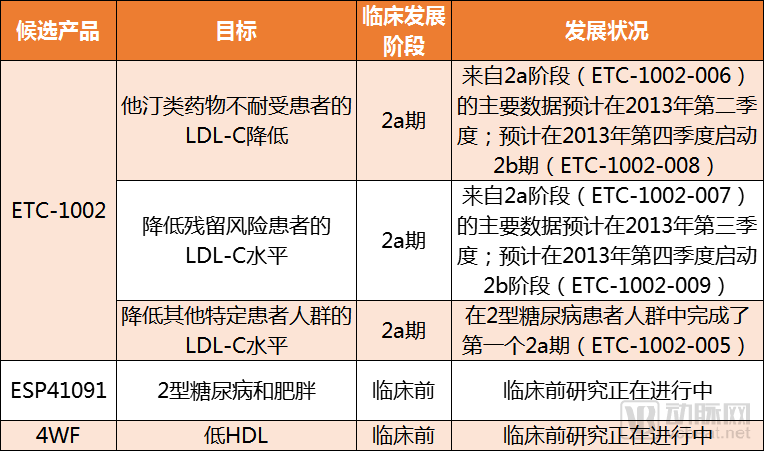
(Esperion's products under development in 2013)
In 2015, Esperion announced the results of the Phase II clinical trial of ETC-1002: patients in the ETC-1002 group experienced a 21% reduction in LDL levels from baseline, whereas those in the placebo group saw a 3% increase. These findings were highly satisfactory to the researchers. Subsequently, Esperion engaged in discussions with FDA officials, and the FDA agreed that the drug could be approved for use in a limited patient population without prior completion of long-term cardiovascular outcomes trials (CVOTs), with the indication to be expanded upon completion of the CVOT. This meant that the approval timeline for ETC-1002 would be significantly shortened.
Buoyed by this positive news, Esperion’s stock price rose from $75.55 to $118.95. Meanwhile, Esperion announced that it would issue approximately $150 million worth of shares. Amid strong investor enthusiasm, the company quickly completed a secondary public offering at $100 per share, raising approximately $190 million. Roger Newton stated, “These funds will help us conduct the Phase III clinical trial of ETC-1002.”
On February 21, 2020, the new drug was finally approved.
On March 18, 2019, Esperion announced that the results of the Phase 3 clinical trial evaluating the long-term safety of its investigational new drug, bempedoic acid (ETC-1002), were published in The New England Journal of Medicine. Concurrently, leveraging the data from this trial, the company submitted New Drug Applications to the U.S. FDA for both bempedoic acid monotherapy and the bempedoic acid–ezetimibe combination therapy.
Roger Newton stated, “Our excitement and confidence continue to grow as ETC-102 approaches approval criteria. Meanwhile, the commercialization of ETC-1002 offers lower costs and greater benefits.”
Three months later, Esperion and investment firm Oberland Capital Management LLC announced a $200 million financing agreement tied to net revenues from bempedoic acid and bempedoic acid/ezetimibe.
Under the agreement, Oberland Capital will make an upfront payment of $125 million, followed by a $25 million payment upon FDA approval of Esperion’s bempedoic acid product portfolio, and an additional $50 million payment once Esperion commences manufacturing and commercial sales of the bempedoic acid products. Upon full repayment, Esperion will regain 100% of the revenue rights to the product portfolio.
Previously, Esperion entered into an agreement with Daiichi Sankyo Europe, a subsidiary of the Japanese pharmaceutical company Daiichi Sankyo. Under the deal, Daiichi Sankyo paid $900 million to secure exclusive marketing rights for bempedoic acid and the combination of bempedoic acid/ezetimibe in Europe. Additionally, Daiichi Sankyo Europe will be responsible for the commercialization of bempedoic acid and bempedoic acid/ezetimibe in these regions.
On February 21, 2020, exciting news emerged as the FDA approved Esperion’s new cholesterol-lowering drug, NEXLETOL (bempedoic acid). Studies have shown that NEXLETOL monotherapy reduces LDL-C by approximately 25%, while its combination with statins reduces LDL-C by approximately 18%.
Following the drug’s approval, Esperion did not immediately disclose its pricing but had previously indicated plans to set the price at approximately $300 per month. Esperion stated that NEXLETOL would be launched in the United States on March 30, 2020, and sold by prescription.
Esperion’s second LDL-C-lowering drug, the bempedoic acid/ezetimibe combination tablet, is currently under review by the U.S. FDA.