

Kedge Data Leverages Knowledge Graph Technology to Deepen Presence in Pharma and Healthcare Sector with Partnerships Including Sanofi and Boehringer Ingelheim
When we enter “Confucius” into Google Search, detailed information about Confucius appears on the right-hand side of the results page, including his biography, place of birth, dates of birth and death, and even related historical figures such as Laozi, Mencius, and Zhuangzi. In addition to providing links to web pages, users are presented with more intelligent, query-specific answers.
In the past, when users entered a query term, search engines would only return webpages they deemed most relevant to that keyword. This technological advancement was made possible by the “Knowledge Graph,” officially introduced by search engine giant Google in May 2012.
Knowledge graphs were initially a technology designed to optimize search engines, but with the continuous advancement of technology, their scope has expanded and broadened. They have now become knowledge containers and incubators within artificial intelligence technologies. In an increasing number of vertical domains, knowledge graphs are also widely applied, effectively serving as fundamental data services.
Nanjing KGDATA Technology Co., Ltd. (hereinafter referred to as “KGDATA”) is dedicated to building a big data association mining platform based on knowledge graph technology. It helps pharmaceutical enterprises break down internal data silos, integrate massive amounts of public unstructured data, and establish an associative knowledge base, thereby maximizing the value of data.
In fact, the founding team of KGDATA had already begun exploring the practical implementation of knowledge graphs before 2015. Wu Gang, Founder and CEO of KGDATA, holds a master’s degree from the Institute of Software, Chinese Academy of Sciences. He previously served as Chief Consultant for China at Thomson Reuters, the world’s largest provider of pharmaceutical, financial, and legal information services, and brings over 20 years of experience in technology, product development, and sales within the field of intelligent information systems.
Professor Qi Guilin, Founder and Chief Scientist, is a leading knowledge graph expert in China and a professor at Southeast University. As the founder of the Open Knowledge Graph Alliance, he began his research on semantic networks while studying abroad more than a decade ago. Since returning to China, he has been dedicated to knowledge graph technology research and major national projects, such as the Gaokao Robot project, exerting significant international influence in the field of knowledge graphs.
Based on years of industry observation, they discovered that substantial data resources across various sectors urgently needed integration, and the knowledge graph market remained a blue ocean. The two founders quickly reached an agreement and established Nanjing KGDATA Technology Co., Ltd. in 2015.
Currently, KGDATA has established a highly experienced core team spanning technical R&D, product development, consulting, and professional knowledge operations and implementation. It is also supported by a research team of dozens from Southeast University. The company holds nearly 30 core independent intellectual property rights, either granted or under application, and is an innovative high-tech enterprise honored with both the Jiangsu Province “Chuangju Engineering” and “Entrepreneurship Nanjing” titles.
Notably, leveraging over a decade of technological accumulation and extensive industry implementation experience, KGDATA has achieved full-stack coverage of knowledge graph technologies, encompassing data acquisition, data cleaning, knowledge extraction, knowledge representation, knowledge reasoning, dynamic ontology modeling, graph storage, visual association analysis, intelligent question answering, and semantic retrieval.
Professional teams and blue-ocean markets are investor favorites, and KGDATA quickly gained capital favor. In early 2019, it completed a Pre-A financing round of nearly RMB 10 million.
Wu Gang noted that knowledge graphs have a wide range of applications, with use cases in finance and public security already reaching maturity. “Although pharmaceutical companies have relatively high technical requirements, there were few players in the field at the time, so we saw it as an opportunity.”
Wu Gang still vividly remembers his first experience interacting with a pharmaceutical company. In his view, this had a significant impact on the subsequent development trajectory of KGDATA.
Impacted by policies such as China’s volume-based procurement and the registration system for pharmaceutical sales representatives, multinational pharmaceutical companies have faced challenges with their traditional sales models. There is an urgent need for digital transformation through technology to enhance efficiency and expand market reach. In this context, a well-known pharmaceutical company proactively approached KGDATA, a promising player in the industry.
Following a competitive POC bidding process and subsequent award, KGDATA secured its first benchmark client in the industry. After a year of product refinement and rapid iteration, KGDATA’s Intelligent Medical Information Q&A System now serves three key user groups: pharmaceutical sales representatives, healthcare professionals (HCPs), and patients. Its partners include renowned multinational pharmaceutical companies such as Sanofi and Boehringer Ingelheim, as well as internationally recognized CRO firms. Meanwhile, its knowledge graph solutions have been deployed by medical research institutions like the China Academy of Chinese Medical Sciences and Capital Medical University, as well as by knowledge-intensive enterprises in sectors including libraries and central state-owned energy companies.
According to the introduction, clients provide data such as drug package inserts, collections of inquiries from physicians, representatives, and patients accumulated by the medical, marketing, and sales departments, professional literature, and training materials. KGDATA then integrates publicly available medical guidelines, expert consensus statements, literature, and corpora. Through its platform, the company rapidly processes and structures this data into a knowledge graph. This system is subsequently integrated with pharmaceutical companies’ user authentication systems, CRM platforms, and WeChat channels, delivering intelligent academic Q&A services to physicians, medical representatives, and patients via mobile endpoints.
“This is equivalent to building a pharmaceutical company’s own academic knowledge brain, automatically resolving approximately 70% of high-frequency disease- and product-related inquiries,” said Wu Gang. He introduced that KGDATA provides full-lifecycle services, ranging from customized product solutions to knowledge operations and maintenance.
In the pharmaceutical and general health sector, KGDATA leverages its cognitive intelligence engine based on industry knowledge graphs to construct a comprehensive knowledge graph linking “diseases, symptoms, medications, diagnoses, nursing care, recipes, ingredients, nutrients, population groups, dietary contraindications, and nutritional health products.” Building upon this graph, KGDATA has developed an intelligent virtual expert assistant for the pharmaceutical and health industries. It provides end-to-end knowledge services throughout the entire healthcare lifecycle to pharmaceutical companies, medical research institutions, hospitals, and enterprises in the nutrition and health sector. These services include sales and market expansion, health management, professional consultation on disease-related medication, assisted diagnosis, and chronic disease nursing care.
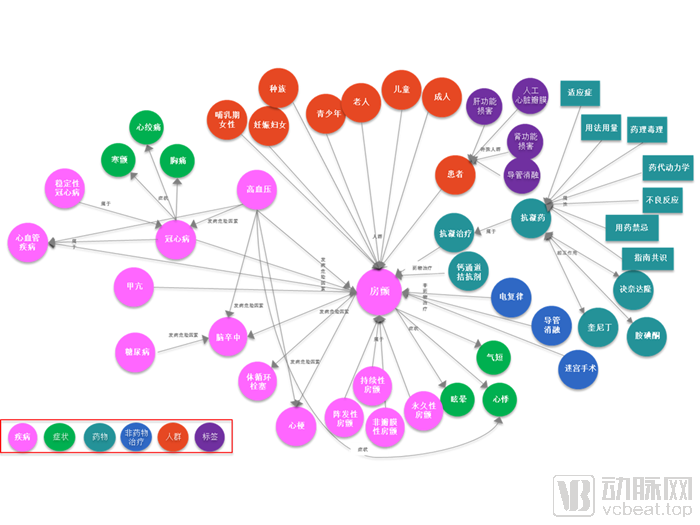
KGDATA Medical Knowledge Graph (Image provided by the interviewee)
During the Spring Festival, in response to the sudden outbreak of COVID-19, KGDATA collaborated with authoritative experts from the National Center for Chronic and Noncommunicable Disease Control and Prevention of the Chinese Center for Disease Control and Prevention to jointly develop an intelligent Q&A assistant for COVID-19. Leveraging its mature product portfolio and extensive industry experience, the product achieved a high level of accuracy through knowledge organization, training, development, and testing after its official launch, and went live in just five working days.
Since its launch on February 3 via the official WeChat channel of the National Center for Chronic and Noncommunicable Disease Control and Prevention (NCCDC), the assistant has provided free access. It has now been integrated into dozens of official accounts belonging to centers for disease control and prevention, enterprises, pharmaceutical companies, healthcare institutions, and social organizations. The assistant has automatically responded to over 100,000 professional inquiries regarding COVID-19 from tens of thousands of users, with content curated and updated daily by experts from the NCCDC.
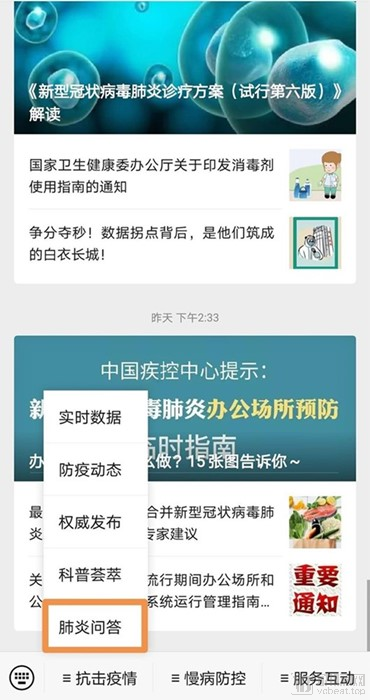
Entry to the Intelligent Q&A Assistant for COVID-19 (Image provided by the interviewee)
Furthermore, in response to the need for remote academic marketing by pharmaceutical companies when representatives were unable to visit doctors during the pandemic, KGDATA has provided a comprehensive suite of customized SaaS solutions. These solutions enable the rapid integration of the latest authoritative clinical practice guidelines and pharmaceutical companies’ academic and product content into the “Academic Brain,” helping healthcare providers and patients promptly and accurately access professional knowledge related to COVID-19—including respiratory diseases, chronic conditions, oncology, critical care, and nutrition—as well as relevant product information from pharmaceutical companies. KGDATA has already onboarded multiple pharmaceutical companies onto its customized solutions, with deployment scheduled within two weeks.
Wu Gang introduced that, in terms of application scenarios, KGDATA is expanding from its post-launch market sales academic brain for new drugs to market intelligence analysis and deep mining of R&D knowledge during the new drug development phase. Meanwhile, its customer base has extended from multinational pharmaceutical companies to over 4,000 domestic pharmaceutical enterprises, covering intelligent application scenarios across pre-launch new drug R&D, CROs, and post-launch departments including marketing, sales, and medical affairs.
KGDATA will help customers across the entire pharmaceutical industry value chain improve the efficiency of new drug R&D, expand into primary care markets, and enhance intelligent academic marketing, patient education, patient health management, and medication adherence management. It will then extend its focus from pharmaceutical companies to hospitals, medical research institutions, government regulators, and other sectors within the broader healthcare industry.
In the long term, KGDATA will implement its “Two Verticals and One Horizontal” strategy.
“The Horizontal Axis” refers to the continuous development of a knowledge graph-based cognitive intelligence platform for full-lifecycle human-machine collaboration, establishing technological barriers; “The Two Vertical Axes” primarily focus on intelligent applications for vertical industries.
“The First Vertical” primarily focuses on the pharmaceutical and broader healthcare industry, building a comprehensive knowledge graph-based digital intelligence platform for pharmaceutical companies, hospitals, medical research institutions, and government disease control agencies. It integrates content resources from leading domestic and international content providers, publicly available pharmaceutical literature and market intelligence, regulatory information, as well as clients’ internal data—including product, sales, key opinion leader (KOL), electronic medical record, knowledge management system content, and clinical trial R&D data—to create an exclusive “Academic Brain” knowledge graph for enterprise research institutions, along with knowledge graph-powered intelligent applications.
In addition, the “One Vertical” leverages a knowledge graph technology platform to provide intelligent knowledge graph platform solutions to knowledge-intensive government and enterprise clients, such as those in the military industry, finance, literature and intelligence, government, central state-owned enterprises, and scientific research institutions, through independent R&D and the establishment of ecological partnerships. Institutions interested in this company should contact the financing assistant Xiao Yun at: DongMai_Investent.