

Suhai Technology Files IPO Prospectus: AI-Powered Solutions for Respiratory Disease Diagnosis and COVID-19 Clinical Research
AI Screening and Nucleic Acid Testing Join Forces: With Multiple Layers of Defense, the Virus Has Nowhere to Hide.
Following the release of the “Expert Consensus on Imaging of COVID-19 (First Edition),” Su Hai adjusted the algorithms of his CT lung AI quantitative analysis system, originally launched in 2019, to target the imaging characteristics of COVID-19. He rapidly introduced a COVID-19 CT-AI quantitative analysis system for auxiliary screening and differential diagnosis, integrated with other common respiratory diseases. The system was validated using real-world cases at designated hospitals in Shandong and Zhejiang provinces, demonstrating significant clinical effectiveness.
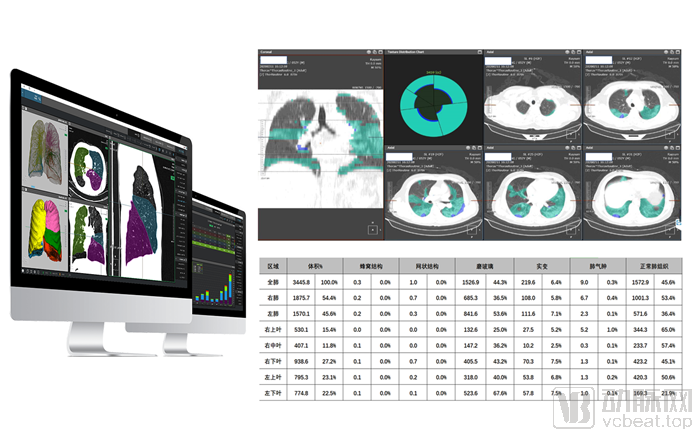
CT-AI Quantitative Analysis System for Assisted Screening and Differential Diagnosis of COVID-19 (Image Provided by the Company)
“Faced with strict lockdowns, we were unable to visit the hard-hit areas to assist hospitals in their operations. To address this, we deployed a cloud-based version built upon our on-premise solution, migrating image data transmission and storage, as well as AI computing, to the cloud.”
Suhai’s technical expert, Wang Ping, candidly stated, “Cloud computing is a model that entails both risks and rewards. While it accelerates deployment and application, hospitals face potential dangers of data breaches and privacy leaks when migrating to the cloud. This issue is a key focus of Suhai’s newly developed ‘Distributed Imaging AI Technology Architecture.’ With Suhai’s ‘Distributed System,’ hospitals can now achieve imaging data sharing and operational collaboration without needing to transmit original DICOM files beyond their controllable security boundaries.”
Suhai is a young enterprise specializing in big data and artificial intelligence for vertical, niche-specific diseases. Its system development team, composed of interdisciplinary professionals with expertise in clinical practice, medical engineering, big data, and AI, hails from Zhejiang University and leading healthcare IT vendors, and is based in Suzhou and Hangzhou.
From Wang Ping’s perspective, AI algorithms for medical imaging are not inherently complex; the real challenges lie in the diversity of diseases, the specificity of clinical practice, and the scarcity of data. Technologically, this translates to efficiently, agilely, and continuously addressing a “small-sample, large-task” paradigm through a series of hybrid tasks involving both physicians and engineers—from formulating clinical questions and designing studies to professional data governance and clinical validation. Su Hai’s competitive advantage stems from its 20 years of dedicated focus and its team’s extensive experience in integrating medicine with engineering.
To this end, Su Hai has focused on researching AI-assisted clinical decision support technologies for major diseases in three specialized verticals—respiratory, oral and maxillofacial, and hepatic and renal systems—as well as developing corresponding “screening, diagnosis, treatment, and management” systems. By prioritizing collaborative research with clinical institutions and providing robust research support, he demonstrates the forward-looking vision and continuity of his dedicated endeavors. He has established collaborative teams comprising top-tier clinicians and researchers from leading domestic and international universities and enterprises, creating a solid competitive moat through “long-term focus.”
Over the past two years since its establishment, Suhai has been dedicated to the research and development of intelligent systems in the fields of respiratory care, stomatology, and liver-kidney transplantation. Since 2019, the company has collaborated with Shanghai Changzheng Hospital, Huadong Hospital, West China School of Stomatology of Sichuan University, Tianjin First Central Hospital, The First Affiliated Hospital of Wenzhou Medical University, Henan Provincial People’s Hospital, and affiliated hospitals of Zhejiang University on research and validation initiatives.
Although newly established, it has won numerous awards.
In April 2019, the “Integrated Digital Diagnosis and Treatment System for Intelligent Respiratory Diseases” was selected as one of the first batches of funded projects in 2019 by the China (Hangzhou) Artificial Intelligence Town. The “PACS Brain—Intelligent Imaging and Structured Reporting and Data System” won sixth place in the finals of the 2019 China Medical Device Innovation and Entrepreneurship Competition (Software and Artificial Intelligence Category). In addition, Su Hai has participated in multiple national, provincial, and municipal scientific research projects related to healthcare filed by renowned universities, hospitals, and central state-owned enterprises, and has established multi-center clinical research and application platforms for digital twin lungs and proactive health.
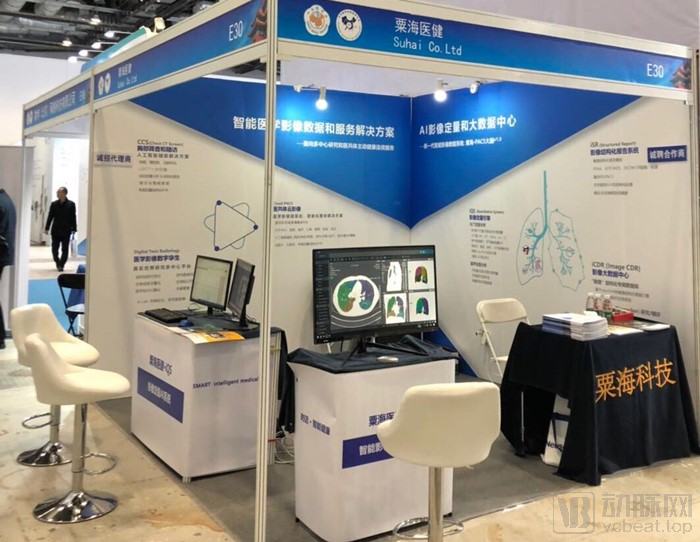
The 26th National Academic Congress of Radiology of the Chinese Medical Association (CCR2019) – Suhai Technology Booth (Image provided by the company)
Wang Ping stated that it is virtually impossible to develop AI products for diagnosing COVID-19 that meet evidence-based medicine requirements within a short timeframe. However, intelligent systems can help physicians improve efficiency, reduce errors, and facilitate research. Therefore, Su Hai has focused on providing physicians with detailed, quantitative, and objective automated analytical data, while striving to enhance data accuracy. “As for the specific diagnostic accuracy of this system, we cannot provide precise figures until rigorous randomized controlled trial data are available. Doing so would not only compromise medical rigor but also be misleading.”
During this outbreak, the CT-AI quantitative analysis system developed by Su Hai is built upon a solid foundation of long-term expertise in the openEHR medical big data technical framework and core technologies for AI-based quantitative analysis of chest imaging, featuring clearly defined functionalities and competitive advantages over other products.
Wang Ping cited as an example that common CT-AI solutions for COVID-19 involve the extraction and quantification of lung and lobar volumes, as well as pulmonary density regions with different Hounsfield unit (HU) values. Specifically, these solutions perform segmentation, extraction, and measurement of multiple patchy ground-glass opacities and consolidations characteristic of COVID-19.
“On this basis, Su Hai performed segmentation, extraction, and quantification of other underlying pulmonary disease features, such as emphysema, honeycombing, and reticular patterns, and quantified disease phenotypes in each lung lobe. ‘To be more precise, it is also necessary to extract and quantify the airways and pulmonary vasculature, calculating their volumetric occupancy in each lung lobe to achieve greater accuracy. In addition, statistical analyses of small airway and pulmonary vascular quantification—particularly quantitative analysis of biomarkers reported in published studies—are highly valuable for differential diagnosis of diseases. These areas represent current research hotspots of significant interest to experts in pulmonology, critical care, and thoracic imaging, and constitute part of our collaborative work with top-tier clinical teams,’ introduced Wang Ping.”
It is worth noting that Suhai’s CT-AI quantitative analysis system can perform automated quantitative analysis of small airways and pulmonary vasculature, facilitating research on phenotyping of lung diseases and diagnostic technologies for extrapulmonary conditions, as well as aiding in clinical diagnosis. It is one of the few products in China currently equipped with this technology.
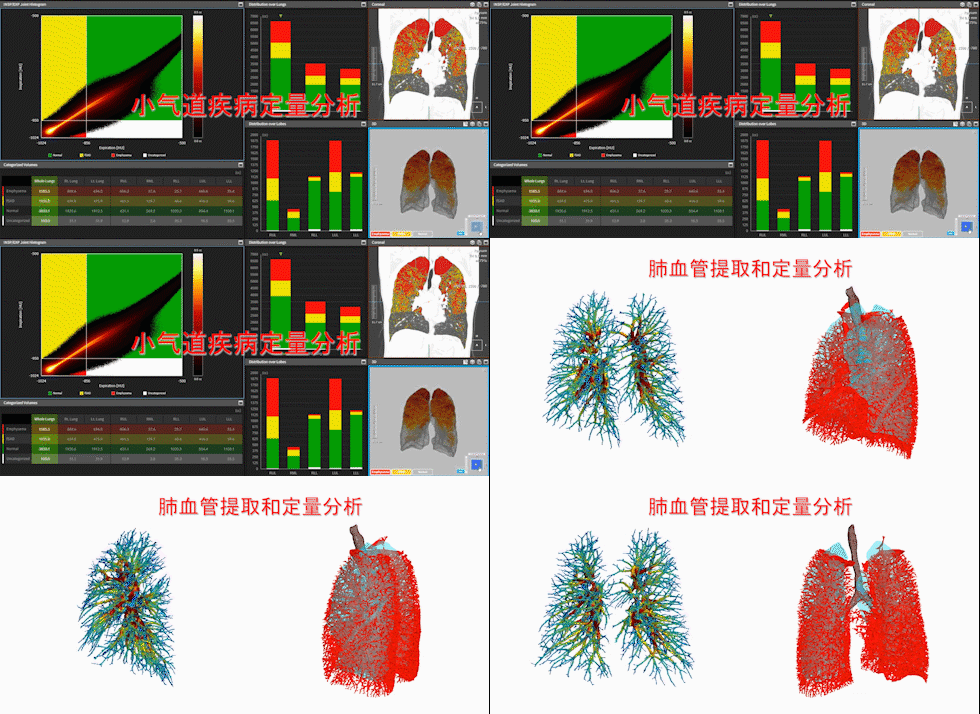
Automated quantitative analysis of small airways and pulmonary vasculature (image provided by the company)
Thanks to the rapid, collaborative efforts of Chinese radiologists, imaging-based screening and diagnosis for 2019-nCoV are no longer challenging. As the epidemic gradually subsides, prognostic assessment and public health and clinical research needs will become increasingly important. This is precisely the area that Su Hai has been focusing on and has already begun to address.
Su Hai has prioritized the following three areas:
1. AI-assisted imaging screening for COVID-19 using DR and CT;
Second, AI-based quantitative CT analysis assists in the differential diagnosis, staging, monitoring of progression, determination of outcomes, and discharge decision-making for COVID-19 patients with underlying comorbidities.
Third, support for clinical research on major respiratory diseases such as COVID-19, including multicenter studies.
“Revere medicine, respect physicians, uphold commitments to medical safety, quality, and evidence-based practice, and let sustained focus over time replace the pursuit of quick, superficial solutions.” Wang Ping stated that, for AI in medical imaging within specialized disease areas, it is entirely infeasible to rely on open or low-dimensional data for deep learning to achieve a certain diagnostic accuracy for a given disease and apply this approach to complex clinical workflows. Instead, it is essential to establish a scientific AI ecosystem consortium, led by clinical experts in specialized disease areas, with medical-engineering teams serving as bridges and data scientists in supporting roles. Only by integrating medical AI into clinical workflows and delivering genuine clinical benefit can it generate commercial value.
Suhai’s current intelligent imaging and data system comprises four modules: Distributed Imaging Sharing and Collaboration, AI-Based Quantitative Analysis of Chest-Specific Disease Imaging, Structured Imaging Reports, and Imaging Big Data and Research.
According to the introduction, the distributed imaging system is built on the concept of “data stays put, algorithms move,” leveraging P2P networking and edge computing technologies. This enables data sharing and collaborative workflows without requiring hospital data to leave its controlled security perimeter, holding significant importance for current applications such as cloud-based medical films, regional data sharing and collaboration, telemedicine, and multi-center clinical research. In Su Hai’s product roadmap, the distributed system will serve as the platform for delivering AI-as-a-Service (AiaaS) for specific diseases and supporting multi-center clinical research.
Among the four modules, AI-based quantitative analysis of disease-specific imaging and structured reporting are the two areas where Su Hai has invested significant R&D resources.
The structured reporting system was jointly developed by Su Hai and a collaborative team from Zhejiang University. Adhering to standards, guidelines, and specifications such as those from the RSNA, DICOM, and ACR RADS, and leveraging the openEHR medical big data technical framework along with natural language processing technologies, it enables standardized, intelligent, and agile structured imaging reports for specific diseases.
“Providing big data and AI solutions to empower ‘proactive health’ for the Chinese population is Su Hai’s vision,” said Wang Ping. Su Hai is more inclined to collaborate with like-minded partners to implement “AI-as-a-Service” (AiaaS)-assisted screening and follow-up for major thoracic conditions that significantly impact health—such as coronary artery disease, chronic obstructive pulmonary disease (COPD), and lung cancer—as well as to deliver continuous chronic disease management services based on quantitative Personal Health Records (PHR).
Wang Ping also mentioned that Suhai is collaborating with partner hospitals to develop AI-assisted screening technology for dental health, as well as AI-assisted diagnostic technology for liver and kidney ultrasound. The research results are expected to be released in the next one to two years. Institutions interested in the company should contact the financing assistant, Xiao Yun: DongMai_Investent.