

Synyi Intelligence Reveals Dynamic Patterns of COVID-19 Case Fatality Ratio Through Advanced Big Data Modeling

SYNYI AI
Provider of Comprehensive Solutions for Medical Big Data
According to information released on the official website of the National Health Commission, as of 24:00 on February 22, a total of 76,936 confirmed cases had been reported nationwide. Consequently, the case fatality rate of COVID-19 has naturally become one of the most pressing concerns for the public.
On February 17, a research paper titled “Analysis of the Epidemiological Characteristics of Novel Coronavirus Pneumonia” was published in the Chinese Journal of Epidemiology. The paper showed that the crude case fatality rate in Hubei Province (2.9%) was 7.3 times higher than that in other provinces (0.4%).
However, on February 21, *The Lancet Respiratory Medicine* published a paper by a team from Tongji Medical College of Huazhong University of Science and Technology and Wuhan Jinyintan Hospital. The team’s single-center retrospective study of severe COVID-19 patients admitted to Jinyintan Hospital showed that the 28-day case fatality rate among critically ill COVID-19 patients was as high as 61.5%, exceeding the figures reported in studies of severe SARS and MERS patients [1].
Many are puzzled by the discrepancies in the data. So, how should we interpret the concept of crude case fatality rate? And what distinguishes it from the true case fatality rate? In response, the Real-World Research Team at SYNYI·AI conducted an in-depth analysis.
Typically, during the early stages of an epidemic, media reports and academic studies commonly employ the following methods to calculate the case fatality rate:
1. Total deaths / Total confirmed cases, i.e., the crude case fatality rate;
2. Total deaths / (Total deaths + Total cured cases);
3. Assuming the average incubation period of the virus is X days, and the average number of days from symptom onset to death is Y days, then the case fatality rate should be calculated as follows: total number of deaths divided by the number of confirmed cases (X + Y) days ago.
If the epidemic has ended, with all patients either discharged after recovery or deceased, the results calculated by these methods will converge. In other words, they are all valid calculation methods. However, during the early and middle stages of the epidemic, as the vast majority of patients were still receiving hospital treatment, the total number of confirmed cases did not equal the sum of total deaths and total recoveries.
Therefore, none of these three calculation methods reflect the true final case fatality rate. Last week, some scholars even published an article in The Lancet explicitly stating that the mortality or case fatality rates for Wuhan previously reported in the literature were inaccurate [2].
What methods can be used to estimate the most accurate results when individual survival times are not publicly available in detail?
Dr. Zhao Hongxin, Head of Real-World Research at SYNYI·AI, believes that the crude case fatality rate is calculated by dividing the officially reported number of deaths by the total number of confirmed cases. However, since additional deaths are expected to occur among those who have been diagnosed but not yet discharged, the crude case fatality rate underestimates the true case fatality rate.
Furthermore, due to the sequence of data release, the case fatality rate calculated in real time on a daily basis exhibited a gradual increase during the early and middle stages of the epidemic. This further demonstrates that the crude case fatality rate fails to objectively reflect the substantial achievements made by the government, society, healthcare workers, and researchers in epidemic control and the optimization of diagnosis and treatment, nor does it accurately capture the true trend of changes in mortality risk.
Therefore, predicting the latest case fatality rates and their trends through data analysis and modeling will provide significant reference value for epidemic prevention and control in the next phase.
On February 21, the real-world research team at SYNYI·AI published a research paper titled “Estimating the case fatality ratio of the COVID-19 epidemic in China” on the medical preprint server medRxiv. This study primarily establishes competing risks models and Joinpoint regression models to analyze currently reported data on confirmed cases, new cases, recoveries, and deaths, thereby leveraging complex mathematical models and early-stage data to estimate the ultimate true case fatality rate and trends in mortality risk [3].
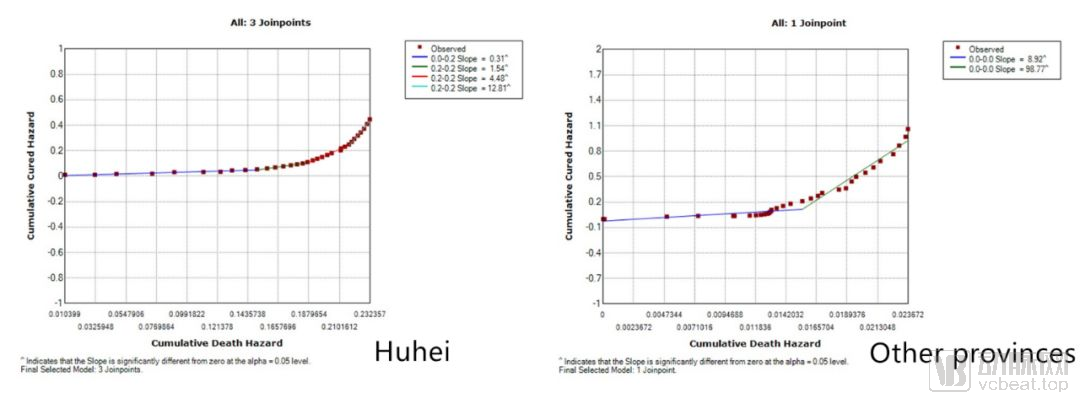
Results of Competing Risks Model and Joinpoint Regression Model Analysis
Dr. Zhao Hongxin explained that, based on mathematical modeling, the team discovered that the case fatality rate is actually a dynamic process characterized by a continuous and significant decline. Therefore, the decision to initially publish the research findings on medRxiv was made to enable daily data updates, in response to the call from the Ministry of Science and Technology of China to “write papers on the front lines of the fight against the epidemic.”
The team estimated that by February 22, the case fatality rate in Hubei Province had declined from a relatively high level at the early stage of the epidemic to the current 7.2% (95% CI: 6.6%-8.0%), while that in other provinces was 1.0% (95% CI: 0.87%-1.2%). This figure is consistent with the trend of the reported crude case fatality rate.
In addition, the team’s analysis revealed three distinct inflection points marking declines in the case fatality rate in Hubei Province on January 30, February 6, and February 14. In contrast, the case fatality rates in other provinces remained relatively stable, with a downward trend observed after February 7.
In the early stages of the pandemic, Hubei Province had a high proportion of severe cases, and critical care resources were constrained, resulting in a genuinely high case fatality rate, consistent with findings from Huazhong University of Science and Technology and Imperial College London. Subsequently, however, thanks to the swift decision-making and response by the government and the entire healthcare system, the united efforts of the Party, the military, and people across China to support Hubei, and the continuous optimization and adjustment by experts, scholars, and frontline clinical staff, the case fatality rate in Hubei declined rapidly.
In this regard, Ma Handong, Vice President of SYNYI·AI, stated, “Based on our estimates, the case fatality rate in Hubei Province will continue to approach that of other provinces. The adjusted overall case fatality rate may decrease to 3–4%, while rates in other provinces could drop to below 1%. Compared with the 10% case fatality rate of SARS, the outlook is more optimistic.”
According to him, although the overall trajectory of the epidemic shows a trend toward gradual control, there are numerous tasks that warrant advance planning. In this regard, SYNYI·AI recommends that healthcare institutions closely monitor the collection, follow-up, and analysis of data throughout the entire course of disease onset and progression. As the epidemic continues to abate, the systematic development of early warning models for the “post-pandemic era” can effectively prevent short-term resurgences or potential recurrences in the coming years.
Zhang Shaodian, Founder and CEO of SYNYI·AI, stated, “Since the outbreak of the epidemic, SYNYI·AI has attached great importance to leveraging big data and artificial intelligence analytics to support and guide epidemic prevention and control efforts. The company promptly assembled a professional and efficient research team that provided scientific evidence on the trends and characteristics of the epidemic’s progression through data analysis and information platforms, and submitted decision-making recommendations to relevant government agencies.”
It is reported that this is the second research paper on COVID-19 published by SYNYI·AI to date. Previously, in collaboration with the Peking University Meinian Health Research Institute, it released a big data model estimate of the incidence rate in Wuhan during the early stage of the epidemic on medRxiv, providing data support for epidemic prevention and control [4].
In addition to scientific research data analysis, Senyi Intelligence’s big data models also play a crucial role in the precise prevention and control of the epidemic. On February 20, Chen Yixin, Deputy Head of the Central Guidance Group and Secretary-General of the Central Political and Legal Affairs Commission, visited the Wuhan Public Security Bureau to gain an in-depth understanding of the role of big data in Wuhan’s epidemic prevention and control efforts. He emphasized that officials at all levels must keep data firmly in mind, ensure the accuracy and authenticity of epidemic prevention and control statistics, tolerate no falsification or underreporting, and provide a scientific basis for accurately assessing epidemic trends and winning the battle to defend Wuhan.
How to Be Data-Driven? Chen Yixin pointed out that to win the battle for Wuhan, it is essential to leverage big data and intelligent technologies to build a timely, precise, and efficient big data platform for epidemic prevention and control, ensuring comprehensive data collection (“collecting all data that should be collected”) and achieving scientific, precise, and efficient command systems.
As Secretary-General Chen Yixin pointed out, this precisely highlights the current limitations of data in medical institutions: further follow-up is required to achieve more accurate predictions. Particularly in the post-pandemic era, healthcare institutions must take a long-term view toward building intelligent systems for early warning and prevention and control of major epidemics. In addition to conceptual innovation and focusing on external visualization, it is essential to conduct genuine “practical drills” to ultimately achieve precise epidemic prevention and control.
In response to the demand for precise prevention and control in medical institutions, and based on the characteristics of COVID-19, the SYNYI·AI team has successfully developed a specialized disease database and follow-up solution for COVID-19.
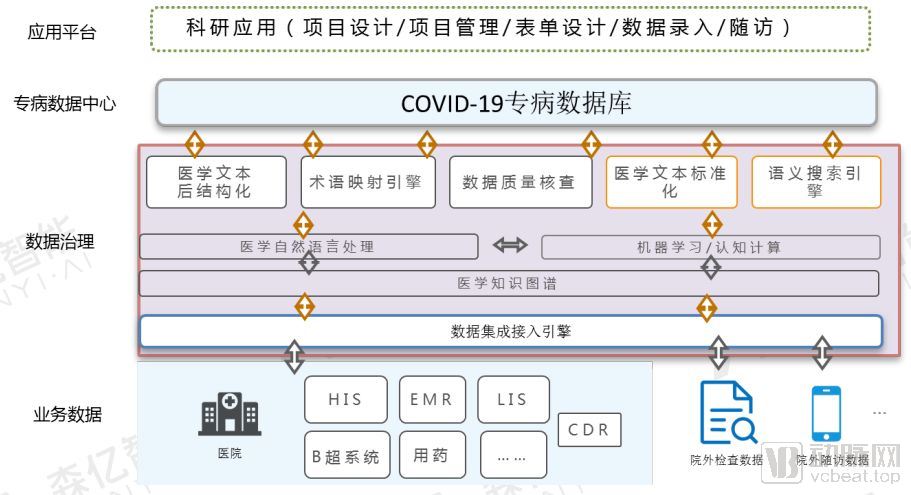
Overall Framework Diagram of the Solution
It is reported that this solution comprises a COVID-19-specific data warehouse, research projects on the COVID-19-specific database, patient follow-up for COVID-19, and a COVID-19-specific dataset.
On February 19, the website of the National Health Commission released the “Notice on Doing a Good Job in Follow-up and Tracking of Discharged Patients with Novel Coronavirus Pneumonia,” which clearly emphasized that all localities should rely on regional population health information platforms to strive for information sharing and operational coordination among residents’ health records, electronic medical records, and post-discharge follow-up files, so as to achieve a full closed loop of clinical diagnosis and treatment and health management for patients with novel coronavirus pneumonia.
SYNYI·AI’s follow-up system not only fully complies with the follow-up requirements of the National Health Commission, but also enables patients to subscribe to follow-up notifications via the hospital’s official WeChat account or mini-program and complete the follow-up forms required for research studies according to the follow-up plans set by their physicians. Furthermore, physicians can manage and supplement the data submitted by patients through SYNYI·AI’s COVID-19 Specialized Disease Data Platform.
Furthermore, the COVID-19-specific disease dataset within the solution integrates relevant literature, clinical guidelines, and real-world clinical practice, primarily comprising the following content:
Basic information, demographic data, visit information, department transfer records, diagnostic information, family medical history, allergy history, lifestyle habits, symptoms, vital signs, physical examination, risk factors and epidemiological survey, laboratory tests, nucleic acid testing, chest imaging examinations, special treatment records, pharmacotherapy, complications/important medical events, outcome status, and death records.
By establishing a specialized COVID-19 dataset, healthcare institutions can collect, follow up on, and analyze data throughout the entire course of disease onset and progression. As the pandemic further subsides, it is essential to systematically plan for the development of early warning models for the “post-pandemic era” to prevent viral resurgence to the greatest extent possible.
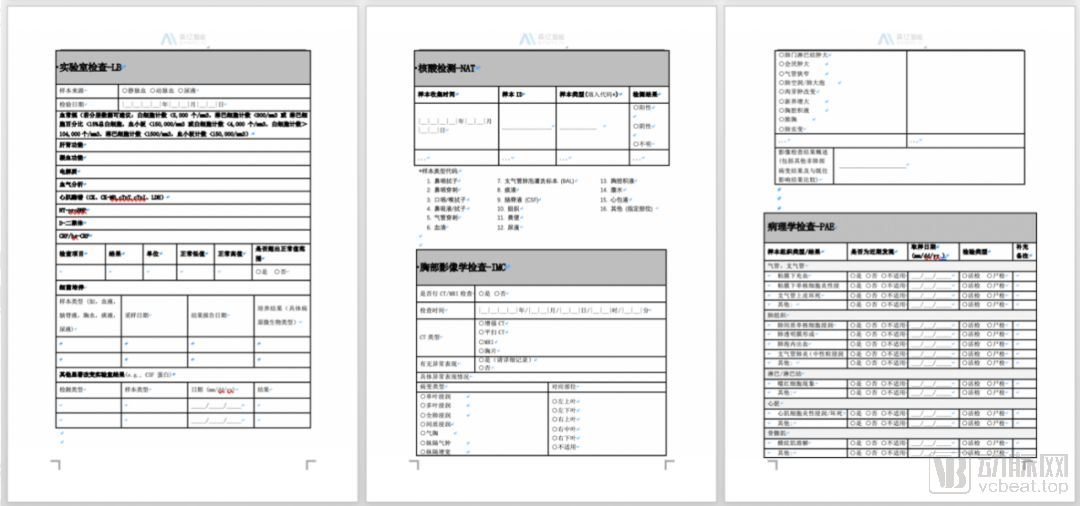
COVID-19 Specialized Disease Dataset
It is reported that the specialized database and follow-up solution for COVID-19 can accumulate a high-quality clinical diagnosis and treatment database, mine and explore optimal treatment regimens, and, in conjunction with biobank development, lay a solid foundation for future new drug development, as well as research into pathogenic mechanisms and innovative therapies. The product is suitable for major tertiary general hospitals and designated hospitals treating patients with novel coronavirus pneumonia.
In addition to disease-specific databases, SYNYI·AI has developed a comprehensive auxiliary diagnosis, treatment, and quality monitoring system for Novel Coronavirus Pneumonia (NCP). Leveraging its AI-powered clinical decision support platform, the system integrates real-time information on the novel coronavirus outbreak with the continuously updated diagnosis and treatment guidelines issued by the National Health Commission. By employing holistic patient data acquisition and governance, along with an AI model engine, it establishes a multidimensional clinical knowledge framework. The system utilizes core technologies such as natural language processing, knowledge graphs, machine learning, and cognitive computing to deliver robust clinical support.
References
[1] Xiaobo Yang, et al. Clinical course and outcomes of critically ill patients with SARS-CoV-2 pneumonia in Wuhan, China: a single-centered, retrospective, observational study. Lancet Respir Med. 2020. doi: https://doi.org/10.1016/S2213-2600(20)30079-5
[2]Zhou Xu, et al. Full spectrum of COVID-19 severity still being depicted. The Lancet. DOI:https://doi.org/10.1016/S0140-6736(20)30308-1
[3]Xing Wang, et al. Estimating the case fatality ratio of the COVID-19 epidemic in China. medRxiv. doi: https://doi.org/10.1101/2020.02.17.20023630
[4]Hongxin Zhao, et al. Epidemic size of novel coronavirus-infected pneumonia in the Epicenter Wuhan: using data of five-countries' evacuation action. medRxiv. doi: https://doi.org/10.1101/2020.02.12.20022285